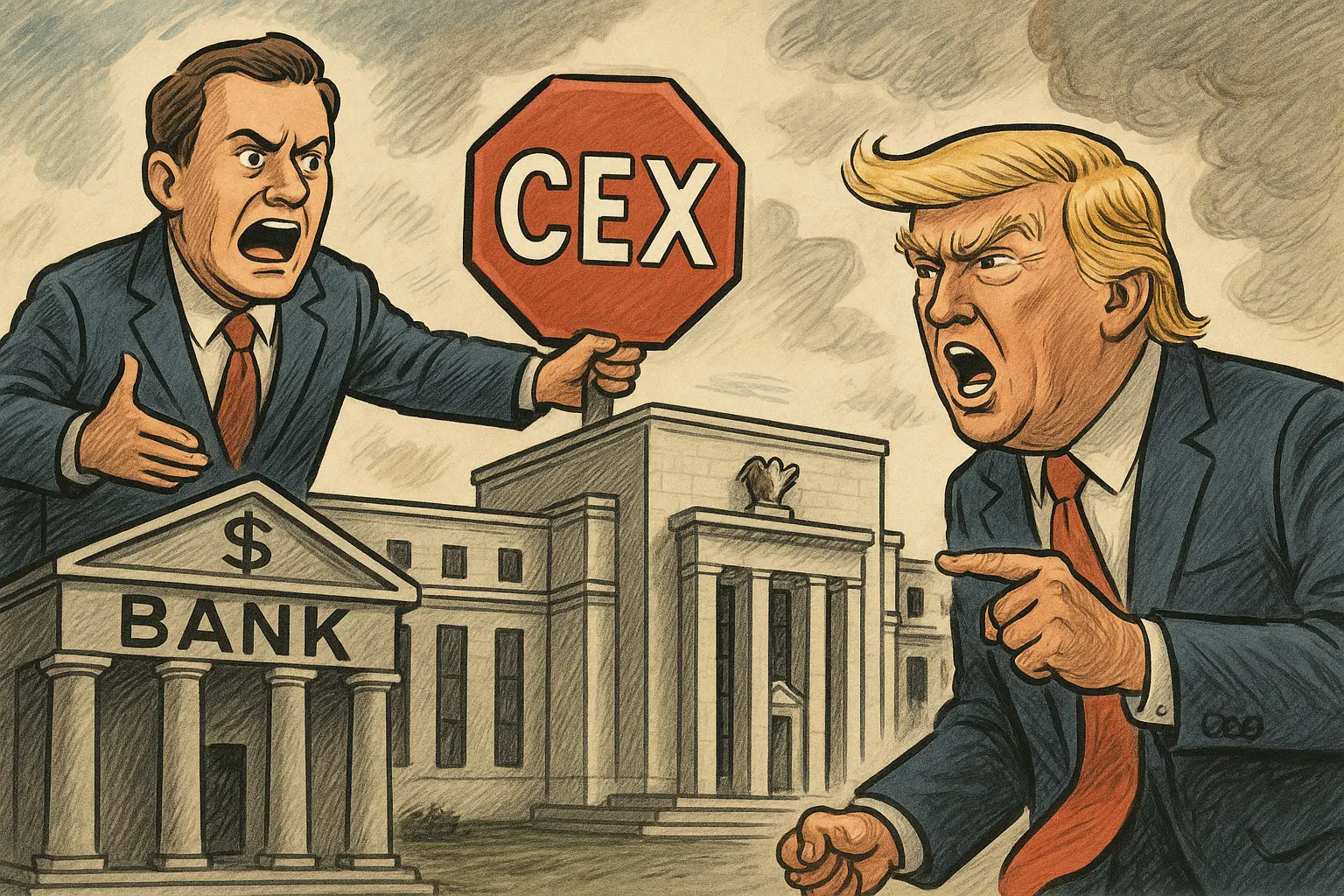
Cryptocurrency exchange Kraken has become the first crypto company to obtain a main account with the Federal Reserve, allowing it to settle U.S. dollar transactions directly through the Fed; the Independent Community Bankers of America (ICBA) and the Bank Policy Institute (BPI) immediately issued strong opposition statements, while President Trump publicly accused banks of obstructing cryptocurrency legislation progress.
Kraken’s Federal Reserve Main Account: Banking Industry Claims It Threatens Financial Stability
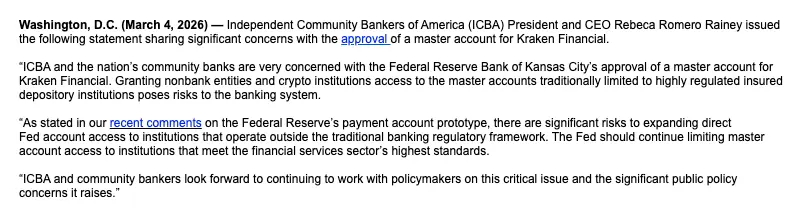
(Source: ICBA)
Kraken becomes the first crypto company directly connected to the Federal Reserve’s core payment infrastructure, meaning it can settle U.S. dollar transactions directly through the Fed, effectively bypassing traditional intermediary banks. However, Kraken has not received all the benefits that traditional banks enjoy from the Fed, such as reserve interest.
Hours after the announcement, ICBA CEO Rebeca Romero issued a statement: “Allowing non-bank entities and crypto firms to use main accounts traditionally limited to highly regulated depository institutions poses risks to the banking system.” BPI criticized the Fed for “ignoring the public consultation process previously required for this framework,” and for a lack of transparency in approval procedures and risk mitigation measures.
Stablecoin Interest Dispute: Structural Concerns Over $6.6 Trillion in Deposits Outflow
The banking industry’s resistance to Kraken’s main account is the latest chapter in broader regulatory debates. In April last year, a U.S. Treasury Department report estimated that stablecoins could lead to a deposit outflow of up to $6.6 trillion. One month after the passage of the GENIUS Act, five banking associations, including ICBA and BPI, jointly wrote to Congress urging to close regulatory loopholes that allow stablecoin issuers to pay interest indirectly through exchanges, warning that such actions could increase borrowing costs and reduce credit for businesses and households.
Currently, the core controversy surrounding the CLARITY Act centers on whether cryptocurrency exchanges can offer returns similar to interest on stablecoins. Trump publicly stated on Truth Social: “Americans should let their money earn more. Banks are creating historic profits, and we will not allow them to undermine our strong crypto agenda, or else cryptocurrencies will eventually flow to China and other countries.”
Key Disputes Between Banking Industry and Trump’s Crypto Agenda
Kraken’s Main Account: First crypto firm connected to Fed payment infrastructure; ICBA and BPI claim it poses stability risks and lacks transparency in decision-making
Stablecoin Deposit Risks: Treasury estimates stablecoins could cause $6.6 trillion in deposit outflows from traditional banks
GENIUS Act Loophole: Banking groups urge banning exchanges from indirectly paying interest to stablecoin holders
CLARITY Act Controversy: Whether crypto exchanges can provide interest-like returns remains a key unresolved issue
Trump’s Public Stance: Accuses banks of obstructing crypto agenda, posts after private meeting with Coinbase CEO Brian Armstrong at the White House
FAQs
What is the significance of Kraken obtaining a Federal Reserve main account?
A Fed Main Account allows the holder to settle U.S. dollar transactions directly with the Federal Reserve, a privilege previously limited to highly regulated depository institutions. Kraken becoming the first crypto company with this access means it can directly connect to the U.S. payment system shared by thousands of banks and credit unions, bypassing intermediaries, reducing settlement costs and times, and marking a major step for cryptocurrencies entering traditional financial infrastructure.
Why are U.S. banks concerned about the development of stablecoins, and is there evidence?
Banks’ main concern is deposit outflow—if users transfer funds into interest-bearing stablecoins, traditional bank deposits could shrink significantly. The Treasury estimates this could be as much as $6.6 trillion, which would weaken banks’ lending capacity, raise borrowing costs, and impact credit availability for businesses and households. These concerns are documented in the joint letter from five banking associations.
What are the political motives behind Trump’s strong involvement in crypto legislation disputes?
The Trump family holds stakes in several crypto companies, and his push for the CLARITY Act to pass before the midterm elections in November is clear—these elections could shift control of Congress. After a private meeting with Coinbase CEO Brian Armstrong at the White House, Trump posted on Truth Social his strongest stance on crypto to date, indicating this is both a policy position and a politically motivated move ahead of the elections.
Disclaimer: The information on this page may come from third parties and does not represent the views or opinions of Gate. The content displayed on this page is for reference only and does not constitute any financial, investment, or legal advice. Gate does not guarantee the accuracy or completeness of the information and shall not be liable for any losses arising from the use of this information. Virtual asset investments carry high risks and are subject to significant price volatility. You may lose all of your invested principal. Please fully understand the relevant risks and make prudent decisions based on your own financial situation and risk tolerance. For details, please refer to
Disclaimer.
Related Articles
The U.S. Treasury Secretary angrily criticized the FT for "fabricating content" and denied ever supporting a model based on the Bank of England.
U.S. Treasury Secretary Scott Bessent criticized the Financial Times report about his support for a accountability mechanism similar to that of the Bank of England, calling it "a complete fabrication." He emphasized that he had not proposed any related plans and expressed disdain for the Bank of England's communication mechanism. This incident reflects the sensitivity of the U.S. regarding the independence of its monetary policy, and it could impact the cryptocurrency market.
GateNews6h ago
David Sacks Steps Down to Become Co-Chair of PCAST: Is the U.S. Crypto and AI Policy Direction Changing?
David Sacks has concluded his 130-day tenure as the White House's cryptocurrency and artificial intelligence affairs chief and will transition to co-chair of the President's Council of Advisors on Science and Technology, continuing to influence U.S. technology policy. He will focus on advancing a unified regulatory framework for artificial intelligence and engage in policy research across several key areas. This change may affect the future coordination of cryptocurrency and AI regulation.
GateNews6h ago
David Sacks steps down as the Crypto Czar, impacting policy direction, and the fate of the "CLARITY Act" remains uncertain.
The regulatory landscape for cryptocurrency in the U.S. is changing, as David Sacks concludes his term in the Trump administration and transitions to co-chair of the Technology Advisory Council, leading to concerns about the continuity of digital asset policy. The outlook for the CLARITY Act has become uncertain, with the market focusing on future legislative developments and the emergence of new policy leaders.
GateNews8h ago
Bank of Japan: Estimates the natural interest rate to be between -0.9% and +0.5%, requiring a comprehensive assessment of the degree of monetary easing.
Gate News reports that on March 27, the Bank of Japan stated that, according to the latest data, Japan's estimated natural interest rate (the neutral rate that neither stimulates nor suppresses the economy) is between -0.9% and +0.5%. The Bank of Japan pointed out that, given the uncertainty in estimating the natural rate, it is necessary to comprehensively evaluate the degree of monetary easing, while carefully examining the trends in economic activity, prices, and financial developments.
GateNews9h ago
Bitunix Analyst: War Delay and Liquidity Contraction Resonance, BTC Stuck in 65K–72K Liquidation Zone
Global market performance looks stable on the surface, but internal imbalances remain. Geopolitical risks still exist. Countries are withdrawing liquidity and stabilizing their domestic currencies through different measures; the inflation logic has shifted somewhat, and a strengthening U.S. dollar reflects liquidity being withdrawn. In the crypto market, BTC is consolidating within a range-bound, choppy zone, with price volatility kept in check. In the short term, it’s necessary to watch for changes in the macro environment to find a trend breakout.
BlockBeatNews10h ago
Bitcoin ETF ends seven consecutive days of gains, Bitcoin price pressure reappears.
Recently, after experiencing a net inflow for seven consecutive trading days, the US Bitcoin spot ETF saw a significant outflow, with a net outflow of $163.5 million on the 18th and an additional outflow of $51.9 million on the 19th, indicating a simultaneous weakening of market funds and prices. The price of Bitcoin briefly dropped below $70,000, highlighting that the fund flows into the ETF can no longer support its rebound, and the deteriorating macro environment is putting pressure on risk assets, leading to a noticeable contraction in investor preferences. The testing of the $70,000 threshold has become a barometer for short-term market sentiment.
区块客10h ago


