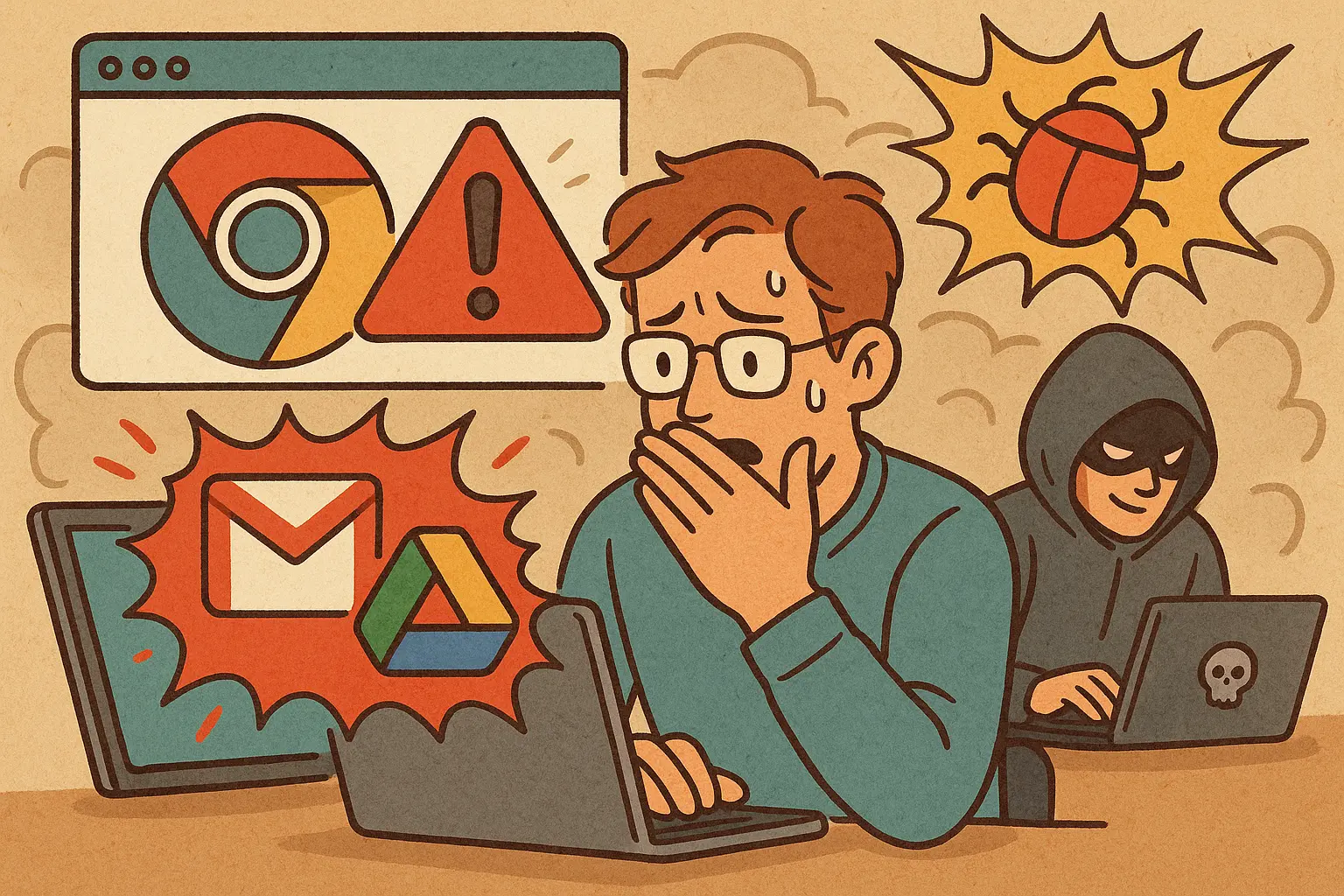
The security monitoring platform GoPlus issued a high-risk alert on March 27, indicating that the Anthropic Claude Chrome browser extension has a critical prompt injection vulnerability affecting installations below version 1.0.41, impacting over 3 million users. Attackers can read Google Drive documents, steal business tokens, and send emails as the user.
Vulnerability Principle: Two Weaknesses Combine to Form a Complete Attack Chain
This vulnerability consists of a combination of two independent security flaws that create a high-risk attack path.
First Weakness: The overly broad subdomain trust of the Claude Chrome extension’s messaging mechanism allows commands from all *.claude.ai subdomains to pass through, one message type, onboarding_task, directly accepts external prompts to be executed by Claude without finer source validation.
Second Weakness: The DOM-based XSS vulnerability in the Arkose Labs CAPTCHA component. Anthropic uses the third-party CAPTCHA provider Arkose Labs, whose CAPTCHA component is hosted on a-cdn.claude.ai—a subdomain that falls within the *.claude.ai trust scope. Security researchers discovered a DOM-based XSS vulnerability in an older version of the CAPTCHA component: the component never verified the sender’s identity (did not check event.origin) when receiving external messages and rendered user-controllable strings directly as HTML without any sanitization.
Complete Attack Chain: Victim visits a malicious webpage → Background silently loads the Arkose iframe with the XSS vulnerability → Injects malicious payload executed within the a-cdn.claude.ai domain → Exploits the subdomain trust whitelist to send malicious prompts to the Claude extension and executes them automatically. The entire process occurs in an invisible hidden iframe, completely undetectable by the victim.
What Can Attackers Do: Account Taken Over Without Awareness
Once the attack is successful, attackers can perform the following actions on the victim’s account without any user authorization or clicks:
· Steal Gmail access tokens (persistent access to Gmail and contacts)
· Read all documents in Google Drive
· Export complete chat history from Claude
· Send emails as the victim
· Open new tabs in the background, open the Claude sidebar, and execute arbitrary commands
Fix Status and Security Recommendations
The vulnerability has been fully patched: Anthropic patched the Claude Chrome extension on January 15, 2026, allowing requests only from specific sources; Arkose Labs fixed the XSS vulnerability on February 19, 2026, with thorough retesting on February 24, 2026, confirming the issue was resolved. GoPlus’s alert aims to remind users still using older versions to upgrade promptly.
GoPlus offers the following security recommendations: Go to the Chrome browser at chrome://extensions, find the Claude extension, and ensure the version number is 1.0.41 or higher; be cautious of phishing links from unknown sources; AI Agent applications should follow the “least privilege principle”; and introduce a human-in-the-loop mechanism for operations involving high sensitivity.
Frequently Asked Questions
How can I confirm if my Claude Chrome extension version is safe?
Go to the Chrome browser at chrome://extensions, find the Claude extension, and check the version number. If the version is 1.0.41 or higher, the vulnerability has been patched; if it is below 1.0.41, please update or reinstall the latest version immediately.
Does this vulnerability require the user to actively click a malicious link to be triggered?
No, it does not. As long as the user visits the malicious webpage, the attack can execute silently in the background without any clicks, authorizations, or confirmations. The entire attack chain is completed in a hidden iframe, completely undetectable by the victim.
Anthropic has completed the fix, so why is an update still necessary?
Some users may not have enabled automatic updates for the browser extension, resulting in them still using an outdated version below 1.0.41. GoPlus’s alert aims to remind these users to actively check their version and manually upgrade to ensure safety.
Disclaimer: The information on this page may come from third parties and does not represent the views or opinions of Gate. The content displayed on this page is for reference only and does not constitute any financial, investment, or legal advice. Gate does not guarantee the accuracy or completeness of the information and shall not be liable for any losses arising from the use of this information. Virtual asset investments carry high risks and are subject to significant price volatility. You may lose all of your invested principal. Please fully understand the relevant risks and make prudent decisions based on your own financial situation and risk tolerance. For details, please refer to
Disclaimer.
Related Articles
Crypto’s most ridiculous robbery? A hacker minted $1 billion in DOT tokens, but only stole $230k
Hackers exploited the Hyperbridge cross-chain bridge vulnerability to mint 1 billion Polkadot (DOT) tokens. The nominal value was over $1.19 billion, but due to insufficient liquidity, they ultimately cashed out only about $237k. The attack was successful because the smart contract did not properly verify messages, allowing the hackers to steal administrative control and mint coins. The incident highlights the key role of market liquidity in the success of arbitrage.
CryptoCity7h ago
Fake Ledger Live App Steals $9.5M From 50+ Users Across Multiple Blockchains
A fraudulent Ledger Live app on Apple's App Store stole $9.5 million from over 50 users by compromising wallet information. The incident, involving significant losses for major investors, raises concerns about App Store security, prompting discussions of a possible lawsuit against Apple.
GateNews8h ago
Criticized for freezing USDC too slowly! Circle CEO: We will definitely wait for the court’s order before freezing—refusing to freeze privately/by ourselves without authorization
Circle CEO Jeremy Allaire said the company will not proactively freeze wallet addresses unless it receives a court order or a request from law enforcement. Even amid hacker money-laundering disputes and community backlash, Circle still insists on operating in accordance with the rule of law.
Jeremy Allaire sets Circle’s law-enforcement bottom line
-----------------------------
As the global cryptocurrency market roils, Circle’s CEO Jeremy Allaire, the stablecoin issuer, delivered a clear stance on the most sensitive issue in the market at a press conference in Seoul, South Korea. He pointed out that although Circle has the technical means to freeze specific wallet addresses, unless it receives a court order or a formal instruction from law-enforcement authorities, the company will not take such action on its own.
CryptoCity10h ago
Attacker Exploiting Bridged Polkadot Vulnerability Transfers $269K to Tornado Cash
On April 15, Arkham reported that the attacker who exploited a Bridged Polkadot vulnerability transferred around $269,000 in stolen funds to Tornado Cash, complicating asset tracking.
GateNews11h ago
Bitcoin Developers Propose BIP 361 to Protect Against Quantum Computing Threats
Bitcoin developers have proposed BIP 361 to safeguard the network against quantum computer risks by freezing vulnerable addresses. The proposal includes a phased plan to transition users to quantum-safe wallets, but it has sparked debate on user control and security.
GateNews11h ago
Hackers Exploit Obsidian Plugin to Spread PHANTOMPULSE Trojan with Blockchain C2
Elastic Security Labs revealed that threat actors impersonated venture capital firms on LinkedIn and Telegram to deploy a Windows RAT named PHANTOMPULSE, using Obsidian note vaults for attacks, which Elastic Defend successfully blocked.
GateNews12h ago


