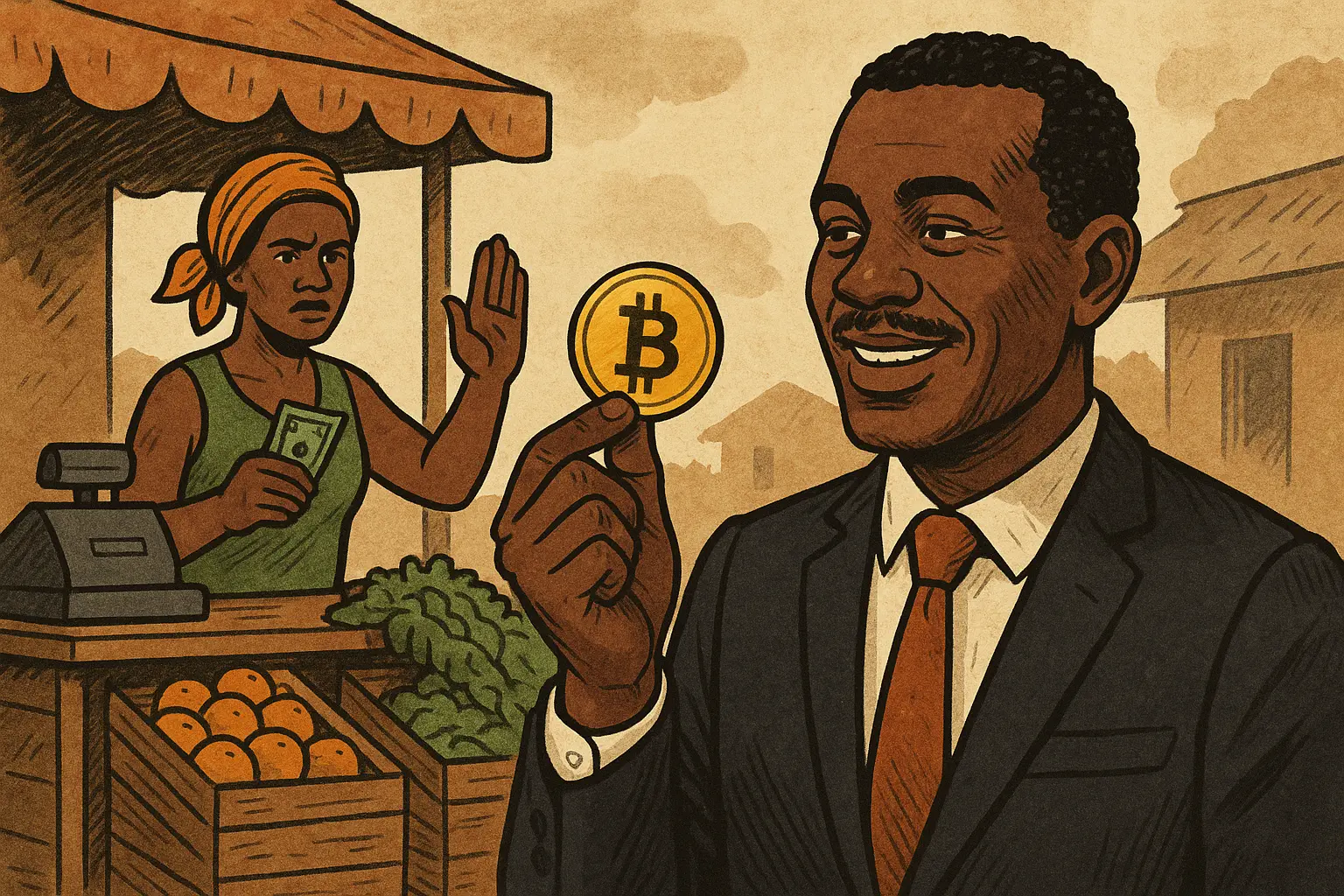
Stafford Masie, Executive Chairman of Africa Bitcoin, stated on the Coin Stories podcast that in some parts of Africa, Bitcoin is actually used as everyday currency, not just as an investment tool — local merchants “don’t accept dollars, but accept Sats,” with inflation reaching 4% to 5% every afternoon.
Masie’s Core Argument: Africa’s Bitcoin Framework Is Completely Different from the West
During an interview with Coin Stories host Natalie Brunell, Masie directly challenged the Western mainstream definition of Bitcoin. In developed markets, investors emphasize Bitcoin as a hedge against inflation and a long-term store of value; but in some parts of Africa, Bitcoin is a functional currency used for daily commercial transactions.
He explained the issue with inflation differences: “You talk about currency devaluation, which is 4% to 5% per year — but we’re talking about 4% to 5% devaluation in an afternoon.” In this context, he describes Bitcoin as “primitive capital” — a financial foundation for individuals and businesses to build wealth: “In Africa, we suddenly have something that cannot be devalued. It’s immutable, decentralized, and cannot be confiscated. For Africans, this is a matter of life and death.”
Masie also emphasized that over a quarter of Africa’s population is under 20 years old, and the younger generation is bypassing traditional financial systems to adopt new technologies like Bitcoin and AI — similar to how mobile communication technology rapidly spread across Africa years ago.
On-Chain Data Validates: Structural Growth in Africa’s Crypto Adoption
Chainalysis data confirms Masie’s description. From July 2024 to June 2025, on-chain transaction volume in Sub-Saharan Africa exceeded $205 billion, a 52% increase year-over-year, making it the third-fastest growing region globally; in March 2025, monthly transaction volume surged to nearly $25 billion, mainly due to Nigeria’s currency devaluation leading to increased activity.
Former UN Deputy Secretary-General Vera Songwe pointed out at the World Economic Forum in January this year that remittances in many African economies have become more important than foreign aid, but traditional transfer fees cost about $6 per $100 sent. In environments where over ten countries have inflation rates above 20% and about 650 million people lack bank accounts, stablecoins and Bitcoin are playing dual roles as payment channels and stores of value.
Key Data on Africa’s Crypto Adoption
- On-Chain Transaction Volume: Sub-Saharan Africa grew 52% from July 2024 to June 2025, surpassing $205 billion
- Global Growth Rank: Third fastest-growing crypto region worldwide; in March 2025, monthly volume nearly $25 billion
- Retail-Oriented Features: Transactions under $10,000 account for over 8% (above the global average of 6%)
- Remittance Cost Gap: Traditional transfers cost about $6 per $100; crypto tools significantly reduce costs
- Financial Inclusion Gap: Estimated 650 million people without bank accounts, creating a large market for crypto tools
FAQs
Why do Africans have vastly different needs for Bitcoin compared to Western investors?
Western investors mainly see Bitcoin as a long-term store of value to hedge against inflation; in some parts of Africa, hyperinflation and currency devaluation happening daily or even hourly make Bitcoin a more stable medium of exchange, directly used for commercial transactions, filling the gap left by malfunctioning fiat currencies.
What is Sats, and why is it more commonly used than Bitcoin in African transactions?
Sats (Satoshi) are the smallest unit of Bitcoin, with 1 Bitcoin equal to 100 million Sats. Because a full Bitcoin is expensive, using Sats is more practical for everyday small transactions, helping Bitcoin circulate as a real currency in low-income markets, similar to using cents instead of dollars for small purchases.
What are the main drivers behind crypto adoption in Africa?
Key drivers include high inflation rates (over 20% in some countries), expensive traditional remittances (about $6 per $100), a large unbanked population (around 650 million), and a young, tech-savvy demographic — over a quarter of Africa’s population is under 20. These factors collectively make Africa one of the most dynamic regions for crypto adoption globally.
Disclaimer: The information on this page may come from third parties and does not represent the views or opinions of Gate. The content displayed on this page is for reference only and does not constitute any financial, investment, or legal advice. Gate does not guarantee the accuracy or completeness of the information and shall not be liable for any losses arising from the use of this information. Virtual asset investments carry high risks and are subject to significant price volatility. You may lose all of your invested principal. Please fully understand the relevant risks and make prudent decisions based on your own financial situation and risk tolerance. For details, please refer to
Disclaimer.
Related Articles
The U.S. March ISM services PMI for prices rose to 70.7, the highest level since October 2022
On April 6, the Institute for Supply Management in the United States released the March services sector data. The services price index rose to 70.7, the largest increase in 14 years. The services index fell to 54 due to slower employment and business activity; the services employment index declined to 45.2, the biggest monthslong drop since the COVID-19 outbreak. New order growth remained strong, but rising energy costs put pressure on businesses.
GateNews54m ago
JPMorgan Chase CEO Jamie Dimon Warns: A War With Iran Could Push Up Inflation and Interest Rates
JPMorgan Chase CEO Jamie Dimon warned in his letter to shareholders that a potential war involving Iran could lead to volatility in oil and commodity prices, worsening inflation and raising interest rates. He mentioned multiple geopolitical risks and noted that while the U.S. economy remains resilient, it still needs to focus on the government’s budget deficit and the need for infrastructure spending.
GateNews4h ago
Institution: Cooling expectations for rate cuts, and easing expectations around Middle East conflict or limiting upside space for gold prices
Sky Links Capital CEO Daniel Takieddine said that, as expectations for Federal Reserve rate cuts weaken, the upside potential for gold is limited. The price of gold is influenced by strong U.S. labor data and geopolitical risk. He noted that gold’s near-term performance will depend on U.S. economic data and policy signals.
GateNews5h ago
Robert Kiyosaki: The world is on the brink of a major war because of oil, and he recommends investing in gold, silver, and Bitcoin
Robert Kiyosaki warns that the world faces the risk of a major war due to an oil crisis, and points out that traditional financial planning faces challenges. He advises investors to treat gold, silver, and Bitcoin as safe-haven assets to respond to the impacts of geopolitical conflicts and a high-inflation environment.
ChainNewsAbmedia6h ago
BTC 15-minute pullback of 0.66%: Trade policy shock combined with large holders selling off triggers downside pressure
From 06:15 to 06:30 (UTC) on 2026-04-06, the BTC price dropped from 68807.2 to 69308.1 USDT; the 15-minute return recorded -0.66%, and the amplitude reached 0.72%. During this period, market volatility intensified, with trading volume and social discussion heat increasing in tandem, reflecting intense short-term capital games.
The main driving force behind this abnormal movement came from sudden changes at the macro policy level. The United States has recently increased tariffs and continued its high-tariff policy, causing a sharp drop in global risk appetite and prompting investors to withdraw en masse from high-volatility assets. Related con
GateNews8h ago
Huatai Securities: The U.S. dollar and oil prices have outperformed expectations this year, and the degree of global liquidity easing has been lower than expected
A Haitong Securities research report says that the conflict in the Middle East has gone beyond short-term impacts, causing capital and supply disruptions. Even if the situation improves, the market’s allocation approach will be different from spring. It expects the U.S. dollar and oil prices to perform better than anticipated. It also calls for paying attention to shortages of goods and supply-chain risks, and maintaining a cautious attitude toward market volatility.
GateNews13h ago


