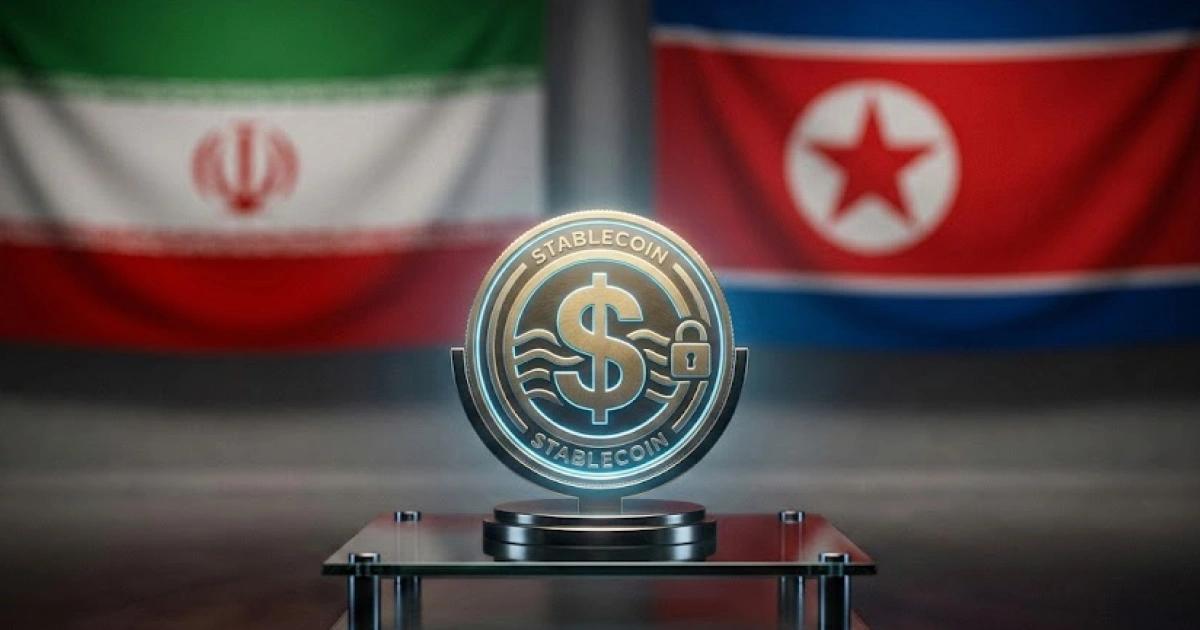
The Financial Action Task Force (FATF) has pointed out that stablecoins are the preferred choice for illegal transactions involving North Korea, Iran, and others, with estimated fraud amounts reaching $51 billion. To prevent vulnerabilities in non-custodial wallets, they strongly urge countries to strengthen anti-money laundering regulations on issuers.
FATF: Stablecoins Are the Top Choice for Illegal Transactions
According to a 42-page report released by the Financial Action Task Force (FATF), stablecoins are currently the most popular virtual assets used in illegal transactions (including sanctions evasion). Participants include countries like Iran and North Korea, prompting calls for stricter regulation of stablecoin issuers.
In January this year, FATF stated that stablecoins account for the majority of on-chain illegal activity transactions. The organization estimates that in 2024, illegal stablecoin activities related to scams and fraud will total approximately $51 billion.
North Korea and Iran Favor Stablecoins
FATF further explained that North Korea’s Lazarus Group and other organizations use stablecoins to purchase military equipment; Iran’s Islamic Revolutionary Guard Corps also relies on stablecoins to acquire drone parts; terrorist groups and drug trafficking organizations heavily depend on Tether ($USDT) and USDC for fund transfers and money laundering.
On July 2, 2025, Tether, the issuer of USDT, conducted the largest-ever freeze of Iran-related funds, freezing 42 cryptocurrency wallet addresses, over half of which are heavily linked to the local exchange Nobitex.
As a global standard-setting body focused on international anti-money laundering efforts, FATF points out that stablecoins, with features like price stability and high liquidity, are attractive tools for criminals to transfer funds.
Further Reading:
Fiat currency devalued by 90%! Iran’s central bank buys $500 million USDT to save rial exchange rate. Iran’s banks are paralyzed, and exchanges have been hacked! Can Bitcoin hedge against information warfare in the Taiwan Strait?
Vulnerabilities in Non-Custodial Wallets Record Illegal Stablecoin Receipts
In its latest report from March 2026, FATF again warns that stablecoins pegged to the US dollar have become key tools in illegal financial activities.
The organization cites a report from blockchain analysis firm Chainalysis, stating that in 2025, illegal virtual asset transactions totaled $154 billion, with stablecoins accounting for 84%, a stark contrast to the Bitcoin-dominated illegal transactions of 2020.
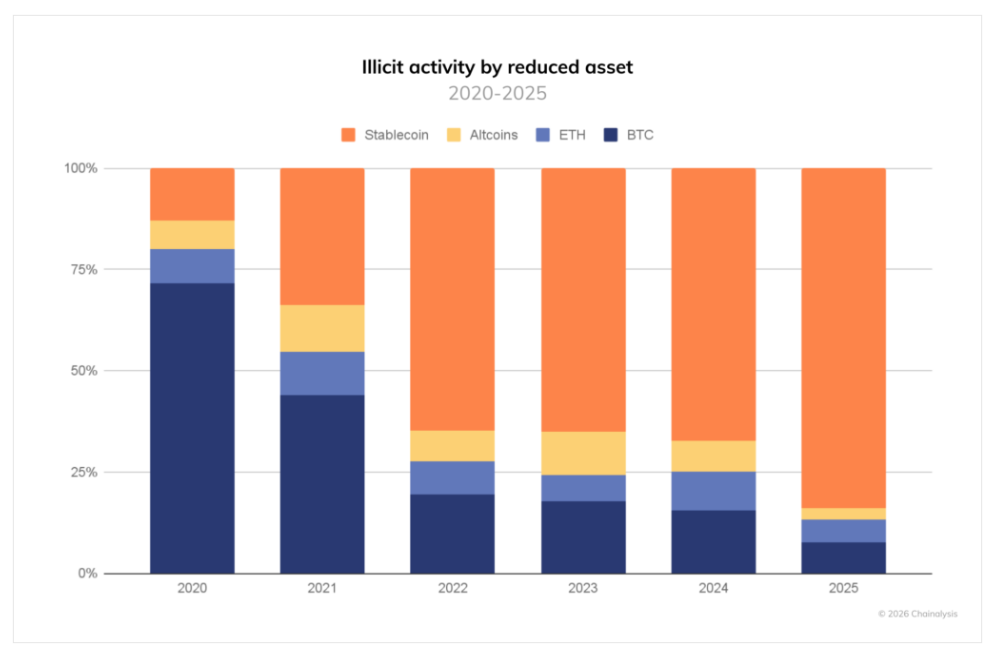
Source: Chainalysis — In 2025, illegal virtual asset transactions reached $154 billion, with stablecoins accounting for 84%
Additionally, according to a report released in mid-February by blockchain analysis firm TRM Labs, illicit entities received a total of $141 billion in stablecoins in 2025, setting a five-year high. The report notes that last year, overall stablecoin activity repeatedly exceeded $1 trillion per month, with 86% related to sanctions.
The report emphasizes that malicious actors often hide their funds using cross-chain technology, decentralized exchanges, and OTC brokers. FATF highlights that peer-to-peer transfers through non-custodial wallets are a critical vulnerability, as these transactions occur in environments lacking anti-money laundering controls, making it difficult for regulators to track geographic locations and beneficiaries.
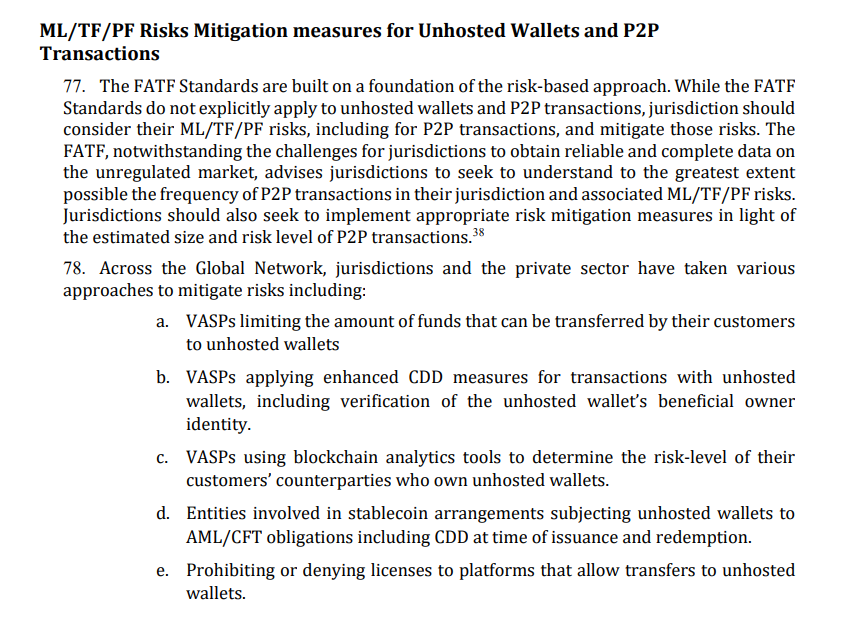
Source: FATF report — Peer-to-peer virtual asset transfers via non-custodial wallets are a key vulnerability
Stablecoin Market Cap Surpasses $300 Billion, Urgent Need for Regulation
It’s important to note that FATF does not call for banning stablecoins outright but strongly urges countries to impose anti-money laundering obligations on stablecoin issuers and intermediaries.
FATF recommends that stablecoin issuers utilize smart contract control features to establish whitelists and blacklists to restrict certain wallet transactions. Issuers should have the technical capability to intercept, freeze, and destroy suspicious stablecoins in secondary markets. To address cross-border operational challenges, FATF encourages countries to establish international regulatory bodies to enhance information sharing and joint oversight.
Currently, the global stablecoin market value has exceeded $300 billion. As adoption accelerates and integration with traditional finance deepens, FATF believes that regulators worldwide must act swiftly and implement blockchain analysis tools to close regulatory and compliance gaps.
Further Reading:
Preparing for Crypto Legislation! E.SUN Bank: Banking sector to adopt three-tier financial models, not missing out on stablecoins and tokenization
Conflict impacts Gaza banks! Trump’s Peace Commission plans to use US dollar stablecoins to promote digital transactions
Disclaimer: The information on this page may come from third parties and does not represent the views or opinions of Gate. The content displayed on this page is for reference only and does not constitute any financial, investment, or legal advice. Gate does not guarantee the accuracy or completeness of the information and shall not be liable for any losses arising from the use of this information. Virtual asset investments carry high risks and are subject to significant price volatility. You may lose all of your invested principal. Please fully understand the relevant risks and make prudent decisions based on your own financial situation and risk tolerance. For details, please refer to
Disclaimer.
Related Articles
Iranian media: Negotiations with the United States do not mean the war is over; all details of the ten-point plan must be met.
Gate News message, April 7, Iranian media said that negotiations with the United States do not mean the war is over; Iran will only accept that the war has ended after all details are finalized according to the ten-point plan. Iran’s proposed ten-point plan includes: gaining control of passage through the Strait of Hormuz (a strategic passage connecting the Persian Gulf and the Gulf of Oman) in coordination with Iranian armed forces, stopping the war against Iran and its allies, and withdrawing all U.S. military bases in all areas.
GateNews7m ago
White House official: Israel has agreed to a temporary ceasefire
Gate News update, April 7, a White House official said that Israel has agreed to a temporary ceasefire. (Source: CNN)
GateNews36m ago
Iran accepts Pakistan’s two-week ceasefire proposal
Gate News update: On April 7, Iran accepted a two-week ceasefire proposal submitted by Pakistan. The ceasefire plan has been approved by Iran’s newly appointed supreme leader.
GateNews37m ago
Trump agrees to a two-week Iran ceasefire to finalize the final talks, and Bitcoin jumps to 71K.
U.S. President Trump agreed to extend Iran’s ceasefire deal by two weeks in order to complete the final negotiations. The news briefly pushed Bitcoin above 71K, and the S&P 500 index also rose. The war in the Middle East has raised concerns about inflation, and durable goods orders fell more than expected.
ChainNewsAbmedia43m ago
ETH 15-minute rally up 1.25%: On-chain capital inflows and derivatives short covering converge to drive the move
2026-04-07 21:00 to 21:15 (UTC), the ETH price’s return within 15 minutes reached +1.25%, with the candlestick price range from 2115.51 to 2152.7 USDT and a swing of 1.76%. During this period, overall market attention increased, liquidity of funds rose, and volatility intensified.
The main driver of this abnormal move is the on-chain inflow of funds and the simultaneous rise in active trading volume. Combined with concentrated short positions in the derivatives market and negative funding rates, the market triggered large-scale short covering driven by spot buy-side participation, which became the core factor behind the rapid price increase
GateNews2h ago
BTC 15-minute up 0.98%: Whale transfers surge in tandem with geopolitical hedging demand
2026-04-07 21:00 to 21:15 (UTC), the BTC price saw a clear spike. The candlestick return rate recorded +0.98%, and the price range was 69309.9-70214.9 USDT, with a 1.31% amplitude. Short-term market volatility increased, participation interest rose, and trading volume and the number of active entities increased in parallel.
The main driver behind this move was whale trading activity. On-chain data shows that the transfer volume to exchanges by whale entities holding more than 1,000 BTC surged before and after the event window. Over the past 24 hours, whale inflow reached 10,5
GateNews2h ago


