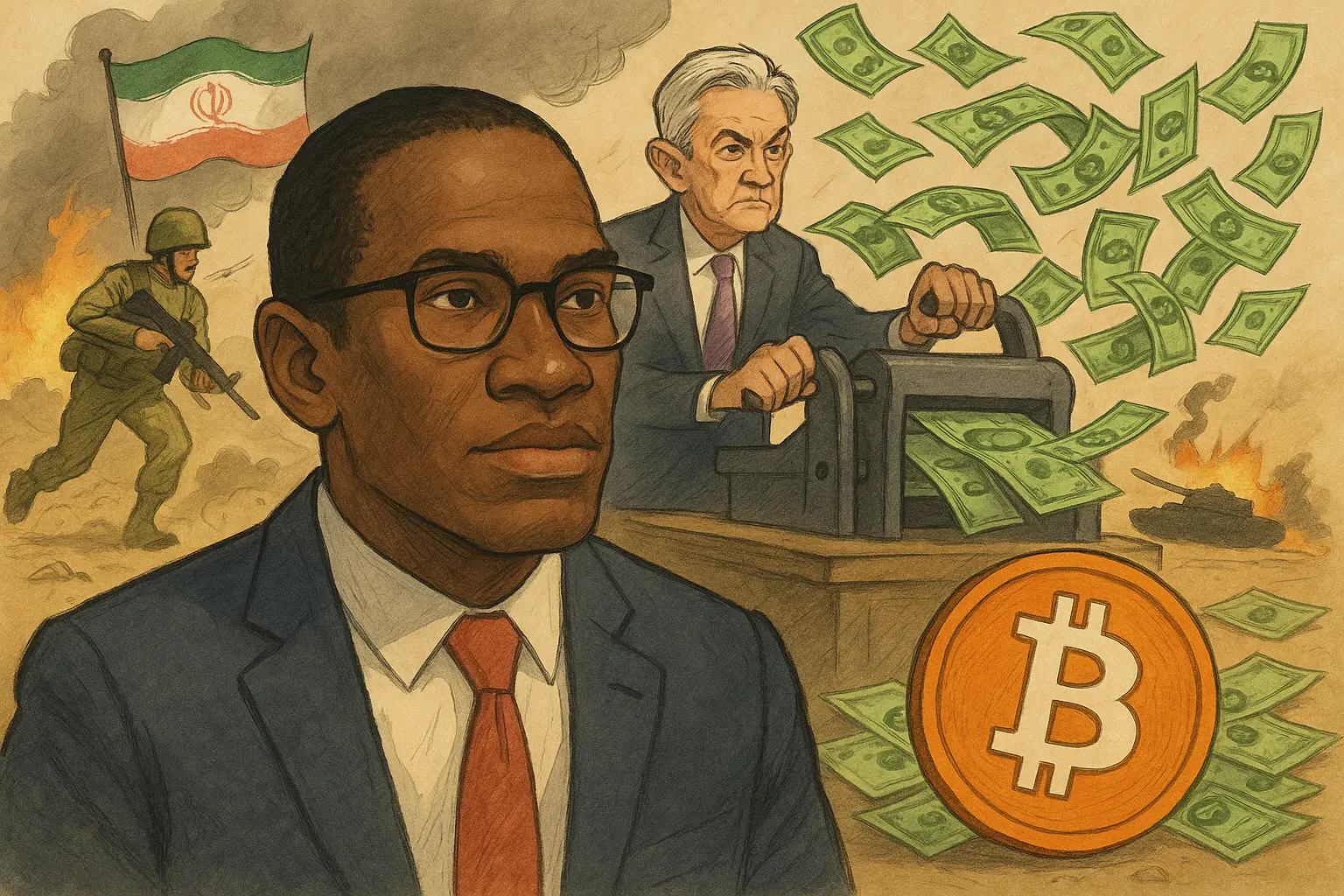
Legendary trader Arthur Hayes posted on March 2nd, offering a systematic analysis of the macroeconomic background as the US-Iran conflict escalates. Hayes pointed out that the longer the Trump administration’s military involvement in Iran continues, the higher the likelihood that the Federal Reserve will cut interest rates or increase the money supply to support war expenditures, which ultimately could serve as a macroeconomic catalyst for driving Bitcoin prices higher. He also noted that currently, it is prudent to remain cautious and wait for the Federal Reserve to take concrete action before entering the market.
Historical Patterns Since 1985: The Relationship Between War and Federal Reserve Rate Cuts
Hayes’s analytical framework is based on a systematic review of U.S. military actions in the Middle East over the past forty years and the Federal Reserve’s policy responses. He cites three major historical cases:
Federal Reserve Policy Responses Following U.S. Middle East Military Actions
1990 Gulf War (George H. W. Bush administration): The Fed maintained interest rates initially after the outbreak of war but explicitly stated in the August 1990 FOMC statement that “the uncertainly surrounding the Middle East situation may, at some point, require policy easing.” Subsequently, the Fed cut rates in November and December 1990 to counteract economic weakness caused by the war.
2001 Global War on Terror (George W. Bush administration): After the September 11 attacks, Fed Chairman Alan Greenspan announced an emergency 50 basis point rate cut, clearly stating that “the events have at least heightened fears and uncertainty, increasing the risk of asset price deflation.” The Fed then accelerated rate cuts multiple times to boost market confidence.
2009 Troop Surge in Afghanistan (Barack Obama administration): By the end of 2008, the Fed had already lowered interest rates to zero and launched quantitative easing (QE). Despite no further immediate action needed for Obama’s large troop increases, the abundant cheap liquidity allowed the military expansion to proceed on a large scale.
From these cases, Hayes distills a core logic: when Middle East conflicts impact U.S. economic and financial market confidence, the Fed often responds under political pressure by providing cheaper and more abundant liquidity.
Current Analysis of the Iran Conflict and Bitcoin Trading Strategy
Hayes views the 2026 Iran conflict as a continuation of this historical pattern. In his framework, since the 1979 Iranian revolution, reshaping Iran’s political landscape has been a long-term goal of U.S. political elites from both parties. This provides the Fed with sufficient political cover to undertake significant monetary easing when the scale of war expands and market confidence falters.
However, Hayes explicitly adopts a cautious stance on trading strategies: “At present, we do not know how long Trump can sustain his involvement, how much money he will spend, or how much geopolitical and financial market shocks he can endure before ultimately withdrawing. The wise approach is to wait and see.”
He recommends entering only after the Fed officially announces rate cuts or increases the money supply, rather than beforehand. He highlights Bitcoin and the decentralized exchange token $HYPE as priority assets to consider in this macro environment.
Frequently Asked Questions
Q: Why does Arthur Hayes believe that prolonged war is beneficial for Bitcoin?
Hayes’s argument is based on a macro chain: prolonged war → increased war spending → Fed cutting rates or printing money to maintain market confidence → expansion of money supply → higher opportunity cost of holding fiat currency → capital flows into Bitcoin and other scarce assets. The premise is that, historically, the Fed tends to choose monetary easing over tightening in response to economic shocks caused by war.
Q: Why does Hayes recommend waiting for Fed action before buying Bitcoin instead of entering immediately?
Hayes emphasizes that it is currently uncertain how extensive and sustained U.S. involvement will be, and how much geopolitical and market shocks the government and markets can withstand. In this uncertain environment, he believes that remaining patient and observing is more rational. Only when the Fed actually implements rate cuts or QE signals a macro shift does he consider it a good entry point.
Q: Why does Hayes list $HYPE alongside Bitcoin?
Hayes describes $HYPE (Hyperliquid’s native token) as a “quality altcoin” that could benefit from a loose monetary environment. Hyperliquid is a decentralized perpetual contract exchange with a certain market position in on-chain financial infrastructure. He believes that in a macro environment of abundant liquidity, crypto tokens with real use cases may also benefit.
Disclaimer: The information on this page may come from third parties and does not represent the views or opinions of Gate. The content displayed on this page is for reference only and does not constitute any financial, investment, or legal advice. Gate does not guarantee the accuracy or completeness of the information and shall not be liable for any losses arising from the use of this information. Virtual asset investments carry high risks and are subject to significant price volatility. You may lose all of your invested principal. Please fully understand the relevant risks and make prudent decisions based on your own financial situation and risk tolerance. For details, please refer to
Disclaimer.
Related Articles
Korea’s central bank: Cryptocurrency trading should introduce a “circuit breaker” mechanism; CBDC should be the digital core
The Bank of Korea recommends introducing a circuit breaker mechanism in the crypto-asset industry to prevent abnormal trading, and points out that the Bithumb mistaken payment incident reveals a structural vulnerability. The governor nominee, Hyun-sung Shin, emphasizes that CBDCs and deposit tokens should be the core of digital currencies, and proposes a phased opening strategy for stablecoins. The Bank of Korea also plans to launch an offshore KRW system with real-time gross settlement in 2027 to reduce credit risk.
MarketWhisper2h ago
CryptoQuant Analyst: In March, the U.S. CPI month-over-month increase hit a record high; if the U.S.-Iran conflict continues or forces the Federal Reserve to raise interest rates
CryptoQuant analyst Darkfost noted that although March CPI recorded the largest month-over-month increase, core CPI remained stable, indicating that U.S. inflation has not fully spread yet. Attention should be paid to upcoming PCE data. If the Iran-Iraq conflict continues, inflation could evolve into a systemic risk and affect economic growth, and the Federal Reserve may need to continue raising rates to respond.
GateNews23h ago
Hassett: The Strait of Hormuz could be opened within two months, and the Federal Reserve still has room to cut rates
Gate News message: On April 10, U.S. National Economic Council Director of the White House, Hassett, said the Strait of Hormuz could be reopened within two months. In addition, Hassett said the Federal Reserve still has room to cut interest rates, and this outlook will be very solid.
GateNews04-10 13:25
Reuters: The market is pricing in expectations that the U.S. Federal Reserve will keep interest rates unchanged throughout 2026
Gate News, April 10, according to Reuters, the market continues to price in expectations that the Federal Reserve will keep interest rates unchanged throughout 2026.
GateNews04-10 13:06
CME Data: The probability that the Federal Reserve will keep interest rates unchanged in April is 98.4%
Gate News message: On April 10, according to CME "FedWatch" data, before the CPI data is released, the probability that the Federal Reserve will raise rates by 25 basis points in April is 1.6%, while the probability of keeping rates unchanged is 98.4%. Looking ahead to June, the probability of cumulative rate cuts of 25 basis points is 1.5%, the probability of keeping rates unchanged is 96.8%, and the probability of cumulative rate hikes of 25 basis points is 1.7%.
GateNews04-10 12:31
Federal Reserve’s Daly: If the Iran conflict is resolved and oil prices fall, a rate cut “is not out of the question”
Gate News, on April 10, Daly, the president of the Federal Reserve Bank of San Francisco, said that if the Iran conflict is resolved quickly and oil prices fall, a rate cut is “not impossible.” She also noted that the likelihood of a rate hike is lower than the likelihood of cutting rates or keeping interest rates unchanged.
GateNews04-10 12:06


