
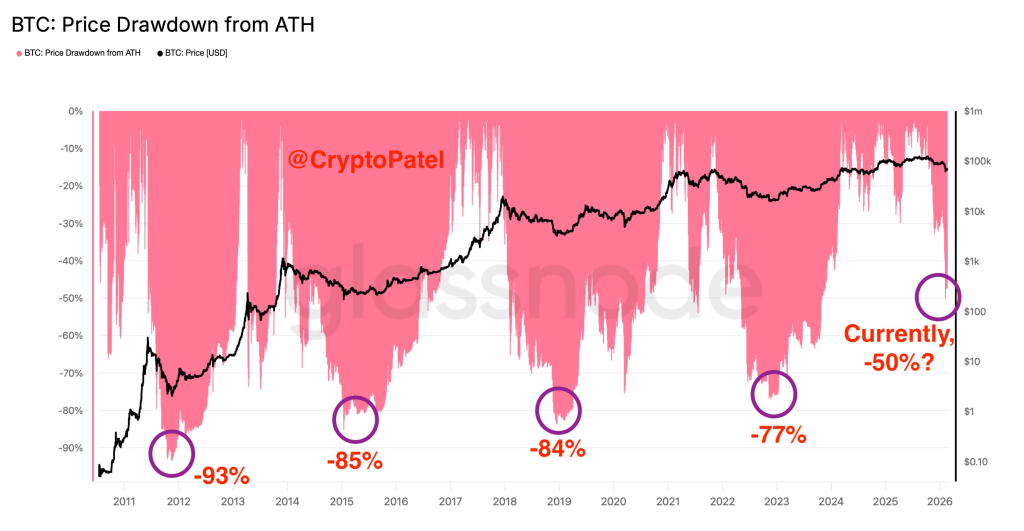
The chart shared by Crypto Patel puts Bitcoin’s current drawdown into long-term perspective by mapping every major peak-to-trough decline since 2011. What immediately stands out is not just how brutal past bear markets were, but how consistently Bitcoin has tested investor conviction before resetting for the next cycle. Compared to earlier crashes, today’s pullback still sits on the shallow end of Bitcoin’s historical spectrum.
The pink area on the chart tracks Bitcoin’s percentage drawdown from its all-time high, overlaid with the BTC price itself. Previous cycle lows were extreme: roughly -93% in 2011, -85% in 2015, -84% in 2018, and -77% in 2022. In contrast, the current cycle is hovering near a -50% drawdown, which is materially less severe than any prior major bottom. From a purely historical standpoint, that suggests Bitcoin has not yet experienced the type of capitulation that has defined past cycle lows.
Crypto Patel’s key observation is valid: each cycle’s maximum drawdown has become less aggressive over time. That trend aligns with Bitcoin’s maturation, deeper liquidity, broader ownership, and increasing institutional participation. However, the chart also delivers an uncomfortable reality check. Even if this cycle continues the pattern of “shallower” losses, a move toward a -70% drawdown would still be well within historical norms, and that would place Bitcoin near the $30,000 zone from current levels.
Source: X/@CryptoPatel
The most important takeaway is not a price prediction, but a framework. Bitcoin does not bottom quietly. Every prior cycle required prolonged pain, time, and psychological exhaustion before a durable low formed. The absence of a deep drawdown does not invalidate the bull thesis long-term, but it does indicate that downside scenarios remain very much alive. Markets rarely reward complacency, especially during transitions between expansion and contraction phases.
Crypto Patel’s conclusion is less about fear and more about preparation. History shows that Bitcoin survives every storm, but not everyone holding it does. Planning for multiple outcomes, including deeper volatility, has historically been the difference between forced exits and long-term survival. If this cycle ultimately bottoms at a higher level than the past, that will be constructive. Until proven otherwise, though, the chart argues for respect (not confidence) in what Bitcoin is still capable of doing on the downside.
Read also: Robert Kiyosaki Buys Another Bitcoin at $67,000 as BTC Price Shows Recovery Signs
Disclaimer: The information on this page may come from third parties and does not represent the views or opinions of Gate. The content displayed on this page is for reference only and does not constitute any financial, investment, or legal advice. Gate does not guarantee the accuracy or completeness of the information and shall not be liable for any losses arising from the use of this information. Virtual asset investments carry high risks and are subject to significant price volatility. You may lose all of your invested principal. Please fully understand the relevant risks and make prudent decisions based on your own financial situation and risk tolerance. For details, please refer to
Disclaimer.
Related Articles
Charles Schwab Wealth Management Warning: Allocating 1%-3% of an investment portfolio to BTC/ETH can significantly alter the risk profile.
Gate News message: On April 7, the U.S. financial giant Charles Schwab released a research bulletin warning that even if only 1%-3% of funds are allocated to Bitcoin or Ethereum within an investment portfolio, it may significantly change the portfolio’s overall risk characteristics. The research report notes that Bitcoin and Ethereum have both historically experienced drawdowns of more than 70%, far higher than the volatility levels of stocks or bonds; therefore, even small allocations can have a noticeable impact during periods of market volatility. Charles Schwab proposed two cryptocurrency allocation approaches: one is the traditional portfolio theory method, which allocates based on expected returns, volatility, and correlation; the other is a risk-based method, which determines the share of crypto assets according to the level of risk one is willing to take, shifting the focus from returns to risk tolerance.
GateNews3m ago
Morgan Stanley’s Bitcoin ETF will be listed on the New York Stock Exchange tomorrow, trading under the ticker symbol MBST
Gate News message, April 7, Eric Balchunas, a senior ETF analyst at Bloomberg, posted on the X platform stating that, according to a listing notice from the New York Stock Exchange (NYSE), the Morgan Stanley Bitcoin exchange-traded fund will be listed tomorrow (April 8), with the trading ticker "MBST".
GateNews57m ago
BTC 跌破 68000 USDT,日内跌幅 1.27%
Gate News message, April 7, according to market data, Bitcoin has fallen below 68,000 USDT and is currently trading at 67,971.75 USDT, with a decline of 1.27% during the day.
GateNews58m ago
BTC 15-minute drop of 0.51%: short-term capital outflow and macro volatility converging to trigger a pullback
Between 2026-04-07 14:00 and 2026-04-07 14:15 (UTC), the BTC price fluctuated within the range of 67801.3 - 68256.1 USDT. The candlestick chart recorded a -0.51% return, with an amplitude of 0.67%. Short-term volatility intensified, and market attention increased significantly. Overall liquidity was still within the normal range, but showed marginal changes.
The main drivers of this unusual move are the combined effect of short-term capital outflows and the simultaneous rise in net inflows to exchanges. Short-term holders take profit or cut losses at market volatility nodes, pushing prices lower. Spot
GateNews1h ago
BTC 跌破 68000 USDT
Gate News bot 消息,Gate 行情显示,BTC 跌破 68000 USDT,现价 67983.9 USDT。
CryptoRadar1h ago


