Author: Stacy Muur
Compiled by: Chopper, Foresight News
Tria is a non-custodial new banking application that supports users in over 100 chains to spend, trade, and earn yields—all without Gas fees or mnemonic phrases. It will launch the “Contribution-Based Sale Round” on Legion’s Nozomi on November 3.
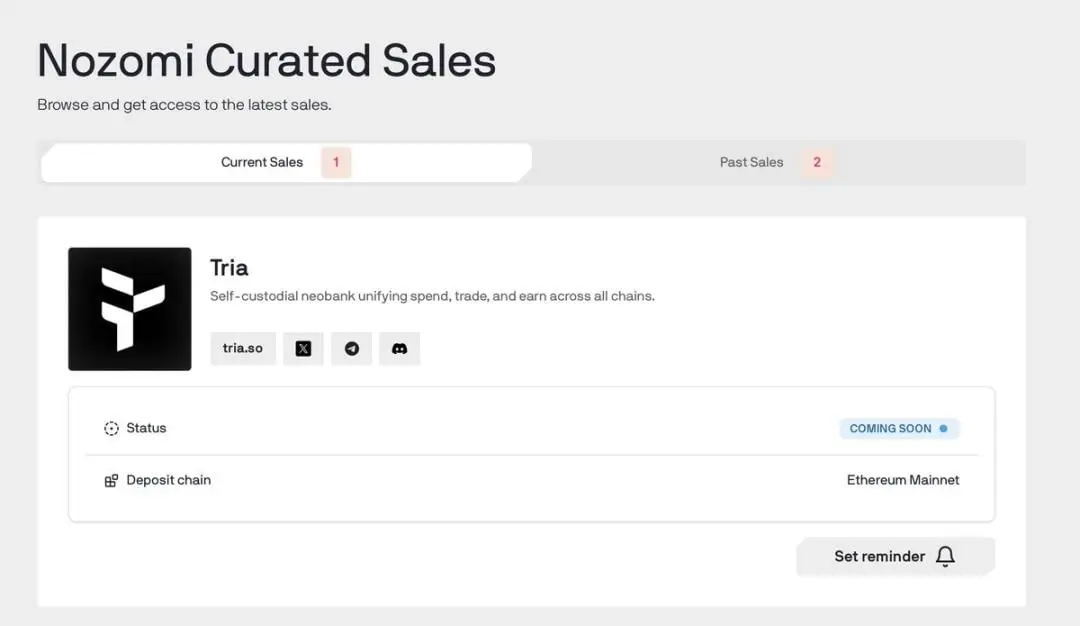
Tria Investment Logic
The core logic of Tria is straightforward. By 2030, on-chain transaction volume is expected to approach $100 trillion, but industry bottlenecks are not revenue or liquidity, but usability.
Stablecoin monthly settlement volume has exceeded $1.1 trillion, surpassing Visa and Mastercard, yet most people still cannot use cryptocurrencies for daily scenarios. Tria addresses this issue through a cross-chain abstracted new banking solution: maintaining non-custodial features while hiding the technical complexity of cryptocurrencies.
Highlights of Tria’s product include:
- Spending: Supports Visa card payments in over 150 countries, with cashback rates up to 6%, and zero Trading Fees for deposits/withdrawals/payments/forex transactions;
- Yield: Idle assets earn up to 15% annualized returns, which can automatically be used to pay bills;
- Trading: An interface covering over 100 chains, with built-in AI narrative tracking—technically supported by BestPath AVS.
- After 11 weeks of closed testing: revenue of $1.2 million, trading volume of $15 million, 20,000 users, and 4,400 alliance members; average revenue per user is $105 (about twice that of Phantom). BestPath has been adopted by over 70 protocols (e.g., Arbitrum, Polygon, Injective, Sentient) and integrated to cover over 250,000 users.
Tria enables “use and go” for cryptocurrencies, demonstrating innovation in the following aspects:
- BestPath AVS (Intent Market): Solvers, relays, liquidity routers, and fast finality layers compete to match the optimal execution path for each trade. The system scores based on cost, speed, and security to ensure the best settlement without cross-chain bridges;
- Unchained (AVS Layer 2 to Layer 1): An EVM-compatible, consumer-oriented execution environment that will upgrade to a Layer 1 network—optimized specifically for payments and proxy interactions;
- Multi-Virtual Machine Support: Compatible with EVM, SVM, IBC, Move, BTC, providing a single SDK to deliver a “chainless” user experience.
Tria’s ultimate goal is to build a “chain-agnostic” financial operating system that retains non-custodial features, simplifies usability, and achieves mainstream user adoption at scale.
Support from Nozomi
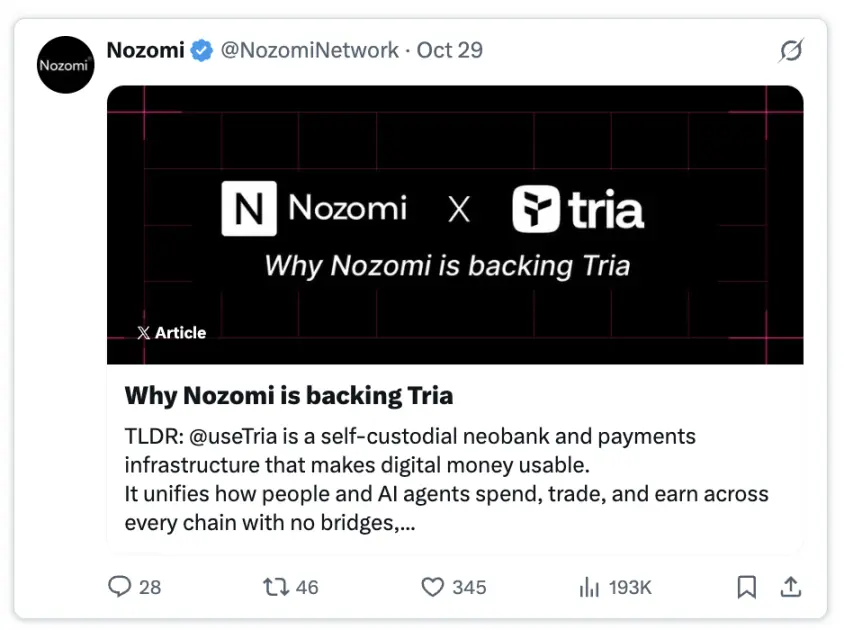
Tria is not only a product launch but also a typical case of Nozomi’s “Fair, Compliant, Contribution-Based” model.
Unlike traditional sales that are “only for VCs and overhyped valuations,” Nozomi adopts the “Legion Score” mechanism, distributing participation rights based on on-chain activity, community contribution, influence, and expertise.
How is the issuance allocated?
- Purchase any Tria card with a discount code (20% off) to access the locked quota channel;
- Complete KYC verification on Legion;
- Submit a priority quota form;
- Actively use the card to unlock airdrops. (Note: Over $30 million in funds are already following, and the sale is highly likely to be oversubscribed.)
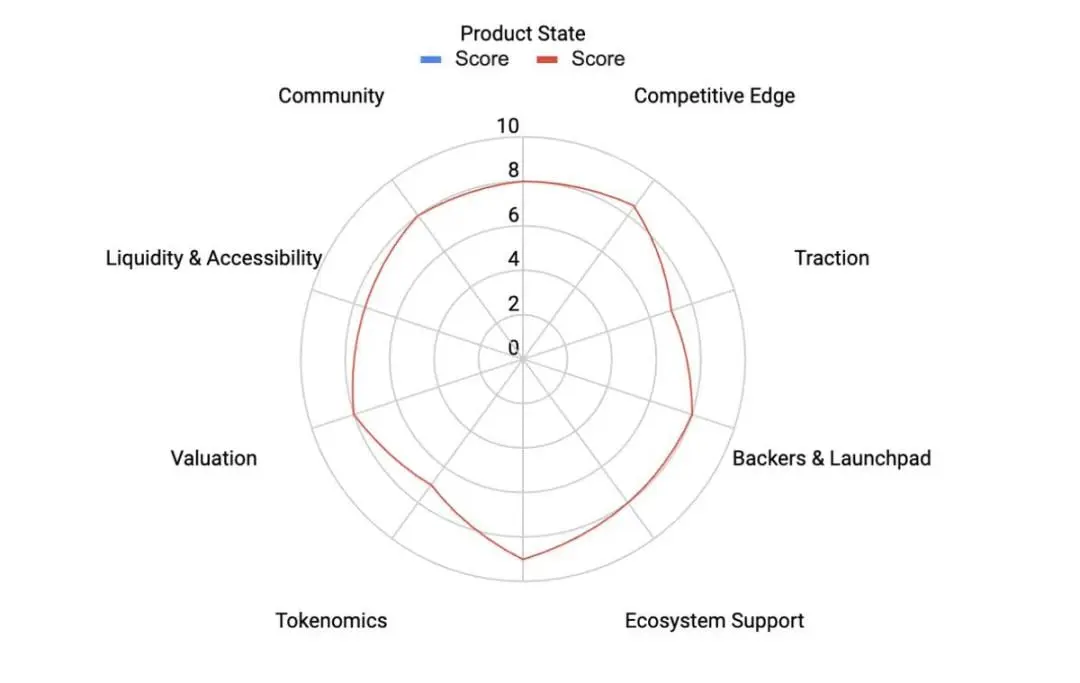
My Evaluation Framework
Muur Score framework focuses on core project dimensions: product, tokenomics, user growth, investors, and market environment, weighted by importance.
For Tria, evaluation dimensions include:
- Product: Chainless new banking experience, BestPath AVS + Unchained infrastructure, closed testing data;
- Tokenomics: Functionality, distribution/unlock mechanisms, issuance valuation;
- Community and Narrative: Alliance promotion network, organic buzz, new banking/intent layer trends;
- Distribution Model: Legion’s contribution-based sale mechanism, card lock quotas.
Overall score: 8.21/10. Tria has real revenue, clear differentiation advantages, and a collaborative distribution model, but uncertainties remain in scaling compliance, liquidity management, multi-VM routing, and execution.
Tokenomics
Tria will launch its community sale round on Legion’s platform on November 3. The fully diluted valuation (FDV) for this round is divided into two tiers: $100 million (30% unlock) or $200 million (60% unlock). The unlock mechanism involves a 2-month lock-up period plus 6 months of linear unlocking.
TRIA tokens will be used for:
- Settlement within BestPath and the new banking ecosystem;
- Discounted Trading Fees (Gas, transaction fees, card fees);
- Staking as “Pathfinders”;
- Ecosystem rewards and governance voting;
- Structured buyback and burn of protocol revenue.
The token launch (TGE) is scheduled for Q4 2025.
Tokenomics assessment:
- Functionality: 9/10— Essential for both consumer and infrastructure sides;
- Structure: 7/10— Balanced lock-up and unlock rhythm, full unlock curve and audit reports pending;
- Valuation: 8/10—FDV of $100-200 million is undervalued compared to similar payment/infrastructure projects, which often have weak pre-launch revenue.
- Liquidity: Not rated before TGE; expected to open trading post-Legion sale, with market makers providing deep liquidity.
Risk Warning
Tria faces the following challenges:
- Compliance risk: Needs to complete regulatory filings for card/deposit channels in over 150 countries, which is complex;
- Execution risk: Managing both consumer banking services and multi-VM infrastructure simultaneously increases operational complexity;
- Competition risk: Custodial new banks may quickly imitate its features, requiring continuous advantage in user experience and fees;
- Liquidity risk: Post-launch short-term liquidity depends on Legion’s sale and allocation, unlock schedule, and market maker depth.
Valuation Reference
Similar payment and infrastructure projects typically have an FDV of $350 million to $1 billion upon launch, with most having weak pre-launch revenue.
Pricing Tria at an FDV of $100-200 million, aligned with high-potential infrastructure projects at TGE, but with actual revenue, users, and dual-use tokens for consumption and infrastructure, offers high cost-effectiveness.
Even capturing just a tiny fraction (e.g., 1%) of Revolut’s $4 trillion annual transaction volume would mean billions of dollars in on-chain transactions routed through BestPath/Unchained, with enormous growth potential.
Summary
Catalyst: Legion sale on November 3, with over $30 million in funds already following;
Core Mechanism: BestPath AVS offers the lowest-cost, fastest cross-chain execution; Unchained gradually upgrades from AVS Layer 2 to Layer 1;
Sale Rules: Purchase Tria cards to lock quotas, with card tiers at $20/$90/$225; active use can unlock airdrops; submit priority forms;
Risk Warnings: Compliance in over 150 countries, token liquidity post-launch, and the complexity of managing both consumer and infrastructure businesses.
My score: 8.21/10. If Tria sustains revenue growth during public testing and successfully achieves global compliance, it could become the “Revolut moment” in crypto and set a benchmark for Legion’s contribution-based sale model.
Disclaimer: The information on this page may come from third parties and does not represent the views or opinions of Gate. The content displayed on this page is for reference only and does not constitute any financial, investment, or legal advice. Gate does not guarantee the accuracy or completeness of the information and shall not be liable for any losses arising from the use of this information. Virtual asset investments carry high risks and are subject to significant price volatility. You may lose all of your invested principal. Please fully understand the relevant risks and make prudent decisions based on your own financial situation and risk tolerance. For details, please refer to
Disclaimer.


