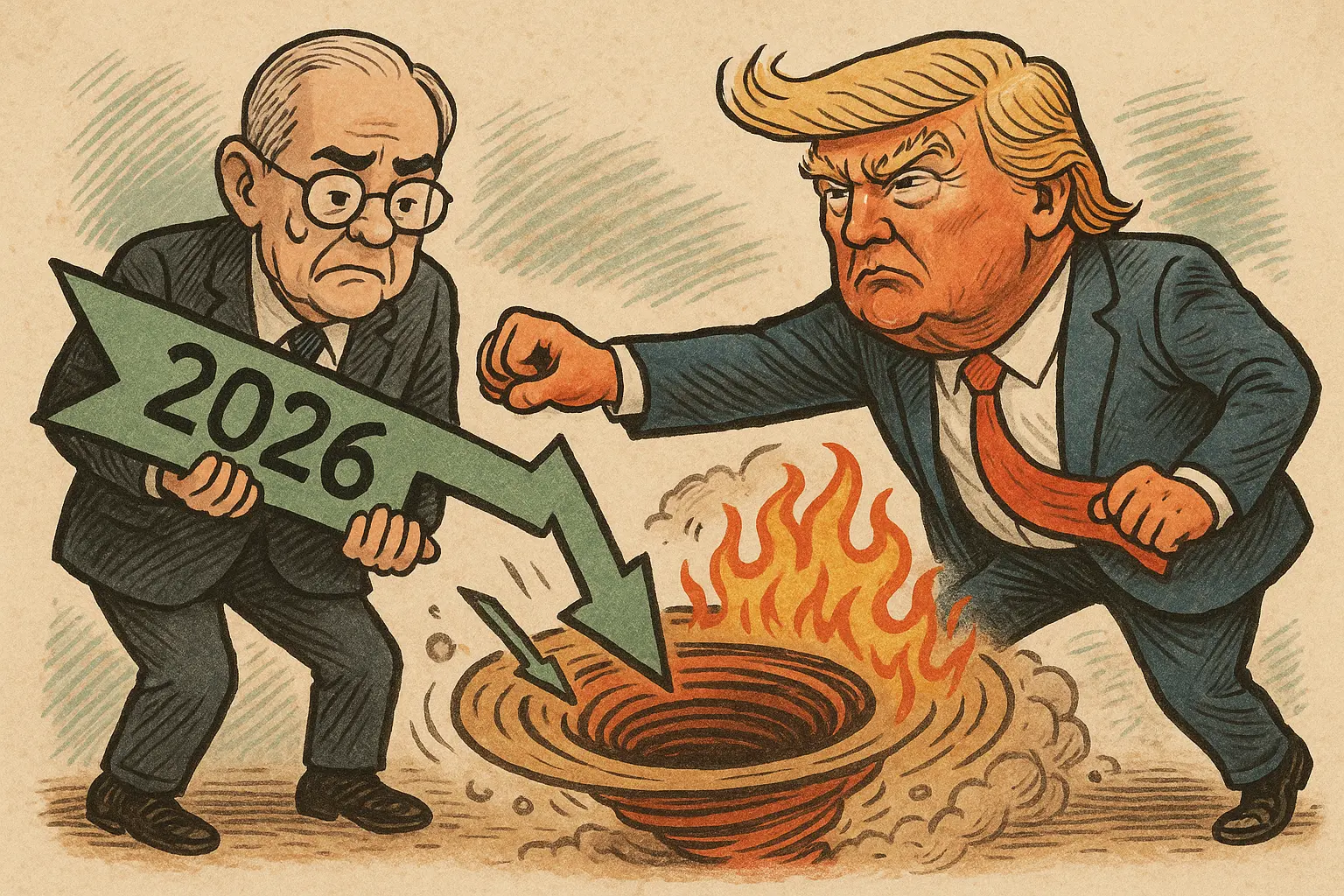
The Federal Reserve and the market are experiencing serious divergence in interest rate outlooks for 2026. The market expects 2 to 3 rate cuts (Polymarket shows a 94% chance of a rate cut in June), but the Fed only hints at one rate cut. Trump’s push for rate cuts has been countered by inflation, with economic policy support dropping to 36%. As midterm elections approach, the economy finds itself in an impossible triangle of rate cuts, inflation, and elections.
2026 Fed Rate Cut Forecast Divergence: 2 Times Most Likely
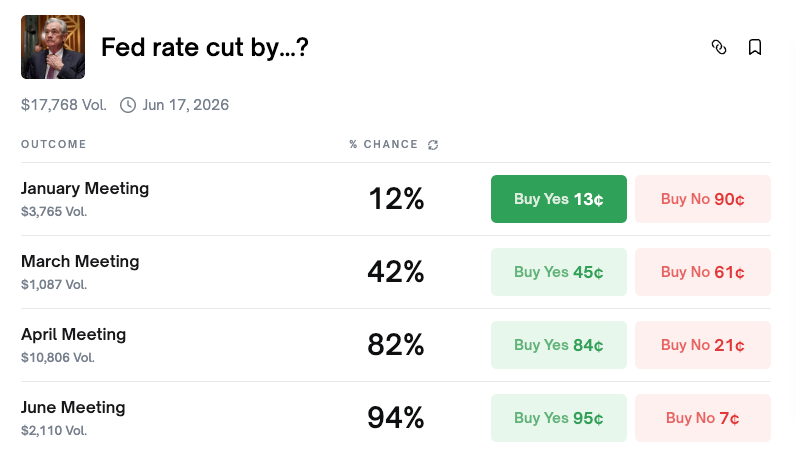
(Source: Polymarket)
According to data from the prediction market platform Polymarket, the probability of a rate cut at the January FOMC meeting is only 12%, with most participants expecting rates to remain unchanged this month. But in the long term, the situation changes significantly: the probability of a rate cut in April rises to 81%, and in June it reaches 94%. Over the year, the highest probability for two rate cuts is 24%, followed by three cuts at 20% and four at 17%. Overall, the chance of two or more rate cuts exceeds 87%.
The CME FedWatch tool depicts a similar picture. The probability of holding rates steady in January is 82.8%, and the chance of at least one rate cut before June is also 82.8%. The probability of 2 to 3 rate cuts before the end of the year is as high as 94.8%. Market consensus is very clear: hold steady in January, start reducing holdings in the first half of the year, and cut 2 to 3 times by December.
However, within the Federal Reserve, a completely different picture emerges. On January 4, Philadelphia Fed President Paulson stated that further rate cuts might have to wait until “later this year.” She emphasized that “small adjustments to the federal funds rate later this year might be appropriate,” but only if inflation slows, the labor market remains steady, and economic growth stays around 2%. She described the current policy stance as “still somewhat hawkish,” implying ongoing efforts to reduce inflationary pressures.
The December FOMC meeting revealed internal divisions within the Fed. The committee lowered rates by 25 basis points to a range of 3.5% to 3.75%, but the voting result was 9 to 3, a larger split than the previous 10 to 2. Powell and Goolsbee favored holding rates steady, while Bowman (widely seen as aligned with the Trump administration) pushed for a 50 basis point cut. A scatter plot reveals clearer signals: seven officials forecast no rate cuts, eight forecast two or more cuts, with the most optimistic predicting rates could fall to 2.125%. The official Fed guidance is for one rate cut, but markets expect two. Why is there a persistent gap between the two?
Inflation Paradox: Trump Pushes for Rate Cuts but Loses Political Capital
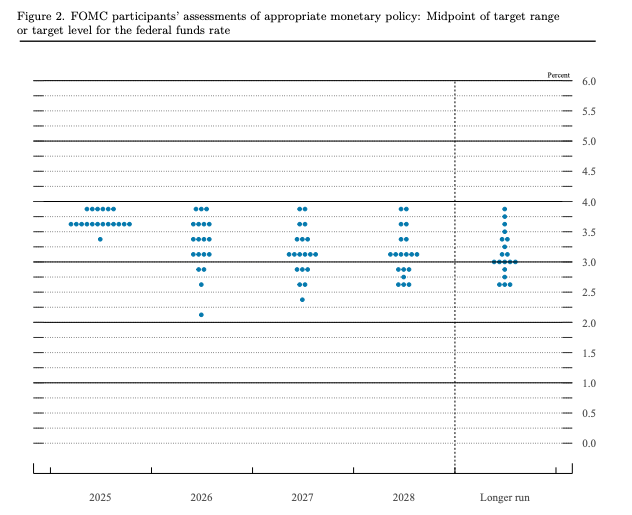
(Source: Federal Reserve)
The main reason markets refuse to accept the Fed’s hawkish guidance is President Trump. Since returning to the White House, Trump has been pressuring the Fed to lower interest rates. In the December FOMC vote, an official closely linked to Trump advocated for aggressive easing, exemplifying this dynamic. More importantly, Fed Chair Powell’s term expires in 2026, and the power to nominate his successor lies with the President. Markets widely expect Trump to appoint someone more inclined toward easing monetary policy.
Structural factors also reinforce this view. The Fed has historically cut rates when the labor market is weak, and internal divisions within the FOMC are deepening. Additionally, tariffs may drag down economic growth, increasing pressure for monetary easing. The market’s simple bet: Trump’s pressure combined with potential economic slowdown will ultimately force the Fed to act.
Ironically, Trump needs political capital to effectively pressure the Fed, but inflation is eroding that capital. Recent polls show Trump’s support for economic policies has fallen to 36%. PBS / NPR / Marist surveys indicate 57% of respondents disapprove of his economic management, and CBS / YouGov polls find 50% of Americans say their financial situation has worsened under Trump’s policies.
Rising Living Costs Erode Public Support
Food prices have surged: according to the U.S. Bureau of Labor Statistics, beef prices have soared 48% since July 2020, and the McDonald’s Big Mac meal has increased from $7.29 in July 2019 to over $9.29 in 2024. Egg prices increased approximately 170% from December 2019 to December 2024.
Affordability crisis: In NPR / PBS News / Marist polls, 70% of Americans say the cost of living in their area is “difficult to afford,” a significant increase from 45% in June. “Affordability” has become the most concerning economic issue.
Election validation: In last November’s New York City mayoral election, Democratic state legislator Mamdani won on a platform of reducing the cost of living. Democratic candidates emphasized easing living costs to win gubernatorial races in Virginia and New Jersey. As the midterm elections approach, over 30 Republican House members have announced they will not seek re-election, and political analysts predict a Republican defeat.
Three Scenarios, None Favor Trump’s Wishes
The intersection of monetary policy and electoral politics creates three possible scenarios for 2026, but none allow Trump to achieve his goals. Scenario one: high inflation risks a midterm defeat for Trump, making him a lame-duck president, but high inflation means the Fed has no reason to cut rates, further weakening Trump’s leverage over the central bank. Scenario two: a sharp economic slowdown would lead to more severe political blows for Trump, as voters punish him for economic weakness, but this would give the Fed a reason to cut rates to support growth. Scenario three: a soft landing with slowing inflation could boost Trump’s political standing, but with a strong economy, the Fed would have little reason to cut rates.
In any of these scenarios, Trump cannot simultaneously maximize political power and lower interest rates. These two goals are fundamentally at odds. Upcoming economic data will be decisive in shaping Fed policy and Trump’s political fate.
Disclaimer: The information on this page may come from third parties and does not represent the views or opinions of Gate. The content displayed on this page is for reference only and does not constitute any financial, investment, or legal advice. Gate does not guarantee the accuracy or completeness of the information and shall not be liable for any losses arising from the use of this information. Virtual asset investments carry high risks and are subject to significant price volatility. You may lose all of your invested principal. Please fully understand the relevant risks and make prudent decisions based on your own financial situation and risk tolerance. For details, please refer to
Disclaimer.
Related Articles
MICA Daily | Why Have Stocks Fallen While Crypto Has Risen Recently? Analyzing the Truth Behind the Decoupling
Since October 2025, the positive correlation between Bitcoin and the S&P 500 Index has significantly weakened, entering a decoupling phase. This change stems from large-scale liquidation events, depressed market liquidity, and reduced risk appetite among traders. Meanwhile, ETF outflows and geopolitical tensions have also impacted Bitcoin's performance, demonstrating that its potential as a safe-haven asset is gradually increasing as deleveraging comes to an end.
区块客31m ago
Gold Plunges to Worst Record Since 1983, Funds May Turn to Bitcoin and Other Assets Amid Liquidity Crisis
On March 23rd, the gold market experienced severe selling pressure, posting its worst week since 1983, prompting investors to reassess safe-haven assets. Analysis indicates that the gold price decline stems from concentrated position liquidation, with market drivers shifting toward liquidity prioritization. Rising bond yields have also triggered cross-asset selling, as institutional investors begin turning toward private markets and digital assets. The gold decline demonstrates that asset pricing mechanisms are changing in a liquidity-driven environment.
GateNews39m ago
Strait of Hormuz Conflict Escalates to "Global Tipping Point," Energy Crisis and US Debt Risk Explode Simultaneously
Middle East tensions escalate as Spain's Prime Minister warns conflict is approaching a critical global tipping point, calling for restoration of Strait of Hormuz navigation. NATO's 22 nations participate in security plans but lack clear military deployment details, with Europe divided on stance. Iran sends hardline signals, triggering heightened volatility in global debt markets and energy sectors, with cryptocurrency markets also affected. Monitor follow-up developments from multi-nation coordinated actions.
GateNews40m ago
US 10-year Treasury yield rises to 4.423%, reaching the highest level since July 2025
Gate News reports that on March 23, the US 10-year Treasury yield (a key indicator of the US government's long-term borrowing costs) rose to 4.423% during the Asian trading session, reaching a new high since July 2025.
GateNews1h ago
Trump's 48-Hour Ultimatum Detonates Oil Market: Brent Surges to $112, Hormuz Crisis Elevates Inflation Risk
US President Trump issued an ultimatum to Iran, demanding the restoration of Strait of Hormuz transit, threatening to strike its energy infrastructure otherwise, causing significant global oil price volatility. Iran responded by threatening to retaliate against Gulf region facilities. Analysis agencies predict oil prices could approach historical highs, with market concerns over Middle East supply disruptions intensifying. Meanwhile, the US is releasing strategic reserves to stabilize markets, but inflationary pressure persists, and the global economy faces uncertainty.
GateNews1h ago
Asian Markets Plummet: South Korean Stock Market Falls Nearly 5%, Hormuz Ultimatum Set to Expire
Asian stock markets plummeted across the board due to escalating US-Iran tensions and surging energy prices, with South Korea's composite index down 4.71%. Japan, which relies on the Strait of Hormuz for oil supplies, was severely affected. The current market faces energy supply disruptions and inflationary pressures, with interest rate cut expectations fading and even the possibility of rate hikes emerging. The crypto market has also been impacted, showing high correlation with equity markets.
MarketWhisper1h ago


