Author: Max.S
Once, Ethereum was the narrative engine of the Web3 world. From the grand vision of “Merge” to the “ultrasound money” myth brought by EIP-1559’s burn mechanism, every key milestone was accompanied by a frenzy of consensus and soaring valuations. However, as we enter 2026, the Ethereum sky has changed.
No longer a radical dream, but a calm engineering project.
Following the Ethereum Foundation’s recent update on its 2026 protocol priorities, a clear signal has been sent: Scaling, Improving UX, and Hardening the L1 have become the three main focuses. This shift is less of a strategic adjustment and more of an “engineering survival” choice driven by competition and real-world pressures. The industry is forcing this behemoth to shift from “telling stories” to “building things,” from “narrative-driven growth” to “engineering-driven survival.”
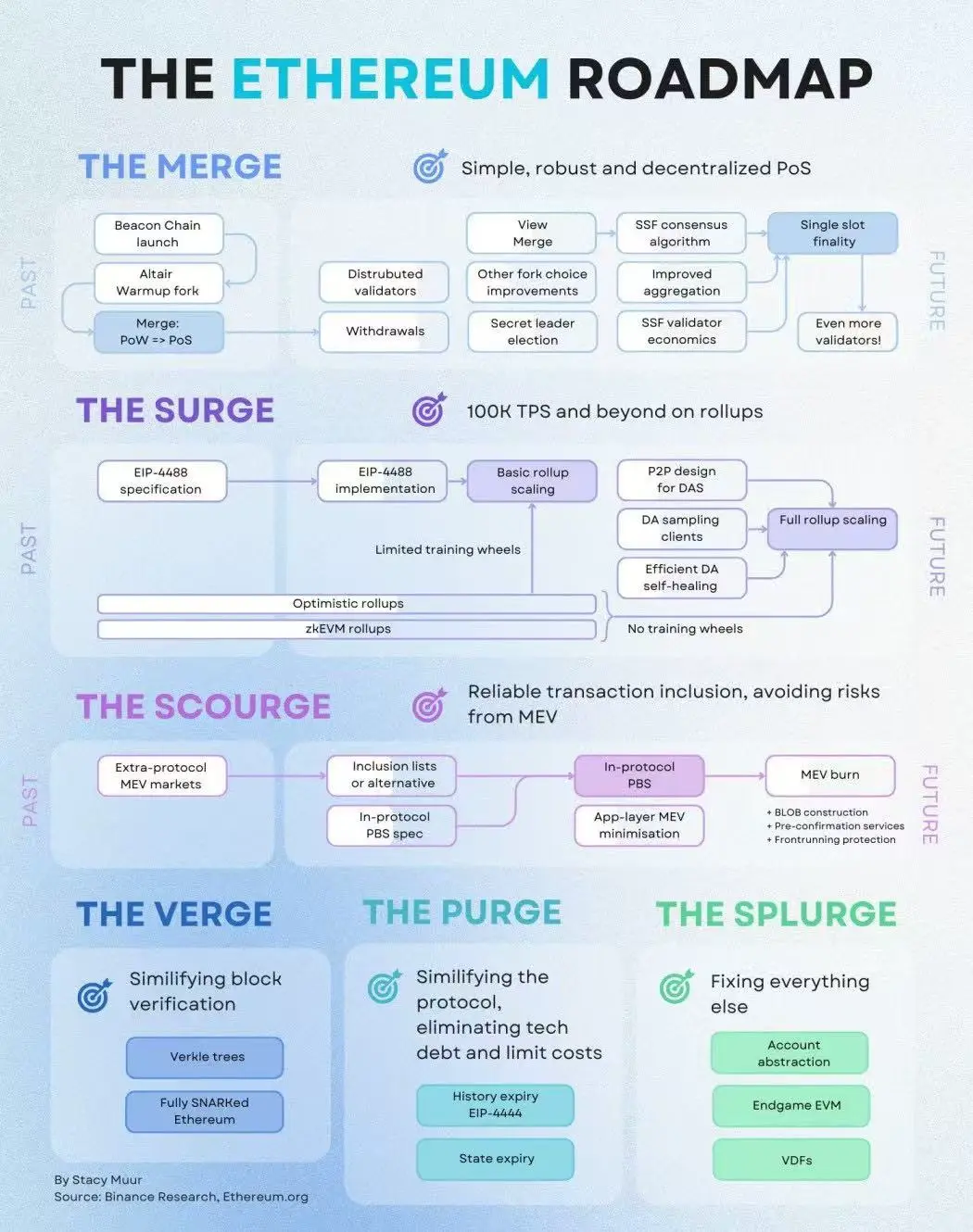
Looking back at Ethereum’s development—from the ICO era of smart contracts, through DeFi Summer, to the transition to PoS and the deflationary narrative—each leap has been accompanied by strong market storytelling. But by 2026, the marginal utility of narratives is diminishing, replaced by cold data metrics and underlying architecture overhauls.
The most emblematic engineering leap in the roadmap is the upcoming Glamsterdam hard fork in mid-year. This upgrade directly targets Ethereum’s long-standing performance bottleneck, with two core metrics especially critical: first, increasing the mainnet gas limit from 60 million to 200 million; second, officially introducing parallel execution architecture on the mainnet.
For a long time, Ethereum’s EVM has used a single-threaded serial processing mode. While this ensures state consistency, it becomes a fatal bottleneck under high concurrency. Introducing parallel execution means Ethereum is shifting from a “single-lane” to a “multi-lane highway.”
Using block-level access lists, nodes can pre-judge which transactions do not involve state conflicts, allowing multiple transactions to be processed simultaneously. Coupled with the gas limit increase to 200 million, the computational and transactional capacity per block will grow exponentially.
But this comes at a cost. Raising the gas limit directly challenges Ethereum’s longstanding goal of “democratizing full nodes.” State bloat will accelerate, demanding more from node hardware in storage and network bandwidth. To hedge this risk, Ethereum engineers plan to shift about 10% of validators from “re-executing all transactions” to “verifying zero-knowledge proofs” within the year. This is called “SNARKing the L1,” which not only significantly lowers the hardware barrier for full nodes but also marks a watershed in Ethereum’s evolution from “repetitive work” to “smart verification.” This means the underlying computation model is undergoing a qualitative change—outsourcing or precomputing heavy calculations, gradually offloading complex execution layers from L1. It’s a pure engineering compromise and progress.
Performance Anxiety and Solana Alpenglow’s Dimensionality Reduction
Ethereum’s deep architecture overhaul is largely driven by external competitive pressure. By 2026, performance wars on public chains are in full swing. Solana, with its Alpenglow upgrade, has completely abandoned its previous Proof of History (PoH) and Tower BFT consensus mechanisms, adopting new Votor and Rotor architectures.
This fundamental restructuring has resulted in: Solana’s transaction finality time shrinking from 12.8 seconds to under 150 milliseconds. This is a highly disruptive metric. 150 milliseconds of latency is within the response range of traditional Web2 infrastructure (like Google Search or Visa payment networks). For high-frequency trading (HFT), on-chain derivatives exchanges, and real-time payments—applications extremely sensitive to latency—this is a deadly attraction.
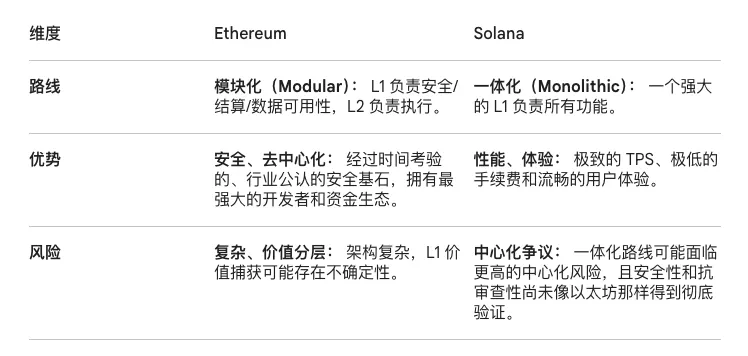
In comparison, although Ethereum’s Glamsterdam upgrade and subsequent Heze-Bogota fork aim to increase TPS and resistance to censorship, its modular (Modular) architecture inherently lags in cross-chain composability and latency. Ethereum’s current block time is about 12 seconds, but true finality takes minutes. While this architecture is robust for high-value, low-frequency asset settlements, it appears too heavy for consumer-facing applications with massive retail users. Ethereum’s performance anxiety is essentially a route choice between monolithic architecture and modular architecture during the 2026 tech explosion.
If Solana’s relentless push is an external threat, Ethereum also faces an internal paradox— the “L2 paradox.”
With the implementation of Pectra, Fusaka upgrades, and the maturation of PeerDAS technology, Ethereum’s rollup-centric scaling strategy has achieved significant engineering victories. L2’s data availability throughput has increased multiple times, and the capacity of data blobs continues to expand. The direct result is that L2 transaction fees have plummeted to $0.001 or even lower.
From a user experience perspective, this is a huge success, perfectly aligning with the “Improve UX” goal in the 2026 roadmap. Native account abstraction and intent frameworks are becoming widespread, hiding complex on-chain interactions beneath seamless wallet operations.

However, this also raises a sharp question: when users enjoy $0.001 transactions on L2 with smooth experiences, do they still care about the underlying Ethereum mainnet’s consensus mechanism? Ethereum’s community prides itself on “decentralized orthodoxy”—a network of thousands of independent validators resistant to censorship—but in the eyes of most end users, this is becoming an invisible backend database, abstracted away.
As applications fully migrate execution to Arbitrum, Base, or ZKsync, with the mainnet serving only as a data availability and state root verification layer, Ethereum not only loses direct access to C-end users but also faces risks of liquidity fragmentation and application layer hollowing out. This is not just architectural decoupling but also a disconnection of brand perception and user mindset.
From “selling Gas” to “selling security settlement services,” ETH’s value capture model is changing.
The evolution of the technical route will ultimately be reflected in asset pricing models. Ethereum’s current transformations are triggering a fundamental reshaping of ETH’s value capture logic.
Between 2021 and 2024, ETH’s value was mainly supported by the “world computer” narrative and the gas burn mechanism introduced by EIP-1559. Higher on-chain activity meant more ETH burned, reinforcing the deflationary “ultrasound money” expectation. This model is essentially retail-oriented—Ethereum “selling Gas.”
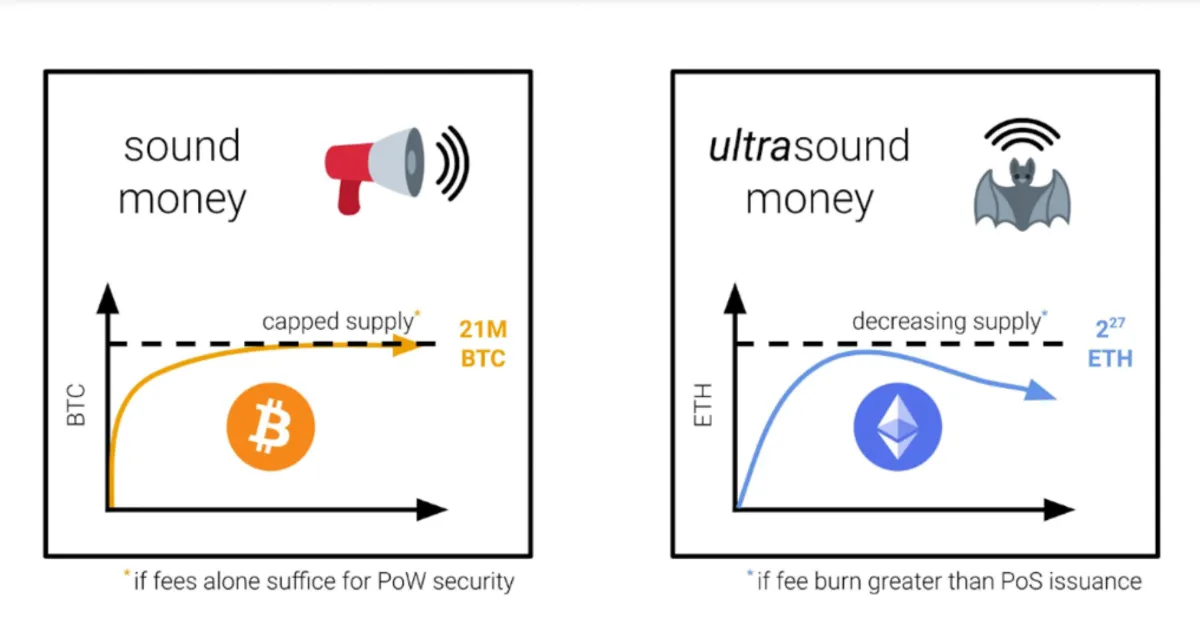
But by 2026, the situation has drastically changed. As activity on the execution layer irreversibly migrates to L2, mainnet gas consumption drops sharply. Although L2s pay data availability (DA) fees to L1, the increasing capacity of blobs means this revenue is far from enough to offset the fee loss from the L1 execution layer. ETH’s burn rate declines significantly, even returning to slight inflation during lows, challenging the traditional deflationary expectation.
From a quantitative finance valuation perspective, ETH’s DCF (discounted cash flow) model is being rewritten. Ethereum is shifting from a high-margin retail-focused computing platform to a low-margin, high-certainty “security settlement layer” aimed at B2B (L2 and even L3). Its new business model is no longer “selling Gas” but “selling economic security” and “ultimate resistance to censorship.”
Under this paradigm, ETH’s return structure as a monetary asset is changing. The implementation of ePBS (protocol-level proposer-builder separation) will reshape the MEV supply chain, making MEV revenue distribution among validators more smooth and predictable.
Staking and restaking will replace gas burns as the core support for ETH valuation. This aligns ETH’s asset profile more closely with traditional government bonds or institutional settlement assets. It no longer relies on flashy meme coin trading to generate fees but depends on its vast staking capital to provide an immutable trust backbone for the entire decentralized finance empire.
Ethereum in 2026 will no longer try to persuade the world with narratives but will prove itself through engineering prowess.
This transformation is not only Ethereum’s “engineering survival” under competitive and real-world pressures but also a redefinition of “what ETH is.” When users no longer care about the underlying L1, and ETH’s value capture shifts from gas sales to security and settlement, ETH must find new narratives to establish its position in the digital universe.
Whether Ethereum can successfully transform and whether ETH can capture the value of its ecosystem’s prosperity will be key issues for quantitative finance practitioners and all financial enthusiasts in the coming years.
But as we enter 2026, the landscape has changed dramatically. With activity on the execution layer irreversibly migrating to L2, mainnet gas consumption has plummeted. Although L2s pay data availability fees to L1, the expanding blob capacity means this revenue is insufficient to compensate for the fee loss at the L1 execution layer. ETH’s burn rate has decreased sharply, even turning to slight inflation during lows, challenging the traditional deflationary narrative.
From a valuation perspective, ETH’s DCF model is being rewritten. Ethereum is transitioning from a high-margin retail computing platform to a low-margin, high-certainty “security settlement layer” for B2B (L2 and L3). Its new business model is no longer “selling Gas” but “selling economic security” and “ultimate resistance to censorship.”
This paradigm shift will fundamentally alter ETH’s return structure as a monetary asset. The implementation of ePBS (protocol proposer-builder separation) will reshape the MEV supply chain, making MEV revenue distribution among validators more smooth and predictable.
Staking and restaking will become the core support for ETH valuation, replacing gas burns. This aligns ETH’s asset profile more with traditional bonds or institutional settlement assets. It no longer relies on meme coin trading to generate fees but depends on its large staking capital to provide an unchangeable trust backbone for the entire DeFi ecosystem.
In 2026, Ethereum will no longer try to persuade the world with stories but will demonstrate its value through engineering.
This transition is not just Ethereum’s “engineering survival” but a redefinition of “what ETH is.” When users no longer focus on the underlying L1, and ETH’s value capture shifts from gas sales to security and settlement, ETH must craft new narratives to secure its place in the digital realm.
Whether Ethereum can successfully transform and whether ETH can capture the value of its ecosystem’s prosperity will be key topics for quant practitioners and all financial enthusiasts in the coming years.
Related Articles
ETH drops 0.69% in 15 minutes: large on-chain transfer outflows trigger a rebound of spot sell pressure
During the period from 2026-04-19 22:00 to 2026-04-19 22:15(UTC), the ETH price fell from 2275.98 USDT to 2252.72 USDT. The return over 15 minutes was -0.69%, and the amplitude reached 1.02%. During this round of unusual price movement, short-term market volatility increased, attention on major coins rose, trading activity improved, and volatility was clearly tilted bearish.
The main driver behind this unusual move is the frequent occurrence of on-chain ETH large transfers with both high frequency and notable volume concentrated in a short period. Using a certain well-known hot wallet as a hub, more than 20,000 ETH were transferred out in a short time, and some of it has been traced on-chain and confirmed to have flowed to other exchanges’ receiving addresses. After funds briefly flowed into trading platforms, the number of sell orders in the spot market increased significantly, bringing about a phase of liquidity pressure and further intensifying the downward move in price. In addition, the futures market is linked to spot volatility; during the decline, highly leveraged long positions were liquidated passively, pushing short-term prices to release more downside pressure.
At the same time, the pace of ETF capital inflows has slowed since mid-April. Within the latest range, continuous net inflows have been trending steadily, and coupled with some funds making small redemptions, this weakens the market’s institutional support. Global risk sentiment is also facing synchronized pressure—repeated swings in macro-level expectations for the Federal Reserve’s policy and heightened geopolitical tensions have driven inflows into safe-haven assets. The U.S. Dollar Index strengthened in the short term, global equity markets came under pressure, and this further reinforced ETH’s ongoing downside pressure. In addition, the 24-hour trading volumes for spot and futures were 21.75 billion USD and 42.76 billion USD, respectively; futures open interest was 30.93 billion USD. The liquidation size showed no abnormality, indicating a structural adjustment under multi-dimensional market convergence.
Going forward, it is necessary to stay alert to risks such as continued large outflows on-chain and ETF capital movements shifting from inflows to outflows. If the macro environment deteriorates further, ETH may further intensify volatility. For short-term support, watch the 2250 USDT area; resistance is at 2275 USDT. The ETF trend, the direction of on-chain transfers, and macro news remain the key indicators to monitor for the next stage. Please closely follow subsequent market developments and the flow of large on-chain funds, and promptly capture relevant trading information.
GateNews2h ago
ETH drops 0.56% in 15 minutes: Institutions’ ETF in-and-out flows and tightened on-chain liquidity dominate the market
From 17:45 to 18:00 (UTC) on 2026-04-19, the ETH price recorded a return of -0.56% within 15 minutes, closing in the 2294.03 - 2311.0 USDT range, with an amplitude of 0.73%. Heightened market volatility triggered increased short-term trading activity and boosted attention, while overall liquidity performance tightened.
The main driving force behind this unusual move is institutions’ short-term in-and-out flows of ETF funds and a lull in on-chain stablecoin activity. In early April, after the ETH spot ETF recorded a net inflow of $120.24 million over a short period, it quickly reversed to a net outflow of $64.61 million, indicating that institutional capital became more short-term and there was no signal of sustained accumulation. Meanwhile, on-chain USDT and USDC activity fell in tandem to an annual low; ETH’s short-term buying power was clearly insufficient, putting pressure on liquidity.
In addition, high-win-rate whales have been frequently shorting ETH and BTC since April 14, with related position sizes exceeding $25 million, further intensifying downward pressure in the short term. On the macro front, the Federal Reserve maintains high interest rates, the U.S. dollar remains strong, risk appetite has shifted to cautious, and some funds have flowed into traditional assets such as U.S. stocks. On-chain data shows that exchange reserves for ETH have fallen to the lowest level in nearly a decade, suggesting that long-term holders are actively shifting away from self-custody, further reducing market liquidity supply and amplifying price anomalies. Network conditions are stable; gas fees are operating at low levels, and on-chain transactions have not shown extreme spikes.
The risk of near-term fluctuations remains high. ETF fund flows, large on-chain transfers, stablecoin activity, and changes in whale positions will be key indicators to watch. If institutions step up selling or stablecoin outflows expand further, ETH price volatility may intensify. Please continue to monitor macro developments and on-chain liquidity changes, stay alert to the risk of sharp short-term volatility, and get more real-time updates.
GateNews7h ago
ETH breaks below 2300 USDT
Gate News bot message, Gate market shows that ETH breaks below 2300 USDT, current price 2299.54 USDT.
CryptoRadar7h ago
A judge ruled that the JENNER meme coin issued by socialite Jenners from the Kardashian family is not a security, dismissing the lawsuit.
The U.S. District Court for the Central District of California ruled that the $JENNER meme coin issued by socialite Jenna, of the Kardashian family, does not meet the definition of a security, dismissing investors’ lawsuit. The judge said the plaintiffs failed to prove the features of a common enterprise and can bring other claims in state court.
ChainNewsAbmedia9h ago
ETH breaks through 2350 USDT
Gate News bot message, Gate quotes show that ETH has broken through 2350 USDT, with the current price at 2350 USDT.
CryptoRadar11h ago
KelpDAO Exploiter Borrows $195M ETH from Aave, TVL Drops $6.28B as Whales Withdraw
Gate News message, the KelpDAO exploiter borrowed over 82,600 ETH ($195M) from Aave using RSETH as collateral, resulting in bad debt appearing on Aave. Following this incident, numerous whales withdrew funds from Aave, causing its TVL to decline from $26.396B to $20.114B, a decrease of $6.28B.
GateNews13h ago


