Texas-based clothing company Beba and the cryptocurrency lobbying organization DeFi Education Fund (DEF) filed a voluntary dismissal with the Western District Court of Texas on March 14, withdrawing their 2024 lawsuit against the U.S. Securities and Exchange Commission (SEC).
Four Policy Signals Led to the Dismissal
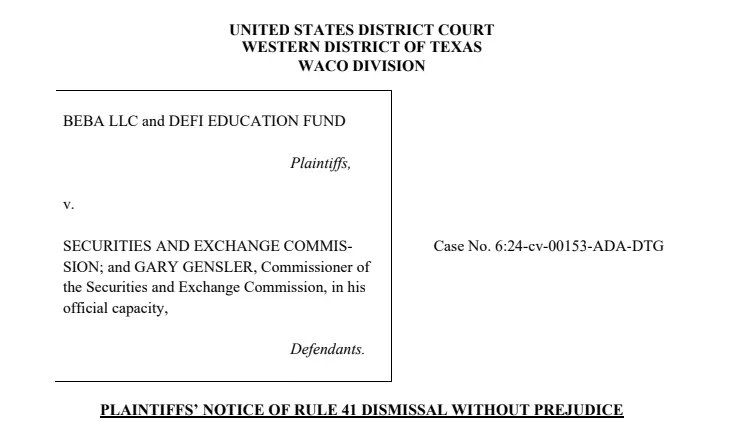 (Source: SEC)
In court documents, DeFi Education Fund listed four key developments that contributed to the decision to dismiss:
Progress of the SEC Crypto Task Force: The task force is actively developing guidelines for the regulation of crypto assets, with airdrop issues expected to be included in the agenda.
Commissioner Pierce’s Public Remarks: In multiple speeches, he clearly stated that free airdropped tokens do not constitute securities.
Pierce’s May Exemption Proposal: The SEC is considering establishing a formal exemption framework for airdrops.
White House Executive Order in January: Encourages regulators to establish “safe harbor” rules for certain types of airdrops.
DeFi Education Fund posted on X: “Given the excellent work of the SEC Crypto Task Force and recent speeches indicating a shift in the commission’s stance on free airdrops, we believe there is no current need to continue the lawsuit. We may refile if necessary in the future.” The lawyer also explicitly stated in court documents: “If the expected guidelines are not realized or are insufficient to protect the plaintiffs, the plaintiffs reserve the right to refile the lawsuit.”
Background of the Original Lawsuit: Legal Classification Dispute Over Airdropped Tokens
Beba launched a free token airdrop in March 2024, followed by a joint preemptive legal challenge with DeFi Education Fund against the SEC, alleging violations of the Administrative Procedure Act (APA). The core argument is that the SEC established digital asset policies through enforcement actions and legal settlements without following the formal “notice-and-comment” rulemaking process—criticized as a “regulatory model of enforcement replacing rulemaking.”
The legal classification of whether an airdrop constitutes a “security” has broad implications. If airdropped tokens are deemed securities, issuers must comply with strict SEC registration requirements, significantly increasing overall compliance costs. If not, the DeFi ecosystem retains greater operational flexibility.
SEC Regulatory Shift After Gensler’s Departure
During former SEC Chair Gary Gensler’s tenure, the SEC was heavily criticized for establishing crypto policies through enforcement and settlements rather than formal rulemaking. After Gensler resigned on January 20, 2025, crypto supporters have observed policy relaxations at multiple levels, including the withdrawal of long-standing enforcement cases against several crypto companies.
In recent cases, the SEC withdrew a two-year lawsuit against blockchain social media platform BitClout founder Nader Al-Naji, which accused him of raising over $257 million through the sale of native tokens and spending more than $7 million for personal expenses. Beba and DeFi Education Fund’s decision to withdraw at this time is seen by the market as a positive response to the new leadership’s policy signals.
Frequently Asked Questions
Why did DeFi Education Fund withdraw the SEC airdrop lawsuit?
The main reason for the withdrawal is the improvement in the SEC policy environment, including Commissioner Pierce’s public statement that free airdropped tokens are not securities, the SEC’s consideration of establishing an airdrop exemption framework, and the White House’s executive order requiring the creation of a safe harbor for airdrops. The plaintiffs believe that continuing the lawsuit is unnecessary under these circumstances but reserve the right to refile if policies do not meet expectations.
Why is there a legal debate over whether airdropped tokens are securities?
Under the U.S. Howey Test, an asset may be considered a security if it involves an investment of money, a common enterprise, and a reasonable expectation of profits from the efforts of others. The controversy over airdrops is that, even if tokens are distributed for free, if holders expect future appreciation, some regulators might argue they meet certain criteria. However, industry consensus generally holds that purely free airdrops should not fall under this framework.
Does this withdrawal mean the SEC has officially classified airdropped tokens as non-securities?
Not yet. Commissioner Pierce’s remarks represent his personal view, not an official SEC rule. The SEC Crypto Task Force is still working on guidelines, and DeFi Education Fund reserves the right to refile the lawsuit, indicating that the policy environment remains uncertain.
Disclaimer: The information on this page may come from third parties and does not represent the views or opinions of Gate. The content displayed on this page is for reference only and does not constitute any financial, investment, or legal advice. Gate does not guarantee the accuracy or completeness of the information and shall not be liable for any losses arising from the use of this information. Virtual asset investments carry high risks and are subject to significant price volatility. You may lose all of your invested principal. Please fully understand the relevant risks and make prudent decisions based on your own financial situation and risk tolerance. For details, please refer to
Disclaimer.
Related Articles
BTC 15-minute rise of 0.86%: A rebound driven by a convergence of short liquidations and inflows into ETFs
2026-04-13 13:45 to 2026-04-13 14:00 (UTC), the BTC price fluctuated within the 70945.9 to 71699.9 USDT range. Within 15 minutes, it recorded a notable gain of +0.86%, with a swing of 1.06%. Market attention has surged, short-term volatility has clearly intensified, and on-chain large transfers, spot, and derivatives trading volumes have expanded in sync, indicating that the activity level of funds by major players is at one of the highest points of the year.
The main driving force behind this anomaly is that BTC has been probing the 72000–73500 USDT range with a large amount of leverage shorts
GateNews3h ago
Korea’s central bank: Cryptocurrency trading should introduce a “circuit breaker” mechanism; CBDC should be the digital core
The Bank of Korea recommends introducing a circuit breaker mechanism in the crypto-asset industry to prevent abnormal trading, and points out that the Bithumb mistaken payment incident reveals a structural vulnerability. The governor nominee, Hyun-sung Shin, emphasizes that CBDCs and deposit tokens should be the core of digital currencies, and proposes a phased opening strategy for stablecoins. The Bank of Korea also plans to launch an offshore KRW system with real-time gross settlement in 2027 to reduce credit risk.
MarketWhisper11h ago
CryptoQuant Analyst: In March, the U.S. CPI month-over-month increase hit a record high; if the U.S.-Iran conflict continues or forces the Federal Reserve to raise interest rates
CryptoQuant analyst Darkfost noted that although March CPI recorded the largest month-over-month increase, core CPI remained stable, indicating that U.S. inflation has not fully spread yet. Attention should be paid to upcoming PCE data. If the Iran-Iraq conflict continues, inflation could evolve into a systemic risk and affect economic growth, and the Federal Reserve may need to continue raising rates to respond.
GateNews04-12 10:00
Hassett: The Strait of Hormuz could be opened within two months, and the Federal Reserve still has room to cut rates
Gate News message: On April 10, U.S. National Economic Council Director of the White House, Hassett, said the Strait of Hormuz could be reopened within two months. In addition, Hassett said the Federal Reserve still has room to cut interest rates, and this outlook will be very solid.
GateNews04-10 13:25
Reuters: The market is pricing in expectations that the U.S. Federal Reserve will keep interest rates unchanged throughout 2026
Gate News, April 10, according to Reuters, the market continues to price in expectations that the Federal Reserve will keep interest rates unchanged throughout 2026.
GateNews04-10 13:06
CME Data: The probability that the Federal Reserve will keep interest rates unchanged in April is 98.4%
Gate News message: On April 10, according to CME "FedWatch" data, before the CPI data is released, the probability that the Federal Reserve will raise rates by 25 basis points in April is 1.6%, while the probability of keeping rates unchanged is 98.4%. Looking ahead to June, the probability of cumulative rate cuts of 25 basis points is 1.5%, the probability of keeping rates unchanged is 96.8%, and the probability of cumulative rate hikes of 25 basis points is 1.7%.
GateNews04-10 12:31


