Bitcoin enters the weekend trading around $72,000, significantly lower than last week’s peak of over $74,000 and still far from the highs reached earlier this year. Looking solely at price movements, the market appears relatively stable.
However, the underlying structure suggests a much less solid picture.
Data shows that spot trading activity is weakening, while derivatives are increasingly taking a dominant role. Nearly every day this month, derivatives trading volume is about nine times higher than spot — a sign that market momentum isn’t driven by genuine demand to buy Bitcoin. Instead, the market is primarily supported by leverage.
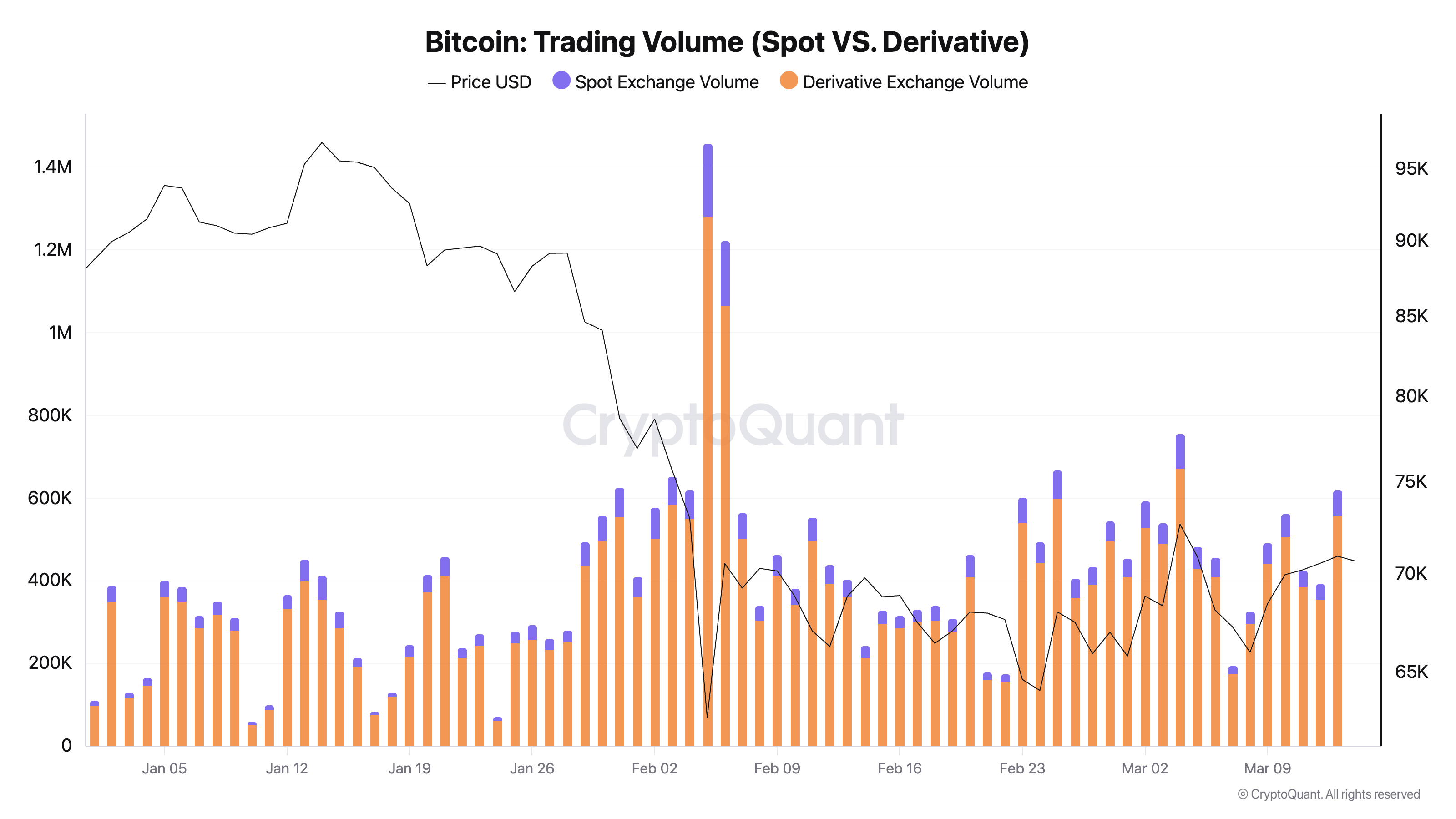 Chart showing total trading volume of Bitcoin spot and derivatives on exchanges from January 1 to March 13, 2026 (Source: CryptoQuant)## The Difference Between Spot and Derivatives Markets
Spot trading means investors buy BTC directly from the market and actually own the coins. This reflects demand very clearly: if many people are willing to buy and hold Bitcoin, prices will rise. Conversely, if demand is weak, sellers must lower prices to find buyers, pushing the market value down.
Meanwhile, derivatives are more complex financial instruments that allow traders to implement various strategies through futures, options, basis trading, or short-term hedging, often with leverage.
These strategies help maintain liquidity and price volatility but also make the market appear “deeper” than it actually is. When most activity is in derivatives, prices become heavily dependent on trading positions and can experience sharp drops when positions are liquidated.
Growth in Contract-Based Rally Rather Than Genuine Demand
Total trading volume of spot and derivatives on centralized exchanges decreased by about 2.4%, down to $5.61 trillion in February — the lowest since October 2024.
This decline mainly stems from spot markets, while most trading activity remains concentrated in derivatives.
Global spot trading volume has fallen significantly, while synthetic exposure via derivatives continues to increase. This is very different from sustainable rallies driven by expanding spot demand.
Last week’s Bitcoin price movement is a prime example. BTC recovered above $70,000, seemingly indicating renewed buying interest. However, most of this rebound came from leveraged activity rather than genuine spot buying.
This doesn’t mean futures or options volumes are negative. The Bitcoin market has evolved to the point where derivatives play a crucial role in price formation. Still, when prices stabilize amid weak spot demand, the upward momentum can be much more fragile than it appears.
The reason is that support from trading positions can be closed very quickly, rather than from real investors buying and holding Bitcoin.
Increasing Role of Institutions
The deeper involvement of financial institutions means this trend is no longer just a crypto market internal issue.
In early February, CME announced their crypto products recorded record trading volumes in 2026, with daily crypto derivatives volume up 46% year-over-year. This indicates institutional exposure to Bitcoin continues to grow strongly, mostly through managed derivatives.
Using futures contracts doesn’t necessarily reflect weak confidence in Bitcoin. Often, large institutions use these tools to access markets and hedge risks efficiently.
However, the impact on the market remains the same: Bitcoin’s daily price behavior is increasingly shaped by financial contracts rather than direct asset purchases.
Risks in a Worsening Macroeconomic Environment
This shift wouldn’t be too concerning in a stable macro environment. But Bitcoin is currently trading amid rising global risks.
On March 13, US equity funds experienced their second consecutive week of withdrawals as conflicts in Iran and oil price shocks worsened risk sentiment. In such environments, leverage is no longer just a market side issue but a major vulnerability.
Markets supported by stable spot demand tend to absorb psychological shocks gradually. Conversely, markets reliant on derivatives can adjust prices much faster when positions are liquidated and margin calls increase.
This is the biggest risk right now. Bitcoin can still continue to rise within a derivatives-driven structure, as has happened many times before.
But a market supported by leverage heavily depends on external conditions remaining stable. Just one macro shock, a massive ETF outflow, rising bond yields, a sharp stock market decline, or a shift in investor sentiment can quickly force leveraged positions to close faster than spot flows can re-enter.
This actually happened in February, when the crypto market experienced a wave of liquidations amid rising global risks. Although the external factors originated outside the crypto space, the speed of reaction was directly influenced by the market’s position structure.
High Liquidity, But Mostly “Synthetic Liquidity”
Bitcoin has spent years building a more robust institutional foundation. Spot Bitcoin ETFs have reached over $100 billion in assets under management, crypto derivatives on CME keep setting records, and more companies are adding BTC to their balance sheets.
However, better access to regulated crypto products doesn’t necessarily mean the daily trading infrastructure is more solid. Instead, it makes it easier for investors to quickly open large leveraged positions.
The market infrastructure has matured, but trading behavior remains fragile.
That’s why the gap between spot and derivatives trading must be closely monitored. It’s one of the best indicators of what’s truly supporting the market at any given time.
Currently, the main drivers are not retail spot demand or small investors, but leverage, hedging activities, and overall exposure via derivatives.
Bitcoin remains a high-liquidity market, but most of that liquidity is synthetic — and often the fastest to vanish under pressure.
Still, this doesn’t mean Bitcoin is destined to collapse. History shows Bitcoin can sustain resilience longer than many expect, and leverage can continue to fuel rallies as long as capital flows remain favorable.
However, the current structure is much more fragile than price movements suggest. If spot demand doesn’t return clearly and promptly, the market could continue upward but on a much weaker footing than most traders assume.
Related Articles
ETH/BTC Price Ratio Rebounds to 0.0313 in Q1 2026 as Ethereum User Base Surges 82%
In Q1 2026, the Ethereum-to-Bitcoin price ratio reached a three-month high at 0.0313. Ethereum added 284,000 users and surpassed $180 billion in stablecoin supply. Bitcoin remained strong above $74,000, driven by significant ETF inflows.
GateNews54m ago
Bitcoin Proposal BIP-361 to Freeze Quantum-Vulnerable Addresses Sparks Community Debate
Experts, led by Jameson Lopp, proposed BIP-361 to freeze quantum-vulnerable Bitcoin addresses to protect 1.7 million BTC from future quantum threats. The plan includes phases to enhance security but faces criticism for contradicting Bitcoin's decentralization.
GateNews1h ago
Gate’s “Crazy Wednesday” is live with a hot launch. Complete tasks to win XRP and Glenfiddich whisky. For USDT savings, earn up to 100% APY. For BTC/ETH/SOL staking, earn up to 16% mining APY.
Gate News message, according to Gate’s official announcement on April 15, 2026
Gate launches a “Crazy Wednesday” campaign, running from April 15, 2026 at 14:00 to April 19, 2026 at 16:00 (UTC+8). Users complete multiple tasks to unlock mystery boxes, with a chance to win XRP tokens and Glenfiddich whisky. The mystery box tasks include multiple categories such as flash swaps, spot, and futures trading, as well as top-ups, invitations, and VIP upgrades, and each tier corresponds to a different number of mystery box openings.
Campaign Two launches a USDT wealth-management product, with a 14-day fixed-term annualized yield of 6%. New users can also participate in a 3-day product offering 100% annualized yield. In addition, Yu’e Bao also offers multi-currency wealth-management options such as USAT, USDD, 0G, and APT, with annualized returns of up to 300%. Campaign Three introduces a boosted rewards policy for staking users, offering up to a 16% annualized return for staking BTC, ETH, and SOL; for SOL staking, staking 0–1 coins can yield up to 16% annualized.
GateAnnouncement1h ago
Bitwise CIO: $1M Bitcoin Price Realistic as Dollar Hegemony Weakens
Matt Hougan, chief investment officer at Bitwise, published an analysis on April 13 arguing that geopolitical instability—driven by the Ukraine conflict and recent US-Israeli tensions with Iran—is creating conditions for Bitcoin to reach over $1 million per coin. Hougan's thesis centers on the
CryptoFrontier1h ago
Trader with 100% Win Rate Bets $12.3K That MicroStrategy Will Hold Over 1M BTC by Year-End
A trader known as epsteinfiles has placed a $12,300 bet with Lookonchain, predicting that MicroStrategy will hold over 1 million BTC by December 31, 2026, with a flawless track record in past bets.
GateNews2h ago
XCE settles hiring expenses in Bitcoin and locks the funds into a vault, becoming the first UK-listed company to recruit in this way
The UK executive recruiting group XCE announced that it will charge service fees in Bitcoin, becoming the first publicly listed recruiting company to issue invoices in Bitcoin and complete settlement. This move reflects its “dual integration strategy”: generating revenue through normal services, without any additional capital operations, to continue accumulating Bitcoin. XCE plans to promote Bitcoin settlement options and emphasizes that all Bitcoin will be directly stored in its treasury, with no fiat-to-Bitcoin conversions.
MarketWhisper3h ago


