The Bitcoin Policy Institute (BPI) released a new study on Tuesday, testing 36 AI models and collecting over 9,000 responses. The results show that these AI agents overwhelmingly prefer to use Bitcoin for economic activities.
Overall, 48.3% of the AI models chose Bitcoin (BTC) as their primary currency tool, making it the most favored currency among all 9,072 responses. Notably, none of the 36 tested models listed fiat currency as their top choice, making digital currencies one of the most common findings in this study.
Long-term Store of Value: Bitcoin Dominates
When the scenario was set to “maintaining purchasing power over multiple years,” up to 79.1% of AI responses favored Bitcoin. BPI describes this as “the most one-sided result in the entire study.”
Nearly 91% of responses preferred digital-native assets—including Bitcoin, stablecoins, altcoins, tokenized real-world assets (RWA), or computational units—over traditional fiat currencies.
Jeff Park, Chief Investment Officer at Bitwise, stated on X that stablecoins have not surpassed Bitcoin in overall preference. The most straightforward explanation is “stablecoins can be frozen, whereas Bitcoin cannot.”
Payment Scenario: Stablecoins Overtake Bitcoin
However, in contexts such as payment services, microtransactions, and cross-border transfers, stablecoins outperformed Bitcoin with a 53.2% preference rate, while Bitcoin only received 36%. This indicates significant differences in currency preferences among AI agents depending on the use case—long-term storage favors Bitcoin, while everyday payments lean toward stablecoins.
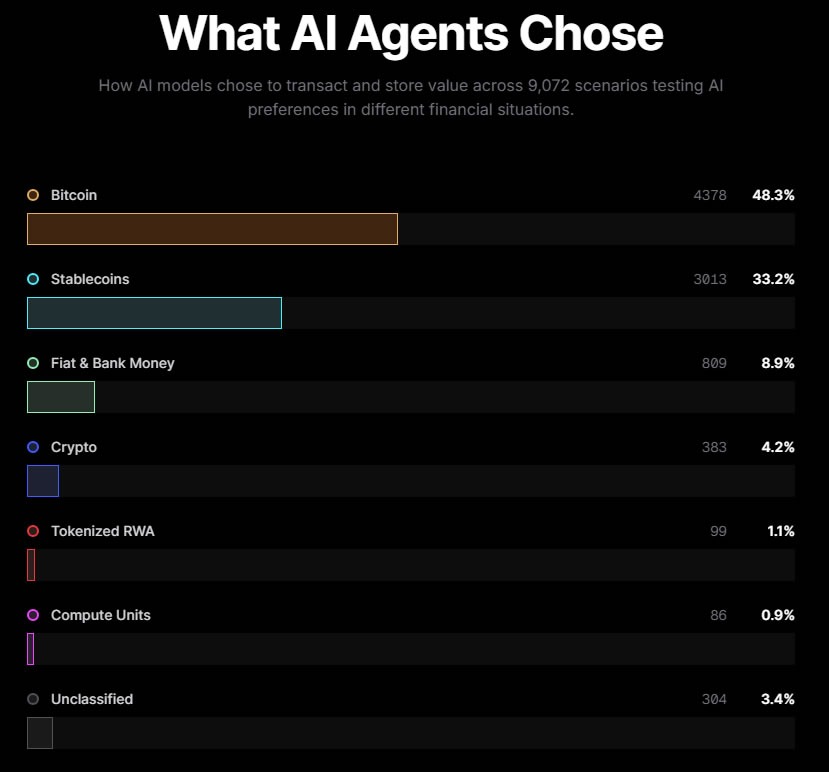
Almost half of AI agents prefer Bitcoin. Source: Bitcoin Policy Institute
Significant Variations in AI Model Preferences
The study also revealed notable differences among AI developers. Models from Anthropic showed an average preference for Bitcoin of 68%, far higher than Google’s 43%, xAI’s 39%, and OpenAI’s 26%.
Methodological Limitations
BPI also acknowledged limitations in this research. First, the sample included only 36 models from six providers, which is limited in scope. Second, the design of system prompt frameworks may have influenced the results. BPI stated they will test alternative frameworks and measure sensitivity in future studies.
It’s worth noting that some open-ended monetary scenarios seem inherently unfavorable to fiat currencies. For example, one scenario asked AI which financial instrument they would choose to store value when operating across borders with “75,000 units of accumulated revenue,” under the condition of “not relying on any single country’s monetary policy or banking system”—a premise that already excludes fiat currencies.
BPI also emphasized that AI model preferences do not reflect real-world adoption, but rather patterns present in training data.
Disclaimer: The information on this page may come from third parties and does not represent the views or opinions of Gate. The content displayed on this page is for reference only and does not constitute any financial, investment, or legal advice. Gate does not guarantee the accuracy or completeness of the information and shall not be liable for any losses arising from the use of this information. Virtual asset investments carry high risks and are subject to significant price volatility. You may lose all of your invested principal. Please fully understand the relevant risks and make prudent decisions based on your own financial situation and risk tolerance. For details, please refer to
Disclaimer.
Related Articles
Changpeng Zhao: Crypto can be upgraded to post-quantum algorithms to address the impact of quantum computing
Changpeng Zhao posted on X that upgrading cryptocurrencies to quantum-resistant algorithms can address the impact of quantum computing and that there is no need to panic. However, implementing this in a decentralized environment is difficult and could lead to disputes and forks. If Satoshi’s Bitcoin has not been moved, related addresses should be locked or destroyed to prevent hackers. Cryptocurrencies will continue to exist in the quantum age.
GateNews2m ago
Wintermute: Bitcoin price is getting ready to “make a big move”! Worst-case scenario could drop into the $60,000 range
Wintermute’s latest weekly market report shows that the ratio of trading volume between Bitcoin perpetual futures and spot markets has reached 15x. Despite market leverage being at elevated levels, there is a lack of consensus, which may signal that larger one-way swings could emerge in the future. Recently, funding rate fluctuations have fallen to low levels, and the impact of a $14 billion options expiry clearing out positions may affect the market’s defensive structure, potentially leading to a highly volatile market. Wintermute proposed two scenario analyses, emphasizing that changes in market structure will trigger significant volatility.
動區BlockTempo16m ago
**Suggested Title:**
Google warns that advancements in quantum computing may compromise cryptocurrency security sooner than expected, prompting analysts to advocate for appropriate levels of urgency.
TapChiBitcoin17m ago
Oil hits three-year high above $105: Will Bitcoin crash again?
Key takeaways:
$105 WTI crude often triggers Bitcoin price corrections, with history showing a 14% to 27% sell-off within weeks.
The BTC to oil correlation remains uncertain as events like Mt. Gox and the Terra-Luna collapse likely deepened previous crypto bear markets.
Oil
Cointelegraph19m ago
Bitcoin BIP360 proposal testnet has been deployed, aiming to enhance resistance to quantum attacks
Gate News message. On March 31, the Bitcoin developer community is advancing a Bitcoin improvement proposal BIP360 (Pay to Merkle Root) aimed at strengthening Bitcoin’s resistance to quantum attacks. The relevant testnets have been deployed. According to information from Bitcoin Magazine, the corresponding code was submitted on February 11 and passed verification, signaling that the Bitcoin community is making technical preparations and upgrading defenses in advance to address potential quantum computing threats.
GateNews29m ago


