Prediction markets cool in February, but high trading volume signals continued demand and sector maturity.
Industry data shows the first monthly decline of prediction markets since August 2025. Even so, activity remained historically high. Total traded volume reached $23.4 billion in February 2026, pointing to sustained user interest despite the cooldown.
Prediction Markets Post First Monthly Decline Since August
After several months of rapid growth, prediction markets cooled in February. Trading activity dipped slightly, but overall participation remained high. Data from Artemis shows the total volume reached $23.4 billion during the month.
That figure marks the first monthly decline after several months of aggressive gains across leading venues. Even with the drop, February’s activity still ranks among the strongest periods on record. Analysts say such slowdowns are common after fast expansion.
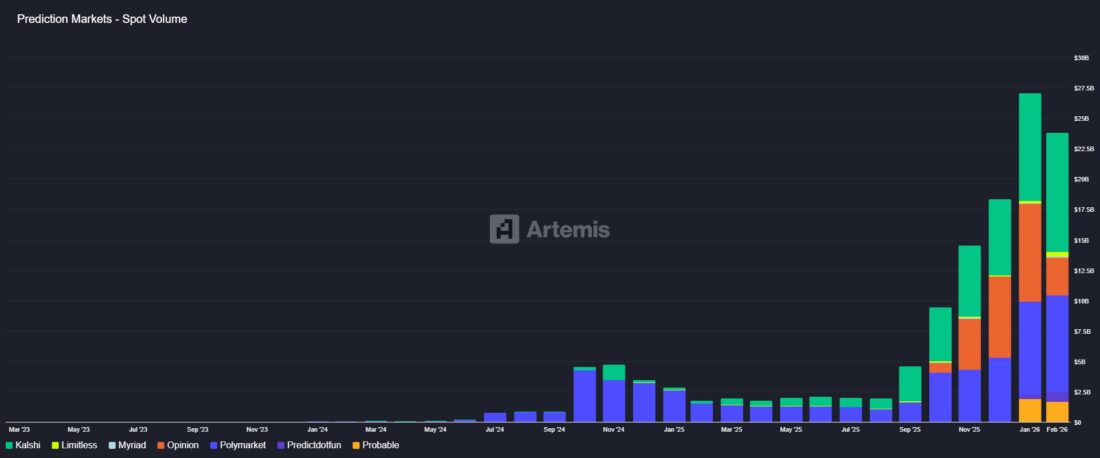
_Image source: _Artemis
Among major platforms, Kalshi extended its lead. February trading volume climbed to $9.8 billion, up from $8.9 billion in January. Growth at Kalshi stood out against broader moderation across the sector.
Regulated status in the United States continues to attract both institutional and retail traders. On the other hand, activity at Polymarket was steadier. Monthly volume reached $7.6 billion, broadly flat or slightly lower than January.
Stabilization followed a period of sharp gains in prior months. Market watchers describe February as a pause within a longer uptrend. Polymarket’s on-chain settlement model and global access remain central to its appeal.
Meanwhile, Opinion Labs saw the sharpest decline in February. The platform’s trading volume dropped to $3.1 billion from $8.1 billion the month before. It indicates fewer traders were active than in earlier months. Some users may have reduced their positions after a period of fast growth.
Strong Baseline Activity Keeps Markets Resilient After Pullback
Momentum across prediction markets remains firm despite February’s decline. Event-based trading platforms have evolved into a distinct segment of the digital asset market, where users take positions on real-world outcomes. Elections, economic releases, and geopolitical developments continue to attract steady activity.
Elevated baseline volume suggests traders still rely on these venues for price discovery and risk management. February’s slowdown appears to be a market reset and not a breakdown. Even though growth has cooled, participation remains well above mid-2025 levels.
Leading platforms are competing on market structure, access, and regulatory clarity, signaling a shift toward sustainability over rapid expansion. If current volumes hold, the industry could transition into a more stable growth phase after months of aggressive gains.
Disclaimer: The information on this page may come from third parties and does not represent the views or opinions of Gate. The content displayed on this page is for reference only and does not constitute any financial, investment, or legal advice. Gate does not guarantee the accuracy or completeness of the information and shall not be liable for any losses arising from the use of this information. Virtual asset investments carry high risks and are subject to significant price volatility. You may lose all of your invested principal. Please fully understand the relevant risks and make prudent decisions based on your own financial situation and risk tolerance. For details, please refer to
Disclaimer.
Related Articles
A federal judge temporarily blocked Arizona’s criminal lawsuit against Kalshi, strengthening the outlook for federal oversight of prediction markets
A U.S. federal judge, Michael Liburdi, temporarily blocked the state of Arizona from proceeding with criminal charges against prediction market platform Kalshi. The state has brought 20 counts of illegal gambling against Kalshi. The CFTC argues that federal oversight takes priority and that prediction markets fall under its regulation; if ultimately established, it would benefit the legal environment for the entire industry. The case still requires further proceedings.
ChainNewsAbmedia1h ago
Sports betting contract is a derivative product! The U.S. CFTC blocks local law enforcement while pushing for regulatory authority over prediction markets
The U.S. federal government is working with the CFTC and the Department of Justice to try to shift regulatory authority over Kalshi prediction markets from state and local governments to the federal level, arguing that sports event contracts are financial derivatives. If the court backs this position, it will change the legal status of prediction markets and standardize regulation nationwide, reducing the influence of state-level gambling laws.
CryptoCity2h ago
Polymarket data: The probability that Bitcoin will break $75,000 in April is 77%
Polymarket data shows that the probability of Bitcoin breaking above $75,000 in April is 77%, and the probability of breaking above $80,000 is 24%; the probability of dropping to below $65,000 is 30%. Deribit data shows that the max pain(maximum pain)price for Bitcoin options expiring on April 24 is $70,000, with a notional amount of approximately $6.98 billion.
GateNews3h ago
“Sports Betting Contract” is a derivative! The U.S. CFTC blocks local law enforcement to fight for regulatory control of prediction markets
The U.S. federal government argues that sports event wagering should be treated as a financial derivative rather than gambling, and it seeks to bar Arizona from enforcing against Kalshi, the prediction market platform. If the court backs the federal position, prediction markets will operate under uniform nationwide regulation, weakening each state’s ability to regulate. This legal dispute concerns the legitimacy of prediction markets and the allocation of regulatory authority, affecting the future development of the industry.
区块客14h ago
Caixin: Polymarket’s use of USDC settlement creates legal risk for participants within China
The article discusses legal disputes involving Polymarket prediction markets, especially the unclear boundary between insider trading and gambling. It emphasizes that using USDC for settlement exposes Chinese participants to legal risk, and it mentions the “End Prediction Market Corruption Act” proposed by a U.S. senator, which prohibits certain government officials and their family members from participating in prediction market trading.
GateNews15h ago


