As the US-Israel coalition escalates military actions against Iran, Tehran’s years-long “shadow economy” has once again become an international focus. This parallel system, combining Bitcoin mining and stablecoin trading, has become Iran’s last shield in seeking survival outside the battered banking system and dollar dominance.
Using cheap electricity to mine Bitcoin
Iran legalized cryptocurrency mining as early as 2019, allowing licensed operators to use government-subsidized electricity for mining. The condition is that all mined Bitcoin must be sold to the Central Bank of Iran, becoming an important tool for paying for imports and settling foreign trade. To some extent, this bypasses the dollar system and Western banking sanctions.

According to statistics, Iran’s Bitcoin hash rate accounts for about 2% to 5% of the global total, but many mining activities are not fully disclosed, so the actual scale may be higher than the figures suggest.
Blockchain analytics firm Chainalysis found that Iran’s cryptocurrency ecosystem had grown to a $7.8 billion scale by 2025, nearly equivalent to the GDP of Maldives or Liechtenstein. Notably, crypto activity tends to surge during military conflicts or domestic unrest, including during the 12-day conflict between Iran and Israel last year.
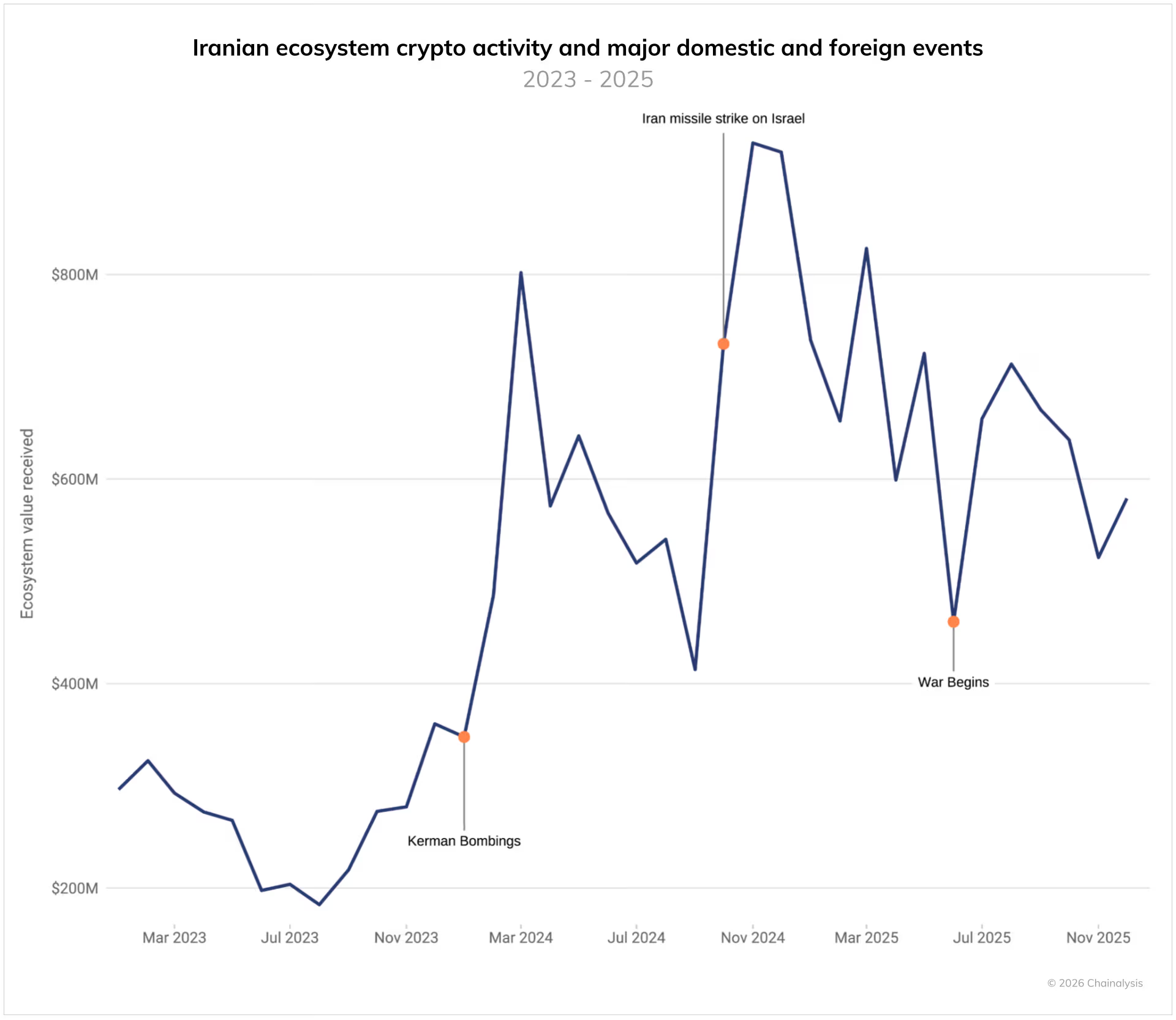
As Iran’s main military force, the Islamic Revolutionary Guard Corps (IRGC) has increasingly relied on cryptocurrencies in recent years. Chainalysis estimates that in Q4 2025, wallets associated with the IRGC accounted for over 50% of Iran’s total cryptocurrency inflows, receiving assets worth over $3 billion last year.
These figures only include publicly known wallet addresses directly related to sanctions lists; the actual scale could be higher.
Rial plummets 96%, USDT becomes the new favorite for trade settlement
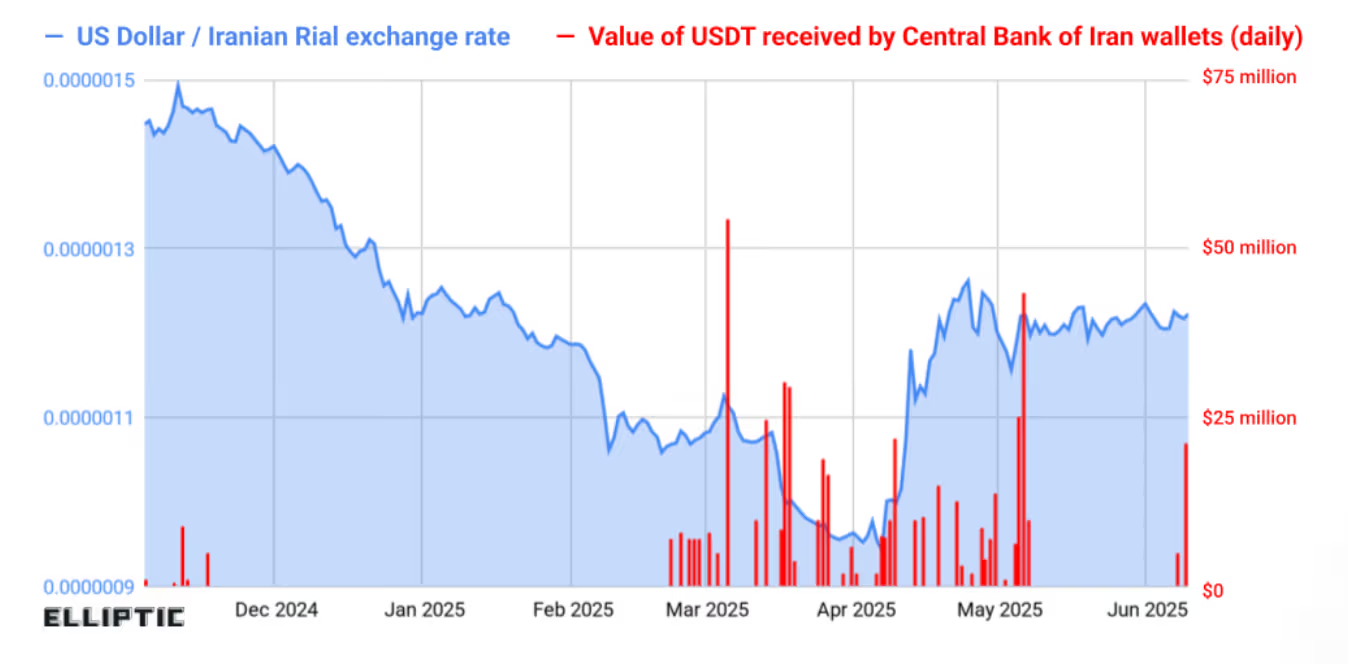
In addition to Bitcoin, stablecoins also play a key role. Blockchain analysis firm Elliptic indicated that by 2025, the Central Bank of Iran had accumulated at least $507 million in USDT, likely used to stabilize the Rial exchange rate and support foreign trade. However, this financial defense seems to have had limited success. Data shows the Rial has depreciated over 96% against the US dollar.
Faced with deep-rooted hyperinflation and an economy on the brink of collapse, ordinary Iranians are also turning to Bitcoin for asset preservation. Data shows that during recent anti-government protests, the amount of Bitcoin withdrawn from centralized exchanges to personal wallets surged sharply, indicating locals’ efforts to keep assets under their control.
Mining costs are only about $1,300 per Bitcoin
External estimates suggest that the cost of mining a Bitcoin in Iran is around $1,300. Miners sell the mined Bitcoin to the central bank, which then transfers funds overseas to pay for equipment, fuel, or daily necessities.
Disclaimer: The information on this page may come from third parties and does not represent the views or opinions of Gate. The content displayed on this page is for reference only and does not constitute any financial, investment, or legal advice. Gate does not guarantee the accuracy or completeness of the information and shall not be liable for any losses arising from the use of this information. Virtual asset investments carry high risks and are subject to significant price volatility. You may lose all of your invested principal. Please fully understand the relevant risks and make prudent decisions based on your own financial situation and risk tolerance. For details, please refer to
Disclaimer.
Related Articles
Tiger Research: Bitcoin ETF rise as traditional finance moves in and eats up market share from exchanges
The report points out that traditional financial institutions are rapidly moving into the cryptocurrency market, creating competitive pressure on exchanges. With the rollout of spot Bitcoin ETFs, investors are increasingly favoring bank and securities products, leading to decreased exchange trading volume and layoffs. If an exchange doesn’t offer unique services, it will be difficult to survive. The trend toward the integration of traditional finance and the crypto industry is also strengthening, and exchanges worldwide face challenges.
GateNews2h ago
BlackRock’s Bitcoin ETF has daily trading volume as high as $18 billion, rivaling leading CEXs.
BlackRock’s iShares Bitcoin Trust (IBIT) has seen a surge in daily trading volume, making it the leader in U.S. spot trading volume. Although there has been overall ETF fund outflow, IBIT’s trading activity indicates that institutional investors are paying closer attention to the crypto market, reflecting intensifying competition between traditional finance and digital assets. In the future, Bitcoin prices and economic signals will influence ETF fund flows.
GateNews2h ago
Nakamoto Holdings keeps selling Bitcoin to maintain operations, while Metaplanet has been increasing its holdings against the trend, showing institutional confidence.
This week, Nakamoto Holdings sold part of its Bitcoin to maintain operations, drawing market attention. Analysts noted that digital asset management companies that rely on asset accumulation face pressure, while Japan’s Metaplanet continues to steadily increase its Bitcoin holdings, showing a firm buying strategy. Market developments still need to be monitored regarding the company’s operations and capital allocation.
GateNews2h ago
XRP Holds Ground as Inflows Rise but Price Trails Highs
Key Insights:
XRP trades about 60% below its peak despite steady ETF inflows, reflecting a gap between improving fundamentals and current market valuation levels.
Institutional exposure through XRP ETFs reached 1.1 billion dollars, yet analysts say inflow scale remains too small to
CryptoFrontNews4h ago
Riot sold 3,778 bitcoins in the first quarter, cashing out nearly $300 million, with its holdings down 18% year over year
Bitcoin miner Riot Platforms sold 3,778 BTC in the first quarter of 2026, raising nearly $290 million in cash and reducing its holdings by about 18%. Several mining companies have cut their positions as well, reflecting rising funding pressure. Despite weakening market demand, some institutions are still accumulating Bitcoin, indicating that demand is concentrating toward participants with stronger financial capacity. In the short term, the price trend will be influenced by the clash between supply and demand.
GateNews4h ago
Grayscale files a TAO trust S-1 amendment, advancing the institutional holdings path
Grayscale has filed an S-1 amendment for its Bittensor (TAO) trust with the U.S. Securities and Exchange Commission, a vehicle that allows investors to gain TAO exposure in the form of securities. The trust carries risks of premium/discount and liquidity restrictions, and has not yet met its goal of tracking the TAO price. This filing could be an important step toward a regulated investment product or an ETF. As attention to technical breakthroughs in the Bittensor ecosystem grows, institutional demand is also increasing.
MarketWhisper5h ago


