
After the United States and Israel launched airstrikes against Tehran, Iran’s largest cryptocurrency exchange Nobitex experienced a surge in crypto asset withdrawals within minutes of the first attack, increasing by over 700%. During that day, the hourly outflow nearly reached $3 million. However, as the Iranian government implemented strict internet blockades, nationwide network connectivity dropped by approximately 99%, and subsequent crypto outflows rapidly subsided.
Analysis of Nobitex’s Outflow Data Post-Airstrike
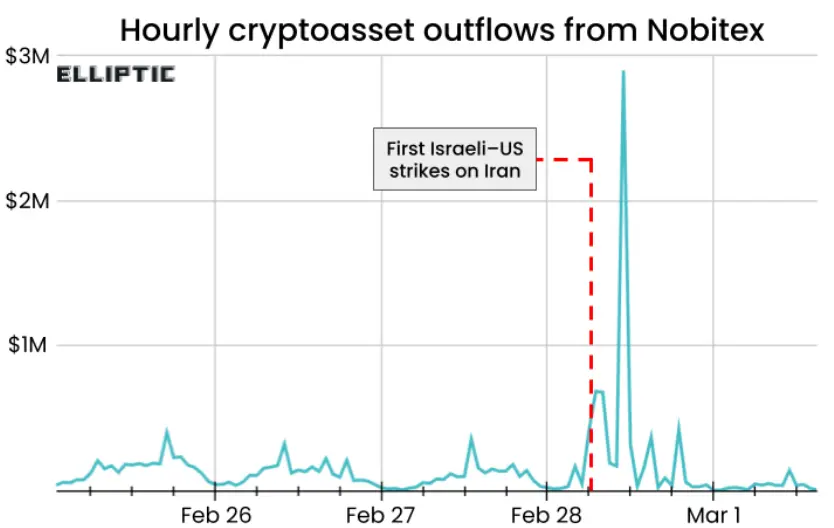
(Source: Elliptic)
Nobitex is Iran’s largest cryptocurrency exchange, handling about 87% of the country’s crypto trading volume. In 2025, it served over 11 million users and processed approximately $7.2 billion in transactions. According to an analysis report released by Elliptic on Monday:
Immediate response after the airstrike: Within minutes of the first strike, Nobitex’s crypto outflows surged over 700%, exceeding $500,000.
Peak intra-day: Later that day, the highest hourly outflow approached $3 million.
Subsequent trend: As internet restrictions were enforced, outflows sharply declined to near halt.
Elliptic’s preliminary tracking indicates that a large amount of outbound funds was transferred to foreign crypto exchanges. The company states this “enables funds to be moved out of Iran while avoiding some scrutiny from the global banking system.”
Diverging Assessments by Elliptic and TRM: Capital Flight or Blockade Effect?
Two major crypto forensic firms have drawn very different conclusions from the same data:
Elliptic’s stance: The sharp increase in outflows “may represent capital flight from Iran,” and the pattern of funds flowing to overseas exchanges aligns with risk-averse capital transfer behavior.
TRM Labs’ rebuttal: “There are no signs of accelerated growth or capital flight in Iran’s crypto ecosystem. Instead, with the government’s strict internet blockades, trading volume and value have declined.” TRM believes that after the initial short-term surge, Iran’s internet connectivity dropped about 99%, fundamentally cutting off subsequent fund transfer channels. Overall data suggests “market paralysis caused by blockade,” rather than ongoing capital outflows.
This disagreement centers on how to interpret the initial capital movements within minutes after the strike—whether they represent organized capital flight or panic-driven reactions that were later halted by network shutdowns.
Structural Context of Iran’s Cryptocurrency Dependence
Iranian reliance on cryptocurrencies is not incidental but a long-term strategic response to financial sanctions and a fragile banking system. Recent banking crises have further reinforced this trend: in October 2025, Ayandeh Bank, one of Iran’s largest private banks, went bankrupt after incurring losses of $5.1 billion and liabilities close to $3 billion, affecting over 42 million customers. The Central Bank of Iran warned that without reforms, eight other local banks face dissolution.
Against this backdrop, platforms like Nobitex have become vital tools for Iranians to evade sanctions, preserve assets, and conduct cross-border transfers. However, these platforms also face security risks: in June 2025, Nobitex was targeted by a hacker attack involving up to $81 million.
Frequently Asked Questions
Q: Does the 700% surge in Iranian crypto outflows confirm “capital flight”?
Currently, two leading blockchain analysis firms hold different views. Elliptic suggests the initial data points to capital flight, while TRM Labs argues that the rapid return to normal after the surge better fits an explanation of market activity being forced to halt due to government internet shutdowns, rather than systematic organized capital transfer. Definitive conclusions require further on-chain data analysis once the situation stabilizes.
Q: How does a 99% network outage affect cryptocurrency usage?
Crypto transactions require network connectivity for broadcasting, verification, and confirmation. When Iran’s internet connectivity drops by about 99%, users holding crypto assets are nearly unable to complete transactions, withdrawals, or transfers. This fundamentally cuts off the use of cryptocurrencies as a tool for capital transfer during crises, directly limiting the scale of capital outflows.
Q: Why do Iranians rely heavily on cryptocurrencies outside the banking system?
Due to extensive US-led sanctions, Iran has long been cut off from the global banking settlement system (including SWIFT), with strict restrictions on cross-border fund transfers. Additionally, Iran’s domestic banking system faces structural issues like high bad debt and currency devaluation, making it difficult for citizens to preserve wealth through traditional financial channels. The decentralized nature of cryptocurrencies makes them an alternative for some Iranians to store and transfer wealth.
Disclaimer: The information on this page may come from third parties and does not represent the views or opinions of Gate. The content displayed on this page is for reference only and does not constitute any financial, investment, or legal advice. Gate does not guarantee the accuracy or completeness of the information and shall not be liable for any losses arising from the use of this information. Virtual asset investments carry high risks and are subject to significant price volatility. You may lose all of your invested principal. Please fully understand the relevant risks and make prudent decisions based on your own financial situation and risk tolerance. For details, please refer to
Disclaimer.
Related Articles
OORT (Oort) surges 49.67% in 24 hours
Gate News update: On April 16, according to Gate market data, as of the time of publication, OORT (Oort) is trading at $0.01195. Over the past 24 hours, it is up 49.67%, with a high of $0.015 and a low of $0.00792. Its current market cap is about $8.8926 million.
OORT is a decentralized AI infrastructure that protects data privacy and saves costs. By integrating global computing and storage resources, OORT can support trusted AI applications. OORT DataHub is a decentralized cloud platform where users can collect and preprocess data, including images, audio, or video, to improve AI and machine learning models. Users can earn OORT tokens by completing micro-tasks, verifying data, and inviting friends, among other ways.
GateNews2h ago
XRP Rises 4% as Ripple Partnership and ETF Inflows Drive Recovery
XRP rose 4% to $1.41, boosted by Ripple's partnership with Kyobo Life and increasing institutional interest. Broader market gains and positive community engagement also contributed, though XRP remains 63% below its peak. Key support is at $1.38.
GateNews2h ago
Bitcoin Drops Below $73,000 as Long-Term Holders Take Profits and ETF Inflows Slow
Bitcoin fell below $73,000, its lowest in over three weeks, as long-term holders booked profits and spot ETF demand weakened. This triggered significant liquidations in derivatives, causing a 4% drop in total crypto market capitalization.
GateNews3h ago
TradFi Rise Alert: COTTON (Cotton) Rises Over 4%
Gate News: According to the latest Gate TradFi data, COTTON (Cotton) has surged by 4% in a short period. Current volatility is significantly higher than recent averages, indicating increased market activity.
GateNews3h ago
KT (KingdomX) jumps 73.93% in 24 hours
Gate News message. On April 16, according to Gate market data, as of the time of publication, KT (KingdomX) is trading at $0.00056. Within the past 24 hours, it is up 73.93%, with a high of $0.00063 and a low retracing to $0.00029. Its current market cap is approximately $206k.
KingdomX is a medieval metaverse chain game, with the game’s core built around an NFT protocol. In the game, users can collect heroes, complete quests, challenge events, participate in wars, and build their own game kingdom through social interaction and territory development. All of the game’s ecosystem is designed around the GameFi protocol; while improving the game’s playability, it preserves the value of in-game assets, so that any user can earn returns through the game and make Token or receive rewards. Kingdom
GateNews3h ago
GT 24H is up 3.29%, current price is 7.22 USDT
Gate News bot message, Gate price action shows, GT is up 3.29% over the past 24 hours, with a current price of 7.22 USDT.
CryptoRadar4h ago


