
Following the joint airstrikes by Israel and the U.S. on Iran, the blockchain-based prediction market platform Polymarket’s single-day nominal trading volume surpassed $478 million. Among these, political markets accounted for $220 million, with the largest single contract settlement reaching $90 million. However, Bubblemaps discovered that at least six addresses profited approximately $1.2 million from bets related to the Iran conflict, raising suspicions of insider trading.
$478 Million Record: Geopolitical Events Trigger Prediction Market Surge
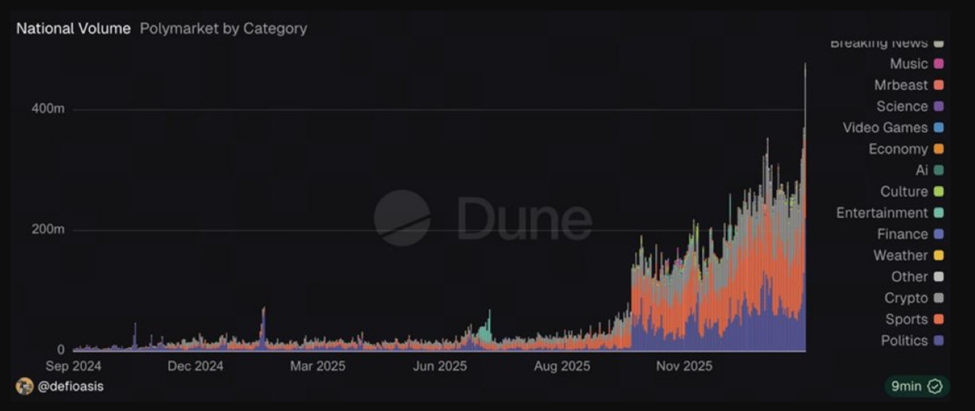
(Source: Dune)
According to on-chain data compiled by Defioasis, the surge in Polymarket’s trading volume directly correlates with the timing of the U.S.-Iran airstrikes, demonstrating the platform’s rapid response in pricing geopolitical events—significantly faster than traditional financial markets or polling models. This record breaks multiple records: the platform’s overall trading volume hit a new high, political markets also reached a new high, and the largest single contract settlement was $90 million, reflecting a large influx of capital in a short period.

(Source: Bubblemaps)
However, Bubblemaps’ on-chain analysis found that at least six wallets collectively profited about $1.2 million from bets related to the Iran conflict, with transaction timing showing abnormal correlations with the events, sparking widespread questions from markets, legislators, and regulators about insider trading and market fairness.
Key Data Highlights of Polymarket’s Record-Breaking Event
- Single-day nominal trading volume: $478 million, a platform record
- Political market volume: $220 million, nearly 50% of total that day
- Largest single settlement: $90 million, indicating high-value capital inflow
- Suspected insider trading: At least 6 addresses, profit around $1.2 million (Bubblemaps analysis)
- Trigger event: Israel-U.S. joint airstrikes on Iran
Kalshi Controversy: Ethical Dilemma Over the Khamenei Death Proxy Market
Coinciding with Polymarket’s record trading volume, competitor Kalshi faced strong criticism over a contract titled “Will Ali Khamenei Step Down as Supreme Leader?” The contract’s total trading volume exceeded $50 million, with about $20 million traded on the day of the strike.
Critics argue that, although Kalshi explicitly prohibits profiting from death outcomes, they have effectively created a death proxy market. Kalshi CEO Tarek Mansour publicly responded on X, emphasizing that all positions will be settled at the last trading price before Khamenei’s death, and positions established after his death will be fully compensated, including all trading fees.
Mansour further explained that the change in Iran’s highest leader has significant implications for geopolitics, economics, and national security, giving these contracts real-world relevance. The settlement process strictly adheres to contract terms submitted to the U.S. Commodity Futures Trading Commission (CFTC). These incidents highlight the core challenge of how prediction markets can efficiently price geopolitical events while balancing ethical dilemmas and regulatory gray areas.
Frequently Asked Questions
Why did Polymarket’s trading volume hit a record high after the Iran airstrikes?
The geopolitical event of Israel and the U.S. conducting airstrikes on Iran triggered a massive influx of capital into Polymarket’s political prediction markets within a very short period, with single-day nominal trading surpassing $478 million. The platform’s rapid response to geopolitical events in pricing makes it a highly event-driven trading platform.
What exactly are the insider trading concerns related to Polymarket?
Bubblemaps’ on-chain analysis found that at least six wallets profited about $1.2 million from Iran conflict bets, with transaction timing suspiciously correlated with the events, raising questions about whether someone had access to non-public information and placed early bets.
How is Kalshi handling the controversy over the Khamenei contract?
Kalshi CEO Tarek Mansour explained that all positions established before Khamenei’s death will be settled at the last trading price before his death, and positions after his death will be fully compensated, including fees. He emphasized that the contracts fully comply with CFTC-approved terms and are legitimate predictions of geopolitical leadership changes, not direct bets on death outcomes.
Disclaimer: The information on this page may come from third parties and does not represent the views or opinions of Gate. The content displayed on this page is for reference only and does not constitute any financial, investment, or legal advice. Gate does not guarantee the accuracy or completeness of the information and shall not be liable for any losses arising from the use of this information. Virtual asset investments carry high risks and are subject to significant price volatility. You may lose all of your invested principal. Please fully understand the relevant risks and make prudent decisions based on your own financial situation and risk tolerance. For details, please refer to
Disclaimer.
Related Articles
Polymarket profit exceeds $1.8 million; an account purchase of $400k on the NBA Magic point spread bet to win against the Celtics
In an NBA regular-season matchup between the Magic and the Celtics, one account has invested over $370k to bet on the Magic to cover the spread. The Magic are currently leading, and the game is in the halftime stage.
GateNews7m ago
Sports betting contracts are derivatives! The U.S. CFTC blocks local law enforcement and seeks regulatory control over prediction markets
The U.S. federal government is working together with the CFTC and the Department of Justice to try to shift regulatory authority for Kalshi prediction markets from local governments to the federal level, arguing that sports event contracts are financial derivatives. If the court supports this position, it will change the legal status of prediction markets and provide uniform national regulation, reducing the influence of state-level gambling laws.
CryptoCity6h ago
Ruling sports betting contracts are derivatives! The U.S. CFTC blocks local enforcement efforts and pushes to take regulatory control of prediction markets
The U.S. federal government is working together with the CFTC and the Department of Justice to try to shift regulatory authority over Kalshi’s prediction markets from state and local governments to the federal level, arguing that sports-event contracts are financial derivatives. If the court supports this position, it will change the legal status of prediction markets and standardize regulation nationwide, reducing the influence of local gambling laws.
CryptoCity9h ago
Sports betting event contracts are derivatives! The U.S. CFTC blocks local law enforcement and seeks regulatory authority over prediction markets
The U.S. federal government is working with the CFTC and the Department of Justice to try to shift regulatory authority over Kalshi prediction markets from state and local governments to the federal level, arguing that contracts for sports events are financial derivatives. If the court backs this position, it will change the legal status of prediction markets and unify nationwide regulation, reducing the influence of state and local gambling laws.
CryptoCity12h ago
Polymarket link briefly appeared in Google News before being removed; Google said it was an error caused by a mistaken push
On April 12, the prediction market Polymarket briefly appeared in Google News search results, but was then removed. Google said this was an error and said it will no longer display it. The platform has been proactively integrated with media and has already partnered with Google and the X platform.
GateNews14h ago
Robinhood, concerned about insider trading restrictions, limits some prediction market contracts
Robinhood takes a cautious approach in its prediction market business, excluding “market mentions” contracts that could easily trigger manipulation risks, and emphasizing that it only offers regulated event contracts to protect customer interests. Recent insider trading incidents have intensified industry concerns, and to mitigate risk, Robinhood partners with regulated platforms to ensure user identity verification.
GateNews14h ago


