 Trusted Editorial content, reviewed by leading industry experts and seasoned editors. Ad Disclosure
Ethereum is navigating a period of heightened volatility and uncertainty as it hovers around the critical $2,000 threshold. While recent price action suggests temporary stabilization after weeks of selling pressure, conviction remains limited. The $2,000 level is functioning less as confirmed support and more as a psychological battleground where short-term positioning, liquidity conditions, and sentiment are colliding.
Trusted Editorial content, reviewed by leading industry experts and seasoned editors. Ad Disclosure
Ethereum is navigating a period of heightened volatility and uncertainty as it hovers around the critical $2,000 threshold. While recent price action suggests temporary stabilization after weeks of selling pressure, conviction remains limited. The $2,000 level is functioning less as confirmed support and more as a psychological battleground where short-term positioning, liquidity conditions, and sentiment are colliding.
Related Reading: The $90,000 Bitcoin Anchor: Decoding The Gap That Is Paralyzing BTC’s Newest Investor CohortA recent analysis from Arab Chain offers additional structural insight through the ETH Binance Liquid vs. Illiquid Supply Model. This framework separates Ethereum held on Binance into liquid supply — coins readily available for trading — and illiquid supply, which is comparatively less likely to move in the short term. As of February, Binance’s total ETH reserves stand at approximately 3.57 million ETH. Of this amount, around 1.16 million ETH is classified as liquid supply, while 2.40 million ETH is categorized as illiquid.
This distribution matters. A relatively smaller liquid component can limit immediate sell-side pressure, but it does not eliminate risk if sentiment deteriorates. Conversely, a larger illiquid base may reflect longer holding behavior or strategic positioning rather than imminent distribution.
At a moment when price hovers near a key technical pivot, the composition of exchange reserves becomes a meaningful variable in assessing Ethereum’s next structural move.
Liquid vs. Illiquid Supply Signals A Fragile Equilibrium
The current reserve composition on Binance suggests Ethereum is operating within a structurally balanced environment rather than an immediate distribution phase. With illiquid supply accounting for the majority of the 3.57 million ETH held on the platform, a substantial portion of coins appears relatively dormant. Illiquid balances are typically associated with longer holding horizons or reduced trading frequency, which tends to dampen immediate sell-side pressure.
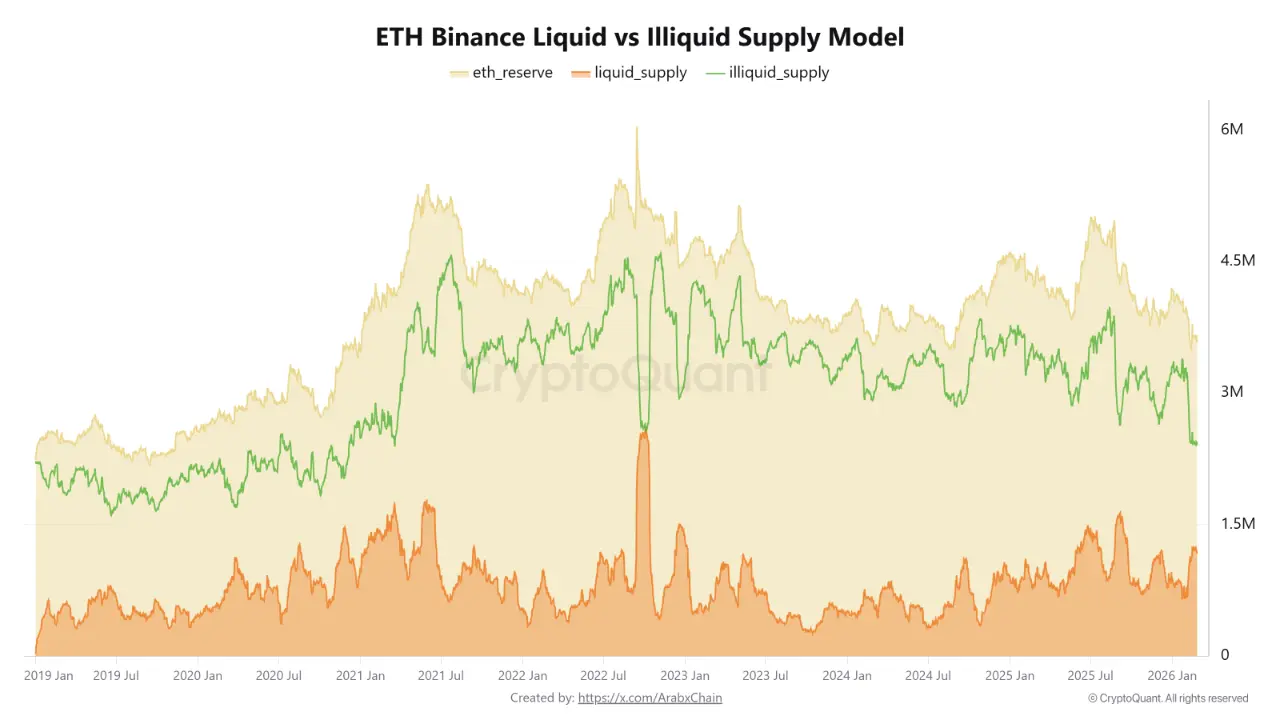 ETH Binance Liquid vs Illiquid Supply Model | Source: CryptoQuantThis matters at a time when ETH is hovering near $2,000. A dominant illiquid share implies that most holders are not actively positioning for a rapid exit. In previous cycles, sharp increases in liquid supply often preceded volatility spikes, as coins became readily available for market execution. That dynamic is not yet evident at scale.
By contrast, liquid supply historically expands during speculative phases, when traders rotate capital aggressively or prepare for directional exposure. The absence of a pronounced expansion suggests that, for now, speculative intensity remains contained.
The relatively stable gap between liquid and illiquid supply indicates equilibrium between holding behavior and active trading. However, this balance is conditional. A meaningful shift toward higher liquid supply would increase the probability of renewed volatility. Conversely, sustained illiquid dominance could help absorb price shocks and moderate downside acceleration.
Related Reading: Bitcoin Stabilizes At $68K as Fund Flow Ratios Signal An Institutional Standstill
Ethereum Tests Long-Term Support As Downtrend Accelerates
Ethereum remains under structural pressure as price hovers near the $2,000 region following a sharp breakdown from the $3,200–$3,400 zone. The weekly chart shows a clear loss of bullish structure, with lower highs forming since the late-2025 peak and momentum decisively shifting to the downside.
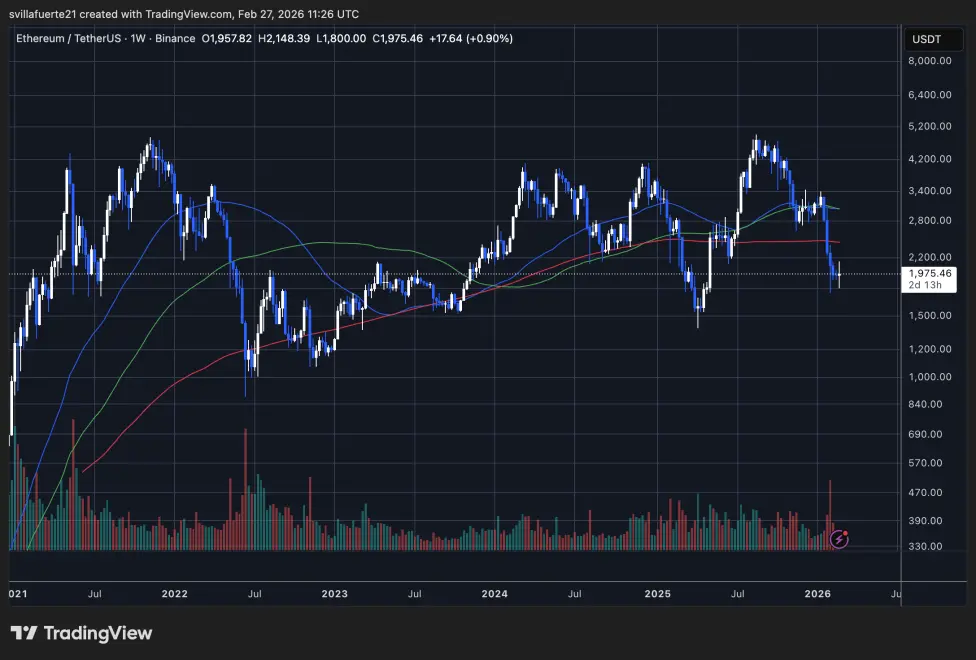 ETH consolidates around the $2,000 level | Source: ETHUSDT chart on TradingView
Price is now trading below the 50-week and 100-week moving averages, both of which are beginning to flatten or slope downward. This configuration typically signals weakening intermediate momentum and a transition into a corrective phase. Notably, Ethereum briefly tested levels near $1,800 before bouncing, suggesting the presence of reactive demand in that liquidity pocket. However, the recovery remains limited and has not yet reclaimed key moving averages.
ETH consolidates around the $2,000 level | Source: ETHUSDT chart on TradingView
Price is now trading below the 50-week and 100-week moving averages, both of which are beginning to flatten or slope downward. This configuration typically signals weakening intermediate momentum and a transition into a corrective phase. Notably, Ethereum briefly tested levels near $1,800 before bouncing, suggesting the presence of reactive demand in that liquidity pocket. However, the recovery remains limited and has not yet reclaimed key moving averages.
Related Reading: Ethereum Exchange Deposits Hit A Six-Month High: Panic Selling Or Structural Reset?
The 200-week moving average, positioned lower on the chart, remains upward sloping, indicating that the broader macro trend has not fully reversed. Historically, this level has served as strong structural support during deeper cycle corrections. If downside pressure resumes, this zone could become a critical area to monitor.
Volume expanded significantly during the recent selloff, reflecting forced positioning adjustments rather than gradual distribution. Since then, activity has moderated, pointing to temporary stabilization.
Featured image from ChatGPT, chart from TradingView.com
![]() Editorial Process for bitcoinist is centered on delivering thoroughly researched, accurate, and unbiased content. We uphold strict sourcing standards, and each page undergoes diligent review by our team of top technology experts and seasoned editors. This process ensures the integrity, relevance, and value of our content for our readers.
Editorial Process for bitcoinist is centered on delivering thoroughly researched, accurate, and unbiased content. We uphold strict sourcing standards, and each page undergoes diligent review by our team of top technology experts and seasoned editors. This process ensures the integrity, relevance, and value of our content for our readers.
Disclaimer: The information on this page may come from third parties and does not represent the views or opinions of Gate. The content displayed on this page is for reference only and does not constitute any financial, investment, or legal advice. Gate does not guarantee the accuracy or completeness of the information and shall not be liable for any losses arising from the use of this information. Virtual asset investments carry high risks and are subject to significant price volatility. You may lose all of your invested principal. Please fully understand the relevant risks and make prudent decisions based on your own financial situation and risk tolerance. For details, please refer to
Disclaimer.
Related Articles
Schwab Wealth Management opens Bitcoin and Ethereum trading: 38.9 million users enter, disrupting the crypto market landscape
Traditional finance giant Charles Schwab plans to launch “Schwab Crypto” in the second quarter of 2026, offering spot trading of Bitcoin and Ethereum to 38.9 million customers. This model will lower the investment threshold, change the previous way investors indirectly allocate to crypto assets, and meet market demand. Meanwhile, with low fees and a large customer base, Schwab may disrupt existing crypto platforms, and in the future it may also roll out stablecoin products to build a digital asset ecosystem.
GateNews11m ago
In the past 24 hours, liquidations across the entire network totaled $197 million, with short liquidations accounting for over 54%.
Gate News message, April 7, according to CoinAnk data, over the past 24 hours the entire network liquidated $197 million in total, including approximately $89.12 million in long positions and approximately $108 million in short positions. By coin, liquidations were approximately $98.06 million for Bitcoin and approximately $37.04 million for Ethereum.
GateNews1h ago
Ethereum spot ETFs had total net inflows of $120 million yesterday, and none of the ten ETFs had net outflows
On April 6, Ethereum spot ETF total net inflows reached $120 million, and all ten ETFs achieved net inflows. BlackRock’s ETF ETHA and Fidelity’s ETF FETH had single-day net inflows of $60.82 million and $40.05 million, respectively, with historical net inflows of $11.62B and $2.33B, respectively. Total net asset value was $12.28B, and the net asset ratio was 4.74%.
GateNews2h ago
The SEC will roll out new rules to “regulate cryptocurrencies”: defining what counts as fundraising and what falls under securities; it has already been submitted to the White House
The U.S. Securities and Exchange Commission (SEC) is set to roll out new rules for “regulating cryptocurrencies” to完善 the crypto asset regulatory framework and clarify whether trading constitutes a security. The rule is based on the 1933 Securities Act and may affect compliance pathways for mainstream assets, aiming to balance protecting investors with encouraging innovation.
GateNews2h ago
Bit Digital staked 43,335 ETH via liquid_col, worth approximately $91.34 million
Gate News message: On April 7, according to monitoring by Onchain Lens, Bitcoin mining company Bit Digital staked 43,335 ETH via liquid_col, worth approximately $91.34 million.
GateNews2h ago
Global central banks exploit crypto infrastructure at low cost, mBridge uses an Ethereum-based architecture
The global cryptocurrency market fell sharply between 2021 and 2022, while central banks in various countries began to use blockchain infrastructure developed by the private sector—such as the BIS’s mBridge project—without having to bear development costs. This model has sparked controversy, because when central banks adopt technology that has already undergone deep validation by the private sector, it may erode incentives for private-sector innovation and affect future financial venture investments.
MarketWhisper3h ago


