The Pi mainnet blockchain protocol is undergoing a critical upgrade, with February 15th set as the deadline for all mainnet nodes to complete their updates. The Pi core team states that 16 million users have migrated to the mainnet, which is based on the Stellar consensus protocol. However, due to the overall decline in the crypto market, Pi has fallen 12% over the past week, reaching a historic low of $0.132.
Countdown to February 15: A dual test of technology and psychology for node upgrades
The Pi mainnet is approaching an important milestone, with a key upgrade scheduled for February 15th. Over the past week, Pi’s price has declined, but it has now stabilized above $0.13. In the last 24 hours, the price increased slightly by 1.29%, reaching $0.134, possibly indicating a rebound before the mainnet upgrade. Whether this slight bounce can continue depends on the completion of node upgrades and the overall market environment.
The Pi mainnet blockchain protocol is undergoing a crucial upgrade, with the deadline set for February 15th. By then, all mainnet nodes must complete the initial phase of the update to remain connected to the network. The Pi core team issued a statement on its current decentralization status, noting that 16 million pioneer users have migrated to the mainnet. The team aims to build the Pi node system into a core component of a large identity-based blockchain ecosystem.
Pi nodes are a type of node that operate on laptops and desktop computers rather than mobile devices. They play a “fourth role” within the Pi community. These nodes are responsible for confirming transactions and maintaining the decentralized ledger. Unlike Bitcoin, which relies on proof-of-work, Pi is based on the Stellar Consensus Protocol (SCP), an alternative consensus model. As the network develops, all mainnet nodes must complete their initial upgrade before February 15th to stay active.
From a psychological perspective, February 15th holds symbolic significance for the Pi community. It’s not only the deadline for the technical upgrade but also a test of the project’s execution capability and community cohesion. If most nodes complete the upgrade on time, it will demonstrate the Pi team’s technical competence and the community’s cooperation, potentially boosting market confidence. Conversely, a low upgrade rate or technical failures could deepen doubts about the project and trigger another wave of sell-offs.
For node operators, the upgrade process itself is relatively straightforward, but time pressure and insufficient technical support could pose obstacles. The Pi core team should strengthen technical assistance and community communication in the final three days to ensure as many nodes as possible complete the upgrade. Community-led tutorials and mutual help also play an important role, reflecting the activity level within the Pi ecosystem.
Historic low of $0.132 and the perfect storm of token unlocks
Affected by the overall decline in the crypto market, Pi has experienced a 12% drop over the past week. The recent price decline pushed Pi to a historic low of $0.132, intensifying the challenges it faces. This decline is driven by increased token unlocks and the ongoing bear market. Although there is speculation that the token will list on new centralized exchanges and whale trading activity has resumed, the price remains unable to break through.
The increase in token unlocks is the biggest structural pressure currently facing Pi. As previously mentioned, on February 12th, 13th, and 14th, a total of 59.4 million tokens will be unlocked, far exceeding the normal monthly average of 8.5 million. This concentrated unlocking occurs just before the upgrade deadline, creating a dual impact of technical uncertainty and selling pressure.
The persistent bear market provides an extremely unfavorable macro backdrop. With Bitcoin struggling between $60,000 and $70,000, Ethereum falling below $2,000, and overall market risk aversion high, high-risk altcoins like Pi are naturally under greater selling pressure. Investors tend to hold mainstream coins or cash during market panic rather than speculative small-cap tokens.
Despite market speculation about new CEX listings and whale activity resuming, Pi’s price remains unable to rise. This “good news not leading to gains” phenomenon is a typical sign of weakness. In a healthy market, expectations of new exchange listings and whale buying should push prices higher. But Pi not only failed to rally, it hit a new low, indicating selling pressure far exceeds buying support. This extreme technical weakness suggests any rebound may be a “dead cat bounce” rather than a genuine trend reversal.
From a market cap perspective, Pi’s current valuation is approximately $800 million to $1 billion (based on circulating supply). This scale classifies it as a mid-small project within the crypto space, with relatively low liquidity. During a broad market downturn, smaller tokens tend to fall more sharply due to insufficient buy volume to absorb selling pressure. Pi’s 12% weekly decline, while painful, is not the worst in the current environment.
RSI rebound and CMF negative divergence: Contradictory technical signals
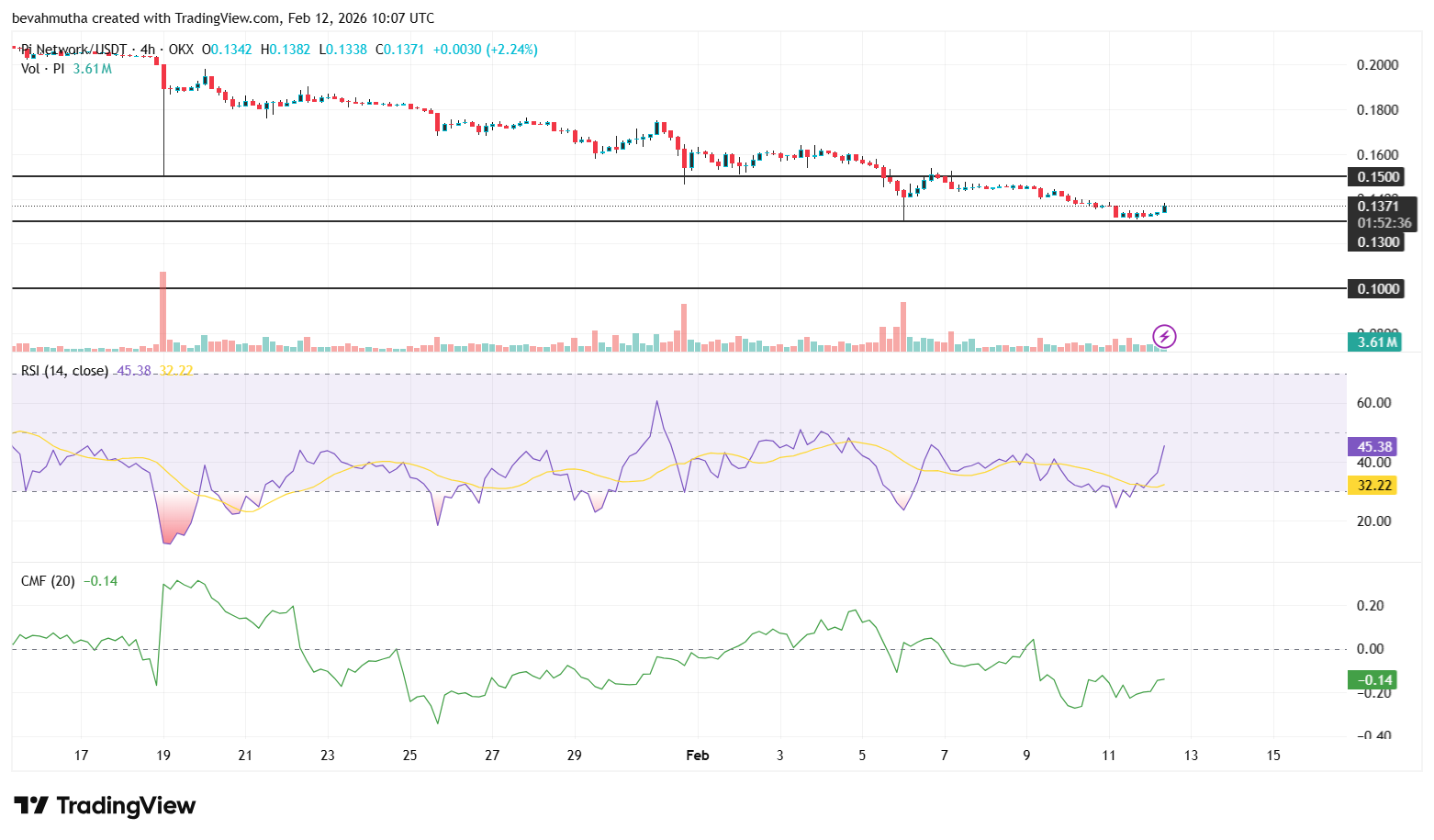
(Source: TradingView)
At the time of writing, Pi’s price is at $0.1359, up 1.34% intraday. The 4-hour chart shows that after a prolonged downtrend, Pi’s price has attempted a small rebound. Recently, Pi’s price has been oscillating between key support and resistance levels. Currently, it hovers around $0.135, with resistance at $0.150.
The Relative Strength Index (RSI) is at 42.07, rebounding from oversold territory. The RSI’s bounce from lower levels (possibly below 30) indicates selling pressure is easing but has not yet shifted to buying dominance. Only when RSI surpasses the neutral 50 line can momentum be confirmed as turning positive. At 42, it’s more an indication that “the decline is slowing,” rather than “a start of an upward move.”
The Chaikin Money Flow (CMF) is at -0.14, indicating that capital outflows still dominate. This reflects market skepticism about the current rebound. CMF measures the buying and selling pressure of funds; negative values mean more funds are leaving than entering. While -0.14 is not extremely negative, it clearly shows a net outflow. This weak capital flow will limit the extent of any price rebound.
The contradiction between RSI’s rebound and the negative CMF signals a classic “dead cat bounce”: prices temporarily rise due to technical oversold conditions, but lack of capital support causes them to fall again quickly. Traders should be cautious about the recent small uptick and avoid chasing the move blindly.
If Pi can sustain above $0.135 and break through $0.150, bulls may target the next resistance at $0.160. Achieving this scenario requires several conditions: successful and high-participation node upgrades, no large-scale sell-offs after token unlocks, and a broader crypto market rebound. Only when these three conditions are met can Pi potentially break through $0.150 and continue upward.
Conversely, if support at $0.130 fails, the price could retest the $0.10 zone. The $0.130 level is just below the recent low of $0.132; breaking below would confirm a new low and possibly trigger stop-losses and panic selling. The $0.10 level is a key psychological threshold; a breakdown could severely damage market confidence and lead to a deeper crash.
In summary, due to market weakness and token unlock pressures, Pi’s price faces downside risks. The upcoming major upgrade on February 15th could influence the trend, with support levels helping determine whether it’s a rebound or further decline. From a risk-reward perspective, the current risk of holding Pi is much higher than potential gains. Cautious investors should wait for clearer bottom signals before entering.


