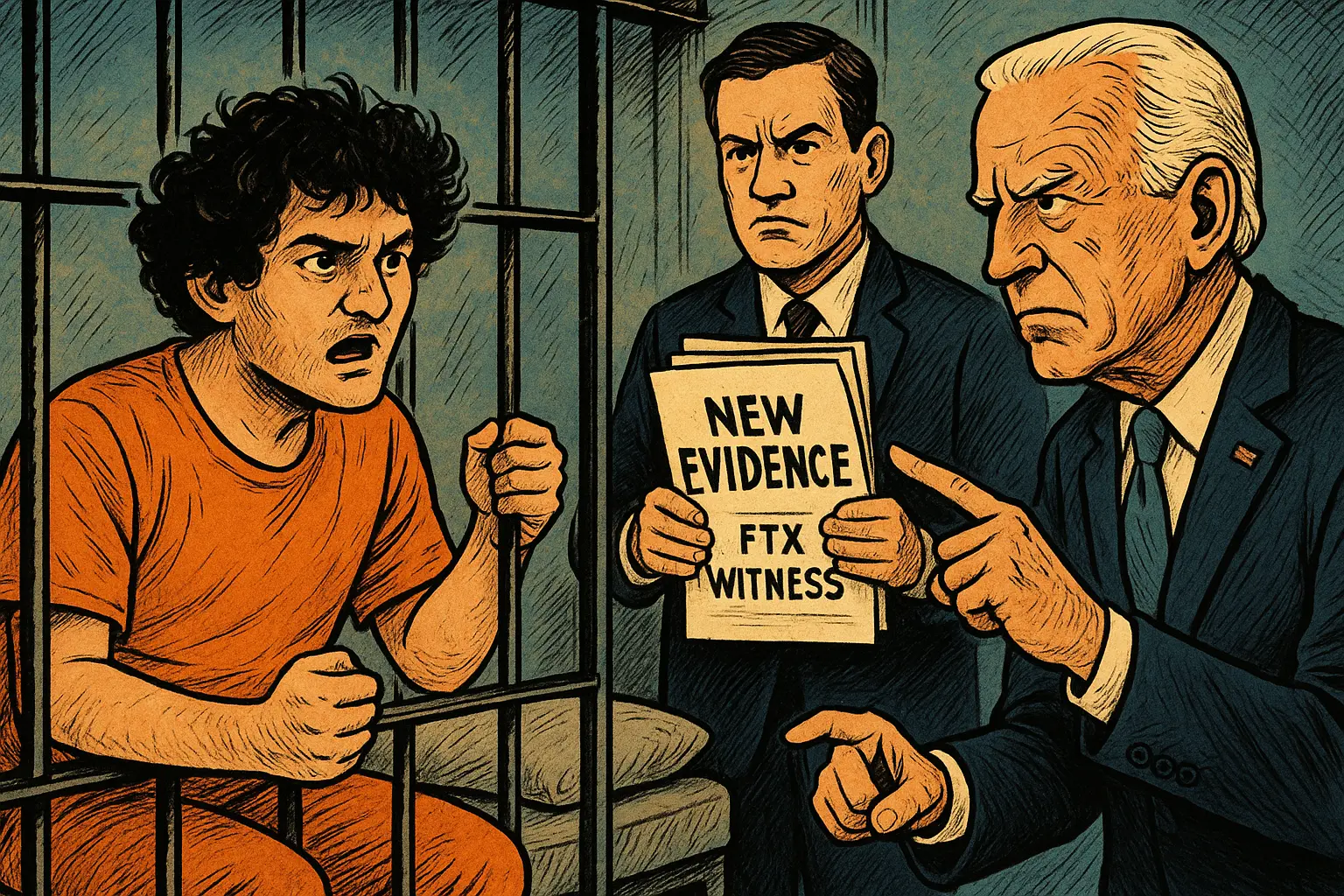
Sam Bankman-Fried claims to have new evidence proving that the U.S. Department of Justice, under the leadership of former President Biden, silenced key witnesses in his fraud case, pushing for a retrial. He attached a court document seeking a retrial under Federal Rule of Criminal Procedure Rule 33. The motion cites a statement from former FTX employee Daniel Chapsky, who said that his lawyers “strongly advised” him not to testify due to facing “media attacks and possible retaliation from prosecutors.”
Former Employee Reveals Prosecutors Threatened Witnesses into Silence
(Source: Court Listener)
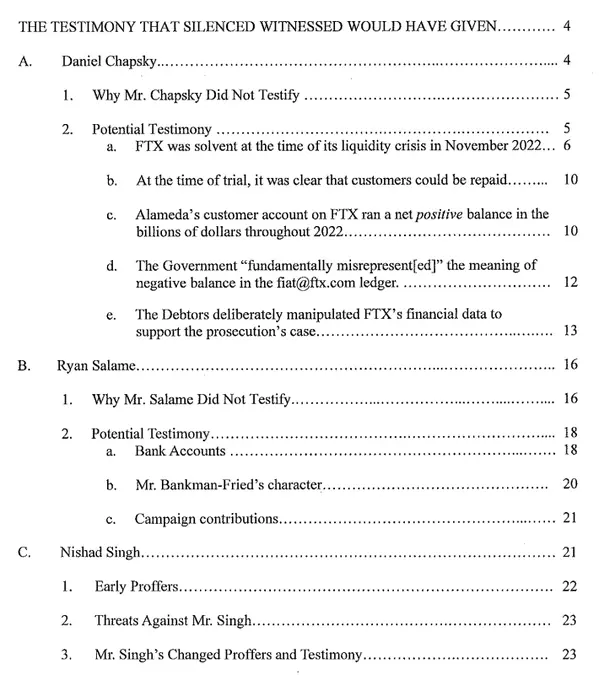
Sam Bankman-Fried claims to have “new evidence” demonstrating that the U.S. Department of Justice, under former President Joe Biden’s leadership, silenced crucial witnesses in his fraud case, and he is seeking a new trial. “The new evidence shows that Biden’s DOJ threatened multiple witnesses to remain silent or alter their testimony. My conviction should be overturned,” SBF wrote in a recent post from prison on Wednesday.
He included a link to a court document requesting a retrial under Federal Rule of Criminal Procedure Rule 33. The motion, filed Thursday, cites a statement from a former FTX employee, which reports that SBF is attempting to challenge his fraud conviction with testimony from witnesses previously unavailable. This submission marks SBF’s latest effort to overturn the 25-year sentence handed down after the collapse of FTX and its 150 subsidiaries.
(Source: Court Listener)
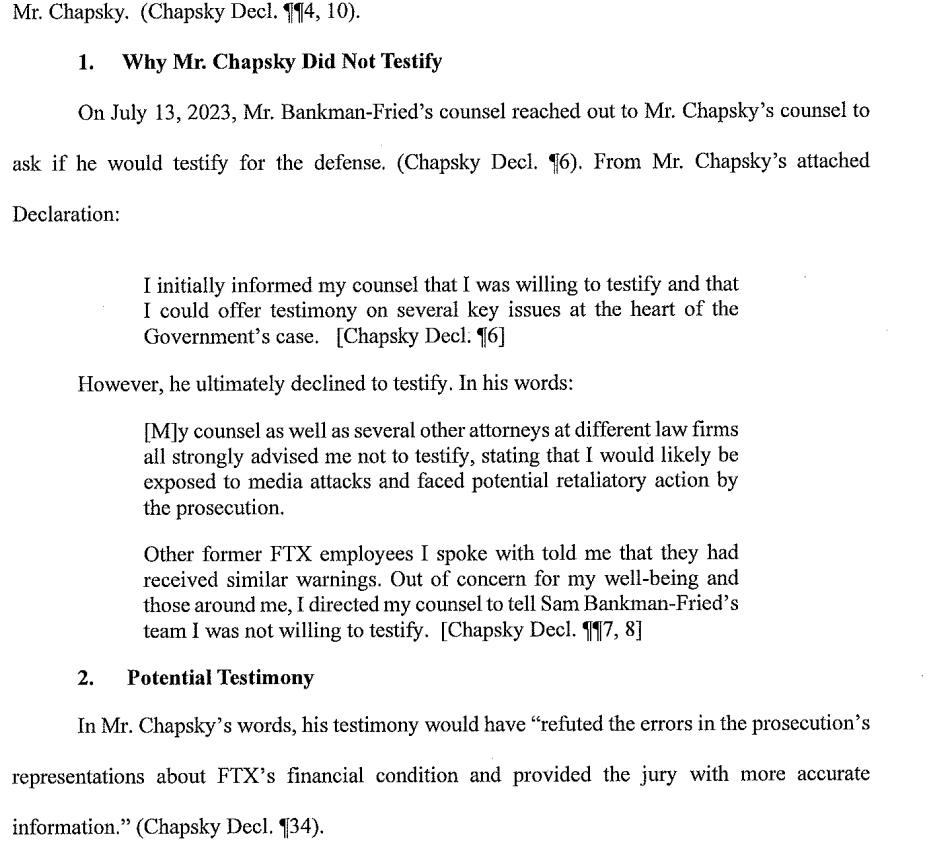
This newly filed document mainly relies on the statement of Daniel Chapsky, who claims to be a former data science director at FTX. According to the motion, Chapsky outlines the testimony he originally intended to provide at trial, assuming it was safe to do so. The document shares a recently uncovered statement made on July 13, 2023, in which Chapsky states that his lawyers “strongly advised” him not to testify because he would face “media attacks and possible retaliation from prosecutors.”
In the attached statement, Chapsky says: “Other former FTX employees I spoke with told me they also received similar warnings. Out of concern for my own safety and that of those around me, I instructed my lawyers to tell Sam Bankman-Fried’s team that I was unwilling to testify.” Chapsky also claims that his testimony would “disprove the prosecution’s claims about FTX’s financial condition and provide the jury with more accurate information.”
SBF Accuses DOJ of Three Major Witness Suppression Tactics
Lawyer Warning: Witnesses say testifying could lead to retaliation and media attacks
Collective Silence: Multiple former FTX employees received similar warnings and are afraid to testify
Safety Threats: Witnesses fear for their own safety and that of others, leading them to refuse to testify
These allegations are extremely serious. If true, they imply that the DOJ used threats and intimidation to prevent witnesses favorable to the defendant from testifying, which violates the defendant’s constitutional right to a fair trial. In the U.S. criminal justice system, defendants have the right to call witnesses in their defense, and prosecutors cannot prevent or intimidate these witnesses. If SBF’s claims are verified, the original verdict could be overturned, and the case may need to be retried.
Key Claims Regarding FTX’s Solvency
(Source: Court Listener)
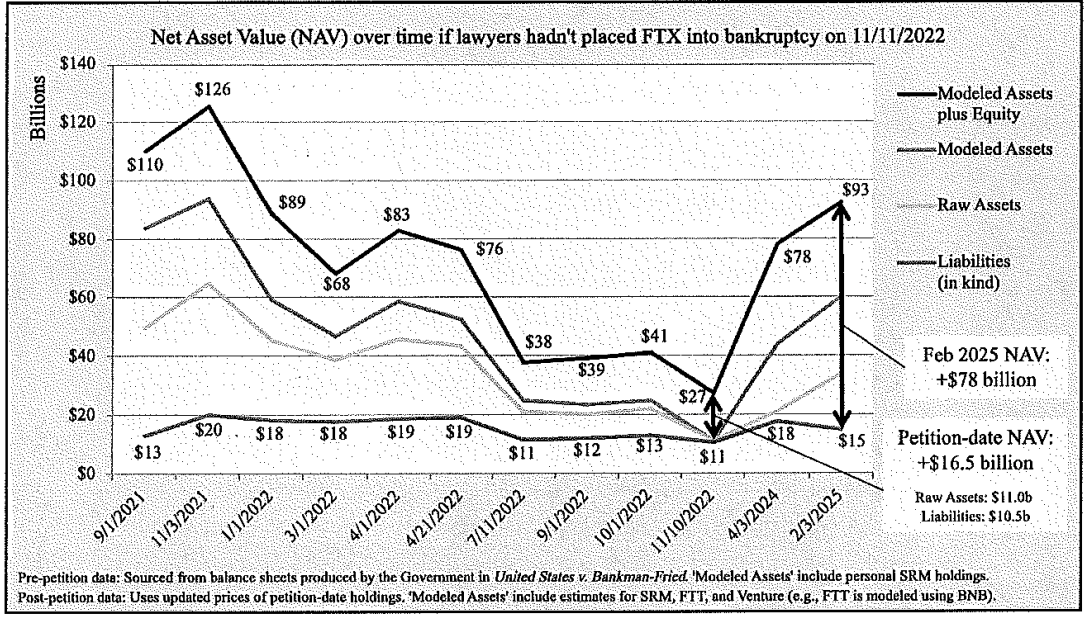
The document argues that Chapsky’s testimony would counter the prosecution’s description of FTX’s financial state, including claims that the exchange was insolvent before filing for bankruptcy in November 2022. It states that Chapsky “corroborates” that FTX and Alameda had the ability to pay their debts and that their assets always exceeded liabilities, even in November 2022, “contradicting what the prosecution told the jury.”
If this claim holds, it would fundamentally alter the nature of the FTX case. The prosecution’s core argument is that SBF misappropriated customer funds, leading to FTX’s insolvency and bankruptcy, with customers losing $8.9 billion. But if FTX was still solvent at bankruptcy (assets exceeding liabilities), then bankruptcy might have been unnecessary, and customer losses could have resulted from the bankruptcy process itself rather than SBF’s misappropriation. If the court accepts this argument, SBF’s charges could be downgraded from “fraud causing bankruptcy” to “misappropriation without insolvency,” potentially leading to a much lighter sentence.
This is not the first time Bankman-Fried has claimed FTX was solvent. In a 2025 interview, he said that shortly after transferring control of the company to bankruptcy expert John J. Ray III on November 11, 2022, he received a call from someone claiming to have an external investment that could save the company. He said handing over control to Ray III was “the biggest mistake I ever made.”
SBF’s narrative attempts to shift responsibility onto bankruptcy lawyers and new management. He suggests that if he still controlled FTX, he could raise funds or sell assets to repay customers and avoid bankruptcy. However, Ray III chose to file for bankruptcy immediately and liquidate assets, leading to huge customer losses. This “I could have saved the company” defense is common in bankruptcy fraud cases but rarely successful, as courts generally hold that if the defendant truly had the ability to save the company, they wouldn’t let it deteriorate to the point of bankruptcy.
Likelihood of Appeal and Legal Experts’ Skepticism
SBF faces seven charges related to the misuse of customer funds at FTX and its sister trading firm Alameda Research. Prosecutors allege that customer funds were transferred to Alameda to cover trading losses, resulting in an $8.9 billion shortfall. The jury found all charges guilty in November 2023, and in March 2024, SBF was sentenced to 25 years in prison.
Applying for a retrial under Federal Rule of Criminal Procedure Rule 33 is extremely difficult. The defendant must prove: that the new evidence was not available at trial; that it could have changed the verdict if presented; and that the evidence is credible and not fabricated. Legal experts generally believe SBF’s chances of success are very low because Chapsky’s statement is just a unilateral claim lacking corroboration, and the DOJ may present counter-evidence showing that witnesses were not threatened.
Moreover, even if Chapsky’s testimony is truthful, it may not change the outcome. The prosecution already presented extensive evidence of SBF’s misappropriation, including internal documents, communications, and testimony from former executives like Caroline Ellison and Gary Wang. An opinion from a data science director about financial health may be insufficient to overturn this overwhelming evidence.
In an interview with The New York Times, Donald Trump ruled out a pardon for Sam Bankman-Fried, further reducing SBF’s chances of release. Even if the appeal fails, SBF might pursue other legal avenues, such as appealing the sentence as excessive, seeking a presidential pardon (though Trump has refused), or applying for early release. But given the severity of his crimes and their societal impact, a 25-year sentence is unlikely to be significantly reduced.
For the crypto industry, SBF’s attempt at appeal serves as a stark reminder of the lessons from the FTX collapse. Regardless of the validity of the charges, the fact remains that FTX customers lost billions, and the reputation of the crypto market has been damaged. The ultimate lesson from this case is that centralized exchanges pose significant counterparty risks; investors should store assets in cold wallets and avoid keeping large sums on any exchange for extended periods.
Disclaimer: The information on this page may come from third parties and does not represent the views or opinions of Gate. The content displayed on this page is for reference only and does not constitute any financial, investment, or legal advice. Gate does not guarantee the accuracy or completeness of the information and shall not be liable for any losses arising from the use of this information. Virtual asset investments carry high risks and are subject to significant price volatility. You may lose all of your invested principal. Please fully understand the relevant risks and make prudent decisions based on your own financial situation and risk tolerance. For details, please refer to
Disclaimer.
Related Articles
Gate Daily Report (April 13): The CFTC seeks “exclusive regulatory authority” for prediction markets; the FBI report says crypto fraud losses totaled 113.6 billion.
Bitcoin has pulled back from its peak to $71,110. The chair of the U.S. CFTC said it will defend its regulatory authority over prediction markets. An FBI report shows that in 2025, losses from cryptocurrency fraud reached $11.36 billion, with seniors hit the hardest. The market is optimistic in the short term, but you should be mindful of the impact of oil prices and monetary policy.
MarketWhisper3m ago
Fake Ledger app appears in Apple Store, musician's 5.9 Bitcoins retirement savings stolen
American musician G. Love downloaded a counterfeit Ledger Live app from the Apple Mac App Store. After entering the recovery phrase, he lost 5.92 bitcoins, worth more than $424,000. The app passed the review successfully, creating a trust crisis for users. Security experts remind hardware wallet users never to enter recovery phrases on internet-connected devices and to go directly to the official website to download the app. The source of the funds appears to be a CEX, and the likelihood of recovery is extremely low.
MarketWhisper28m ago
CFTC Chair: Predicts that market oversight authority is exclusively federal; states have no power to replace it with state law
CFTC Chair Mike Selig emphasized that the CFTC has the only regulatory authority over prediction markets, and that states cannot replace federal oversight. At the same time, the CFTC is clarifying regulatory details through rulemaking and welcomes public input. In addition, the digital asset classification guidance jointly released by the CFTC and the SEC will help businesses clearly determine the nature of digital assets.
GateNews51m ago
FBI: In 2025, losses from cryptocurrency fraud reached $11.366 billion, and people aged 60 and above accounted for nearly 40% of the losses
The FBI’s 2025 Internet Crime Report shows that losses from cryptocurrency-related fraud reached $11.37B, up 22% from 2024. Losses among people ages 60 and older totaled $4.4 billion, mainly stemming from cryptocurrency investment scams. California had the highest losses at $2.1B.
GateNews1h ago
Sun Yuchen says, “I am the biggest victim of WLFI,” listing four charges: smart contracts with backdoors, an illegal freeze of wallets…
Sun Yuchen publicly accused World Liberty Financial (WLFI) of embedding a backdoor in its smart contract, claiming that its wallet was unlawfully frozen in 2025, and pointing out four categories of misconduct by the WLFI team: charging unreasonable fees, controlling the backdoor, freezing funds, and manipulating governance. He emphasized that this conduct violates basic investor rights and called on WLFI to restore transparency.
動區BlockTempo4h ago
Absolute Energy fraud scheme mastermind Qiu Zhihao carried out fraud again during his release on bail, using fake DeFi lending with high interest rates to lure victims
A loan-shark smart contract scam case led by Chiou Zhihau raised over 50 billion yuan, and 14 people have already been detained. The platform lured victims with high returns of 3% to 7% monthly interest, but in reality it was a carefully designed con, using DeFi concepts to lower their guard. During the period when Chiou Zhihau was released on bail, he committed fraud again, reflecting regulatory loopholes; prosecutors are currently continuing to investigate.
動區BlockTempo6h ago


