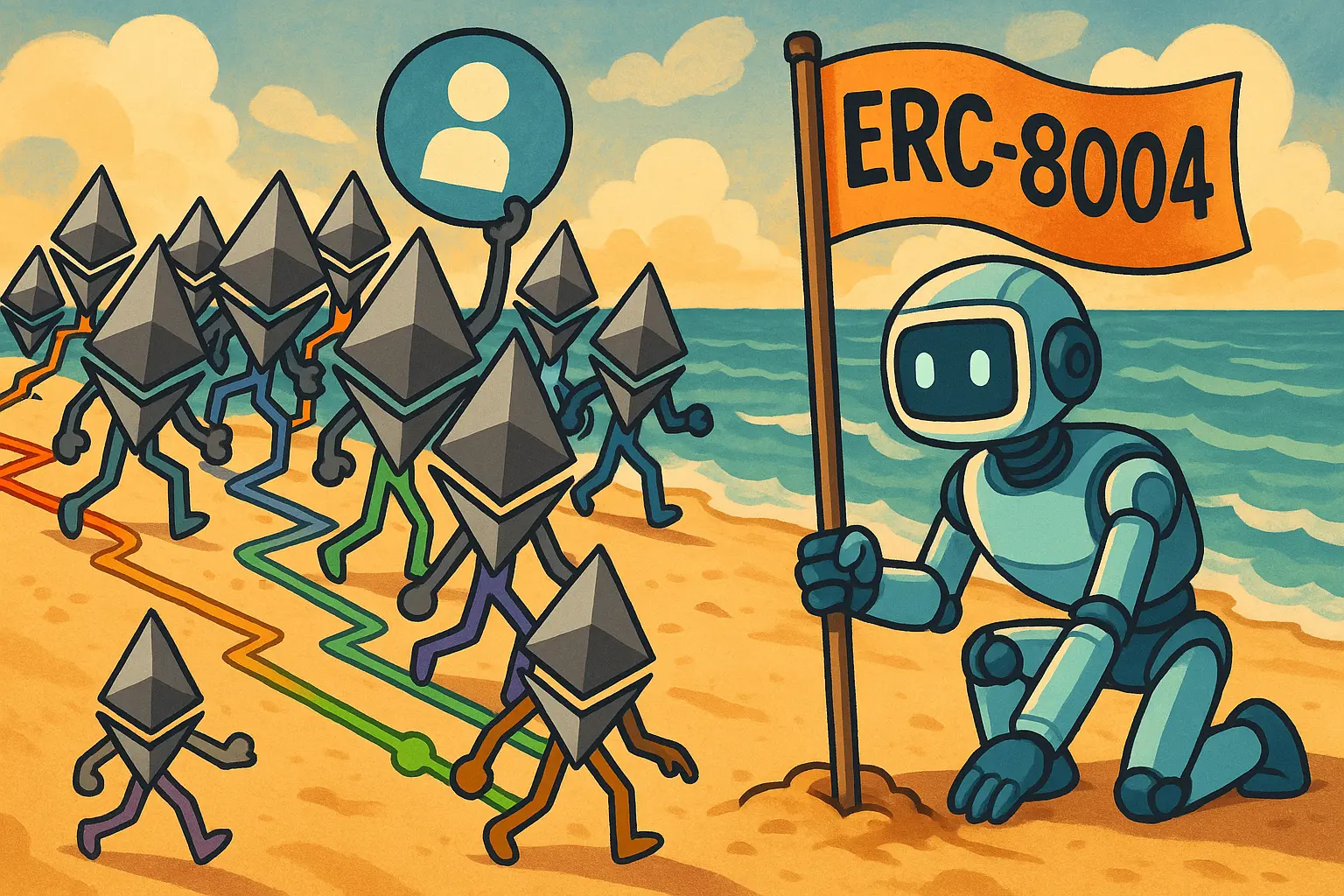
Ethereum Mainnet Launches ERC-8004 Standard to Establish Identity, Reputation, and Verification Mechanisms for AI Agents. Led by MetaMask AI leaders and other industry experts, gathering feedback from over 80 teams. Built trust systems through three on-chain registries and integrated with x402 payment protocol. Deployed on 12 chains, with ecosystems including Virtuals Protocol, ElizaOS, and more.
ERC-8004 Core Registry: The Digital Trust Trio for AI Agents
(Source: Ethereum)
ERC-8004 is a technical standard operating on Ethereum, with the core goal of creating a cross-platform, verifiable system of “Identity + Reputation + Verification” for AI agents. Key leaders in the standard include MetaMask AI head Marco De Rossi, Ethereum Foundation AI lead Davide Crapis, Google software engineer Jordan Ellis, and Coinbase engineering director Erik Reppel. During the draft phase, feedback was collected from over 80 teams, forming broad industry consensus.
The core design of ERC-8004 relies on three on-chain “registries” that support the entire trust system, all of which are “singleton contracts”—meaning only one deployment per blockchain, shared by all AI agents to ensure standardization. These registries can be thought of as the AI agent’s “Digital ID,” “Credit Profile,” and “Skill Certification Report,” working together to address the core trust issues in AI agent interactions.
Identity registration functions as the AI agent’s “Digital Identity Card.” Each registered AI agent receives a unique Agent ID, which is an ERC-721 NFT. This “ID card” contains metadata called “Agent Card,” recording the agent’s name, capabilities (e.g., “manage DeFi investments,” “auto content writing”), contact methods (supported communication protocols), wallet address, and identity systems like DID/ENS. Moreover, this identity is portable—regardless of platform, carrying the NFT allows quick recognition of the agent’s identity.
Reputation registration acts as the AI agent’s “Credit File,” permanently recording its performance on-chain—immutable and unerasable. After completing a task, feedback can be submitted, including metrics like uptime, success rate, response quality, as well as tags like “efficient” or “precise,” with optional detailed off-chain review links. All feedback is permanently linked to the agent’s identity, publicly accessible for verification.
Verification registration is the AI agent’s “Skill Certification Report.” For high-risk scenarios—such as managing large DeFi assets or medical diagnostics—good reviews are not enough; authoritative endorsements are needed. This registry allows third-party organizations to independently verify the agent’s work results and record the verification on-chain. Verification methods include zero-knowledge proofs (zkML) of AI computations, trusted execution environments (TEE) ensuring secure calculations, and more.
Core Problems Addressed by ERC-8004
Cross-Platform Trust: AI agents developed by different companies can discover, hire, and collaborate with each other without permission.
Reputation Portability: An AI agent’s work record isn’t confined to a single platform; it can carry its reputation across ecosystems.
Automated Verification: On-chain historical records help distinguish high-quality agents from scams, reducing manual review costs.
Why is ERC-8004 crucial? Some may ask, with many AI agent platforms already available, why is a standard like ERC-8004 necessary? The answer is clear: without a unified standard, the AI agent economy remains fragmented, preventing true scalability and autonomy.
80 Teams, 12 Chains Deployed: Ecosystem Exploding
ERC-8004 launched on Ethereum mainnet in late January 2026, and has since been deployed on Polygon, BNB Chain, Base, Monad, Scroll, Arbitrum, Mantle, Taiko, Gnosis Chain, Avalanche C-Chain, Celo, MegaETH (launched February 10), and others—totaling 12 chains. This multi-chain deployment underscores ERC-8004’s design as a cross-chain standard rather than Ethereum-only.
Ecosystem participants include key categories: first, browser and indexing tools like 8004scan and Agentscan, providing discovery and reputation query services; second, development frameworks such as Virtuals Protocol, ElizaOS, and Daydreams, offering standardized SDKs to lower integration barriers; third, verification and accountability layers like EigenCloud and Phala Network, leveraging TEE tech for cryptographic proofs of registration.
Notably, The Graph released an ERC-8004 subgraph covering 8 chains in early February, creating a unified cross-chain trust directory. For example, an agent on Base can verify the reputation of an Arbitrum agent instantly via this subgraph. This cross-chain interoperability is a key infrastructure for scaling the AI agent economy.
Virtuals Protocol integrates ACP with ERC-8004, aiming to turn verifiable agents into true economic participants—on-chain hosting, agent-to-agent trading, and instant registration. All agents certified by Virtuals ACP will be automatically registered on-chain via ERC-8004. ElizaOS is building Eliza Cloud as the foundational infrastructure for agent economy, supporting autonomous agent creation, operation, and scaling.
Warden raised $20 million in a strategic round in January, with a valuation of $200 million, with investors including 0G, Messari, Venice.AI, and others. Warden’s Warden Studio enables creators to build, publish, and monetize AI agents in one minute, integrating ERC-8004 and x402 to create a verifiable, trustless infrastructure.
ERC-8004 + x402: Complete Closed-Loop AI Agent Economy
ERC-8004 itself does not handle payments; it only manages “who is who and how reliable.” To truly form a closed-loop economy—discovery, collaboration, payment, reputation feedback—an efficient machine-to-machine micro-payment layer is needed. Community and infrastructure projects generally see ERC-8004 + x402 as complementary components of the agent economy.
x402 is a payment protocol designed specifically for AI agents, supporting real-time USDC settlement and low-friction microtransactions. When two AI agents need to collaborate, they first query the ERC-8004 registry to verify each other’s identity and reputation. Once trust is established, they use x402 to complete the payment for the task. After completion, feedback is submitted to ERC-8004 to update reputation records. This forms a complete economic cycle.
Questflow focuses on orchestrating multi-agent ecosystems, enabling AI agents to autonomously research, act, and earn rewards on-chain. It supports multi-agent collaboration, integration with Web2/Web3 services, and uses x402 for inter-agent payments and monetization. Ethy AI already leverages Virtuals ACP and x402 to enable native payments and incentives within workflows. By integrating ERC-8004, Ethy’s marketplace evolves into a trust-based agent marketplace.
In practical applications, the combination of ERC-8004 + x402 unlocks numerous new use cases. For example, a market research AI agent could automatically hire data collection, analysis, and reporting agents, all without manual intervention. Each sub-agent completes its task and receives instant payment via x402, with reputation updated on ERC-8004. This autonomous agent collaboration network will fundamentally transform organizational forms of knowledge work.
As multi-chain deployment and ecosystem projects continue to mature, a new era of digital economy—driven by trusted AI agents collaborating autonomously and creating value—is accelerating. The launch of ERC-8004 provides the core trust infrastructure for the AI agent economy, transforming AI from “isolated tools” into “economic participants.”


