Solana’s price approached $90 on Monday, maintaining the 11% rebound from last Friday, but has been stuck in consolidation for the third consecutive day. Derivative data shows that retail interest continues to decline, with SOL futures open interest decreasing by 2% within 24 hours to $5.32 billion, and funding rates remaining negative. The US spot Solana ETF experienced outflows of $11.86 million, and the RSI has fallen to 29, indicating an oversold condition.
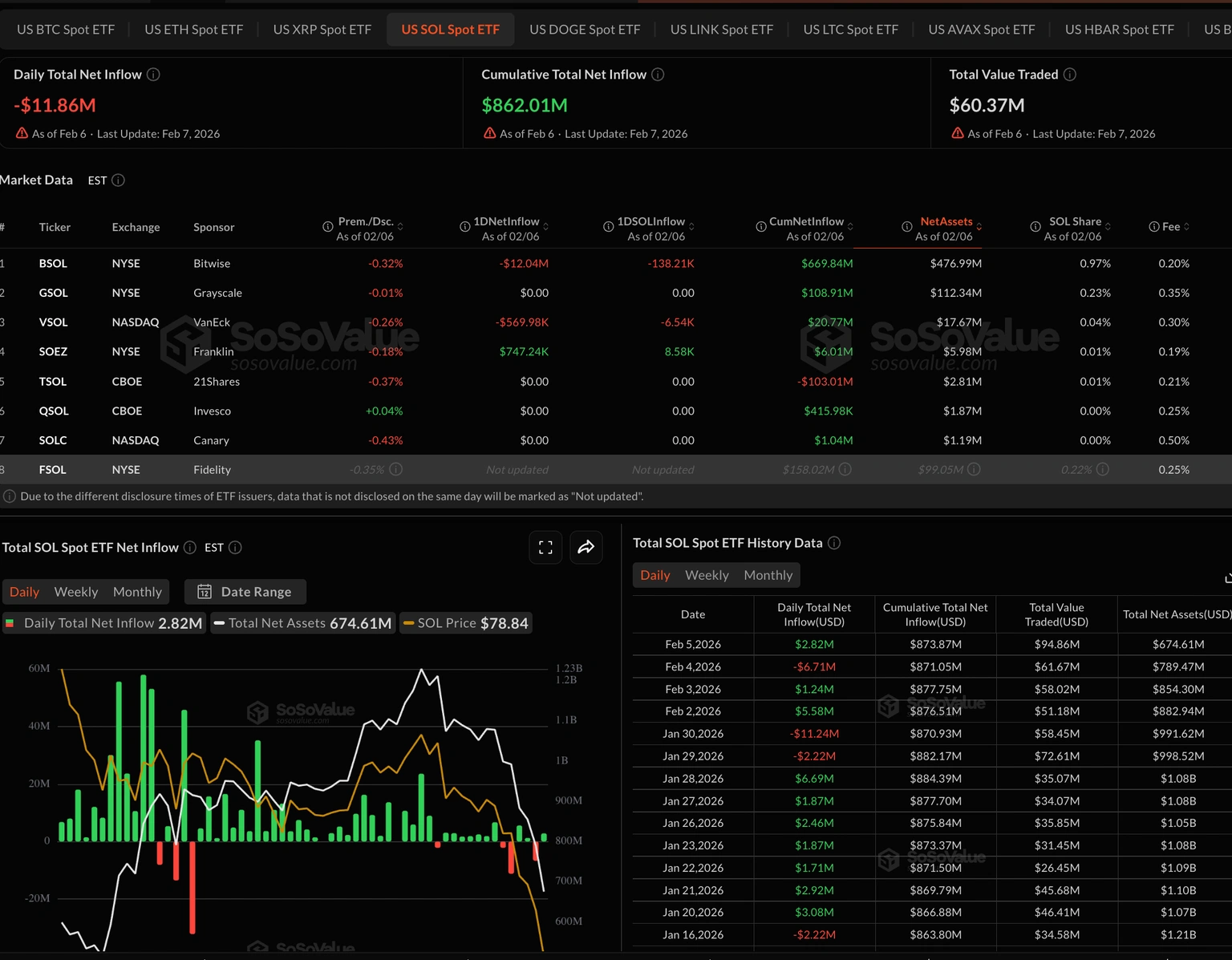
Solana ETF Outflows of $11.86M Shake Institutional Confidence
(Source: CoinGlass)
Due to reduced risk appetite among investors, overall market confidence in Solana remains subdued. Bitcoin has fallen 50% from its all-time high, exerting pressure on the entire crypto market. The ETF focused on SOL recorded nearly $11.86 million in outflows, excluding Fidelity’s FSOL, which has yet to report earnings. This capital outflow reflects cautious sentiment among institutional investors regarding Solana’s short-term outlook.
The outflow from the Solana ETF is not an isolated event but part of a broader weakness in the crypto ETF market. The ongoing bear market, triggered by Bitcoin’s decline, has made it difficult for primary tokens to sustain institutional and retail demand, increasing downside risks. Institutional investors typically allocate via ETFs; when they withdraw, it often signals negative market sentiment.
Compared to Bitcoin ETFs, Solana ETFs are smaller in scale and liquidity, making them more susceptible to capital flows during market turbulence. Even a few million dollars in outflows can significantly impact Solana’s price. Moreover, ETF capital flows are often viewed as a sentiment indicator; persistent outflows could trigger broader confidence crises.
Fidelity’s FSOL has not yet disclosed earnings, adding uncertainty. As a traditional asset management giant, the fund’s Solana ETF capital flow is influential on market sentiment. If Fidelity’s product also experiences outflows, it would further confirm institutional withdrawal from Solana. Conversely, inflows could provide some market relief.
From a broader perspective, the launch of Solana ETFs signifies a sign of ecosystem maturity. However, launching or operating ETFs during a bear market presents greater challenges. Investors need clear value propositions and growth drivers to increase allocations in a downturn. While Solana demonstrates technical and ecosystem strengths, these fundamentals are difficult to translate into capital inflows amid falling prices.
Weak Derivatives Market, Open Interest Down 2%, Funding Rate Turns Negative
(Source: Coinglass)
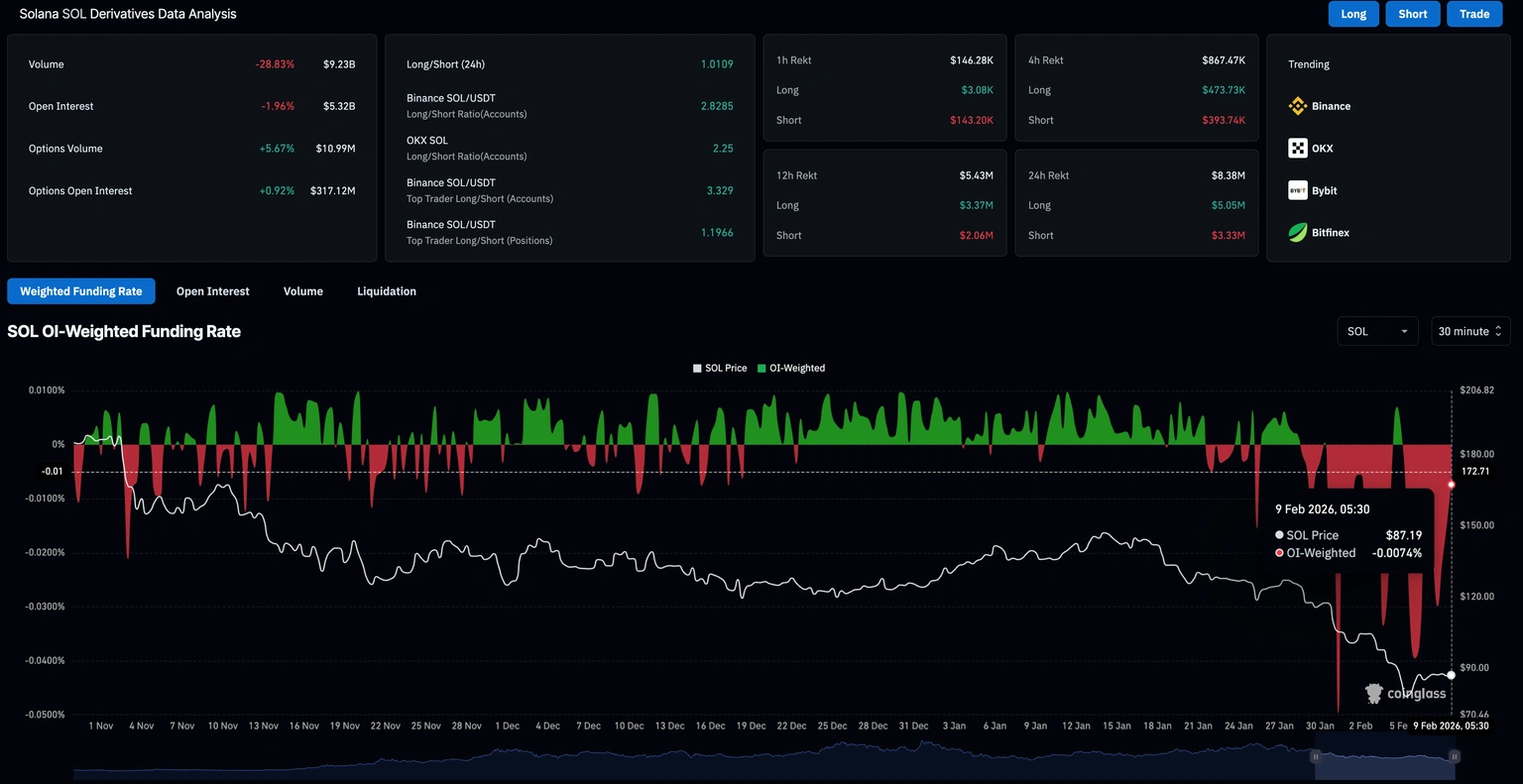
In derivatives, CoinGlass data shows that SOL futures open interest (OI) declined nearly 2% in the past 24 hours to $5.32 billion. The decrease in open interest indicates reduced capital exposure as traders adopt a cautious, wait-and-see approach. This pattern often appears when market direction is unclear, with traders closing positions rather than holding risk.
Along with the decline in open interest, SOL derivatives saw total liquidations of $8.38 million in the past 24 hours, with longs liquidated for $5.05 million and shorts for $3.33 million. Liquidations on both sides are similar, indicating increased volatility and a cautious market sentiment. This dual-sided liquidation suggests a lack of clear market direction—neither a capitulation by bulls nor a short squeeze—just declining participation.
Negative funding rates are another key indicator. When funding rates are negative, shorts pay longs to maintain their positions, reflecting a bearish market sentiment. Coupled with declining open interest, this paints a clear picture: traders are losing interest in both long and short positions, and overall market activity is waning.
Key Indicators in Solana Derivatives Market
Open Interest: $5.32 billion (down 2% in 24 hours)
24-hour Liquidation Volume: $8.38 million (longs $5.05M, shorts $3.33M)
Funding Rate: Negative (shorts pay longs)
Market Sentiment: Cautious, declining participation
Historically, persistent declines in open interest often signal prolonged consolidation or a slow downtrend. Only when open interest stabilizes or increases, and funding rates turn positive, can a trend reversal be confirmed. Currently, Solana’s derivatives market does not show these signs.
The collapse of retail demand is the biggest current issue. During bull markets, retail investors drive prices higher, but in bear markets, they are often the first to exit. As a popular high-performance blockchain, Solana’s price is highly sensitive to retail activity. When retail trading activity diminishes, liquidity drops, making prices more vulnerable to large sell orders.
Technical Resistance at $111, Key Support at $67
(Source: TradingView)
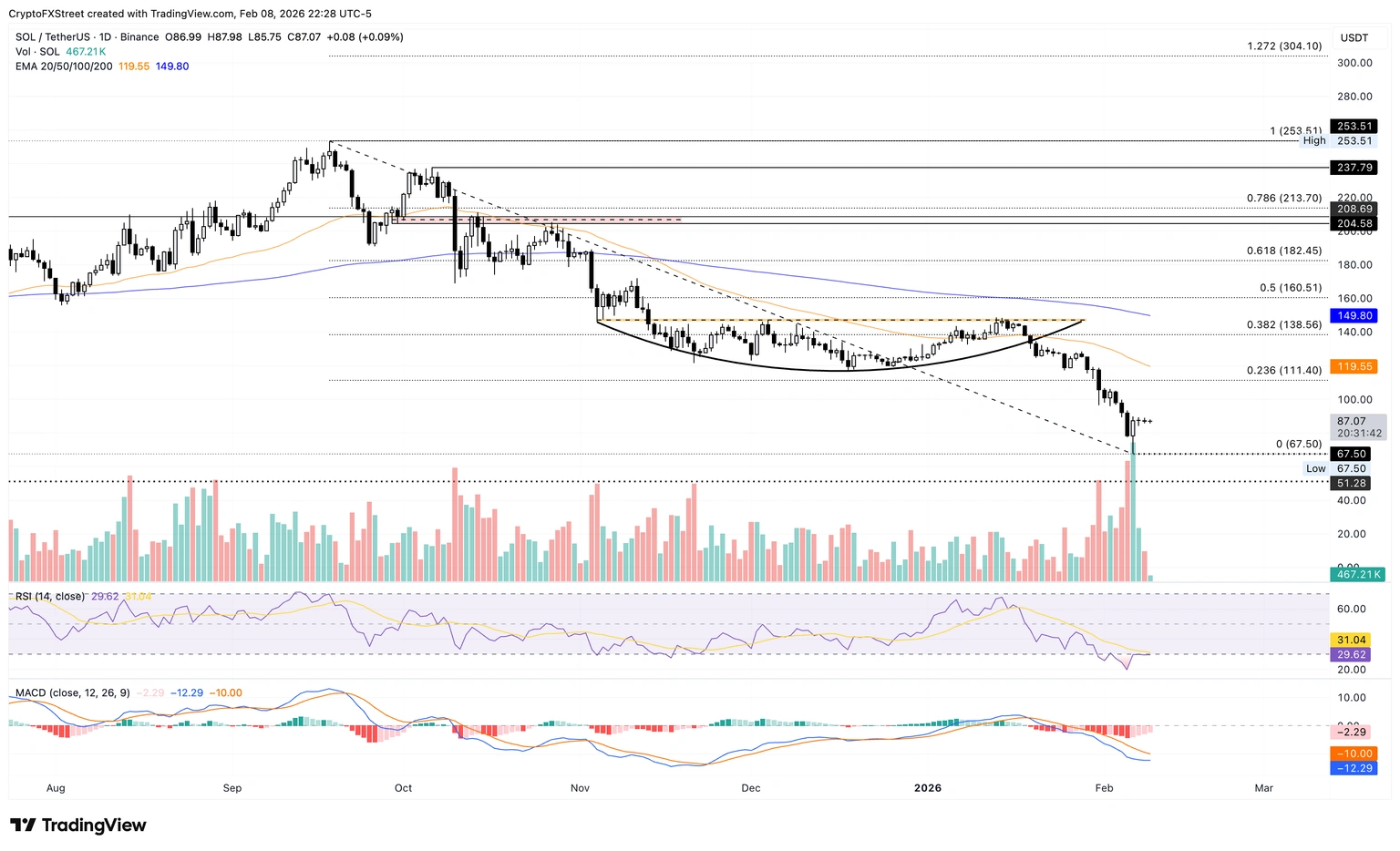
Currently, Solana’s price remains well below the 50-day and 200-day exponential moving averages (EMA), confirming its overall bearish trend. As of Monday, the price is below $90, after an 11% rebound last Friday, with a third day of sideways movement, and weekly losses narrowed to 14%. This low-volatility consolidation suggests the market is searching for a direction but lacks a clear bullish catalyst.
The slight rebound may face selling pressure from short-term moving averages. The 50-day EMA is a key mid-term trend indicator; when the price remains below it, each bounce toward this level tends to encounter profit-taking or stop-loss selling. The 200-day EMA represents the long-term trend and is farther away, making it less accessible in the near term.
On the daily chart, the MACD (Moving Average Convergence Divergence) indicator has been in a sideways consolidation after last week’s sharp decline, with the histogram narrowing and remaining below zero. This suggests weakening bearish momentum and the potential for a bottoming process. However, MACD remains negative, and the fast line has yet to cross above the slow line to form a bullish crossover, so the downtrend is not yet technically over.
Meanwhile, the Relative Strength Index (RSI) remains at 29, in the oversold zone, indicating a potential rebound. An RSI below 30 is often considered oversold, historically triggering technical bounces. Yet, in a strong downtrend, RSI can stay oversold for extended periods, and prices may continue to decline. Relying solely on RSI oversold signals to identify a bottom is premature.
From the high of $253 on September 18 to the low of $67 on February 6, Fibonacci retracement levels at 23.6% and 38.2% are at approximately $111 and $138, respectively, forming recent resistance zones. A daily close above the $111 level would improve market sentiment and attract technical buying. Breaking through $111 would open the path toward the next resistance at $138.
If the price fails to break above $111, the rebound will be limited, and downside risks remain. Immediate support is at $67, the recent low from February 6, where many stop-loss orders and psychological support are clustered. A deeper support level is at $51, which previously helped trigger a rebound in November 2023. If $67 breaks, $51 becomes the last line of defense for bulls.
Retail Demand Collapse Is the Biggest Worry for Solana
The ongoing crypto bear market, driven by Bitcoin’s decline, hampers both institutional and retail demand for Solana, increasing downside risks. As the entire crypto market remains under pressure, Solana’s technical outlook remains bearish. Bitcoin’s 50% decline from its all-time high has systemic effects on the entire market, with Solana, as a top ten market cap coin, bearing significant impact.
The collapse of retail demand is the most pressing challenge Solana faces now. During the 2024 bull run, Solana attracted many retail investors due to its high performance and low transaction fees, with on-chain activity reaching new highs. However, in the current environment, retail confidence has shattered, and on-chain activity has plummeted. This decline in participation is reflected not only in prices but also in ecosystem project funding and user growth slowing down.
DeFi and NFT projects within the Solana ecosystem are also affected. Total Value Locked (TVL) has fallen from peak levels of billions of dollars to current levels, with many projects experiencing sharp declines in trading volume and active users. This ecosystem weakness further undermines Solana’s fundamentals, making it more reliant on speculative trading rather than real usage.
The key to recovery is re-attracting retail and institutional participation. This requires price stabilization, new ecosystem developments, and broader market sentiment improvements. Until these conditions are met, Solana’s price outlook remains cautious, and investors should be alert to further downside risks.


