
Kaspa is wrapping up another difficult January, ending the month lower than it started and extending a trend that has been weighing on the asset for months. Price action is now close to a major support zone, and the chart suggests February could be a decisive period rather than a turning point. A quick look at the broader Kaspa trend leaves little room for optimism, especially with sellers still firmly in control.
At the time of writing, KAS price is trading around $0.038, which places it more than 80% below the 2024 all time high near $0.2. That steep drawdown continues to shape sentiment and technical structure, with the market showing few signs of sustained recovery pressure.
- Kaspa Price Tests Critical Support After Weak January Close
- Internal And External Pressures Weigh On Kaspa Outlook
- February Outlook Hinges On $0.036 Support Level
Kaspa Price Tests Critical Support After Weak January Close
January is closing with Kaspa pricebelow prior consolidation ranges, confirming another lower high on the daily chart. Price is now hovering just above a long-tested horizontal support around $0.036, a level that has repeatedly acted as a floor during previous sell-offs.
Buyers have tried to defend it in the past. That defense has grown weaker over time as rebounds become smaller and less convincing.
A daily close below $0.036 would likely shift market structure again. That scenario opens the door to a deeper retracement, with historical price memory pointing toward $0.02 as the next meaningful area of interest. If downside momentum accelerates, even $0.01 cannot be ruled out during February.
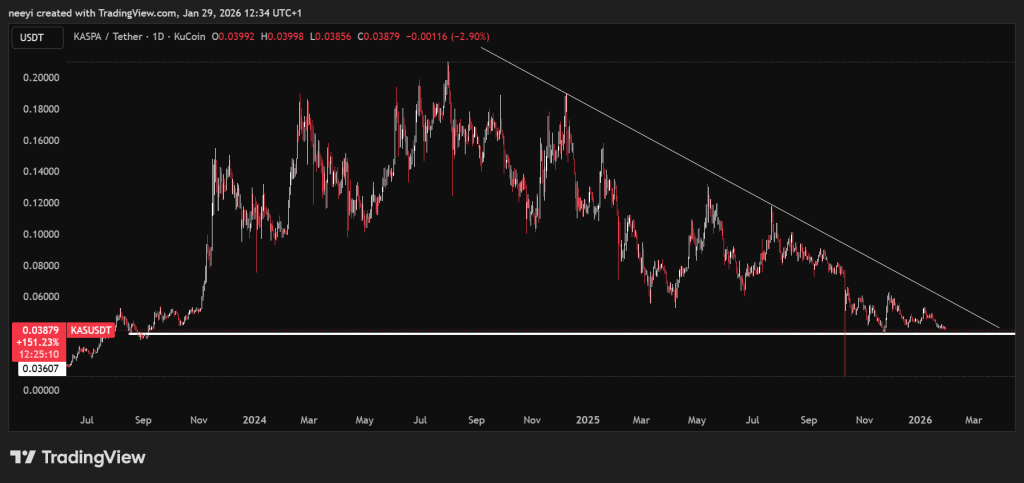
KAS Price Chart
Even if the $0.036 support holds through February, Kaspa would still face this trendline overhead. A move toward $0.05 or $0.06 would likely attract sellers again unless broader crypto market conditions turn decisively bullish. Without a strong shift in sentiment across major assets like Bitcoin, Kaspa may struggle to build enough momentum to challenge that resistance.
The chart suggests consolidation rather than expansion remains the most realistic outcome if support survives. Sideways movement between $0.036 and $0.06 would still reflect a market lacking conviction.
Internal And External Pressures Weigh On Kaspa Outlook
Beyond the technicals, Kaspa continues to face sentiment challenges that feed into price behavior. Internal friction within the Kaspa community has intensified, with disputes around leadership direction, branding clarity, and communication quality creating visible strain. Discussions that once focused on development progress now often revolve around mining profitability concerns and frustration with perceived stagnation.
External pressure has added to the weight. Scam accusations and persistent rug pull narratives continue to circulate despite Kaspa fair launch structure, open source code, and transparent emissions. Bitcoin maximalist criticism has also contributed to a defensive atmosphere around the project, while skepticism around partnerships and ecosystem growth fuels uncertainty.
These factors do not directly dictate price, yet they influence confidence during key technical moments. Weak confidence often translates into weaker support defenses when the market is tested.
How Much Could $1,000 in Worldcoin (WLD) Be Worth by 2027?_**
February Outlook Hinges On $0.036 Support Level
February outlook for Kaspa price largely comes down to whether $0.036 can hold. Best case conditions would see price stabilize above that level and enter a consolidation range, potentially oscillating between $0.036 and $0.06 while the market waits for clearer direction.
Failure of that support would likely bring a more aggressive downside phase, with price exploring lower historical zones that have not been tested since early adoption periods. The chart currently favors caution, with trend structure and momentum still pointing lower rather than higher.
Disclaimer: The information on this page may come from third parties and does not represent the views or opinions of Gate. The content displayed on this page is for reference only and does not constitute any financial, investment, or legal advice. Gate does not guarantee the accuracy or completeness of the information and shall not be liable for any losses arising from the use of this information. Virtual asset investments carry high risks and are subject to significant price volatility. You may lose all of your invested principal. Please fully understand the relevant risks and make prudent decisions based on your own financial situation and risk tolerance. For details, please refer to
Disclaimer.
Related Articles
BTC drops 0.52% in 15 minutes: Whale inflows to exchanges combined with insufficient liquidity amplify sell pressure
From 2026-04-17 10:15 to 2026-04-17 10:30 (UTC), the BTC price rapidly fell within the 75214.3 – 75725.9 USDT range. The cumulative return over 15 minutes was -0.52%, and the amplitude reached 0.68%. During this period, market sentiment shifted from cautious to bearish, volatility on the board increased, mainstream trading pairs saw an increase in主动 sell-side volume, buy-side acceptance became constrained, and overall trading activity declined significantly.
The primary driver behind this unusual move is that large holders (whales) concentrated their short-term inflows into exchanges. On-chain data shows that net inflows to addresses holding more than 1000 BTC per address changed from a steady state to a positive value, directly boosting exchange balances over the short term. Historical data indicates that whale inflows to exchanges are highly correlated with sell pressure in the medium to short term. In the same period, order book snapshots reflected a significant increase in the volume of主动 sell orders, and the成交价梯度 shifted downward, highlighting that weak market absorption capacity caused a short-term drop in price.
In addition, in the derivatives market, the long/short positioning structure tilted toward shorts. The number of主动 sell contracts exceeded that of buys in a short time, and rising pressure to close long positions further intensified the downtrend. Market liquidity overall was relatively weak; the number of active addresses over the past 10 minutes was only about 42k, and both fees and the mempool were near their lowest levels of the recent month. Against a backdrop of insufficient capital absorption, the marginal impact of large sell orders was amplified. On the macro front, the Federal Reserve’s monetary policy tightening and industry media repeatedly downgraded BTC’s near-term expectations led investors’ risk appetite to generally decline, creating a resonance at the level of market sentiment.
In the short term, it is still necessary to stay alert to liquidity risk and the price impact of one-way large transactions in specific trading pairs. Going forward, focus on key developments such as changes in whales’ on-chain holdings, exchange balances, and rebounds in activity metrics, as well as the potential impact of macro policy direction on risk assets. Relevant users should primarily guard against the risk of sharply amplified short-term price volatility and promptly track more market information.
GateNews24m ago
Popular Analyst Remains Aggressively Bullish on Crypto Prices, Predicts Parabolic Surges Soon
Popular analyst remains aggressively bullish on crypto prices.
The expert then predicts parabolic surges soon.
The move could spark dead coins into pumping heavily as well.
The crypto community continues to hold
CryptoNewsLand36m ago
RAVE, SIREN Rally Despite Manipulation Warnings
Rave DAO and Siren tokens surged to near all-time highs, facing volatility and liquidation risks. Concerns grew over potential market manipulation and supply concentration, particularly for RAVE. A new KuCoin listing boosted RAVE's visibility, despite inherent trading risks.
CryptoFrontier1h ago
ETH rises 0.65% in 15 minutes: ETF fund inflows and leverage long accumulation resonate to lift spot prices
Between 2026-04-17 09:15 and 2026-04-17 09:30 (UTC), ETH fluctuated within the 2351.53 to 2376.99 USDT range. The 15-minute return recorded +0.65%, with a swing of 1.08%. Within this range, buying pressure significantly strengthened, with trades dominated by medium-sized orders, which increased market attention and amplified short-term volatility.
The main drivers behind this anomaly are continued inflows of institutional capital into ETH spot ETFs, especially with cumulative net inflows over the past 4 days exceeding $212 million. On April 17 alone, the ETF added an additional $9.5 million in inflows, and spot buy orders expanded in sync within 15 minutes. Leveraged long positions in the derivatives market are the second-largest catalyst. From April 14 to 17, ETH futures open interest grew 26% week over week, indicating that capital via multiple paths is simultaneously betting on an upside move. The funding rate being neutral suggests the leveraged structure is temporarily healthy.
In addition, global macro market risk appetite has rebounded (geopolitical tensions easing, and the Federal Reserve keeping rates unchanged), driving a broad rebound across mainstream risk assets, and the crypto market has attracted liquidity accordingly. At the industry level, major financial institutions are advancing filings for ETFs and trust products. Mining companies have increased their ETH holdings and also maintained active staking activity, further reinforcing medium- to long-term market expectations. Multiple factors overlap and resonate, amplifying volatility. On-chain transfers remain generally stable, and there is no abnormal concentration of fund flows migrating between exchanges.
What needs attention is that although the current market is lifted by the resonance of institutional capital and leverage, the continuous growth of futures positions combined with the spot price failing to rise above the 2400 USDT area will bring the risk of forced liquidation. Meanwhile, if ETF subscription inflows slow down or macro liquidity reverses, ETH spot support could weaken. Please focus on tracking ETF net inflows, changes in futures open interest, the macro news backdrop, and nearby support and resistance levels, and stay alert to short-term volatility and potential abrupt adjustments. For more real-time market information, please keep watching.
GateNews1h ago
BTC up 0.58% in 15 minutes: exchange net outflows and ETF buy orders converge to lift the price
Between 2026-04-17 08:45 and 2026-04-17 09:00 (UTC), the BTC price surged in the short term. The candlestick return was +0.58%, with a price range of 75265.0 - 75862.3 USDT and a range of 0.79%. Market volatility increased and attention rose, with trading volume significantly higher than usual, reflecting a convergence between capital flow and technical signals.
The main driver behind this unusual move is the exchange’s net outflow of BTC in sync with ETF capital inflows. Data shows that within the past 24 hours, exchanges recorded a net outflow of 2,844.68 BTC
GateNews1h ago
Citi Study: Bitcoin and Gold Together Outperform Single Asset Allocation in Long-Term Portfolios
A Citi study recommends combining Bitcoin and gold in investment portfolios for improved long-term returns, noting better performance in various market conditions. Wells Fargo predicts gold could rise to $8,000 by 2027, driven by central bank concerns. Meanwhile, Bitcoin funding rates have reached lows, historically marking turning points.
GateNews1h ago


