The Federal Reserve pressed the pause button at its first FOMC meeting in 2026, keeping interest rates unchanged. Gold immediately broke through $5,500 to hit a record high, but Bitcoin and other risk assets reacted calmly. As macro directions remain unclear, the market is shifting focus to the next Fed chair candidate.
(Background: 2026 Fed Regime Change: Powell’s Era Ends, US Rates May Be Cut “All the Way Down”)
(Additional context: Latest FOMC Minutes: Divergences Remain, but “Most” Officials Support Continued Rate Cuts)
Table of Contents
- The Dust Has Settled but the Direction Is Unclear
- Macro Markets: Gold Leads the Way, Other Assets Remain Steady
- More Important Than Rate Cuts: Who Will Shape the Next Phase of the Fed?
- Will Bitcoin Continue Its Bearish Trend?
- Summary: Macro Uncertain, Structural Changes Underway, Markets Await Answers
After three consecutive rate cuts, the Fed finally hit the “pause” in its first policy meeting of 2026.
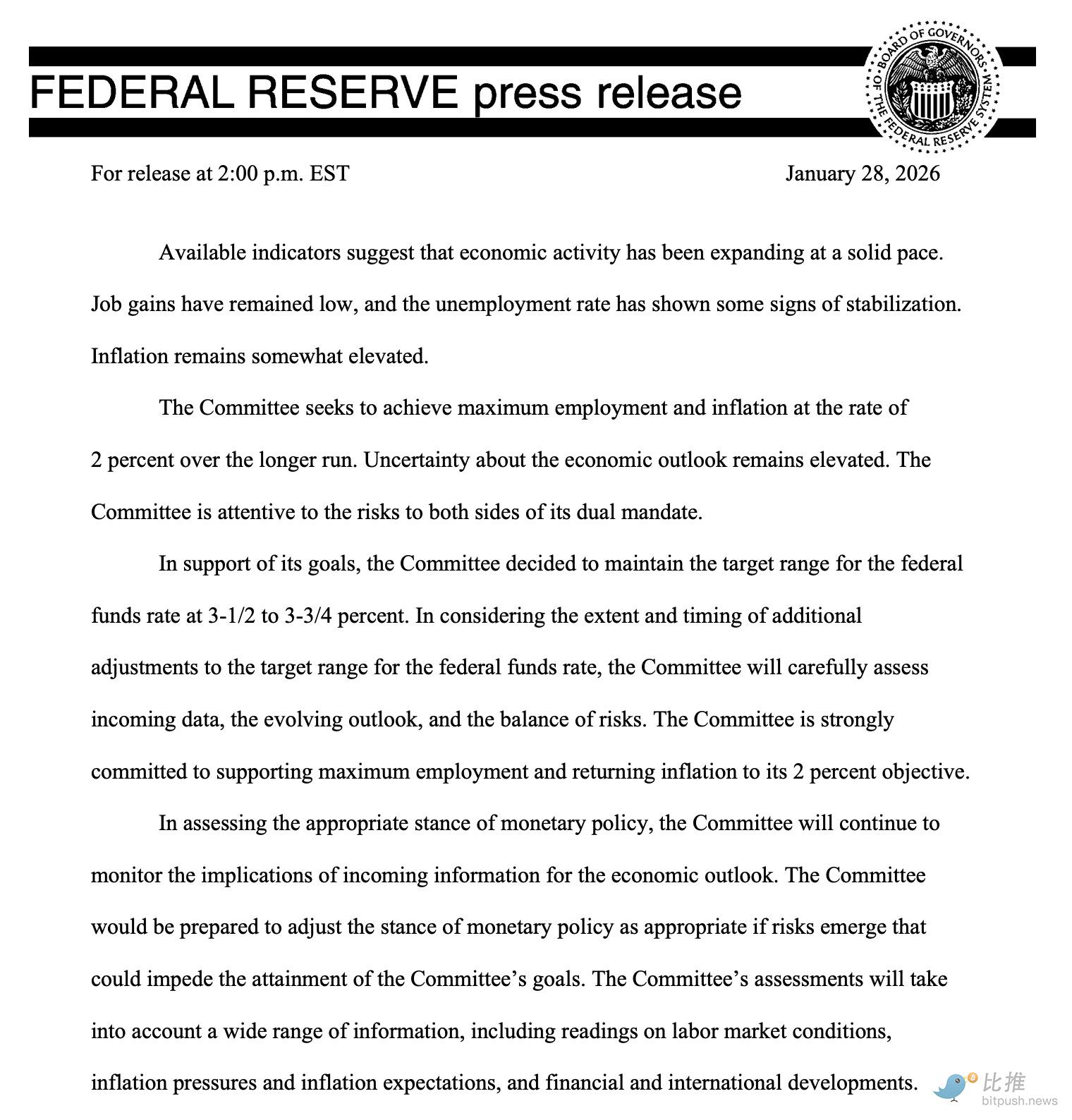
In the early hours of Thursday Beijing time, the Fed announced it would keep the benchmark interest rate in the 3.5% to 3.75% range. This somewhat “flat” decision aligned with over 97% of market expectations but also revealed subtle internal cracks: two Fed officials voted against the decision, supporting a further 25 basis point rate cut.
The Dust Has Settled but the Direction Is Unclear
In its policy statement, the Fed continued with a relatively cautious tone: the economy remains in “moderate expansion,” inflation has “eased but remains above the target,” signs of cooling in the labor market have appeared but do not yet constitute systemic risk. The key message is clear — monetary policy has shifted from “active adjustment” to “observation and verification” phase.
It’s worth noting that the internal consensus within the Federal Open Market Committee (FOMC) is not monolithic. Two members voted to continue rate cuts, indicating that between inflation easing and economic slowdown, policy stance still shows divergence. Overall, the Fed appears unwilling to make new policy commitments in the current environment, preferring to leave decisions to upcoming data.
This stance sets the tone for the market: in the short term, clear directional guidance is unlikely, and asset prices will focus more on “expectation changes” rather than “policy changes.”
The current Fed Funds rate market pricing shows investors generally expect rates to remain unchanged this quarter, with the first rate cut now projected to occur in June, and further expectations of a pause through 2027.
However, there are still significant disagreements among institutions regarding the rate path beyond this quarter: Morgan Stanley, Citigroup, and Goldman Sachs forecast rate cuts in June and September; Barclays believes cuts could happen in June and December; JPMorgan maintains expectations of unchanged rates throughout the year.
Macro Markets: Gold Leads the Way, Other Assets Remain Steady
If the Fed’s decision itself did not cause much turbulence, then the divergence in asset performance is the real signal worth noting.
Following the rate decision, spot gold prices surged, breaking through $5,500 per ounce for the first time. In just four trading days, gold prices rose from slightly below $5,000, breaking multiple hundred-dollar thresholds, with a total increase of over $500 and a weekly gain of 10%. This speed and magnitude made gold the undisputed star of the current global markets.
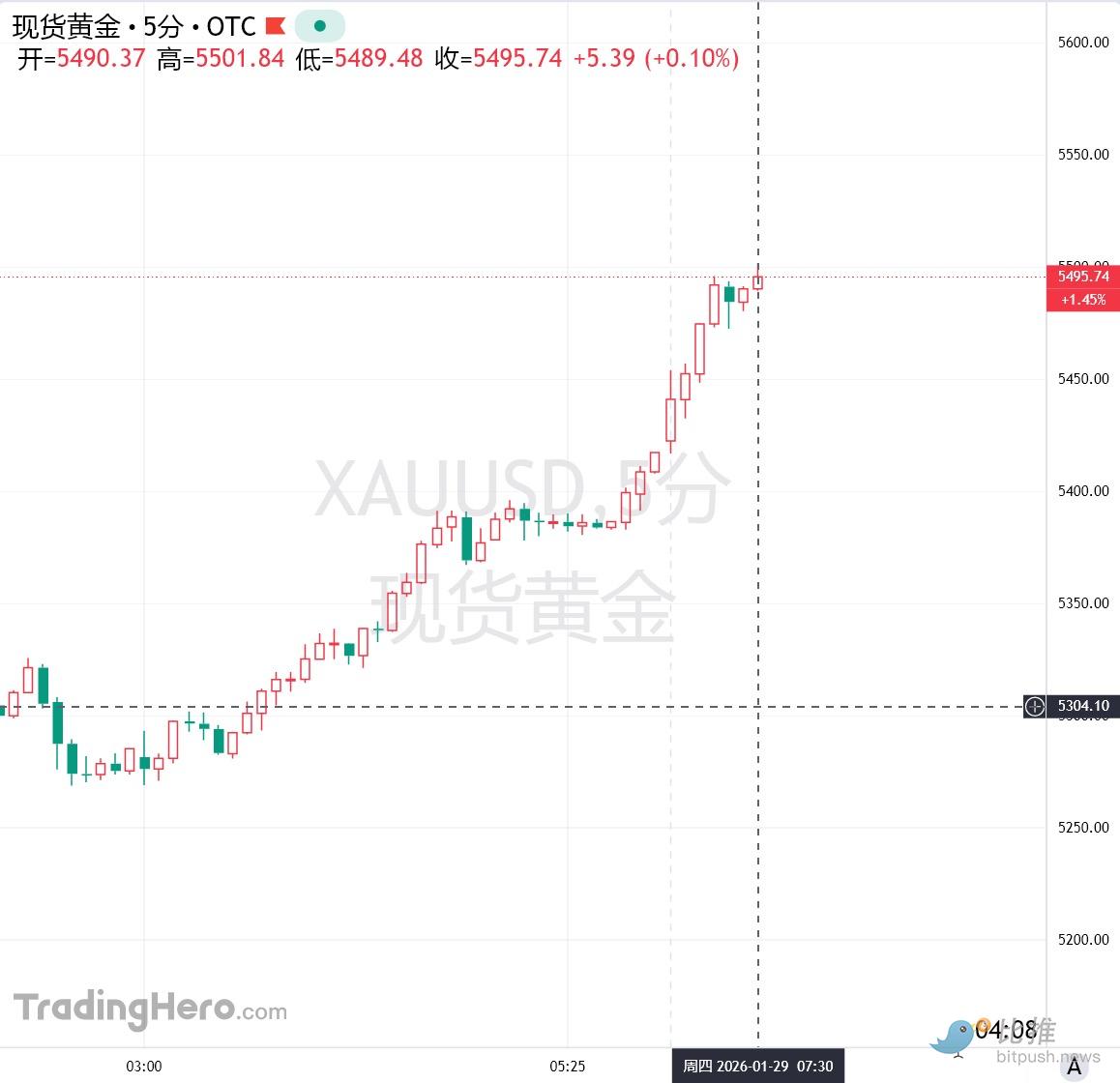
The strength of gold is not simply explained by interest rate logic. Although the Fed paused rate cuts, after a series of easing measures, policy is now close to neutral, easing the marginal constraints on real interest rates; meanwhile, persistent inflation, trade frictions, political uncertainties, and global policy battles continue to amplify safe-haven demand. Amid multiple uncertainties, capital has chosen the most traditional and consensus safe asset.
In stark contrast, other assets performed calmly. US stocks remained range-bound after the decision, with no trend breakout; the US dollar index showed limited volatility; US Treasury yields adjusted slightly but did not evolve into systemic safe-haven flows.
Cryptocurrencies behaved similarly. Bitcoin’s price, after the announcement, briefly dipped from $89,600 to $89,000, then quickly rebounded to around $89,300. Volatility was less than 1%. Ethereum (ETH) hovered around $3,000, while mainstream altcoins like Solana and XRP remained within previous fluctuation ranges.
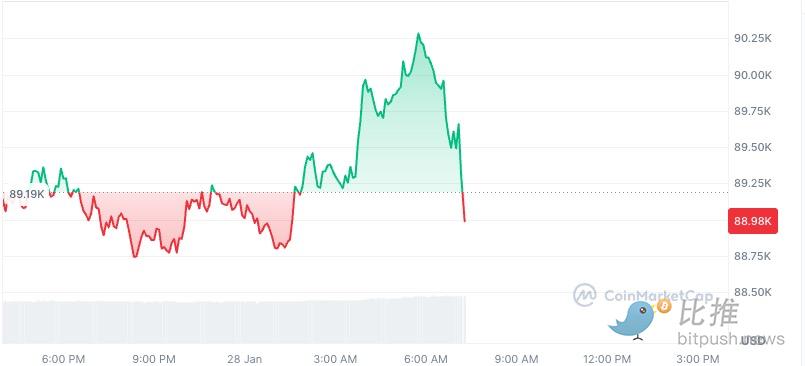
The market’s most straightforward answer: when the direction is unclear, gold is pushed back to center stage, while other assets enter a waiting mode.
More Important Than Rate Cuts: Who Will Shape the Next Phase of the Fed?
After the rate decision, market focus quickly shifted. Compared to “when will rates be cut,” investors are now paying more attention to another question: who will lead the next phase of the Fed?
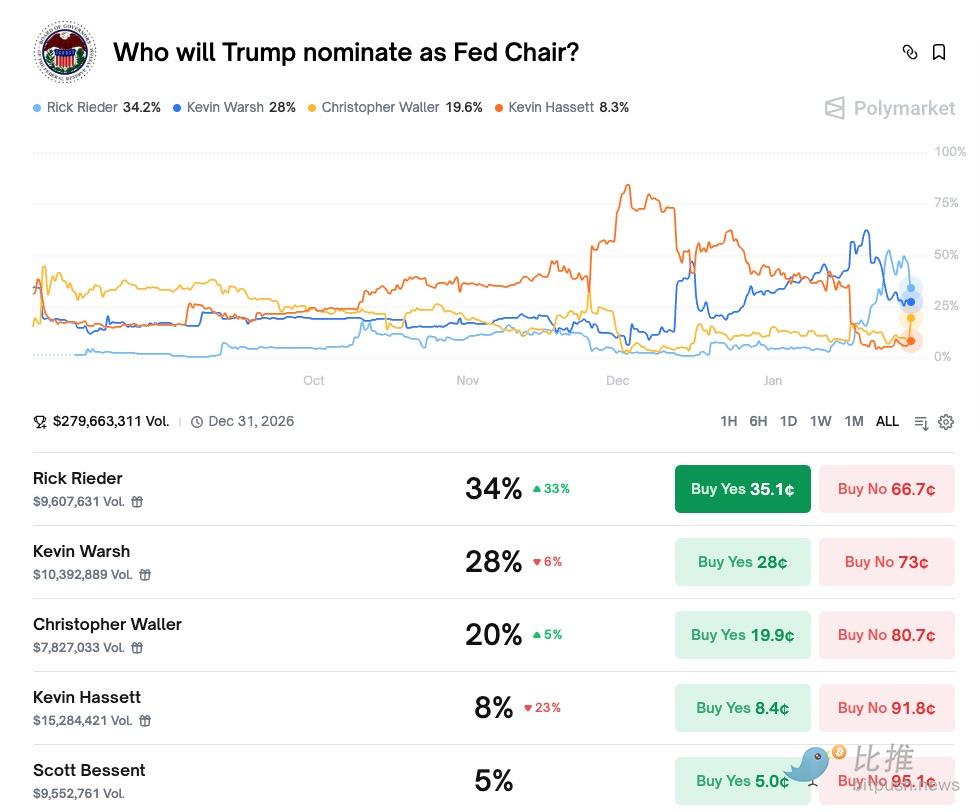
According to the latest data from Polymarket, in the betting market on “Who will Trump nominate as Fed Chair,” several candidates have pulled ahead:
Rick Rieder: The Market’s Favorite “Pragmatist” (about 34%)
Currently, the highest betting probability is for Rick Rieder, with support around 34%, and a recent upward trend.
Rieder is the Chief Investment Officer of Global Fixed Income at BlackRock, with long-term deep involvement in bond markets and macro asset allocation decisions. He is regarded as one of the few truly crossing “policy—market—fundamental structure” boundaries. His public views often emphasize financial market stability, policy transmission efficiency, and avoiding unnecessary systemic shocks.
Market expectations suggest that if Rieder becomes Fed Chair, monetary policy will focus more on financial conditions and asset price signals, maintaining flexibility within inflation tolerances. This expectation explains why he is increasingly supported in predictive markets — a bet on “predictability” and “market friendliness.”
Kevin Warsh: The Representative of Discipline and Credibility (about 28%)
Second place goes to former Fed Governor Kevin Warsh, with support around 28%.
Warsh is known for his clear stance and strong style, emphasizing the Fed’s credibility and long-term discipline on inflation. He has publicly expressed concerns about excessive easing and is seen as a key hawkish figure.
If Warsh wins, markets generally expect the Fed to be more cautious about rate cuts, asset price tolerance, and communication. This style tends to suppress inflation expectations but also requires risk assets to adapt to a tighter financial environment.
Christopher Waller: The Academic Fed Governor (about 20%)
The current Fed Governor Christopher Waller has about a 20% chance of being nominated, ranking third.
Waller has a strong academic background, with clear policy logic, and is regarded as one of the most influential hawks within the Fed (advocating high interest rates to curb inflation). However, in this FOMC, he voted against the rate cut, supporting continued easing, implying he believes inflation is no longer a major threat or is under political/economic pressure.
If Waller takes the helm, the Fed might give more weight to employment and growth targets, with a relatively flexible policy pace. But whether he can maintain independence in a highly politicized environment remains a key market concern.
Will Bitcoin Continue Its Bearish Trend?
Amid increasing macro uncertainties, on-chain data is beginning to send warning signals.
CryptoQuant’s latest analysis shows that the 365-day moving average of “Supply in Loss” for Bitcoin is rising again. This indicator measures the proportion of Bitcoin currently trading below its most recent on-chain transfer price, serving as an important tool to observe structural market changes.
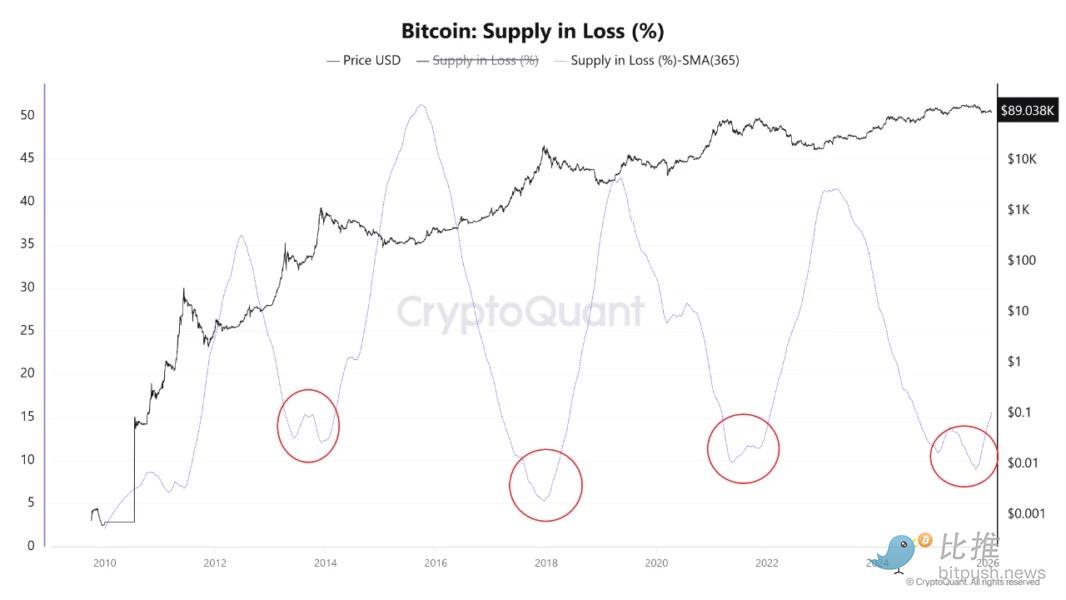
When Bitcoin hit a historical high of $126,000 in October last year, this indicator briefly dropped to its cycle’s lowest point, reflecting a highly profitable market. But as prices retreated, the Supply in Loss started to rise steadily, indicating that losses are gradually spreading from short-term traders to longer-term holders.
Historical experience suggests that such directional shifts often occur early in market transitions from bull to bear. However, it’s important to note that the indicator has not yet reached the typical “capitulation zone,” and currently signals more of a risk warning than a confirmed trend.
This means Bitcoin’s current state is closer to digesting high levels and restructuring rather than entering a clear bear market phase. Whether it will evolve into a deeper correction still heavily depends on macro liquidity and subsequent capital flows. Gabe Selby, Head of Research at CF Benchmarks, states: “Short-term bullish catalysts for Bitcoin still exist, but they are increasingly political rather than monetary in nature.”
Summary: Macro Uncertain, Structural Changes Underway, Markets Await Answers
Overall, this round of market changes is not driven by a single event but results from multiple factors working together; capital is embracing gold amid uncertainty, pushing safe-haven sentiment to the forefront; and Bitcoin’s next move still requires further convergence of macro and cycle signals.