
Crypto giant Tether Holdings has become the world’s largest gold reserve holder outside of banks and nations, currently holding about 140 tons of gold with a total value of $23 billion, continuously increasing at a rate of 1 to 2 tons per week. These gold reserves are stored in Swiss nuclear bunkers. Analysts point out that Tether’s purchases may have contributed to last year’s 65% surge in gold prices.
Swiss Nuclear Bunkers Hide the Largest Gold Reserves in the Crypto World
According to Bloomberg, Switzerland has approximately 370,000 Cold War-era nuclear bunkers, most of which have been unused for many years. However, Tether Holdings has converted one into a high-security vault, receiving over 1 ton of gold shipments weekly. Tether CEO Paolo Ardoino revealed in an interview that this storage facility “is a typical James Bond-style place, it’s crazy.”
Why choose nuclear bunkers as a gold storage location? These Cold War-era structures possess security features that modern vaults cannot match. First, they are designed to withstand nuclear attacks, with walls and structural strength far exceeding ordinary buildings. Second, these facilities are usually located deep underground, naturally shielding them from external threats. Third, multi-layer steel doors and complex access control systems provide additional security. For institutions holding hundreds of billions of dollars in physical gold, such physical security is crucial.
Ardoino emphasized that owning physical gold rather than paper gold or gold futures contracts is central to the company’s strategy. In the crypto world, the saying “not your keys, not your coins” applies, and Tether extends this logic to gold: only by physically controlling gold bars can assets be secured in extreme situations. This approach differs sharply from many traditional financial institutions that rely on custodial accounts or derivatives.
Switzerland is also a deliberate choice as a storage location. The country has long been a hub for global gold trading and storage, with a mature legal framework, political stability, and strict banking secrecy traditions. A large volume of physical gold circulates through Swiss refineries, enabling Tether to efficiently buy and store gold bars locally. Additionally, Switzerland’s neutral stance provides extra security during geopolitical tensions.
Purchased Over 70 Tons Last Year, Surpassing Most Central Banks’ Purchases
According to Bloomberg calculations, Tether rapidly increased its gold purchases last year, acquiring over 70 tons for reserves and its own gold-backed stablecoin. This scale is astonishing: it surpasses nearly all individual central bank purchases, with only Poland increasing its gold reserves by 102 tons through public purchases. Moreover, this figure exceeds all other purchases outside the top three ETF funds, which represent the collective activity of thousands of individual traders and investors.
Tether’s Gold Reserve Comparison
Current holdings: approximately 140 tons, valued at $23 billion
2024 purchases: over 70 tons, surpassing most central banks
Purchase rate: 1 to 2 tons weekly, planned to continue for several months
Ranking: known as the largest reserve outside of central banks, ETFs, and commercial banks
This scale of purchase is extremely rare in the history of the gold market. Usually, only sovereign nations or ETFs representing millions of investors have such large-scale buying capacity. Tether, as a private crypto company, buying 70 tons of gold in a year, demonstrates remarkable financial strength. The company profits from its USDT stablecoin, which is a giant in the field with a circulation of $186 billion. It exchanges real dollars for USDT tokens and invests these funds in U.S. Treasuries and other assets, earning billions in interest and trading profits.
Ardoino stated that Tether’s weekly purchase rate is about 1 to 2 tons, and plans to continue this “over the next few months.” When asked whether they might reduce gold purchases at some point, the 41-year-old Italian said, “Maybe we will reduce, but not sure yet. We will evaluate the demand for gold quarterly.” This ongoing purchase commitment suggests Tether may add several more tens of tons of gold in the coming months, further solidifying its position in the global gold market.
It’s worth noting that Tether’s 140-ton gold reserve consists of two parts. Most is its own reserve, generated from profits of its USDT stablecoin business. The other part is gold bars backing its gold-backed stablecoin, allowing investors to hold gold exposure via blockchain. This dual-purpose strategy supports Tether’s core stablecoin business while creating new revenue streams.
Recruiting Top Traders from HSBC to Build Gold Trading Capabilities
Tether’s ambitions in the gold market are not limited to passive holdings. Last year, when two senior gold traders resigned from HSBC Holdings, the world’s largest precious metals bank, industry speculation about their destination was rampant, but few guessed it was Tether. Their addition indicates Tether’s desire not only to be a major gold buyer but also to compete with banks in gold trading.
HSBC is a key player in the global gold market, responsible for setting the daily benchmark price for the London Bullion Market Association (LBMA), and providing trading services to global mining companies, central banks, and investors. Recruiting senior traders from such an institution means Tether is gaining deep market expertise, client relationships, and trading strategies. These professionals understand the nuances of the gold market, including liquidity management, hedging strategies, and regulatory environment.
Ardoino compared the company’s role in the gold market to that of a central bank, predicting that Washington’s geopolitical rivals will launch an alternative dollar currency backed by gold. He revealed that Tether plans to continue investing its huge profits into gold and is beginning to compete with banks in gold trading. Ardoino said, “We will soon become one of the world’s largest gold reserve banks.”
This ambition reflects the blurring lines between crypto and traditional finance. Tether, originally a digital asset company, is transforming into a hybrid financial institution with physical gold trading capabilities. This shift could reshape the competitive landscape of the gold market, as traditional banks face a new rival with substantial capital, technological innovation, and a global customer base.
Analysts: Tether Could Drive Gold Prices Up 65%
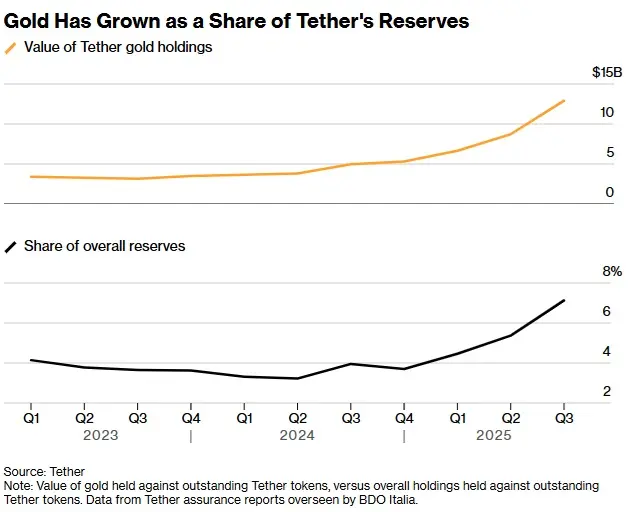
(Source: Bloomberg)
The confidentiality of the gold market means that, while broad investment drivers can be easily described, pinpointing exactly who is behind purchases can be more difficult. However, Tether’s publicly disclosed scale of buying is so large that some market observers explicitly attribute a role to it in global price movements.
Jefferies Financial Group analysts stated in a report that Tether’s purchases may have contributed to last year’s 65% increase in gold prices, describing Tether as “an important new buyer” that “may drive continued demand for gold.” This assessment is significant because it links the actions of a single entity to the overall market trend.
Gold prices over the past year have indeed been astonishing, breaking $5,100 per ounce to hit record highs. This rally is often attributed to multiple factors, including central bank buying, geopolitical tensions, inflation fears, and declining dollar confidence. However, Tether as a “hidden whale” may be an underestimated driver. When a buyer consistently purchases 1 to 2 tons of gold weekly, this steady and predictable demand can support prices and attract other buyers to follow.
The intersection of Tether and the gold market symbolizes the merging worlds of cryptocurrency and gold, both sharing a common distrust of government debt. Crypto enthusiasts and gold advocates tend to question the long-term value of fiat currencies and seek alternative stores of value. By holding both digital stablecoins and physical gold, Tether creates a unique business model connecting these two worlds.


