Glassnode and Coinbase Institutional jointly release the Q1 2026 report, revealing structural market shifts after de-leveraging: BTC market share approaching 59%, systemic leverage ratio dropping to 3% of the total cryptocurrency market cap, and options open interest surpassing perpetual futures for the first time.
De-leveraging Reshapes Market Structure
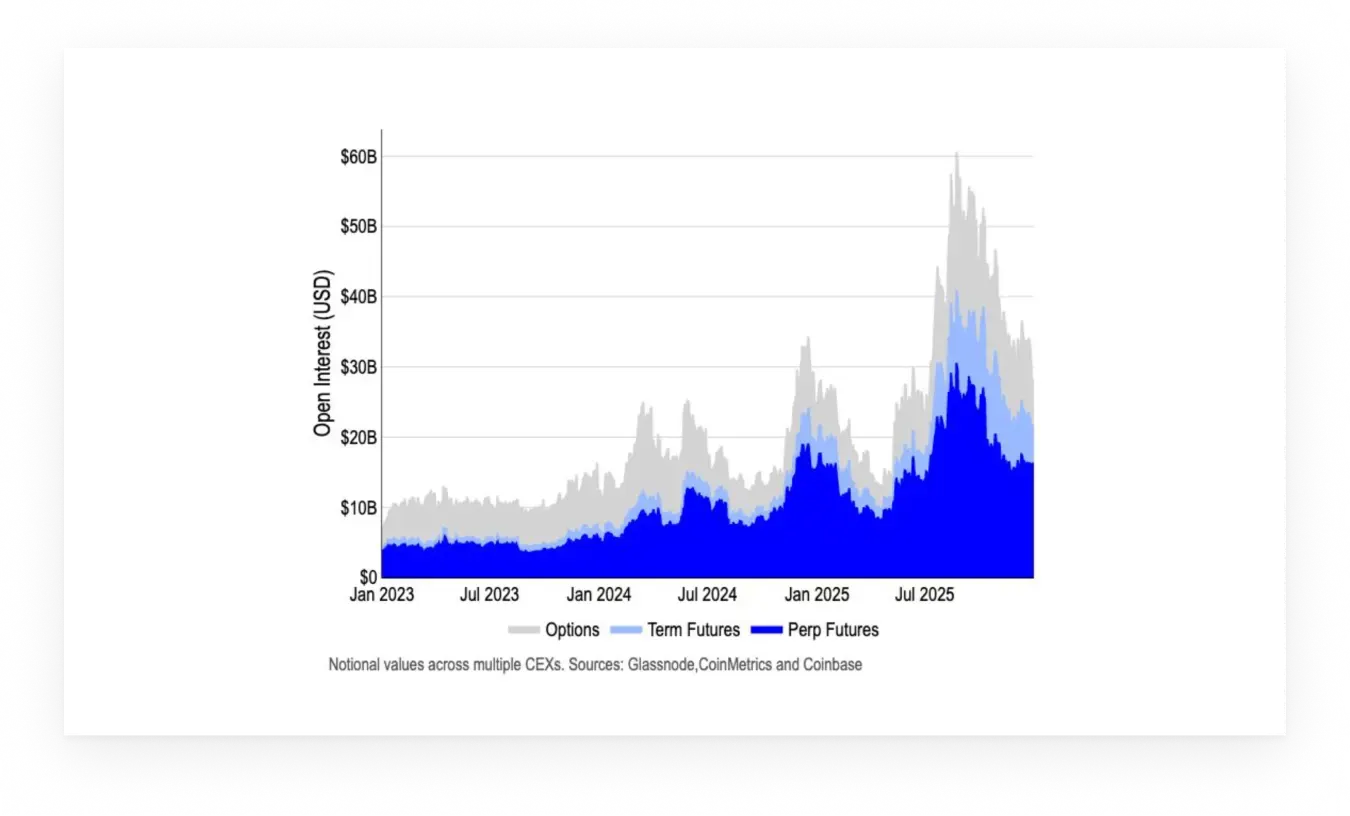
After the October 2025 liquidation event, the digital asset market entered 2026 with a clearer structure, lower leverage, and more cautious risk appetite. Glassnode data shows that large-scale liquidations of perpetual futures positions caused the systemic leverage ratio, excluding stablecoins, to fall to about 3% of the total crypto market cap. This marks a stark contrast to the high-leverage market environment of most of 2024 and early 2025.
This de-leveraging is not a market collapse but a process of risk repricing. The Glassnode report indicates that market participants are not entirely avoiding risk but reallocating their risk exposure into the options market. Currently, open interest in Bitcoin options has exceeded that of perpetual futures, with positions leaning toward defensive structures such as protective puts and collar strategies. This shift reflects a market preference for manageable risk exposure, moving from “high leverage chasing gains” to “limited risk participation.”
From a market structure perspective, even if short-term sentiment remains cautious, this transition helps build a more resilient trading environment. Low leverage means future price volatility is less likely to trigger chain reactions of liquidations, and the options-dominated structure allows investors to manage risk more precisely. This is the core reason why Glassnode believes 2026 will see a market with “structural resilience stronger than previous cyclical shifts.”
BTC Market Share at 59%: Small Altcoins Losing Momentum
Although small and mid-cap assets have failed to sustain previous gains, Bitcoin maintains a structural lead with a market share approaching 59%. This is the highest level since the 2021 bull market peak, reflecting a trend of capital flowing into “safe-haven assets.” Glassnode data shows that in uncertain environments, investors prefer allocating to the largest, most liquid assets rather than chasing high-risk, high-reward altcoins.
Behind this market share increase is the continued outflow from small and mid-cap coins. In Q4 2025, aside from a few leading DeFi tokens and AI-related coins, most altcoins significantly underperformed compared to BTC and ETH. The Relative Strength Index (RSI) from Glassnode indicates that over 70% of small and mid-cap tokens are in the “relative weakness” zone, meaning even if the overall market warms up, these tokens are unlikely to rebound in sync.
Three Main Drivers of BTC Market Share Growth
Institutional Preference: Coinbase institutional surveys show that amid ongoing geopolitical uncertainties, institutions favor investing in large-cap stocks
Liquidity Concentration: Trading volume is increasingly focused on BTC spot and derivatives markets, with trading depth in small altcoins continuing to shrink
Narrative Simplification: The market is shifting from complex narratives like DeFi, NFTs, and GameFi back to the simple logic of “digital gold”
Glassnode believes this market share structure is unlikely to reverse in the short term. Unless new killer applications emerge or regulatory environments improve dramatically, capital will continue to flow toward BTC. For investors, this suggests that “choosing the right sector” is more important than “finding ten-bagger coins.”
Bitcoin Supply Activity Surges to 37% Indicating Volatility
Glassnode’s on-chain data reveals another key signal: investor positions suggest Bitcoin supply will be active within three months, with the proportion of supply moved in Q4 2022 rising to 37%, while long-dormant supply has slightly decreased. Changes in supply activity are often associated with increased market volatility, as more holders consider moving their positions.
What does a 37% active supply mean? It indicates approximately 7.7 million BTC (out of a total supply of 21 million) have moved on-chain in the past three months, including exchange deposits, withdrawals, and wallet transfers. Historical data from Glassnode shows that when this ratio exceeds 35%, the market is often in a “decision window”—holders are reassessing their positions, which can lead to sharp price swings in either direction.
The slight decline in long-dormant supply (usually defined as BTC that hasn’t moved in over 3 years) is also noteworthy. These “HODLers” tend to move only during extreme optimism or pessimism. Data suggests that some long-term holdings bought at the 2021 bull peak are now being unlocked, possibly reflecting that these holders believe current prices are near a reasonable profit-taking zone.
From a trading strategy perspective, rising supply activity requires investors to be more alert to short-term volatility. Glassnode recommends that during periods of active supply, breakout movements—upward or downward—are more likely, as market liquidity structures become more fragile.
Market Sentiment Remains Anxious but Structure Is Stable
Entering Q1 2026, Bitcoin market sentiment remains subdued. Glassnode’s Unrealized Profit/Loss (NUPL) indicator shifted from optimism to anxiety during October’s liquidation event and has since stabilized at a lower level. This reflects that even if macroeconomic conditions and price structures stabilize, market participants remain cautious.
Historical patterns suggest that prolonged anxiety often coincides with consolidation phases, where investors stay engaged but are cautious about re-taking directional risks. Glassnode believes that, structurally, if volatility narrows or macroeconomic conditions remain stable, sentiment could improve. Key catalysts might include clarity from US regulators, continued ETF inflows, or major institutions announcing new BTC allocation plans.
However, anxiety and market structure stability are not mutually exclusive. The report emphasizes that the current “structural resilience”—characterized by low leverage, options dominance, and increased institutional participation—means that even if short-term sentiment fluctuates, systemic collapse akin to 2022 is unlikely.
Deep Implications of Ethereum Cycle Signal Failure
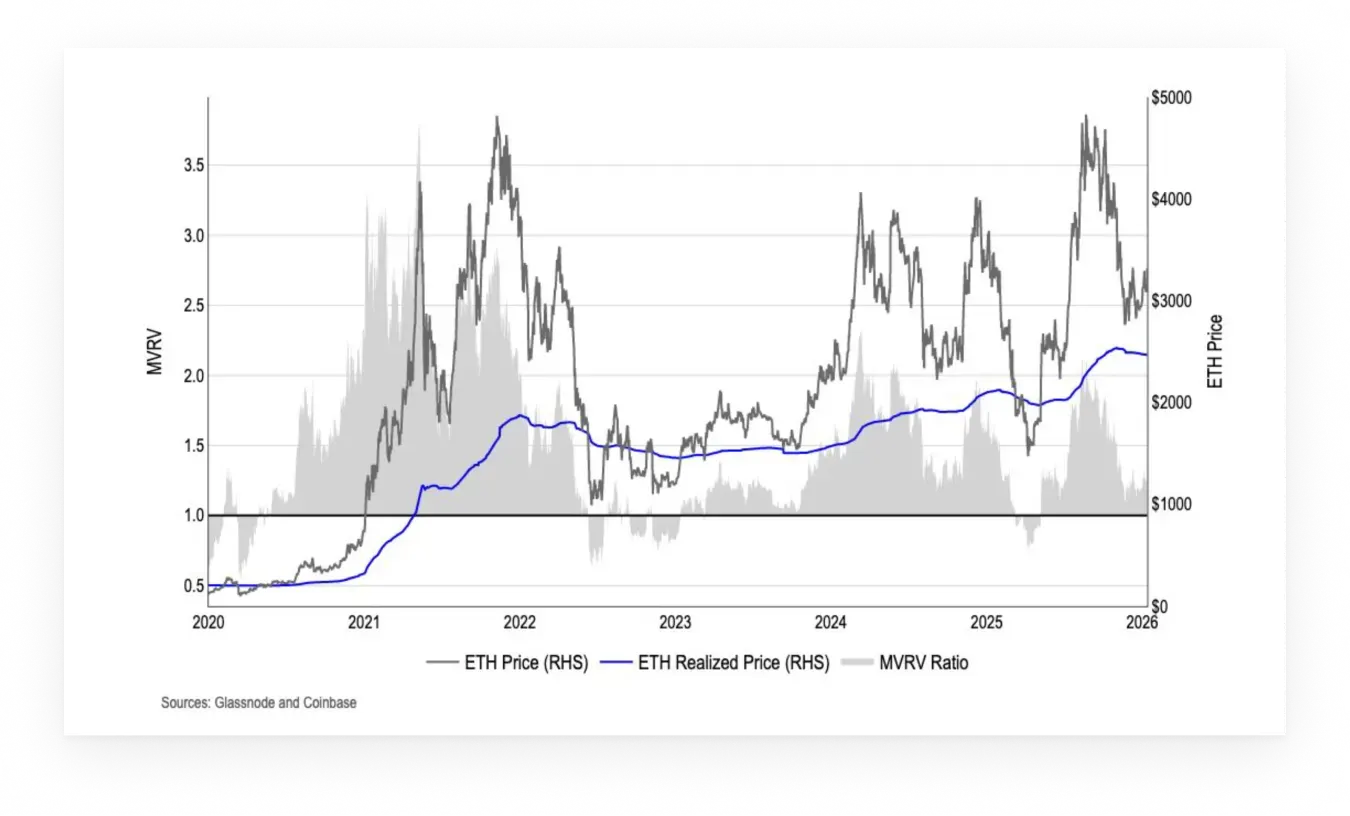
Glassnode’s analysis of Ethereum reveals a significant shift: traditional cycle frameworks are losing predictive power. ETH appears to be approaching the late stage of its current price cycle (which began at the June 2022 lows), but recent indicators suggest cycle-based signals are becoming less reliable.
The primary reason is structural changes within the Ethereum ecosystem. Explosive growth in Layer-2 solutions has led to a sharp decline in mainnet fee revenue. Glassnode data shows that ETH burn rate (via EIP-1559) has shifted from a deflationary state at its peak in 2021 to a more moderate inflation. Additionally, staking yields, MEV extraction, and complex DeFi interactions make ETH’s value accumulation mechanisms harder to quantify.
Therefore, despite the increasingly evident late-cycle features in ETH, cycle timing as an independent indicator for future performance is diminishing. Glassnode believes that ETH’s market trajectory is now more influenced by broader liquidity conditions and relative positioning rather than solely cycle duration. This suggests that traditional “four-year cycle” trading strategies may no longer be suitable for ETH, requiring a shift toward more dynamic fundamental and technical analysis frameworks.
Disclaimer: The information on this page may come from third parties and does not represent the views or opinions of Gate. The content displayed on this page is for reference only and does not constitute any financial, investment, or legal advice. Gate does not guarantee the accuracy or completeness of the information and shall not be liable for any losses arising from the use of this information. Virtual asset investments carry high risks and are subject to significant price volatility. You may lose all of your invested principal. Please fully understand the relevant risks and make prudent decisions based on your own financial situation and risk tolerance. For details, please refer to
Disclaimer.
Related Articles
Bitcoin ETFs See $213M Daily Inflow, Ethereum ETFs Record $83M Outflow on April 24
Gate News message, according to the April 24 update, Bitcoin ETFs recorded a single-day net inflow of 2,733 BTC (approximately $213.15 million), with a 7-day net inflow of 18,232 BTC (approximately $1.42 billion). Ethereum ETFs showed a single-day net outflow of 35,713 ETH (approximately $82.93 mill
GateNews2h ago
Bitcoin Breaks $78,000 but Falls 0.47% Intraday
Gate News message, April 24 — Bitcoin broke through $78,000 today, though it recorded a 0.47% decline over the intraday period.
GateNews3h ago
Project Eleven awards Q-Day 1 BTC bounty: researchers use a quantum computer to crack a 15-bit elliptic curve key
Project Eleven, a nonprofit organization focusing on research into “Q-Day (Quantum Computer Breaks Blockchain Cryptography Day),” announced on 4/24 that it would award a $1 Bitcoin bounty to independent researcher Giancarlo Lelli. Using a Shor algorithm variant on publicly accessible cloud quantum computer hardware, Lelli successfully cracked a 15-bit elliptic curve key—marking the largest public quantum attack demonstration to date.
Attack Scale and Significance
Project Content Winner Giancarlo Lelli (Independent Researcher) Attack Target 15-bit elliptic curve key, searching 32,767 possibilities Using Hardware Publicly accessible cloud quantum computers Algorithm Shor
ChainNewsAbmedia3h ago
Nasdaq-Listed Nakamoto Unveils Active Bitcoin Derivatives Strategy Since Q1 2026
Gate News message, April 24 — Nakamoto, a Nasdaq-listed company, has announced an actively managed Bitcoin derivatives program running since Q1 2026. The strategy aims to generate recurring volatility income from a portion of the company's Bitcoin holdings while hedging against downside price
GateNews3h ago
Metaplanet Issues $50 Million in Zero-Interest Bonds to Fund Bitcoin Purchases
Gate News message, April 24 — Japanese bitcoin treasury firm Metaplanet announced on Friday that it is issuing 8 billion Japanese yen (approximately $50 million) in zero-interest ordinary bonds to fund future bitcoin purchases. The bond issuance was fully subscribed by EVO Fund, a Cayman
GateNews4h ago
Abraxas Capital Deposits 4,835 BTC Worth $378M to Major CEX
Gate News message, April 24 — According to on-chain data tracked by Lookonchain, Abraxas Capital deposited 4,835 BTC, valued at approximately $378 million, to a major CEX in the past hour.
The institutional investor also transferred 6,000 XAUT tokens, worth approximately $28 million, to several maj
GateNews4h ago


