Pi Network Token PI rebounded 6% in the past 24 hours to $0.1881, strongly bouncing off the key support level at $0.180. Despite a 93% plunge from the all-time high of $2.99, technical indicators show signs of a turnaround. The RSI of PI has been below 50 for about 8 consecutive months, indicating extreme oversold conditions, and has broken through a steep downtrend channel. This rare phenomenon suggests a potential significant breakout or an eventual decline.
Technical significance of the rebound from the $0.18 key support level
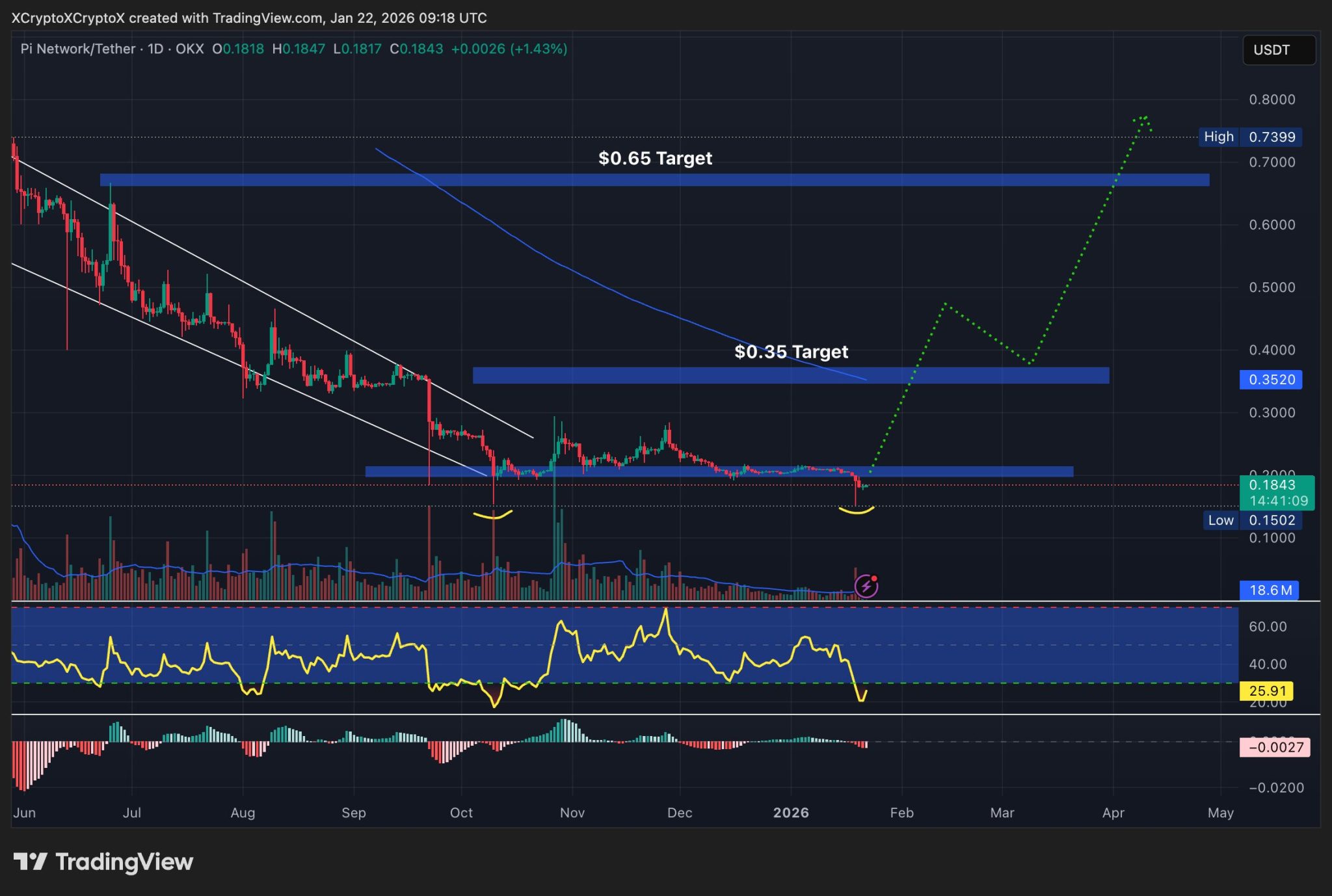
(Source: Trading View)
In the past 24 hours, Pi Network token price rebounded 6%, rising to $0.1881, as President Trump’s remarks on the Greenland issue eased, boosting market sentiment. Although there was a rebound, PI still declined 9% over the past week and 7% over the past month. Since reaching a historic high of $2.99 last February, this altcoin has fallen 93%.
However, today’s rebound indicates that PI may have bounced off the critical support zone around $0.180, where it previously found a bottom. From today’s Pi Network price chart, it’s evident that after staying in the oversold zone for too long, the token has begun a strong rebound. Why is the $0.18 level so crucial? From a technical analysis perspective, it is a confluence point of multiple support factors.
Firstly, looking at volume distribution, there is a large amount of historical trading activity near $0.18, meaning many investors’ costs are concentrated in this range. These holders are strongly motivated to defend their positions when the price falls back to their cost basis, forming natural buy support. Secondly, this level is close to previous key lows during corrections, where classic technical analysis suggests that prior lows often provide support during subsequent retracements.
More importantly, the support around $0.18 has been tested multiple times. The price has repeatedly bottomed out and rebounded in this zone, with each test failing to break below it effectively. This repeated validation enhances the reliability of this support. Technical analysts generally believe that the more times a support level is tested, the more significant it becomes. However, it also means that once broken, the subsequent downward momentum could intensify.
Considering Pi Network’s community efforts to make Pi Coin and its platform more useful, the long-term price outlook for Pi Coin remains promising. If the $0.18 support can hold, combined with other positive technical signals, PI could initiate a new rebound cycle.
Rare phenomenon of 8 months of extreme oversold conditions
In fact, aside from a few brief rebounds in late October and late November, PI’s Relative Strength Index (RSI) has been below 50 for about 8 consecutive months. For a top 100 cryptocurrency, such a situation is extremely rare, leading to only two possible conclusions: Pi Network’s price is about to make a significant breakout, or it is experiencing its final decline.
RSI is a momentum indicator measuring the speed and change of price movements, ranging from 0 to 100. Typically, RSI below 30 indicates oversold conditions, while above 70 indicates overbought. The neutral level is 50, serving as a dividing line between bullish and bearish momentum. Sustained RSI below 50 suggests that the bears have maintained dominance. An 8-month RSI below 50 in a mainstream crypto is exceedingly rare.
Historically, such extreme oversold states tend to resolve in two ways. The first is a strong rebound, where the selling pressure is fully released, and RSI begins to rise, often resulting in a sharp technical bounce as oversold conditions attract bargain-hunting speculators. The second is a continued decline toward zero, especially if fundamentals worsen and no new catalysts emerge, making the oversold state a mid-point in a prolonged downtrend.
For Pi Network, this technical setup indicates that the price is at a critical turning point. If RSI can break above and stabilize above 50, it would signal a trend reversal from downtrend to uptrend, attracting trend followers. Conversely, if RSI remains low or dips further, it could indicate deeper corrections ahead.
It’s worth noting that PI has broken out of a steep downtrend channel. This is a significant technical signal, as a channel breakout often marks the end of a downtrend and the start of a new upward trend. Coupled with the recent bounce from $0.18, there is a real possibility of seeing this cryptocurrency reach new levels soon.
The double-edged sword of absence from three major exchanges
On the other hand, skeptics might argue that this behavior indicates the coin is undergoing its final decline, especially considering PI’s failure to list on major exchanges, which could be a fundamental challenge. This is one of the biggest hurdles Pi Network faces.
Listing on major exchanges is crucial for liquidity, visibility, and institutional adoption. Not being listed on top centralized exchanges (CEXs) means Pi Network misses out on access to a large pool of potential buyers. Moreover, exchange listings are often seen as endorsements of project quality, as they involve due diligence on technology, team, and compliance.
The reasons for Pi Network’s absence from major exchanges could be multifaceted. One possibility is that the project has not yet met the listing standards of these exchanges, such as technical maturity, liquidity requirements, or regulatory documentation. Another is that Pi’s distribution model and community governance structure may not align with traditional exchange operations. It’s also possible that the Pi team prefers to focus on developing its own ecosystem rather than rushing to list on exchanges.
However, this “absence” can also be a double-edged sword. From a negative perspective, it limits liquidity and price discovery efficiency. From a positive angle, it maintains a higher degree of decentralization and reduces reliance on a single exchange. Moreover, if Pi Network eventually gets listed on major exchanges, it could serve as a powerful price catalyst, similar to other tokens that surged after listings on Binance or Coinbase.
Large community support is a long-term value driver
Nevertheless, it’s important to emphasize that Pi Network still has a large and active community, which will help enhance its usability and value in the long run. Since its launch, Pi has attracted millions of users through its unique mobile mining model, creating a user base that many other crypto projects cannot match.
Community size is Pi Network’s greatest competitive advantage. In crypto, network effects are vital: the more users, the higher the network’s value. A large user base means Pi has the potential to become a mainstream payment tool or platform. If the community remains active and engaged in ecosystem development, Pi’s long-term prospects look brighter.
The community’s ongoing efforts to make Pi Network and its platform more useful are also noteworthy. From developing dApps, building merchant acceptance, organizing offline events, to educational outreach, Pi’s community demonstrates strong self-organization. This grassroots ecosystem development, though slow, tends to be more resilient and sustainable.
From an investment perspective, Pi Network is currently in a high-risk, high-reward phase. The technical signals suggest possible reversal, but fundamental challenges remain significant. For risk-tolerant investors, the current extreme oversold state may present a buying opportunity on dips. For conservative investors, waiting for clearer trend confirmation signals (such as RSI breaking above 50 or major exchange listings) might be more prudent.


