
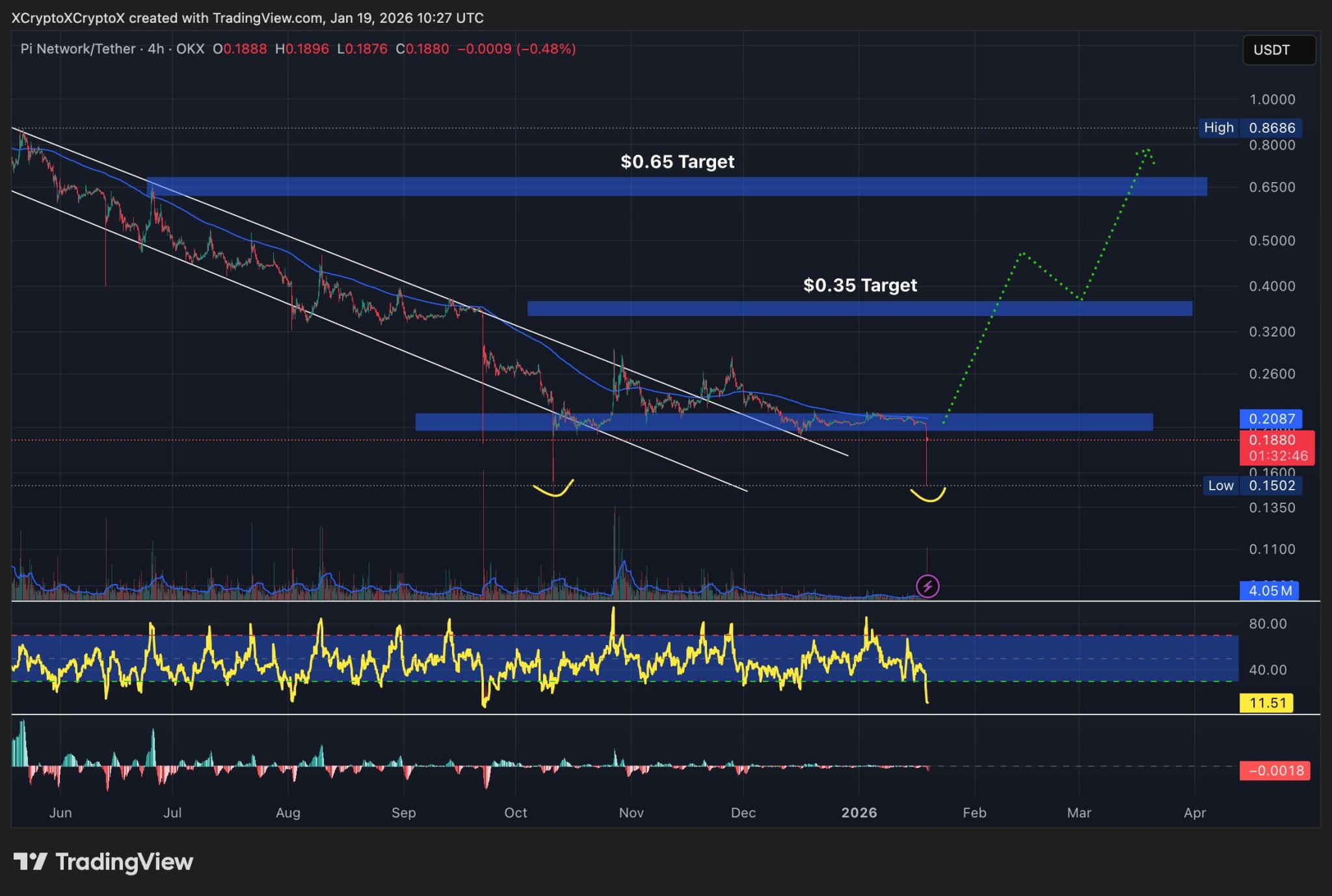
Pi has plummeted 8% in the past 24 hours to $0.188, crashing 93.7% from its February all-time high of $2.99. However, technical indicators show signs of bottoming out, with RSI dropping to 11.5, hitting a one-year low and entering an extremely oversold zone. A similar rebound occurred in October after a sharp decline, rising to $0.289.
Pi’s Crash of 93.7% Sets Record for Worst Decline
In the past 24 hours, Pi’s price fell 8%, reaching $0.188, while the entire crypto market declined 2.5% today. Over the past week, PI has decreased 9%, and over the past month, it has fallen 11%. Since hitting its all-time high of $2.99 on February 26, this altcoin has suffered a catastrophic 93.7% drop.
Such a decline is considered extreme in crypto history. A 93.7% drop means investors have lost over 90% of their principal, a level of devastation only seen during major events like the 2018 bear market and the Terra Luna collapse in 2022. For investors who bought Pi at its peak, this has been a disaster—$10,000 invested is now worth only $630.
Despite the current dire situation, PI has already shown a bottoming rebound in the past day, strongly indicating a potential reversal. Given Pi’s large community—one of the biggest among all altcoins—its price outlook could turn bullish very soon. Pi claims to have over 30 million active users, a community base that most small coins cannot match. Even if only 10% are truly active, that still amounts to 3 million users, enough to support certain market demand.
From another perspective, the 93.7% crash also implies that downside potential is now very limited. Continuing to cut from $0.188 would only bring it down to $0.094, and a 100% rebound from that low would bring it back to $0.376. This asymmetric risk-reward profile makes the current price attractive to investors with high risk tolerance.
RSI Dropped to 11.5, Entering Extreme Oversold Zone
(Source: Trading View)
Looking at Pi’s chart today, all indicators are at their lows. Especially the Relative Strength Index (yellow), which has plunged to 11.5, a one-year low. RSI below 30 is generally considered oversold, and an 11.5 reading is extremely oversold, often signaling a short-term technical rebound.
In recent days, its MACD has also turned clearly negative. Based on other recent declines over the past few months, Pi’s price may need to fall further before a true recovery begins. The MACD (Moving Average Convergence Divergence) turning negative indicates the downtrend persists. Although RSI is oversold, MACD has not yet shown a reversal signal. This divergence suggests the price could oscillate at the bottom for a period.
A notable feature of the chart is that since reaching $1.24 in May last year, Pi has been trading within a steady declining range. Currently, its price is actually above that range, implying it might fall back into this zone before any rebound begins. This technical insight provides an important risk warning: if the price breaks below the downtrend channel, it could test lower support levels.
On the positive side, the previous sharp decline did trigger a significant rebound, as seen in October when Pi rose to $0.289. This historical example supports the current rebound expectation. The October rebound was about 50%. If a similar proportion of rebound occurs now from $0.188, the target price would be in the $0.28–$0.30 range.
Pi Technical Indicators Overview
RSI: 11.5 (Extremely oversold, lowest in history)
MACD: Clearly negative (downtrend continues)
Support levels: $0.188, lower boundary of the descending channel
Resistance levels: $0.25, $0.35
Historical rebound reference: October rebound from lows to $0.289
Therefore, we might see similar movements in the coming weeks, with Pi’s next medium-term target at $0.35. This target is based on technical rebound potential and historical trend comparison, representing about an 86% upside from current levels. Achieving this could offer substantial gains for short-term traders.
Platform Development and Exchange Listings Are Long-Term Key
In the long run, Pi’s price forecast largely depends on its organic growth as a platform and the possibility of being listed on new exchanges. Honestly, Pi’s periodic updates and new features make the platform more efficient for users and developers. This provides a broader foundation for adoption and promotion. Over the long term, its price could surpass $1 or even $1.50 by year-end.
Recent features include the “2025 Review,” developer payment library, support for 100 types of wallets, etc., indicating active ongoing development. The developer payment library allows applications to integrate Pi payments within 10 minutes, a low-entry barrier that could attract more dApps to build within the Pi ecosystem. As real use cases increase, Pi’s utility will improve, providing fundamental support for its price.
Mainstream exchange listings are the biggest uncertainty in Pi’s price forecast. Currently, Pi is mainly traded on smaller exchanges with limited liquidity. If a new round of CEX listings is initiated, it could bring a significant boost in liquidity and user base. However, these exchanges have strict standards, including technical security, project transparency, and legal compliance. Pi’s KYC delays and incomplete mainnet features may be reasons it hasn’t yet gained top-tier exchange approval.
Fundamentally, Pi faces the challenge of proving its actual value. Unlike Bitcoin or Ethereum, Pi lacks widely recognized use cases or technological innovations. Its main asset is a large user base, but how many will actually use Pi for transactions or payments remains uncertain. If most users are just holding for appreciation without real usage, Pi’s intrinsic value will be questioned.
(# Three Major Preconditions for Long-Term Pi Price Forecast
Exchange Listing: Listing on major exchanges to boost liquidity and credibility
KYC Resolution: Enabling most users to migrate testnet Pi to mainnet and trade freely
Real-World Adoption: Flourishing developer ecosystem with genuine payment and dApp use cases
If these three conditions are met, reaching $1 or even $1.50 by year-end is feasible. But if KYC issues persist, and top exchanges remain hesitant, Pi may stay at low levels long-term. For investors, the current ultra-low price offers a potential bottom-fishing opportunity, but they must also recognize the structural risks. Only invest funds that can be completely lost, and closely monitor Pi Network’s development progress and exchange listing news.


