XRP has now completed a backtest of its Ichimoku Cloud breakout on the 2-week timeframe, according to market analyst Cantonese Cat.
Interestingly, this pattern emerged on the 2-week chart. Because it highlights the broader market structure rather than short-term volatility, analysts tend to place greater weight on signals drawn from such longer-term timeframes.
Key Data Points
- XRP broke above the Ichimoku Cloud in November 2024 when prices soared above the $0.6 resistance.
- After this breakout, XRP hit a new peak above $3 in July and then pulled back to consolidate throughout 2024.
- The consolidation ended when XRP collapsed in Q4 2024, leading to a backtest of the Ichimoku Cloud breakout.
- With January 2026 providing a relief rally, XRP has now held support above the cloud, completing the backtest.
Historical Context Leading into the Breakout
For most of 2024, XRP changed hands below the Ichimoku Cloud, with price largely trading under $0.60. This period coincided with a red (bearish) cloud overhead, indicating persistent downside pressure and resistance. However, the structure changed in November 2024.
In early November 2024, XRP printed two large bullish 2-week candles that surged from roughly $0.50 to above $2.9. These candles broke through long-standing horizontal resistance and cleared the entire Ichimoku Cloud
The breakout also coincided with a change in the forward-projected cloud from red to green, indicating a transition from bearish to bullish market structure. Notably, this marked XRP’s first confirmed 2-week Ichimoku Cloud breakout in years.
XRP’s Post-Breakout Expansion and Consolidation
Following the breakout, XRP continued higher into December 2024 and January 2025, reaching a peak of $3.4. During this phase, several Ichimoku components moved in favor of trend continuation
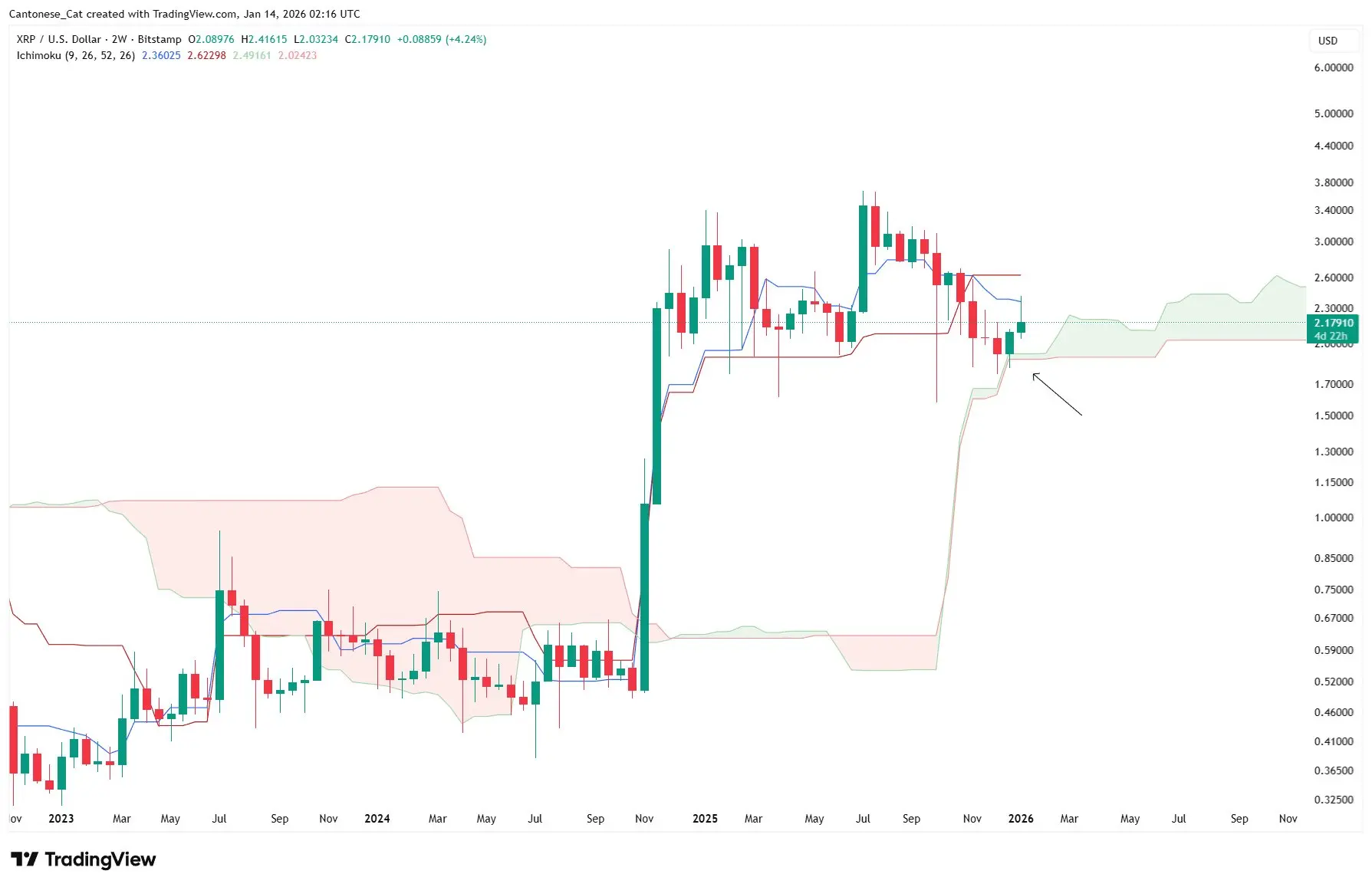 XRP 2W Chart | Cantonese CatSpecifically, the Tenkan-sen (conversion line) pushed above the Kijun-sen (base line), signaling improving short- and medium-term momentum, while the Chikou Span (lagging line) cleared both price and the cloud and confirmed the trend strength.
However, between February and July 2025, XRP entered a consolidation range, as its price fluctuated between $1.6 and $2 on the downside and a range of $3 to $3.60 on the upside. Despite heightened volatility and long wicks on several candles, XRP did not post a 2-week close back inside the cloud.
The Backtest Phase
Meanwhile, the most important phase occurred during late October to early November 2025. After rolling over from the mid-$3 range, XRP retraced toward the top of the green Ichimoku Cloud. The price fell into the $1.90 to $2.00 area, directly interacting with Senkou Span A and the rising Kijun-sen.
This move represented an Ichimoku backtest, where price returns to the cloud after a breakout to confirm whether former resistance has flipped into support. Importantly, XRP held this zone. Notably, no 2-week candle closed below the cloud, and the cloud itself remained green and upward-sloping.
Backtest Completion and Current Structure
In the weeks following the pullback, XRP began stabilizing above the cloud. By January 2026, price had reclaimed the Tenkan-sen and was trading above $2, with the Kijun-sen stationed just below price. The forward cloud remains green, indicating that bullish structural conditions are still in place.
This sequence, which involves a breakout above the cloud, prolonged consolidation above it, a pullback into the cloud, and a successful hold, prompted Cantonese Cat to conclude that XRP has now completed the backtest of its 2-week Ichimoku Cloud breakout. Such a backtest is mostly bullish for future price action.
Disclaimer: The information on this page may come from third parties and does not represent the views or opinions of Gate. The content displayed on this page is for reference only and does not constitute any financial, investment, or legal advice. Gate does not guarantee the accuracy or completeness of the information and shall not be liable for any losses arising from the use of this information. Virtual asset investments carry high risks and are subject to significant price volatility. You may lose all of your invested principal. Please fully understand the relevant risks and make prudent decisions based on your own financial situation and risk tolerance. For details, please refer to
Disclaimer.
Related Articles
Best Crypto Presale to Buy: Why Pepeto Targets Massive Returns Before Listings While XRP and Ethe...
The best crypto presale to buy is not always the project making the most noise. Retail buyers are trying to read a market where large caps keep trading sideways. As XRP ETF inflows hit $119.6 million in one week and the CLARITY Act heads to a Senate markup, now is the time to lock in the best crypto
BlockChainReporter43m ago
XRP ETF Inflows Hidden in OTC Markets, Spot Price Stagnates
Analyst Zach Rector argues that XRP's recent price consolidation reflects a structural disconnect between institutional accumulation and public market activity. Speaking on the Paul Barron Podcast, Rector described the current environment as a clash between over-the-counter (OTC) institutional
CryptoFrontier50m ago
XRP Beats BTC and ETH in ETF Flows, Shiba Inu Extends Price Rally, Cardano Founder Takes Jab at XRP, Ripple CTO Emeritus Says No One Holds Satoshi’s Keys — Top Weekly Crypto News - U.Today
XRP beats Bitcoin, Ethereum, Solana and Dogecoin in 24-hour ETF flows
Cardano founder criticizes XRP
Adam Back denies Satoshi rumors again
David Schwartz explains why no one alive likely has Satoshi's keys
SHIB extends price rally amid 237% surge in burn activity
XRP beats Bitcoin, Ethereum,
UToday2h ago
Self-Proclaimed Satoshi Accuses Ripple's Schwartz of 'XRP-Style' Control Projection - U.Today
David Schwartz and Craig Wright recently engaged in a heated debate on X over decentralization. Wright accused Schwartz of misapplying centralization concepts to Bitcoin, asserting that stable protocols can function without governance, while Schwartz countered that maintaining stability requires active measures against system changes.
UToday10h ago


