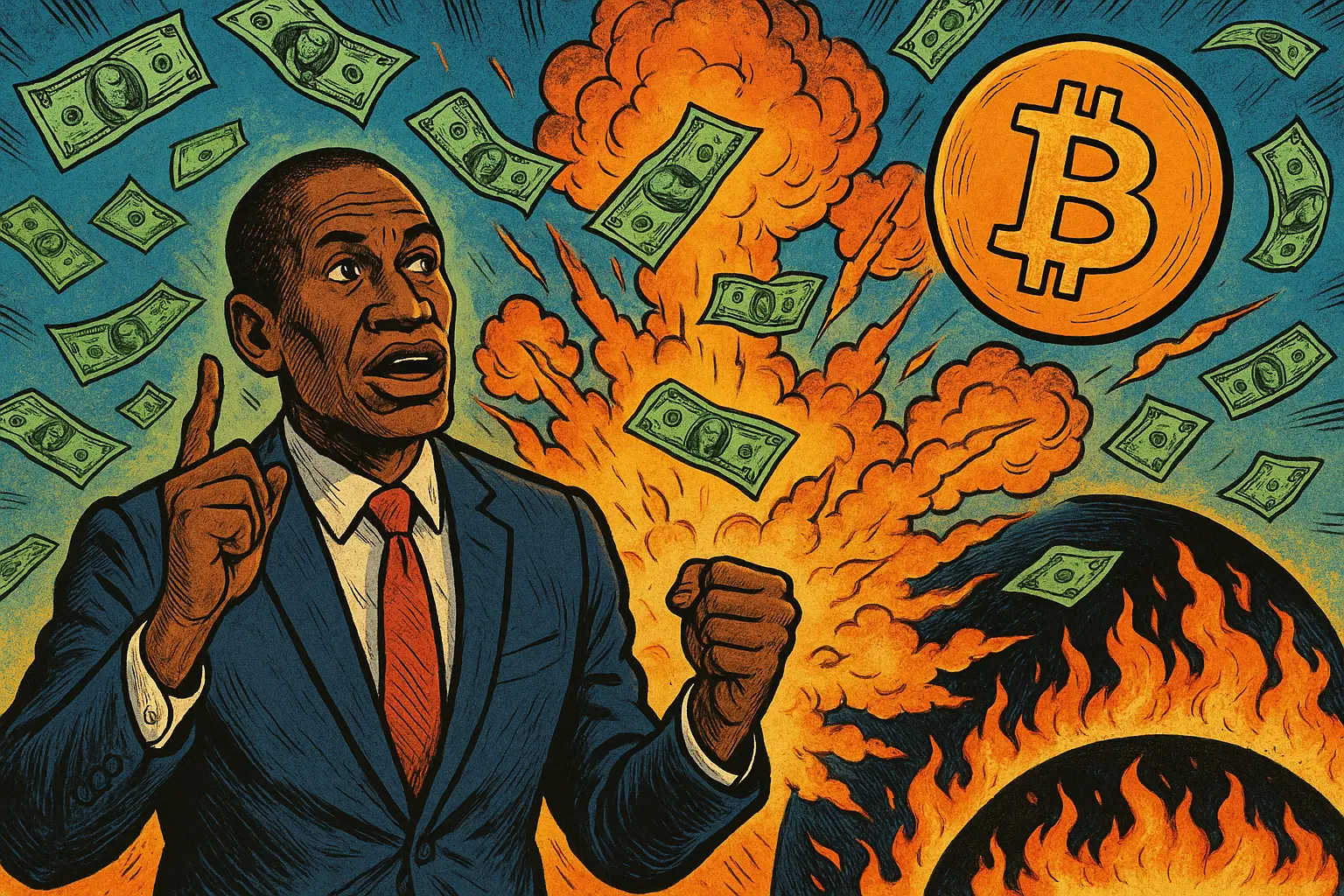
Arthur Hayes predicts that in 2026, dollar liquidity expansion will drive Bitcoin to regain market share from gold and the Nasdaq. The three main catalysts: Federal Reserve balance sheet expansion through money printing, declining mortgage rates, and commercial banks lending to strategic industries. In 2025, Bitcoin underperformed due to liquidity contraction, but Hayes emphasizes that Bitcoin is a monetary technology whose value is related to fiat currency devaluation.
The Three Main Engines of Dollar Liquidity Expansion
On Wednesday, Arthur Hayes explicitly stated in a blog post that dollar liquidity must expand for Bitcoin to regain vitality. “If gold and the Nasdaq index are trending strongly, how can Bitcoin regain vitality? Dollar liquidity must expand to achieve this,” Hayes wrote. “Obviously, I believe this will happen in 2026.”
Hayes pointed out that several catalysts will support a significant increase in dollar liquidity in 2026. The first catalyst is the Federal Reserve expanding its balance sheet through “money printing.” During times of economic stress or financial market turbulence, the Fed typically engages in quantitative easing (QE), purchasing government bonds and mortgage-backed securities to support the market, directly injecting liquidity. Although the Fed has not explicitly announced a new round of QE, Hayes believes that the economic environment in 2026 will compel central banks to restart money printing.
The second catalyst is the continued easing of liquidity leading to lower mortgage rates. The US real estate market froze in 2023-2024 due to high interest rates, with many potential homebuyers delaying purchases because of high borrowing costs. If mortgage rates decline, it will release a large suppressed demand, and the influx of funds into the real estate market will also boost risk asset prices through the wealth effect. Hayes believes this liquidity release will eventually spill over into the crypto markets.
The Three Main Drivers of Dollar Liquidity Expansion
Federal Reserve Balance Sheet Expansion: Buying government bonds and MBS through QE to directly inject liquidity into the market
Declining Mortgage Rates: Releasing suppressed demand in real estate, boosting risk assets via wealth effects
Strategic Industry Lending Expansion: Commercial banks increasing loans to US government-supported military and tech industries
The third catalyst is commercial banks being more willing to lend to strategic industries supported by the US government. Hayes states that the US will continue to “demonstrate its military strength.” “The US will keep showcasing its military power, and to do so, it needs to leverage the banking system’s funds to produce weapons of mass destruction,” Hayes said. This expansion of credit to strategic industries will inject new liquidity into the economy, ultimately flowing into various asset markets.
Currency expansion generally benefits Bitcoin because investors expect the dollar to depreciate due to inflation, attracting riskier assets like cryptocurrencies. This is the core logic Hayes discusses—Bitcoin’s value is not generated in isolation but is a reflection of fiat currency devaluation. Bitcoin has risen 12.20% over the past 30 days, and this upward trend may be an early signal of improved liquidity expectations.
Liquidity Contraction in 2025 and the Tech Sector Exception
Hayes states that although dollar liquidity declined in 2025 and Bitcoin also fell, the Nasdaq did not follow suit because AI has been “nationalized” by China and the US. He said, “Trump, through executive orders and government investments, weakened free-market signals, causing capital—regardless of actual equity returns—to flood into all AI-related sectors.”
Tech stocks were the best-performing sector in 2025. In that year, tech stocks were the top-performing sector in the S&P 500, with a total return of 24.6%, outperforming the overall S&P 500 return of 18% by 6.6%. This performance contradicts the macro environment of liquidity contraction, but Hayes believes it is the result of government intervention distorting the market.
“Liquidity is insufficient to support our cryptocurrency portfolio. But we cannot draw the wrong conclusion from Bitcoin’s poor performance in 2025. It’s still a liquidity issue, as before,” Hayes emphasized. His analytical framework reduces all asset prices to a core variable: liquidity. When dollar liquidity is abundant, all risk assets rise; when liquidity contracts, most assets fall except those supported by special policies.
This analysis reveals the fundamental reason for Bitcoin’s poor performance in 2025. It is not due to deteriorating fundamentals of Bitcoin itself but because the macro liquidity environment does not support risk assets. The reason AI-related tech stocks can rise against the trend is that the government views them as strategic assets and artificially creates demand through subsidies and policy support. Bitcoin does not have this privilege, making it more sensitive to changes in liquidity.
Bitcoin as a Monetary Technology, Not a Speculative Tool
Hayes states that Bitcoin is a “monetary technology,” whose value is only related to the degree of fiat currency devaluation. “This alone is enough to guarantee that Bitcoin’s value is greater than zero. But to bring Bitcoin’s value close to $100,000, fiat currency must continue to devalue,” Hayes added. This positioning frames Bitcoin as a tool to counter currency devaluation rather than purely a speculative asset.
This positioning is especially important in the current macro environment. Major global central banks printed money massively during the COVID-19 pandemic in 2020-2021, leading to a sharp expansion of the money supply. Although aggressive rate hikes in 2022-2023 temporarily curbed inflation, the base of the money supply has been permanently enlarged. Hayes believes that the liquidity expansion in 2026 will be a continuation of this long-term trend, not a short-term phenomenon.
By 2026, Bitcoin should be able to reclaim some “market share” from gold and the Nasdaq, supported by some catalysts that also favor dollar liquidity expansion. This forecast is based on the assumption that investors will reassess asset allocations when liquidity is abundant, and the narrative of Bitcoin as “digital gold” will regain appeal. As expectations of fiat devaluation heat up, Bitcoin’s advantages over gold (divisibility, transferability, no physical storage needed) will become more prominent.
Disclaimer: The information on this page may come from third parties and does not represent the views or opinions of Gate. The content displayed on this page is for reference only and does not constitute any financial, investment, or legal advice. Gate does not guarantee the accuracy or completeness of the information and shall not be liable for any losses arising from the use of this information. Virtual asset investments carry high risks and are subject to significant price volatility. You may lose all of your invested principal. Please fully understand the relevant risks and make prudent decisions based on your own financial situation and risk tolerance. For details, please refer to
Disclaimer.
Related Articles
ADA Price Weakens Under Resistance While Large Wallets Accumulate
Key Insights:
Cardano trades below all major moving averages, reinforcing bearish pressure while price struggles to reclaim even short-term resistance levels across multiple timeframes.
Whale wallets holding large ADA balances have steadily accumulated since February, reaching their
CryptoNewsLand2h ago
Dogecoin Holds Near $0.09 as April Pattern Shapes Outlook
Key Insights
Dogecoin maintains stability above the $0.09 support, with buyers defending the level despite consistent selling pressure that limits strong upward momentum in early April trading sessions.
April performance remains historically mixed, with past rallies and declines shaping
CryptoNewsLand2h ago
SHIB Holds Weak Range as Burn Rate Drops and Pressure Builds
Key Insights
SHIB remains within a long-standing descending channel, with price stuck in the lower range and unable to break persistent resistance levels.
The burn rate dropped sharply, removing a short-term support factor and reducing retail-driven momentum seen earlier during increased
CryptoNewsLand2h ago
Bitcoin tends to outperform gold and stocks after global shocks, Mercado Bitcoin finds
According to a study from Mercado Bitcoin, Bitcoin outperformed gold and the S&P 500 in the aftermath of major global crises, displaying stronger returns during economic shocks. Despite its volatility, it has shown resilience and growth during turbulent times.
CoinDesk2h ago
BTC Consolidates At $67,105 As Renewed Whale Accumulation Sparks Bitcoin Breakout Hopes
Bitcoin (BTC) is attracting serious attention from big investors, according to a market observation disclosed today by analyst Ali Martinez. The analyst shared data on X, revealing that whales have accumulated a total of 10,000 BTC over the past 72 hours, a clear signal that high-net-worth investors
BlockChainReporter2h ago
SHIB Price Rises on Golden Cross and Growing Market Activity
Key Insights
The Shiba Inu price rose about five percent as an hourly golden cross and higher volume signaled renewed trader participation and short-term momentum strength.
Exchange outflows and rising liquidity suggest accumulation behavior among holders while reinforcing price stability
CryptoNewsLand3h ago


