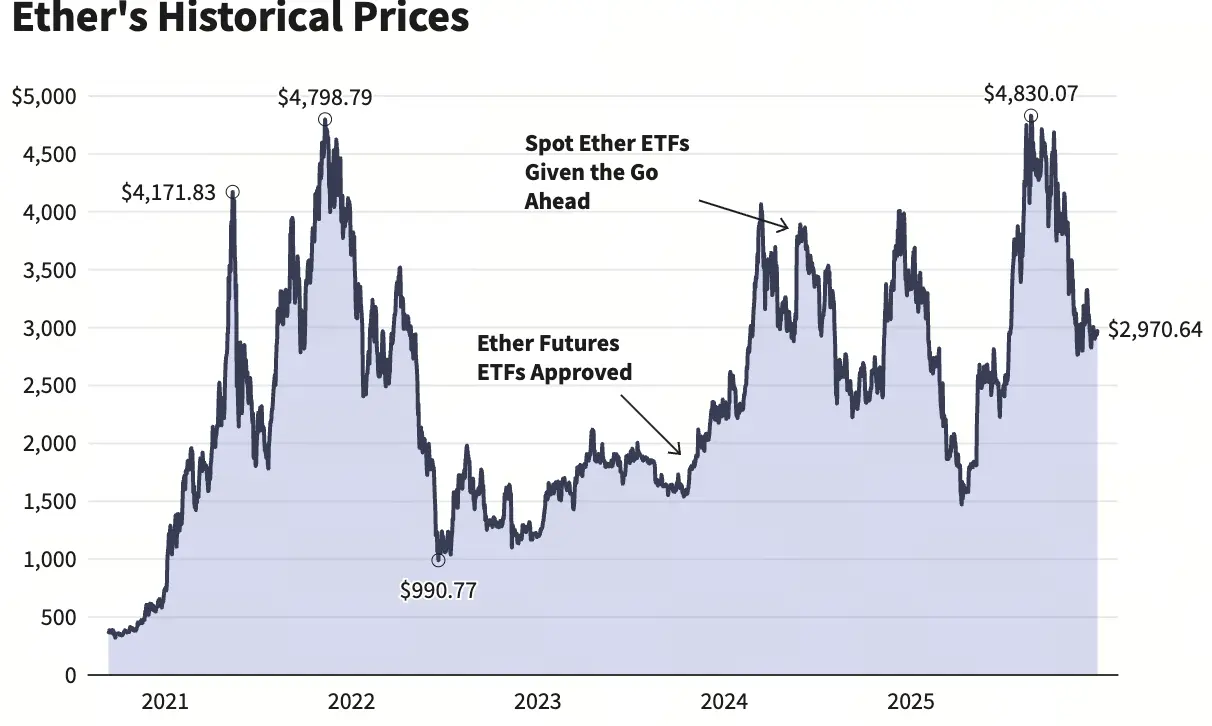
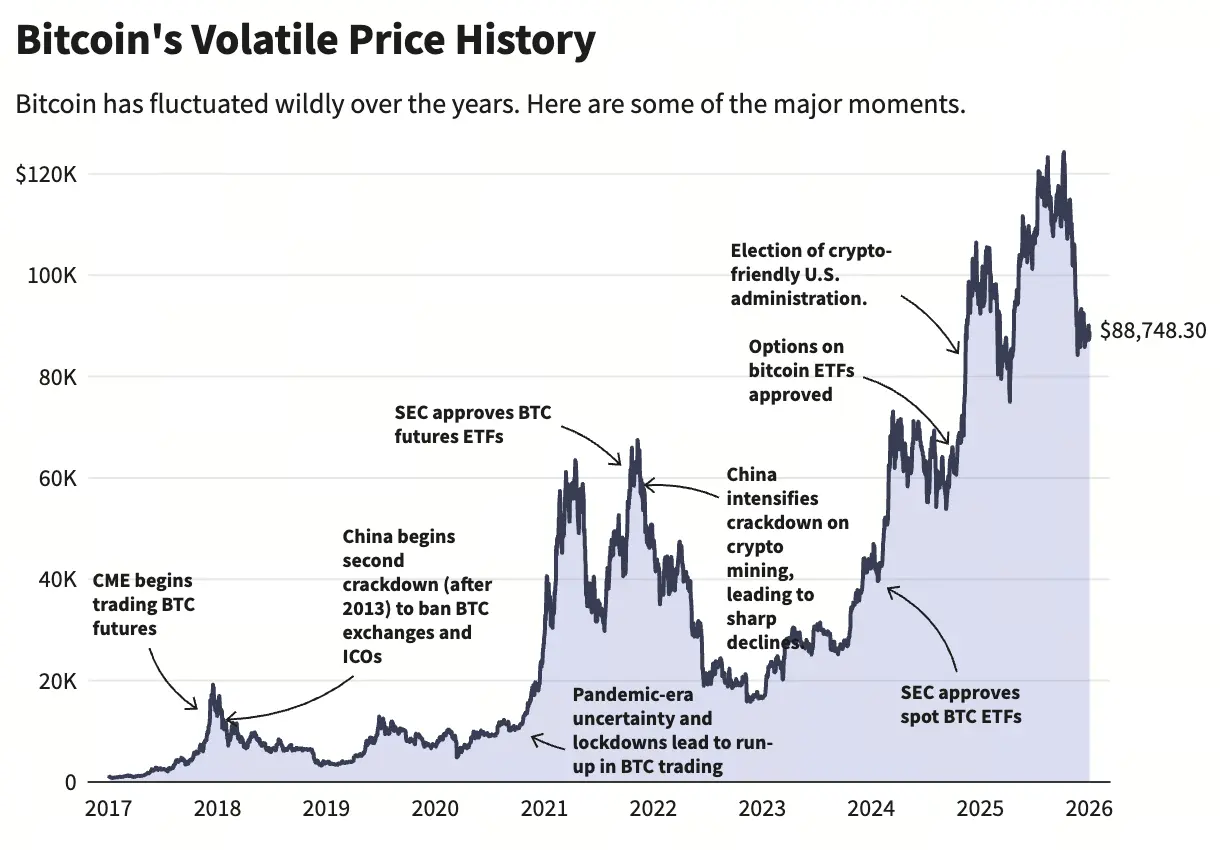
Ethereum has historically been more volatile than Bitcoin—rising harder in bull markets and falling steeper in downturns. In 2025, ETH lost 7.9% YTD through mid-December versus BTC’s 0.8% decline. But does this mean greater long-term potential, or just amplified risk?
Ethereum’s Volatility: Bigger Wins, Bigger Losses
ETH outperformed BTC during the 2020–2021 cycle (+310% vs. BTC’s 303% in 2020; +399% vs. 60% in 2021), fueled by DeFi and NFT booms.
(Sources: TradingView)
In 2023, ETH gained 91% amid lower fees post-proof-of-stake upgrade, though BTC rose 156%.
Recent six months (June 2025 onward): ETH +24% while BTC -12%.
Yet ETH trails BTC significantly from 2021 peaks (-43% vs. BTC’s relative strength), losing nearly two-thirds of its BTC-pair value.
November 2025 alone saw ETH drop 22% (vs. BTC’s 17.5%), dragging total crypto cap below $3 trillion.
Ethereum’s Unique Advantages Over Bitcoin
(Sources: TradingView)
Bitcoin functions as “digital gold”—a store of value with no yield or broader utility.
Ethereum powers a full ecosystem: dApps, NFTs, DeFi lending, and staking for passive income (~3–5% APY historically, dipping below 3% in 2025—comparable to 30-year Treasuries).
~30% of ETH supply is staked, providing network security rewards. Platforms like Lido allow liquid staking (tradeable stTokens), keeping capital flexible.
Layer-2 rollups have slashed fees below $0.30, enhancing scalability.
The Added Risks Ethereum Carries
Ethereum’s expanded utility introduces vulnerabilities Bitcoin largely avoids:
- Hack Risks: DeFi exploits like Yearn Finance’s $9 million drain highlight smart contract dangers.
- Regulatory Uncertainty: ETH’s security status flipped post-2014 ICO; without permanent commodity classification, reclassification remains possible.
- Competition: Solana and others offer cheaper/faster transactions, eroding ETH’s dominance.
These factors amplify ETH’s beta to BTC—greater upside in rallies, sharper downside in corrections.
Outlook: Volatility vs. Sustainable Growth
For short-term traders, ETH’s swings offer more opportunity—both up and down.
Long-term holders may prefer BTC’s relative stability and “digital gold” purity, especially given ETH’s post-2021 underperformance.
ETH’s ecosystem advantages (staking, utility) provide yield and growth levers Bitcoin lacks, but risks like hacks and regulation cap its edge.
In 2026, ETH could reclaim leadership if L2 adoption accelerates and fees stay low—but BTC remains the safer bet for capital preservation amid uncertainty.
Bottom Line: Ethereum has more upside potential in bull runs due to utility and volatility, but Bitcoin edges out for reliability and lower systemic risks. Diversify based on your horizon and risk tolerance.
Disclaimer: The information on this page may come from third parties and does not represent the views or opinions of Gate. The content displayed on this page is for reference only and does not constitute any financial, investment, or legal advice. Gate does not guarantee the accuracy or completeness of the information and shall not be liable for any losses arising from the use of this information. Virtual asset investments carry high risks and are subject to significant price volatility. You may lose all of your invested principal. Please fully understand the relevant risks and make prudent decisions based on your own financial situation and risk tolerance. For details, please refer to
Disclaimer.
Related Articles
Former special correspondent talks in depth about the history of Bitcoin being normalized after witnessing it in the White House, and offers beginner advice
Bitcoin Magazine interviews former White House reporter Corva, sharing his experience of becoming a Bitcoin advocate and analyzing Bitcoin’s role in humanitarianism and global finance. He emphasizes that policy needs legislative support, advises beginners to use dollar-cost averaging, and encourages community involvement to expand its broader impact.
ChainNewsAbmedia5m ago
Iran Bitcoin Hashrate Drops 77% Amid Ongoing Conflict
Iran’s Bitcoin mining industry has taken a sharp hit. New data shows the country’s hashrate has dropped by 77% in just one quarter. Reports suggest Iran has lost around 7 exahashes per second. Its total hashrate now sits near 2 EH/s. Compared to past levels, when the nation had built a robust mining
Coinfomania2h ago
BTC 15-minute decline of 0.52%: Exchange inflows and whale selling converge, triggering short-term pressure
2026-04-08 14:30 to 2026-04-08 14:45(UTC), BTC spot return recorded -0.52%, with a price range of 70922.5 to 71512.2 USDT and a swing of 0.83%. During the event, market liquidity faced pressure; short-term volatility drew market attention, showing dynamic shifts between the funds side and the positions side.
The main driver behind this abnormal move is the increase in exchange capital inflows and the whale’s large transfers being sold off. On-chain data shows that within 10 minutes, about 6.5 BTC were transferred into exchanges, with a clear increase, reflecting that some of the capital is accelerating the rotation between the fund side and the positions side.
GateNews2h ago
Bitcoin drops below 71,000 USDT, with a 1.29% intraday decline
Gate News message: On April 8, according to some CEX price data, Bitcoin fell below 71,000 USDT and is currently trading at 70,997.66 USDT, with a daily decline of 1.29%.
GateNews2h ago
BTC 跌破 71000 USDT
Gate News bot 消息,Gate 行情显示,BTC 跌破 71000 USDT,现价 70994.2 USDT。
CryptoRadar3h ago
Iran requires oil tankers to pay Bitcoin tolls for the Strait of Hormuz: where geopolitics and cryptocurrency intersect
Iran has set up a tiered toll system in the Strait of Hormuz, requiring tankers to pay a toll of $1 per barrel in RMB or cryptocurrency. This move is reshaping global energy trade and the cryptocurrency market landscape.
InstantTrends3h ago


