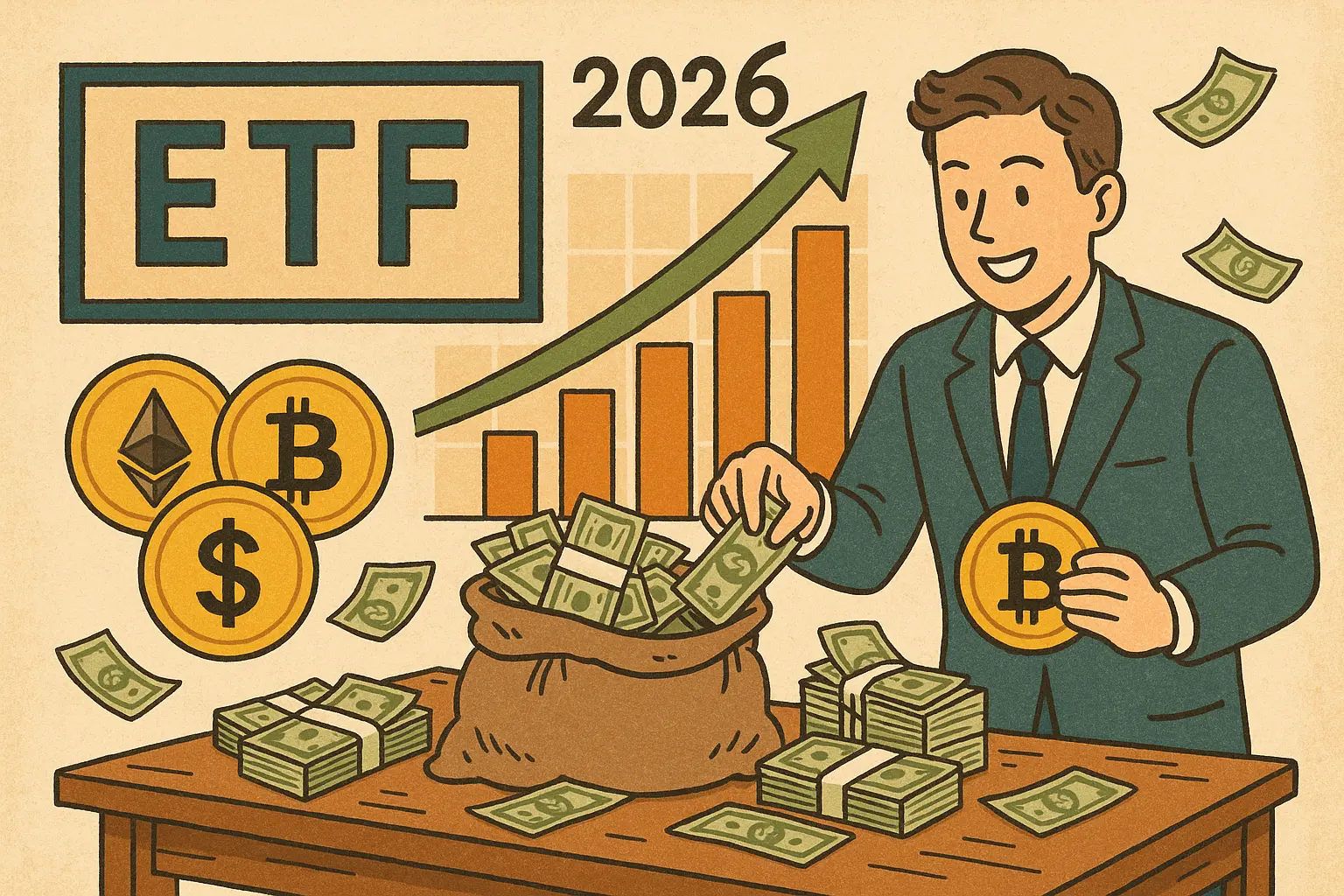
U.S. Cryptocurrency ETFs recorded a net inflow of $669 million on their first day in 2026, reversing the trend of fund withdrawals at the end of the year. BlackRock’s IBIT led with a single-day inflow of $287 million, accounting for 61% of total Bitcoin ETF inflows. The total inflow into Bitcoin products reached $471 million, with Ethereum funds growing by $174 million. Fund flows extended into smaller asset ETFs such as Solana, XRP, and Dogecoin, indicating that institutions are positioning for the 2026 crypto cycle.
BlackRock IBIT’s Dominance Reinforced
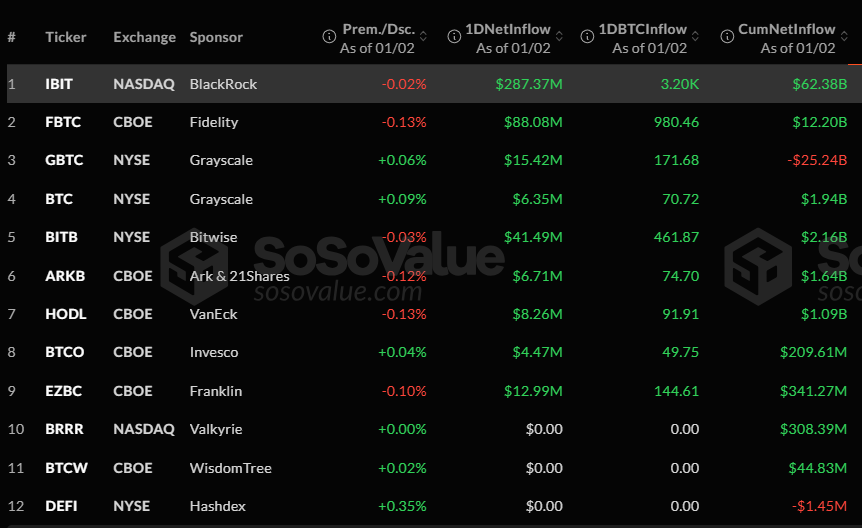
(Source: SoSoValue)
The fund flow data on January 2 reveals the power structure of the cryptocurrency ETF market. According to tracking data from SosoValue, BlackRock’s iShares Bitcoin Trust (IBIT) led with a single-day inflow of $287 million, representing 61% of total Bitcoin ETF inflows. This dominance is no coincidence; since its launch in 2024, IBIT has accumulated over $50 billion in assets under management, leveraging BlackRock’s brand reputation and distribution network, making it the largest physical Bitcoin ETF globally.
Fidelity’s Wise Origin Bitcoin Fund (FBTC) ranked second with $88 million, though smaller than IBIT, its stable institutional client base makes it an important market participant. Bitwise Bitcoin ETF (BITB) saw $41.5 million in inflows, indicating that mid-sized asset managers are also capturing market share. Notably, Grayscale Bitcoin Trust (GBTC), which had long faced outflows, finally experienced a positive inflow of $15 million, possibly signaling a weakening of the negative impact from its high fee structure.
This collective surge represents the second-highest single-day inflow since November 11, 2025, surpassing the peak of $457 million on December 17. More importantly, the timing suggests that the strong inflows at the start of the year typically reflect institutional asset allocation decisions for the new fiscal year, rather than retail impulsive trading. This coordinated buying indicates that Wall Street is integrating cryptocurrency ETFs into formal investment portfolio strategies.
Ethereum Grayscale Reversal Breaks 2025 Trend
The most surprising shift in the crypto ETF market occurred with Ethereum products. On January 2, Ethereum funds reported a total net inflow of $174 million, led not by BlackRock or Fidelity, but by the much-criticized Grayscale. Grayscale Ethereum Trust (ETHE) led with $53.69 million in inflows, contrasting sharply with the sustained outflows throughout 2025.
In 2025, ETHE triggered large redemptions when converting from a closed-end trust to an ETF, causing investors to flee to lower-cost competitors. However, the early-year capital inflow suggests market sentiment may be shifting. Possible reasons include: expectations of fee adjustments for ETHE, rumors of approval for Ethereum spot ETFs with staking features, and institutional investors perceiving current prices as attractive. Grayscale Ethereum Mini Trust followed with $50 million raised, and BlackRock’s iShares Ethereum Trust (ETHA) raised $47 million.
The revival of Ethereum ETFs holds significant market implications. In 2025, Ethereum products underperformed Bitcoin, with some analysts even questioning institutional interest in ETH. But the strong inflow at the start of the year indicates that when prices are reasonable, institutional funds have not abandoned the second-largest crypto asset. This dual-engine dynamic may signal a more diversified crypto ETF market in 2026.
Small Asset ETFs Breakthroughs Mark a New Phase
The collective inflows into these small asset ETFs mark a new phase in the crypto ETF market. From 2024 to 2025, the market focused on Bitcoin and Ethereum as the main assets. But as more altcoin ETFs gain approval, institutional investors can now allocate to a broader range of crypto assets through compliant channels. This diversification trend could become the main narrative for the 2026 crypto ETF market.
First Day 2026 Small Crypto ETF Inflows
XRP ETF Debuts Strongly: Funds related to XRP saw $13.59 million in inflows, leading the altcoin ETF segment. This figure is especially remarkable given that the XRP ETF was only approved at the end of 2025 and is still in the market introduction phase.
Solana Institutional Adoption Accelerates: Solana-based ETFs increased by $8.53 million, indicating growing Wall Street interest in high-performance public chains. Solana’s dominance in DeFi and NFT sectors makes it a third choice for institutional allocations.
Dogecoin ETF Hits Record High: Dogecoin ETF experienced $2.3 million in inflows, setting a daily record for this asset class since its inception. This seemingly absurd product actually reflects institutional demand for meme coin liquidity.
Post-Tax-Loss Harvesting, Institutional Rebalancing Logic
The $669 million first-day inflow is not just a numerical rebound but reveals the operational logic of institutional investors. In December 2025, crypto ETFs experienced consecutive weeks of outflows, partly due to tax-loss harvesting strategies. Investors sold losing positions before year-end to offset capital gains taxes—a common seasonal phenomenon in traditional stock markets.
The sharp reversal at the start of the year suggests many institutions are not genuinely bearish on crypto assets but are using tax rules to optimize their portfolios. The large buy-in on January 2 may be these funds re-entering after completing tax operations. This “sell and rebuy” strategy allows them to maintain long-term exposure while reducing tax burdens. Market analysts believe that the synchronized inflows into Bitcoin, Ethereum, and other cryptocurrencies are evidence of this coordinated operation.
Deeper reasons may relate to macro expectations for 2026. The approval of a spot Bitcoin ETF in the U.S. has changed how institutions participate in the crypto market, and if Ethereum staking features are approved for ETF inclusion, it will further enhance product appeal. Additionally, as more countries launch crypto ETFs, global liquidity pools are expanding. These structural changes make institutions view crypto ETFs as essential rather than optional components when rebalancing assets at the start of the year.
Disclaimer: The information on this page may come from third parties and does not represent the views or opinions of Gate. The content displayed on this page is for reference only and does not constitute any financial, investment, or legal advice. Gate does not guarantee the accuracy or completeness of the information and shall not be liable for any losses arising from the use of this information. Virtual asset investments carry high risks and are subject to significant price volatility. You may lose all of your invested principal. Please fully understand the relevant risks and make prudent decisions based on your own financial situation and risk tolerance. For details, please refer to
Disclaimer.
Related Articles
Ethereum rebounds to $2,257 as network stablecoin supply surpasses $180 billion, setting a new all-time high
Fueled by a ceasefire agreement between the United States and Iran, the price of Ethereum rose by about 9% on Wednesday, reaching a new high in several weeks. At the same time, stablecoin supply hit a historical high, suggesting increased activity across the Ethereum ecosystem. Analysts believe this provides solid support for Ethereum, and investors should watch macro events and changes in technical indicators.
GateNews26m ago
Price predictions 4/6: SPX, DXY, BTC, ETH, BNB, XRP, SOL, DOGE, HYPE, ADA
Key points:
Bitcoin rose above the $70,000 level on Monday, but analysts remain skeptical, expecting a drop below the $60,000 support.
Several major altcoins have bounced off their supports, indicating demand at lower levels.
Buyers pushed Bitcoin (BTC) above the $70,000 level, but
Cointelegraph32m ago
South Korea plans to regulate real-world assets and stablecoins, pushing for the legalization of digital assets
The Democratic Party of Korea plans to regulate tokenized real-world assets and stablecoins in the soon-to-be enacted “Framework Act on Digital Assets.” The proposal would require issuers to deposit assets with a trustee-managed trust institution, and classify stablecoins as a means of payment, subject to oversight by foreign exchange regulators. The bill bans earnings from idle stablecoins and calls for the development of interoperable technical standards, aiming to improve market transparency and safety. This marks an important step forward for South Korea’s digital asset regulation.
GateNews42m ago
SEC report disclosure: In the Gary Gensler era, crypto cases “did not bring benefits to investors”
The U.S. Securities and Exchange Commission (SEC) acknowledged in its FY 2025 enforcement report that crypto registration cases under the leadership of the former chair did not effectively protect investors. The current chair, Paul Atkins, emphasized that the focus will be on fraud and market manipulation that directly affect investors’ interests, and has already withdrawn enforcement actions against several crypto companies, which is expected to improve the compliance environment for crypto businesses. This indicates that the SEC is re-evaluating its regulatory strategy, with an emphasis on market health and investor protection.
GateNews53m ago
Huang Licheng recently added to his position by buying 300 ETH long contracts, and placed a take-profit sell order in the $2260–$2300 range.
Gate News message: On April 8, according to monitoring by Hyperinsight, Huang Licheng (nickname “Maji”) recently added to a leveraged ETH long position by 25x, about 300 ETH, bringing the total position size to $25.16 million. They also placed sell orders in the $2,260 to $2,300 range, planning to partially take profit of about $1.8 million of the position. During this round of the upswing, this address has accumulated profits of $1.5 million, with account funds increasing to $2.57 million; the current ETH liquidation price for their holdings is $2,066.
GateNews2h ago
Biconomy and the Ethereum Foundation jointly launch the ERC-8211 standard, introducing a smart batch processing mechanism
Biconomy and the Ethereum Foundation launch the ERC-8211 smart batch processing standard to address static limitations in smart contract execution, support dynamic parameter adjustments, and enhance the execution capabilities of AI agents and complex DeFi workflows.
GateNews3h ago


