Today, the Polkadot (DOT) price recorded an impressive increase of about 12% in just one day, surprising many traders. The main driver comes from the major upgrade on Kusama – a network closely linked to Polkadot. This event has contributed to improving short-term sentiment across the entire Polkadot ecosystem.
However, overall, the long-term trend remains unclear. DOT has still decreased approximately 53.5% over the past three months. A strong rally cannot erase the prolonged downtrend that preceded it.
Investors are now asking a big question: Is this the start of a new trend, or just a technical rebound in a weak market?
Kusama Upgrade Brings New Momentum to Polkadot Market Sentiment
The price increase of DOT is driven by Kusama – Polkadot’s testnet, where improvements are tested before official implementation. This week, Kusama deployed a notable upgrade, reducing block processing time to under 2 seconds and enhancing smart contract support. Transactions are faster, and expanded development tools attract more community interest.
Although this upgrade occurred on Kusama, not directly on Polkadot, the two networks are closely connected. Therefore, improvements on Kusama often influence market sentiment and DOT’s price.
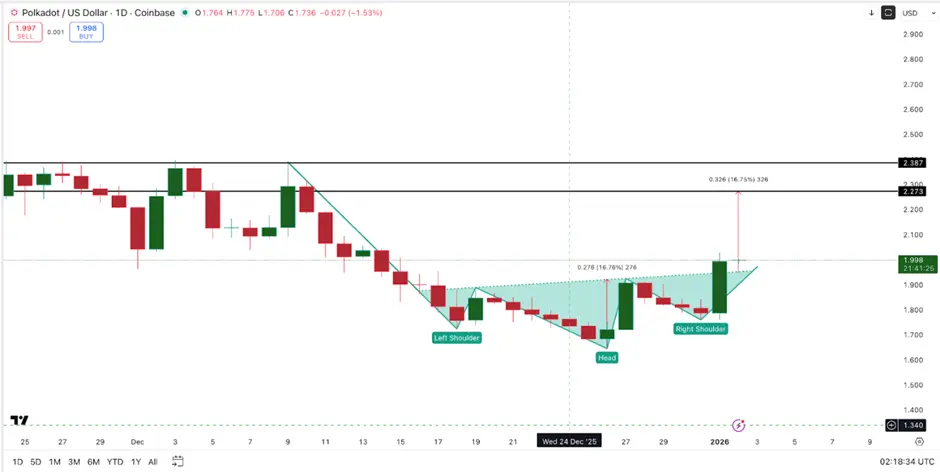 Polkadot DOT Price Surge | Source: TradingView Positive reactions from the cryptocurrency market to technical changes are common. An upgrade can create a “story” in the short term, attracting speculative capital and causing significant price volatility.
However, for a sustainable upward trend, real capital flow and demand must align. This remains a weak point in this rally.
DOT Chart Signals Breakout, but Buying Pressure Is Not Yet Strong Enough
From a technical analysis perspective, DOT recently broke the inverse head and shoulders pattern – often appearing at bottoms and signaling a potential trend reversal. If the rally continues, DOT could target the $2.27 level, representing an additional potential increase of about 13% from current levels. This is why DOT is back in the spotlight for many investors.
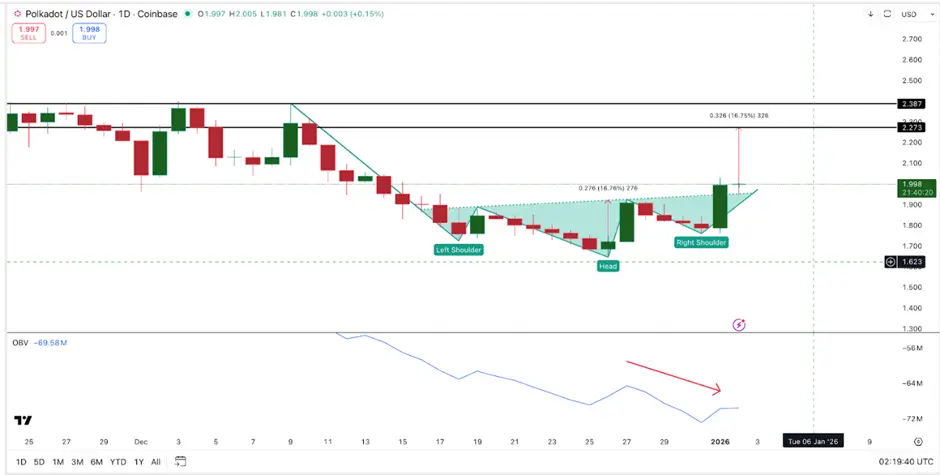 DOT Volume | Source: TradingView However, price patterns need to be confirmed by actual buying strength. The On-balance Volume (OBV) indicator – which tracks whether buyers or sellers control the trend – is still trending downward, indicating that trading volume has not fully aligned with the price. This often reflects uncertain market sentiment.
Similarly, the Chaikin Money Flow (CMF) indicator – measuring money flow into/out of the asset – remains below zero, suggesting large investors have not yet fully entered the market.
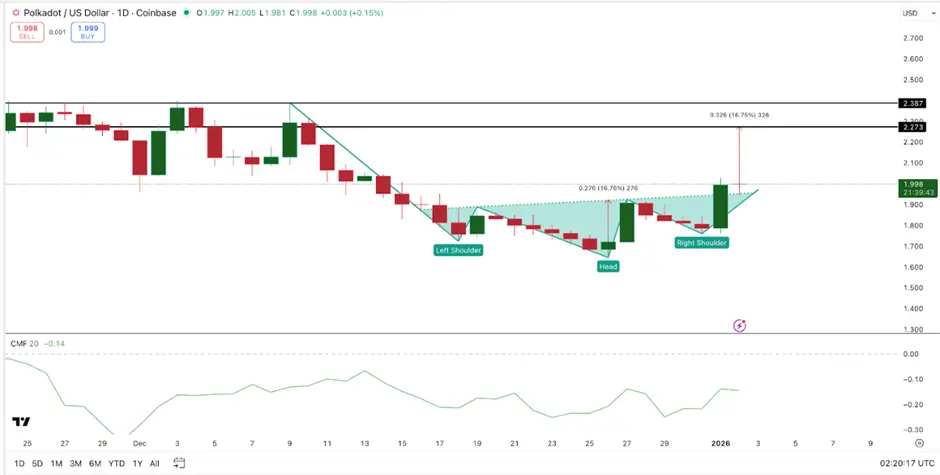 DOT CMF Indicator | Source: TradingView The DOT balance on exchanges has not changed significantly, reflecting that the recent price increase is mainly driven by short-term sentiment rather than strong capital inflows.
In summary, although technical charts show positive signals, the fundamental factors related to capital flow have not yet fully supported a sustained rally.
Important Price Levels of DOT to Watch
In the context of mixed indicators, identifying key price zones becomes more important than peripheral information.
If DOT stays above $2.02, the bullish outlook remains. This is a short-term support zone, maintaining the breakout structure.
Conversely, if DOT drops below $1.76, the technical pattern will weaken, buying pressure may retreat, and market confidence could decline rapidly.
If DOT breaks below $1.64, the recovery is likely to end, and the price could revert to a prolonged downtrend.
Currently, DOT’s movement remains uncertain. The Kusama upgrade provides upward momentum, and technical charts create trading opportunities, but what’s missing is confirmation from trading volume and capital flow. Without improvements in these factors, DOT’s rally may be only temporary.
Disclaimer: The information on this page may come from third parties and does not represent the views or opinions of Gate. The content displayed on this page is for reference only and does not constitute any financial, investment, or legal advice. Gate does not guarantee the accuracy or completeness of the information and shall not be liable for any losses arising from the use of this information. Virtual asset investments carry high risks and are subject to significant price volatility. You may lose all of your invested principal. Please fully understand the relevant risks and make prudent decisions based on your own financial situation and risk tolerance. For details, please refer to
Disclaimer.
Related Articles
ADA Tests Key $0.230 Support While Upgrade Timeline Holds
Key Insights:
ADA trades at the wedge apex near $0.2387 as price compresses between $0.230 support and $0.245 resistance ahead of a decisive breakout move.
Protocol 11’s timeline remains intact despite the memory bug fix, keeping Cardano fundamentals stable while macro risks dominate short-t
CryptoNewsLand11m ago
XRP Breaks Above $1.40 as Spot ETF Inflows Hit $17.6M Milestone
XRP breaks $1.40 after Ripple partnership boosts investor confidence and market momentum.
Spot XRP ETFs record $17.6M inflows, signaling rising institutional demand and interest.
Technical indicators show resistance ahead, with support holding near $1.40 and $1.3840.
Ripple’s XRP is
CryptoNewsLand4h ago
PEPE Reclaims 0.00000400 — Is This 1.8% Move the Start of a Bigger Run?
PEPE rebounds from 0.00000385 support, forming higher lows and stronger bullish structure.
Technical indicators like MACD and RSI show momentum with room for further upside.
Key resistance at 0.00000410; support at 0.00000380 critical for trend continuation.
PepeCoin — PEPE, has
CryptoNewsLand9h ago
ETH drops 0.58% in 15 minutes: derivatives liquidity contraction and proactive position reduction dominate short-term pullback
From 2026-04-19 04:30 to 2026-04-19 04:45 (UTC), within ETH’s 15-minute candlestick chart, the return recorded -0.58%, and the price range was 2321.62 to 2342.04 USDT, with an amplitude of 0.87%. The short-term selloff occurred against a backdrop of increased overall market volatility and a broad decline in the prices of major crypto assets; overall market risk appetite clearly fell, and traders’ wait-and-see sentiment strengthened.
The main driver behind this abnormal move is a sharp contraction in liquidity in the derivatives market and leveraged funds proactively reducing positions. Data shows that over the past 24 hours, the ETH/USD perpetual contract trading volume dropped 67.16% to approximately 74.87 million, open interest edged down 3.33% to 329 million, and liquidation amounts did not expand unusually. This structure indicates that the market lacks the risk of passive cascades; more funds chose to proactively step aside and wait on the sidelines, intensifying short-term selling pressure.
In addition, the long/short structure in which shorts held the upper hand (long/short ratio 47.48%:52.52%) and sentiment synchronization with the panic range reinforced the downward price trend. During the same period, major coins such as BTC and SOL also fell 2%-3.4% in tandem, further showing that this pullback was driven by system-wide risk sentiment. On-chain funds did not show any large abnormal transfers or large-scale liquidations of DeFi protocols; spot and on-chain liquidity remained generally stable, and no sudden system risk resonance was observed.
Current volatility-related risks still need close monitoring, especially as overall risk appetite continues to contract—ETH’s short-term price may face further downside probing. Watch subsequent changes in derivatives trading volume and open interest, extreme shifts in the long/short ratio and funding rate, and promptly monitor on-chain fund flows, large transfers, and any signs of amplified platform net outflows. For more market anomalies and deeper analysis, please continue to follow our upcoming market updates.
GateNews10h ago
Spark Protocol's January delisting of rsETH proves prudent as Aave faces ETH liquidity crisis
Spark Protocol's strategy of delisting low-usage assets and tightening collateral has faced initial backlash but proved wise during market turmoil. While maintaining higher interest rate caps, SparkLend ensures liquidity, unlike Aave, which now faces significant risks.
GateNews10h ago
Request Network (REQ) Surges 23.68% in 15 Minutes, 24-Hour Gain Reaches 116.52%
Request Network (REQ) surged 23.68% in just 15 minutes, reaching $0.152, with a 24-hour rise of 116.52% and trading volume over $8 million. Factors include retail interest and whale accumulation. Resistance at $0.160 and support at $0.122 are under observation.
GateNews11h ago


