
- **Ethereum’s Vitalik Buterin has emphasized the importance of projects focusing on decentralization to achieve a balance of power. **
- **He noted that while people like an independent society, they dislike things like the Taiping Rebellion. **
Ethereum (ETH) co-founder Vitalik Buterin has emphasized the need to prevent the excessive concentration of power to avoid societal crises and advance technology, culture, and the economy. This statement was made in his article titled “Balance of Power.” In that article, Vitalik noted that the right balance in society could be attained using technology and decentralization.
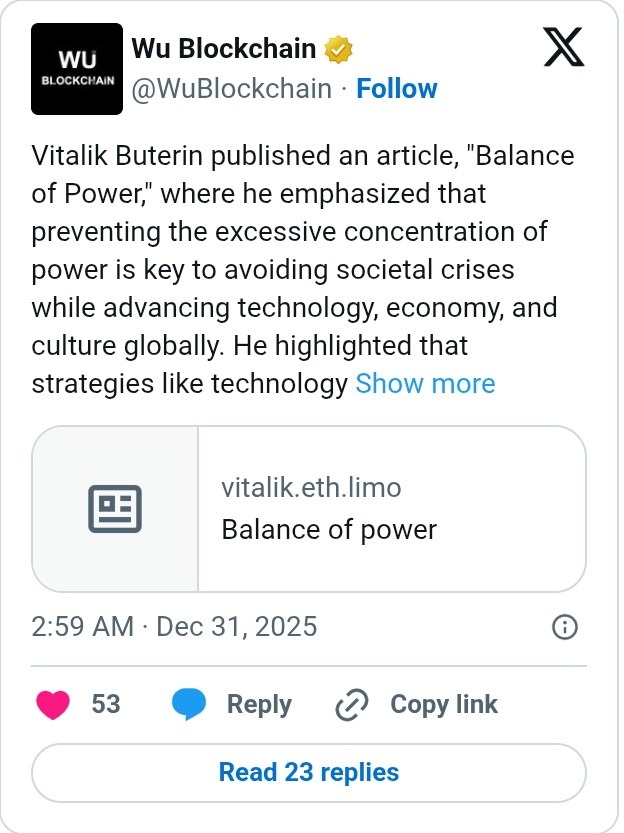
Source: Wu Blockchain on X
Details of the Article
According to Vitalik, there are “three corners of a triangle” that many like and dislike, and the first one is the government. To him, many individuals are interested in the police, court, public order, and many more, but dislike the decisions of governments to arbitrarily restrict what people say, read, or think. Also, he pointed out that governments have the power to ruin society or people far worse than anything crypto sellers could ever do.
The second corner of the triangle is business. According to Vitalik, many people are actually afraid of business, but they like the products and services provided by companies. Delving into this, he disclosed that companies have been accused of being evil and lame. The reason is that they tend to diverge from profit optimization and move away from the goal of their users and society once they get more powerful.
The Final “Corner of the Triangle” and How Ethereum Achieved Balance
Finally, Vitalik spoke about the Big Mob. Under this, he highlighted that while people like the independent civil society, charities, and Wikipedia, they dislike the aspects of mobs lynching people or things like the taiping rebellion. To achieve balance, Vitalik highlighted several solutions, and one of them is pluralist morality.
Slave morality says, “You are not allowed to be powerful.” Master morality says, “You are commanded to be powerful.” A synthesis morality focused on the balance of power might say, “You are not allowed to be hegemonic, but you are encouraged to be impactful and to empower others.”
According to him, it is important to have high diffusion towards the outside world to find balance. In Ethereum, he highlighted the decentralized staking pool, Lido, as an example. Lido has 24% of the total Ethereum staked supply. However, people are less afraid than they would be of anything that has a 24% stake.
Lido does not operate as a single actor. Instead, it operates as an internally decentralized DAO with about a dozen operators. Vitalik suggests that instead of projects operating as just business models, they should have a decentralization model and avoid concentrating power in themselves.
Disclaimer: The information on this page may come from third parties and does not represent the views or opinions of Gate. The content displayed on this page is for reference only and does not constitute any financial, investment, or legal advice. Gate does not guarantee the accuracy or completeness of the information and shall not be liable for any losses arising from the use of this information. Virtual asset investments carry high risks and are subject to significant price volatility. You may lose all of your invested principal. Please fully understand the relevant risks and make prudent decisions based on your own financial situation and risk tolerance. For details, please refer to
Disclaimer.
Related Articles
Yesterday, Ethereum spot ETFs saw net inflows of $106 million, with BlackRock's ETHA bringing in $90.94 million.
On April 9, Ethereum spot ETFs saw net inflows of $106 million, a marked increase compared with the previous day. BlackRock’s ETHA and ETHB had net inflows of $90.94 million and $13.67 million, respectively, while Grayscale’s mini version of ETH recorded net inflows of $9.67 million. Meanwhile, 21Shares TETH, Franklin EZET, and Grayscale ETHE saw net outflows.
GateNews19m ago
Swing Trader 0x4F51 Exits Final ETH Position With $1.44M Loss
Gate News message, swing trader 0x4F51 sold his remaining 1,000 ETH valued at $2.22 million 5 hours ago, realizing a $1.44 million loss on the transaction. Since January 27, 2025, the trader has executed 4 swing trades, with 3 resulting in losses totaling $2.45 million.
GateNews1h ago
Metalpha linked wallet deposited 7,200 ETH into a certain CEX, worth approximately $15.79 million
Gate News message, on April 10, blockchain analyst Onchain Lens monitored data shows that a wallet associated with Metalpha deposited 7,200 ETH, worth about $15.79 million, into a certain CEX.
GateNews1h ago
ETH 15-minute pump of 0.60%: exchange net capital outflows and on-chain large transfers drive a short-term rebound
2026-04-10 01:30 to 2026-04-10 01:45 (UTC), ETH traded within the 2185.0 to 2204.03 USDT range. The candlestick return was +0.60%, and the 15-minute intraday swing was 0.87%. During this period, mainstream market attention increased, with trading volume expanding by about 20% compared with the periods before and after, indicating stronger short-term liquidity.
The main drivers behind this unusual move were exchange net outflows and active on-chain large transfers. On-chain data shows that during this period, ETH saw multiple transactions, each over 8,000 ETH,
GateNews1h ago
Giant whale “sets 10 big targets first” — the BTC short position is currently down by $650k, and the ETH short position is currently up by more than $410k
A giant whale updated its position status. It currently holds 2,201.507 BTC short contracts, showing an unrealized loss of $650k; it also holds 7,093 ETH short contracts, showing an unrealized gain of $413k; the total value of its short contracts of $173 million currently has an estimated net unrealized loss of about $237k.
GateNews1h ago
Ethereum Researchers Float ‘Block-in-Blobs’ Upgrade to Cut Validator Data Load
Ethereum researchers propose EIP-8142, aiming to encode transaction data directly into blobs, reducing validators' data processing load and addressing scalability issues. This shift could enhance network efficiency while prompting broader architectural considerations.
CryptoNewsFlash2h ago


