The cryptocurrency market has shed more than $1.2 trillion in value over the past few months of 2025, with total capitalization falling from a yearly high of $4.3 trillion to around $2.9 trillion. Bitcoin has dropped from $126,200 to near $88,000, dragging most altcoins lower in a broad risk-off move.
Investors are now asking: why is crypto crashing, and can 2026 bring a reversal—or deeper losses?
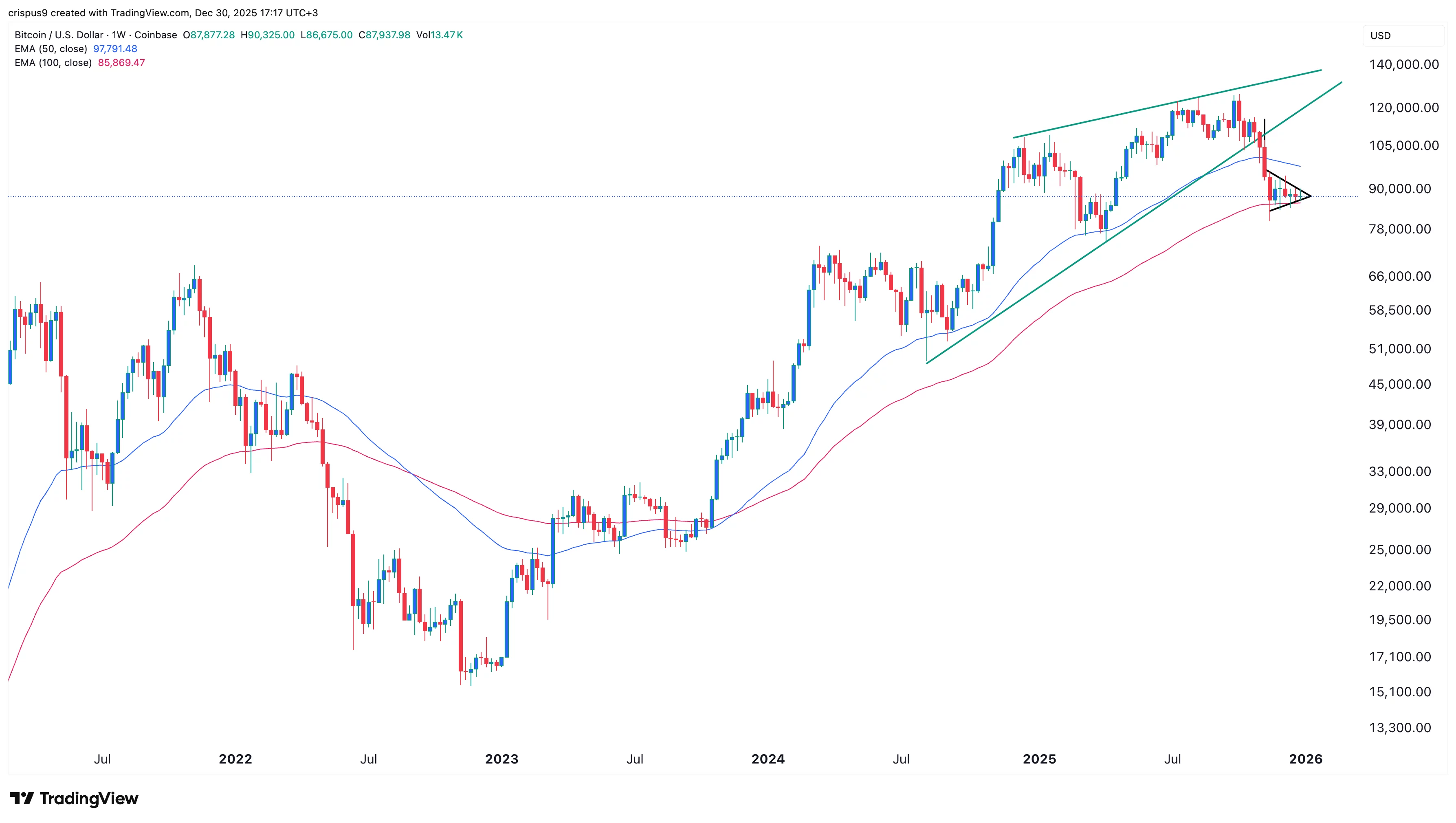
(Sources: TradingView)
The Immediate Triggers Behind the 2025 Crash
Several factors converged to accelerate the downturn in the second half of 2025:
- Macroeconomic Pressure: Rising bond yields and persistent inflation concerns shifted capital toward safer assets, squeezing risk-on investments like crypto.
- Profit-Taking After Early Highs: Bitcoin and major altcoins hit all-time highs early in the year, prompting widespread distribution as holders locked in gains.
- Regulatory Uncertainty: Delays in finalizing comprehensive market structure legislation (e.g., the CLARITY Act) created hesitation among institutions.
- Technical Breakdowns: Bitcoin formed a rising wedge and bearish pennant on weekly charts, breaking below key supports and the Supertrend indicator—signaling sustained downside momentum.
These elements combined to erase gains and push sentiment into deep fear territory.
Why the Crash Hit Harder Than Expected
Despite early 2025 optimism—fueled by spot ETF approvals, corporate treasuries, and pro-crypto political rhetoric—the rally proved short-lived.
Liquidity rotated out of speculative assets amid thinning holiday volumes and year-end portfolio rebalancing. Altcoins suffered disproportionately, with many losing 50%+ from peaks as capital concentrated in Bitcoin before flowing out entirely.
On-chain metrics reflected fading conviction: declining trading volumes, reduced active addresses, and persistent long-term holder distribution.
The crash exposed lingering vulnerabilities: over-reliance on short-term catalysts, leverage washouts, and sensitivity to broader risk appetite shifts.
Potential Catalysts for Recovery in 2026
Several developments could counter the bearish momentum:
- CLARITY Act Passage: Bipartisan market structure legislation, already advanced in the House, could provide jurisdictional clarity between SEC and CFTC—unlocking institutional inflows.
- Fed Policy Shift: Expectations for multiple rate cuts and a potentially dovish new Fed chair could boost M2 money supply above $22 trillion, historically bullish for risk assets.
- Tariff Dividends and Tax Relief: Proposed policies distributing checks and larger refunds could increase disposable income for speculative investments.
- Employer-Sponsored Crypto Access: Potential approval for retirement plans to allocate to digital assets would open trillions in new capital.
These tailwinds could reverse the crash narrative if executed effectively.
Technical Risks: Why Crypto Could Crash Further
Charts remain concerning. Bitcoin’s weekly setup—rising wedge breakdown and bearish pennant—suggests potential for lower lows unless reclaimed resistances hold.
Failure to overcome the Supertrend and key Fibonacci levels risks testing sub-$80,000 zones.
Altcoins face similar patterns, with many already in multi-month downtrends and limited buying volume to absorb selling.
2026 Outlook: Rally or Extended Crash?
The crypto crash of late 2025 stems from a mix of profit-taking, macro shifts, and technical exhaustion—exacerbated by delayed catalysts.
2026 could mark a turning point if regulatory clarity and accommodative policy materialize, potentially reigniting institutional demand and reversing outflows.
However, absent strong catalysts, technical breakdowns and fading retail interest risk prolonging the downturn.
For now, the question “why is crypto crashing?” points to a market in reset mode—awaiting proof that fundamentals can overpower lingering bearish structure.
Disclaimer: The information on this page may come from third parties and does not represent the views or opinions of Gate. The content displayed on this page is for reference only and does not constitute any financial, investment, or legal advice. Gate does not guarantee the accuracy or completeness of the information and shall not be liable for any losses arising from the use of this information. Virtual asset investments carry high risks and are subject to significant price volatility. You may lose all of your invested principal. Please fully understand the relevant risks and make prudent decisions based on your own financial situation and risk tolerance. For details, please refer to
Disclaimer.
Related Articles
Bitcoin falls below 71,500 USD, U.S.-Iran talks remain deadlocked, and the Strait of Hormuz becomes the biggest point of contention
On April 11, the U.S. and Iran began 20 hours of negotiations in Pakistan. The core issue was freedom of passage through the Strait of Hormuz. After Bitcoin briefly rose to $73,800, it quickly fell back to $71,557. The U.S. side took a hardline stance, demanding that Iran open the strait, while Iran insisted that easing restrictions must wait until a comprehensive agreement is reached. The two sides have not yet reached a consensus.
動區BlockTempo3h ago
Crypto Market Maintains Steady Growth Trajectory As Top Assets Show Gains
The crypto market continues to grow, with a market cap of $2.44T and Bitcoin and Ethereum showing slight increases. Top gainers include $GPM and $BASE. Meanwhile, DeFi TVL declined, NFT sales rose, and notable developments include a trader's significant loss and a push for regulatory clarity in Congress.
BlockChainReporter4h ago
BTC 15-minute chart slightly down 0.57%: leveraged long positions passively cut risk and macro sentiment disturbances drive volatility
2026-04-12 12:45 to 13:00 (UTC), the BTC price range was 71081.7 to 71493.2 USDT, with an amplitude of 0.58%. Within 15 minutes, the return recorded was -0.57%. During the period of unusual activity, market volatility increased somewhat, risk sentiment warmed up, and overall attention rose; however, there was no extreme surge in volume or a sudden drop in liquidity.
The main driver behind this unusual activity is that, under the leverage structure, long positions were reduced passively. Recently, the funding rate for perpetual contracts turned from negative to positive. Leverage among longs in the market accumulated; the price dipped slightly, triggering liquidations of some leveraged long positions and sell orders for position closures, resulting in
GateNews6h ago
Analyst: Bitcoin’s current pullback is relatively mild compared with past ones, but the bottom has not been confirmed yet.
Crypto analyst Axel Adler Jr said the current Bitcoin pullback is smaller than historic bearish-market levels, but a bottom has not yet been confirmed. He believes the market is still in a mild bear phase, and that a true recovery will require patience and waiting.
GateNews8h ago
Bitcoin long-term holdings increased to 12.4 million coins, and the 30-day change has remained positive.
CryptoQuant analyst Darkfost says the Bitcoin market is entering an early stabilization phase, with stronger long-term holding behavior. The amount of BTC held for more than a year has increased, and investors are more inclined to hold than to distribute. This suggests the market is transitioning toward long-term conviction; the current trend is viewed as an early stability signal, but it needs longer-term confirmation.
GateNews9h ago
XRP Payments Fall 77% as Price Eyes End to Rally - U.Today
XRP's on-chain payment volume has dropped 77% to 86 million, signaling bearish momentum as its price stagnates below $1.35. This decline has raised investor concerns about potential volatility in the crypto market.
UToday11h ago


