Pi Network drops to $0.2027, down 30% from November’s high and over 90% from the year’s peak. Daily trading volume is only $8.6 million, yet its market cap reaches $1.69 billion, indicating extreme liquidity anomalies. In January, 136 million tokens are unlocked, with 1.24 billion more to be unlocked over the next 12 months. The technical double top pattern’s neckline at $0.2021 is at risk; a breakdown could test $0.1515.
Pi Trading Volume Collapse Reveals Liquidity Crisis
Pi’s 24-hour trading volume is just $8.6 million, making it one of the lowest-volume cryptocurrencies in the industry. For a crypto with a market cap over $1.69 billion, this daily volume is negligible. In comparison, the recently launched Midnight token’s trading volume exceeds $200 million, 23 times that of Pi.
This liquidity depletion is not accidental. Pi is not listed on major exchanges like Binance, Upbit, or Coinbase, severely limiting its access to mainstream investors. Some exchanges worry Pi might be a scam, while others consider it highly centralized and not compliant with listing standards. When a project is excluded from mainstream exchanges, its liquidity and price discovery mechanisms are severely impacted.
Even more concerning is the extreme disparity between trading volume and market cap. Healthy crypto projects typically have daily trading volumes of 3-10% of their market cap. Pi’s daily volume is only 0.5%, indicating most holders are either trapped or waiting on the sidelines, with little active buying support. In such an environment, any sizable sell-off could trigger sharp price swings.
From a technical perspective, low trading volume also makes the price more susceptible to manipulation. A few large orders can cause significant volatility, putting retail investors at a severe disadvantage. With millions of users claiming to have tens of millions of users, such low trading volume suggests two possibilities: either most users are not actively trading, or most holders have lost confidence and exited.
12.4 Billion Unlock Wave Casts Shadow of Selling Pressure
Despite ongoing daily unlocks increasing supply, trading volume has been declining, which warrants attention. Data shows over 190 million tokens were unlocked in December. Subsequently, over 136 million tokens will be unlocked in January, with 1.24 billion more to be unlocked over the next 12 months, worth $252 million.
Currently, circulating supply is 8.3 billion tokens out of a max supply of 100 billion. This means over 91.7 billion tokens will eventually be unlocked. This supply structure exerts long-term downward pressure on the price. As circulating supply increases by billions each month while demand continues to shrink, a price decline becomes inevitable.
Pi Supply Unlock Schedule and Selling Pressure Analysis
January Unlock: 136 million tokens, approximately $27.56 million sell pressure at current prices
Next 12 Months: total unlock of 1.24 billion tokens, valued at $252 million, averaging $21 million per month in sell pressure
Long-term Supply: 8.3 billion circulating out of 100 billion max, with 91.7 billion still to be unlocked
Supply-Demand Imbalance: daily volume of $8.6 million struggles to absorb monthly sell pressure of $21 million, indicating structural imbalance
This unlock mechanism was designed to prevent early participants from dumping all at once, but continuous linear unlocks create persistent selling pressure. Every month, a large number of new tokens enter circulation, while market demand fails to grow and even shrinks. This widening supply-demand gap is the fundamental reason for Pi’s ongoing price decline.
Worse, as prices fall, subsequent unlocks put more pressure on holders to sell. Early unlocks at higher prices may still be held, but as prices hit new lows, panic selling accelerates. This self-fulfilling negative cycle could lead to rapid price declines.
Double Top Pattern Indicates Further Downside
(Source: Trading View)
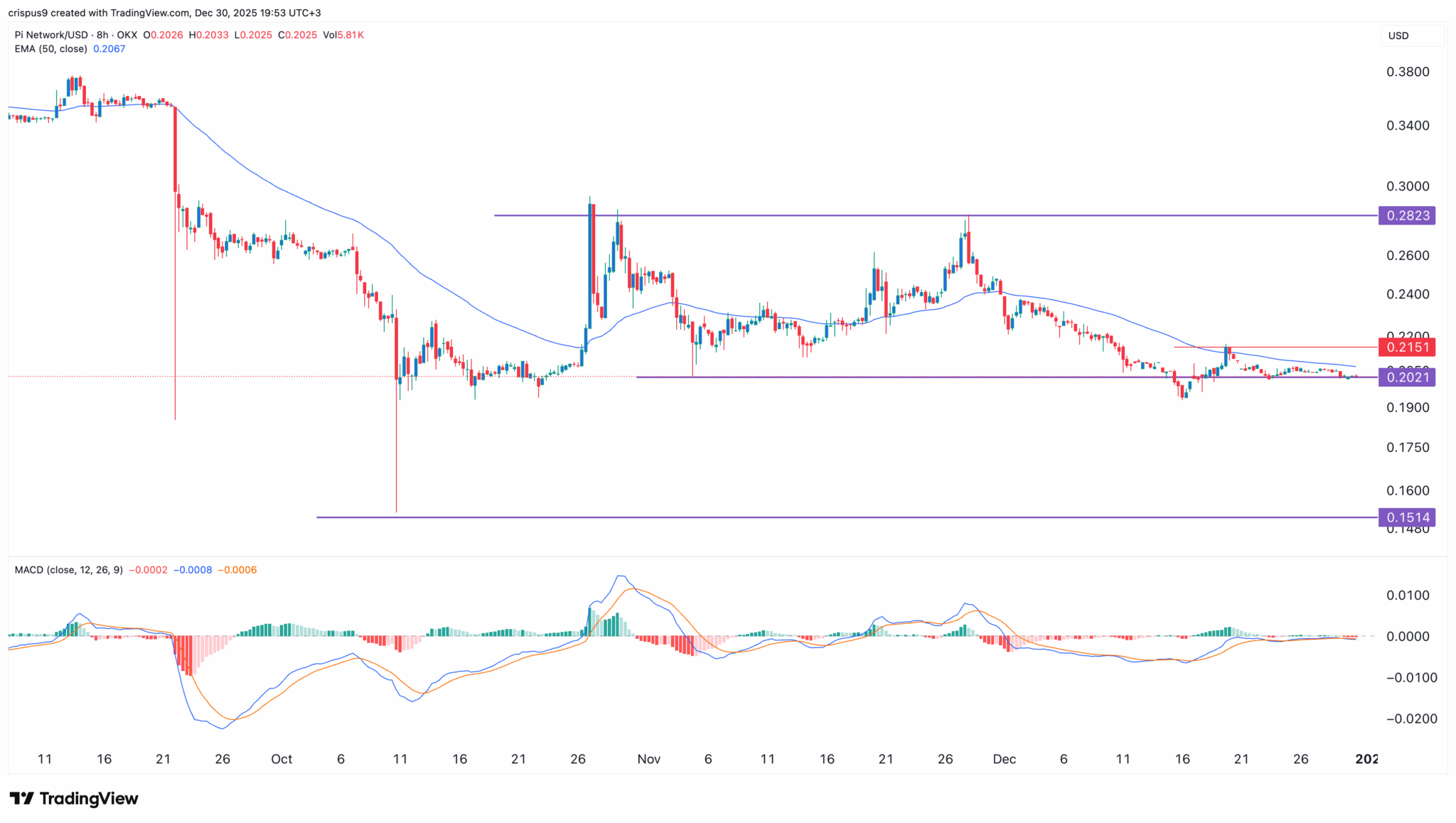
Technical analysis suggests that Pi may continue to decline in the coming weeks. The 8-hour chart shows Pi’s price has fallen sharply from the November high of $0.2823 to the current $0.2028. A double top pattern has formed at $0.2823, with the neckline at $0.2021, which was the lowest point on November 4.
The double top is one of the most reliable bearish patterns in technical analysis. When the price hits a high twice but fails to break through, and then falls below the low between the two highs (the neckline), it often signals a trend reversal. Pi’s current price of $0.2027 is very close to the neckline at $0.2021. A confirmed breakdown would validate the double top and trigger a new downtrend.
The token has broken below the 50-week exponential moving average (EMA), and the MACD indicator remains neutral at zero. The break below the 50 EMA indicates a shift to a medium-term bearish trend. When the price operates below the moving average, rebounds to the EMA are met with selling pressure. MACD at zero suggests a temporary balance of bullish and bearish forces, but combined with price position and unlock pressures, the bias favors bears.
Therefore, the token could experience a strong downward breakout in the coming days, with the next key support at $0.1515, the lowest price this year in October. A drop from current levels to $0.1515 implies about 25% decline, which is entirely plausible given the current supply-demand structure.
Ghost Chain Skepticism and Ecosystem Dilemma
Pi Network faces ongoing adverse factors affecting its performance. Some analysts consider it a “ghost chain” with no meaningful applications within its ecosystem. Although DEXs like Coixa have started deploying on Pi, their TVL and trading volume are negligible compared to mainstream blockchains.
Pi claims to have tens of millions of registered users, but on-chain activity is extremely low, indicating most users do not actively use Pi for transactions or DeFi participation. When a blockchain lacks real-world use cases, its token value can only be supported by speculation. Once speculative enthusiasm wanes, the price will revert to its true value — which, in Pi’s case, could be close to zero.
If Pi’s price rises to near the critical resistance at $0.2150 (the December 20 high), bearish forecasts would be invalidated. However, given the current supply-demand dynamics and technical patterns, such a rebound is highly unlikely.
Disclaimer: The information on this page may come from third parties and does not represent the views or opinions of Gate. The content displayed on this page is for reference only and does not constitute any financial, investment, or legal advice. Gate does not guarantee the accuracy or completeness of the information and shall not be liable for any losses arising from the use of this information. Virtual asset investments carry high risks and are subject to significant price volatility. You may lose all of your invested principal. Please fully understand the relevant risks and make prudent decisions based on your own financial situation and risk tolerance. For details, please refer to
Disclaimer.


