 Trusted Editorial content, reviewed by leading industry experts and seasoned editors. Ad Disclosure
Ethereum is once again struggling to regain the $3,000 level, highlighting the fragile state of the market as selling pressure continues to weigh on price action. After multiple failed attempts to push higher, ETH remains locked below key resistance, reflecting broad uncertainty and a lack of conviction among both traders and long-term investors.
Trusted Editorial content, reviewed by leading industry experts and seasoned editors. Ad Disclosure
Ethereum is once again struggling to regain the $3,000 level, highlighting the fragile state of the market as selling pressure continues to weigh on price action. After multiple failed attempts to push higher, ETH remains locked below key resistance, reflecting broad uncertainty and a lack of conviction among both traders and long-term investors.
Related Reading: Galaxy Digital Moves $39M In Bitcoin To Exchanges, Signaling Potential Sell-OffMarket sentiment has deteriorated sharply, with apathy and fear dominating positioning as participants remain hesitant to deploy fresh capital. Rather than aggressive capitulation, the current environment points to exhaustion and indecision, a common feature of late-cycle corrective phases.
According to a recent report by XWIN Research Japan on CryptoQuant, Ethereum is now in a late-stage bearish phase that appears to be transitioning into a more range-bound structure. While bearish pressure still dominates the broader trend, the nature of selling activity is changing.
Instead of sharp, panic-driven sell-offs, the market is experiencing slower, more methodical distribution, suggesting that many weak hands may have already exited. This shift often marks a critical inflection point, where volatility compresses, and price stabilizes within a defined range.
The report notes that such phases typically reflect a market searching for equilibrium. Although this does not guarantee an immediate recovery, it does indicate that downside momentum may be weakening. For Ethereum, the coming weeks will be decisive in determining whether this range evolves into a base for recovery or resolves into another leg lower.## Ethereum’s On-Chain Structure Improves As Price Weakness Persists
While Ethereum continues to struggle below key resistance levels, on-chain indicators suggest that the underlying market structure may be gradually improving. Data shows ETH leaving exchanges at the fastest pace of this cycle, a move increasingly associated with self-custody, staking, and long-term holding rather than short-term trading activity.
This shift is reinforced by validator queue dynamics: for the first time in six months, the entry queue has surpassed the exit queue, with roughly 745,000 ETH waiting to be staked versus around 360,000 ETH queued for withdrawal. The imbalance points to renewed staking participation and a tightening medium- to long-term supply profile.
Additional context comes from the 90-day Spot Taker CVD, which indicates a transition away from strongly sell-dominant conditions toward neutral to mildly positive pressure. Although this does not imply an immediate price rebound, it suggests that aggressive selling is beginning to lose intensity.
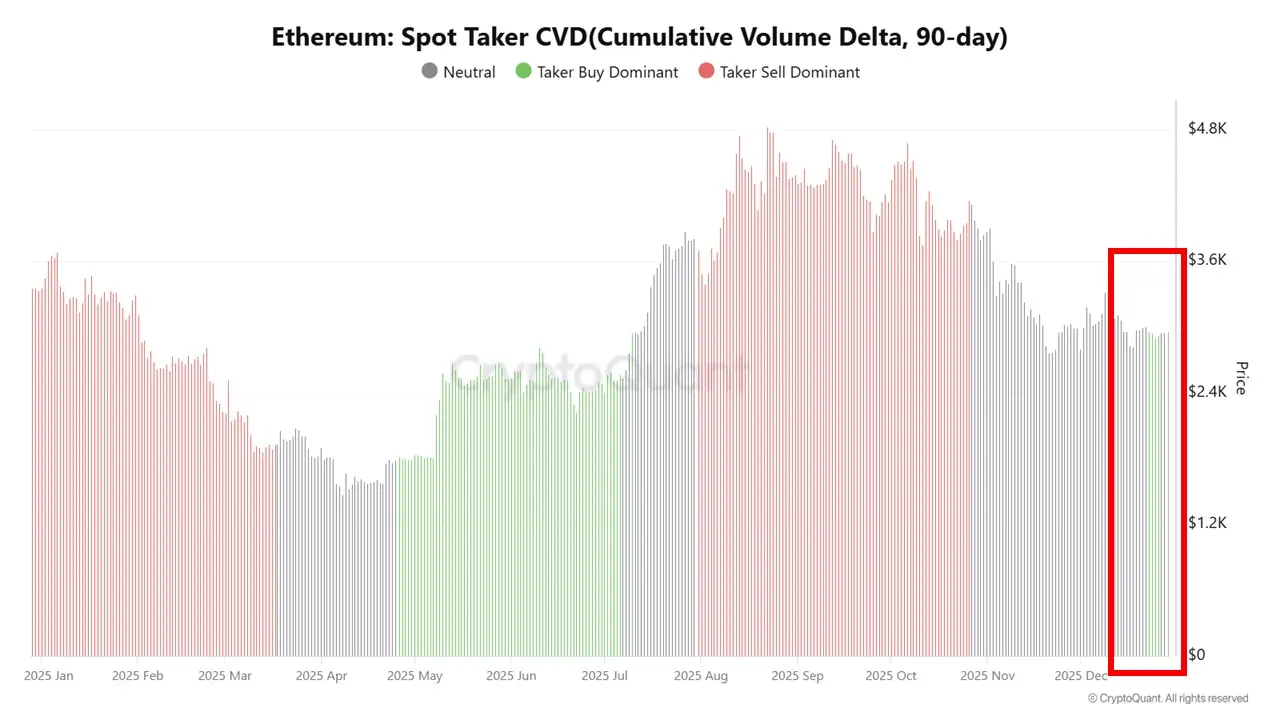 Ethereum Spot Taker CVD | Source: CryptoQuantThat said, Ethereum ETF flows remain negative on both daily and weekly timeframes, signaling that institutional demand via financial products continues to weigh on price action.
Beyond market flows, Ethereum’s network activity remains resilient. Deployed smart contracts reached a record 8.7 million in Q4 2025, while on-chain real-world asset value expanded to approximately $19 billion, led by Ethereum. These trends indicate that usage-driven demand remains intact despite weak sentiment.
The data support a scenario of ongoing price pressure alongside gradual structural improvement. This assessment would weaken if exchange balances rise again or sell-side flows regain dominance.
Related Reading: Bitcoin Sees Post-Capitulation Conditions Align: Selling Pressure Falls 80%
Price Remains Below Key Moving Averages
Ethereum continues to trade in a tight consolidation near the $2,900–$3,000 zone, reflecting persistent indecision after the sharp correction from the $4,800 cycle peak. The chart shows ETH struggling to reclaim the 50-day and 100-day moving averages, which are now acting as dynamic resistance around the $3,200–$3,600 region. Each attempt to push higher has been met with selling pressure, reinforcing the broader bearish structure that has been in place since November.
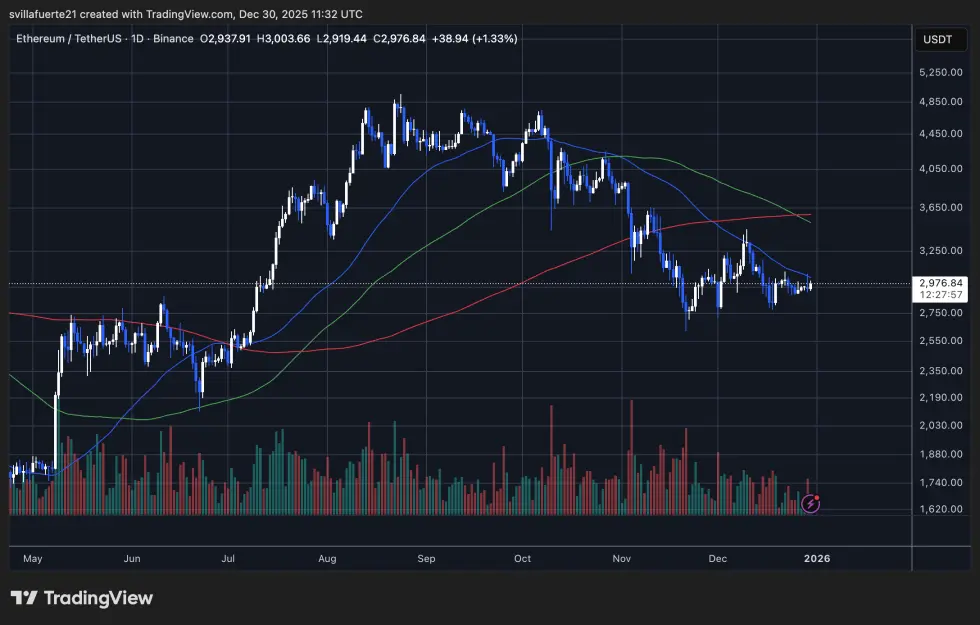 ETH consolidates below key MAs | Source: ETHUSDT chart on TradingView
From a trend perspective, price remains below the declining short-term moving average, while the 200-day moving average near the $3,500 area continues to slope downward. This configuration signals that Ethereum is still trading in a corrective phase rather than a confirmed recovery.
ETH consolidates below key MAs | Source: ETHUSDT chart on TradingView
From a trend perspective, price remains below the declining short-term moving average, while the 200-day moving average near the $3,500 area continues to slope downward. This configuration signals that Ethereum is still trading in a corrective phase rather than a confirmed recovery.
However, downside momentum appears to be weakening. The recent series of higher lows around $2,750–$2,800 suggests that buyers are defending this range as a short-term demand zone.
Related Reading: Ethereum In Limbo As Muted On-Chain Flows Reflect Market Indecision
Volume has also compressed during the latest consolidation, a sign that aggressive selling may be losing intensity. This aligns with the broader narrative of exhaustion rather than renewed capitulation. Still, without a decisive reclaim of $3,200 and a move back above the 50-day average, any upside attempts remain vulnerable.
Featured image from ChatGPT, chart from TradingView.com
![]() Editorial Process for bitcoinist is centered on delivering thoroughly researched, accurate, and unbiased content. We uphold strict sourcing standards, and each page undergoes diligent review by our team of top technology experts and seasoned editors. This process ensures the integrity, relevance, and value of our content for our readers.
Editorial Process for bitcoinist is centered on delivering thoroughly researched, accurate, and unbiased content. We uphold strict sourcing standards, and each page undergoes diligent review by our team of top technology experts and seasoned editors. This process ensures the integrity, relevance, and value of our content for our readers.
Disclaimer: The information on this page may come from third parties and does not represent the views or opinions of Gate. The content displayed on this page is for reference only and does not constitute any financial, investment, or legal advice. Gate does not guarantee the accuracy or completeness of the information and shall not be liable for any losses arising from the use of this information. Virtual asset investments carry high risks and are subject to significant price volatility. You may lose all of your invested principal. Please fully understand the relevant risks and make prudent decisions based on your own financial situation and risk tolerance. For details, please refer to
Disclaimer.
Related Articles
ETH drops 1.23% in 15 minutes: Retail’s concentrated sell-off and amplified ETF fund outflows weigh on the spot order book
2026-04-16 13:45 to 14:00 (UTC), ETH spot prices fell by 1.23% in just 15 minutes. The candlestick price range covered 2291.2 to 2336.98 USDT, with a swing of 1.96%. Market volatility intensified, sell pressure on the board became concentrated, and the trading community’s focus clearly shifted toward changes in capital outflows.
The main driver behind this abnormal move is large-scale, concentrated selling from retail. In the spot market, net outflows in the first 5 minutes reached as high as -$95.57M. Although some lead/major funds attempted to accumulate at lower prices (net inflows of +$18.95M in large orders over 5 minutes), the overall scale was limited and unable to effectively hedge the overall short-term selling pressure. Meanwhile, the ETH futures market did not show extreme liquidations or large-scale position closures, indicating that the core of the abnormal move came from a spot supply-and-demand imbalance rather than leveraged liquidation cascades.
In addition, ETH spot ETF funds have continued to experience net outflows in early April. On April 1, the single-day net outflow was $7.1M. The overall trend in Q1 was bearish, directly reflecting weakening institutional capital allocation intent and further undermining market confidence. Some funds have shifted to on-chain staking and emerging DeFi protocols. It is also worth noting that large holders with holdings in the 100,000-ETH range have continued to reduce their positions since the end of March. Whale capital outflows have persisted, and retail has followed the above signals, leading to a multi-factor selloff resonance effect in the short term. Although both the number of active addresses on the ETH chain and daily trading volume have hit historical highs, network usage and liquidity are overall strong, but capital flow has not formed any substantive spot buy orders, making it difficult to drive a price reversal.
At present, short-term market risk remains significant. Investors should pay attention to the strength of subsequent retail selling, the direction of ETF fund flows, and changes in large-holder positions. If large holders and major funds do not form a strong follow-through/acceptance, the spot market may continue to be affected by the release of structural supply. It is recommended that investors monitor key support zones in real time, track large on-chain fund movements, and watch for macro news developments, in order to reasonably mitigate the risk of short-term price fluctuations and promptly obtain more market information.
GateNews14m ago
ETH falls below 2300 USDT
Gate News bot message, Gate quotes show that ETH has fallen below 2300 USDT, with the current price at 2296.29 USDT.
CryptoRadar21m ago
Charles Schwab Launches Schwab Crypto Spot Trading for Bitcoin and Ethereum
Charles Schwab launched Schwab Crypto on April 16, a spot cryptocurrency trading service for retail customers. It supports direct trading of Bitcoin and Ethereum and offers education and support, integrating with existing financial services.
GateNews29m ago
Ethereum Foundation Funds $1M Audit Program for Smart Contract Developers
The Ethereum Foundation has launched a $1 million subsidy program designed to help Ethereum mainnet builders pay for professional smart contract security audits.
Key Takeaways:
The Ethereum Foundation launched a $1 million audit subsidy program on April 14, 2026, to help builders cover security r
Coinpedia58m ago
InterLink Launches Visa Card Supporting USDT and ETH Across 100M+ Merchants
InterLink has launched a Visa card allowing users to spend USDT and ETH at over 100 million merchants worldwide. It offers instant crypto-to-fiat conversion and integrates with mobile payment apps, enhancing the use of digital assets in daily transactions. Future updates will include support for InterLink's native tokens.
GateNews1h ago


