Pi Coin (PI) has traded sideways for the past week, hovering near $0.2025 amid low volume and fading momentum. With a major 134 million token unlock scheduled for January 2026, investors are watching closely to see if the event sparks renewed volatility or further pressure on the Pi Coin price.
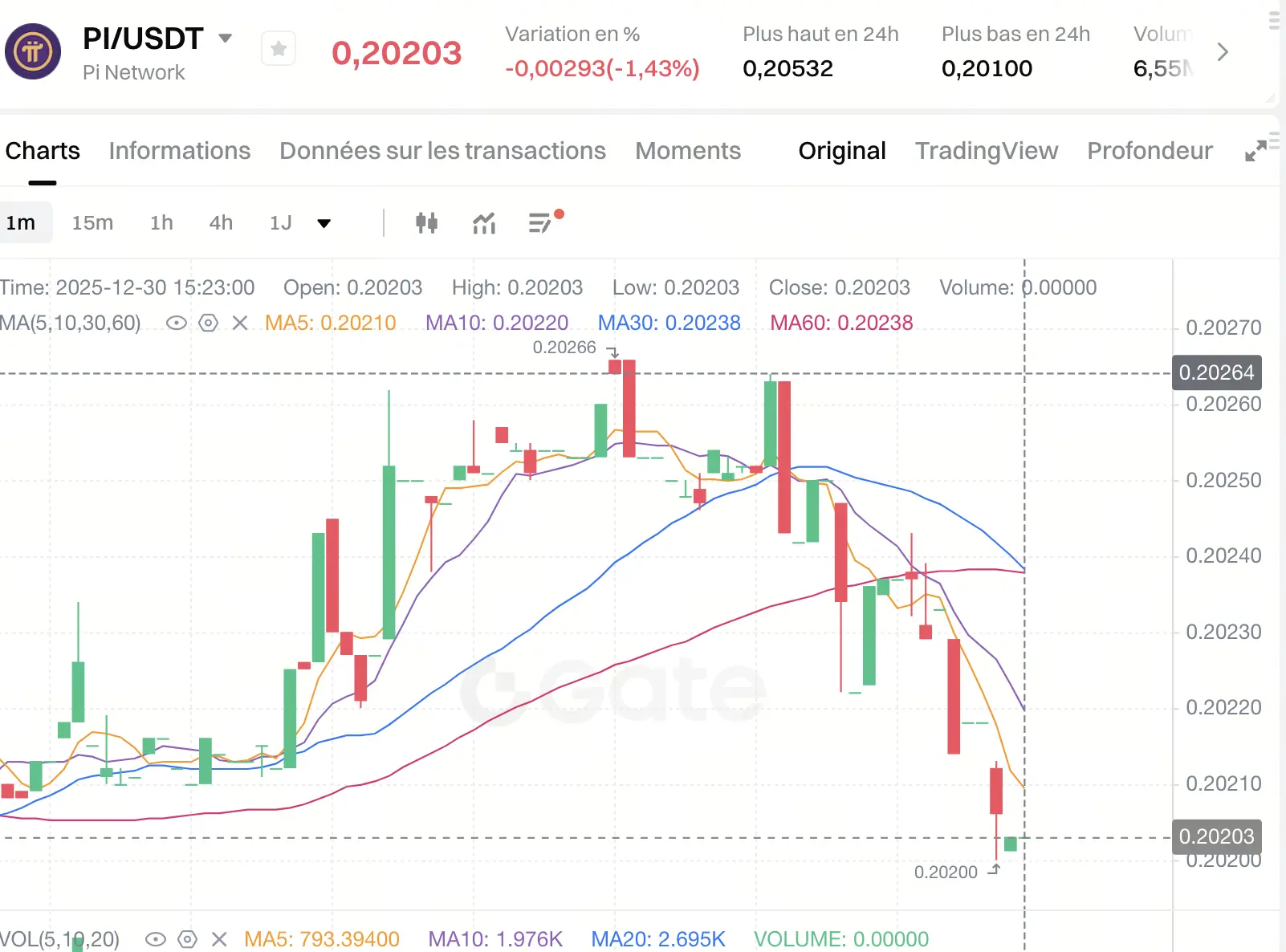
- Pi Coin price stuck around $0.2025, down over 93% from its all-time high.
- January unlock: 134 million tokens (~$27 million at current prices).
- Unlock pace slows after December’s 190 million release, potentially easing inflation.
- Daily trading volume has dropped to ~$10 million despite $1.6B+ market cap.
The Pi Network team continues ecosystem development, but secondary market demand remains subdued as traders await clearer catalysts.
January Unlock: Supply Pressure or Buying Opportunity?
The upcoming 134 million token release represents a significant but smaller tranche compared to December’s 190 million.
This reduction in unlock velocity could gradually lower inflationary pressure in the first half of 2026—potentially supportive for the Pi Coin price if demand stabilizes.
However, historical patterns around unlocks often see short-term selling as recipients liquidate portions, especially in low-liquidity environments.
The Core Team has emphasized long-term utility over speculation, recently investing part of its $100 million ecosystem fund into projects like CiDi Games and OpenMind.
Ongoing Ecosystem Developments
Pi network advances several initiatives aimed at boosting real-world adoption:
- Testnet trials of a decentralized exchange (DEX) and automated market maker (AMM), with mainnet launch targeted for 2026.
- Recent hackathon winners: Blind Lounge (privacy-focused social/dating app) and Starmax (loyalty rewards platform)—both leveraging Pi Coin for transactions.
These efforts focus on creating genuine utility to drive organic demand rather than relying on speculative trading.
Pi Coin Price Technical Analysis
On the 3-day chart, Pi Coin has consolidated near the key support at $0.2021—also the neckline of a double-top pattern formed earlier.
The token remains below the 50-day Exponential Moving Average, with the Supertrend indicator signaling bearish control.
A decisive break below $0.2021 could open the path toward the all-time low near $0.1514 (~25% lower).
Upside requires reclaiming $0.2823 resistance to invalidate the bearish structure.
With volume muted and momentum indicators neutral-to-bearish, the Pi Coin price outlook leans cautious heading into the unlock.
Pi Coin Price Outlook: 2026 Scenarios
Bearish Case Persistent low demand and unlock-related selling could push Pi coin toward $0.15 or lower early in 2026, especially if broader market risk appetite remains weak.
Neutral/Base Case Stabilization around $0.20–$0.25 as unlock pace slows and ecosystem tools gain traction.
Bullish Case Successful DEX/mainnet rollout and rising utility drive renewed interest, targeting $0.35–$0.50 if adoption accelerates.
Long-term Pi Coin price potential hinges on transitioning from community mining to sustainable real-world usage.
Pi Coin FAQ
1. What is the January 2026 unlock size? 134 million tokens (~$27 million at current prices).
2. How does this compare to previous unlocks? Smaller than December’s 190 million, signaling slowing inflation pace.
3. Will the unlock crash the Pi Coin price? Possible short-term pressure from selling, but reduced velocity could ease long-term supply concerns.
4. What could drive Pi Coin higher in 2026? Mainnet DEX/AMM launch, merchant adoption, and real-world app growth.
5. Is Pi Coin a good investment now? High-risk/high-reward—suitable only for those comfortable with volatility and long timelines.
6. Where is Pi Coin traded? Primarily secondary markets; full exchange listings expected post-mainnet.
Pi Network’s path forward depends on execution: turning its massive user base into active economic participants. The January unlock will test market absorption—watch volume and utility developments closely for the next directional clue.
Disclaimer: The information on this page may come from third parties and does not represent the views or opinions of Gate. The content displayed on this page is for reference only and does not constitute any financial, investment, or legal advice. Gate does not guarantee the accuracy or completeness of the information and shall not be liable for any losses arising from the use of this information. Virtual asset investments carry high risks and are subject to significant price volatility. You may lose all of your invested principal. Please fully understand the relevant risks and make prudent decisions based on your own financial situation and risk tolerance. For details, please refer to
Disclaimer.
Related Articles
Pi Network PIRC baseline protection mechanism sparks controversy, implying a “quasi-stablecoin” logic
Pi Network member Daniel F raised a logical contradiction in the PIRC token design, noting that if it has a 23.8% floor protection, it would need to behave like a stablecoin, which conflicts with its high volatility on CEX. This floor is based on Pi’s price calculations; if Pi itself fluctuates significantly, it will be unable to effectively protect holders. Daniel emphasized the importance of transparency, but the project team did not respond to it, leading the community to continue speculating about the reasons for its silence.
MarketWhisper1h ago
Pi Network Major Transformation: 210 Ecosystem Applications Deployed, 23k Developers Ready
The Pi Network ecosystem is accelerating its transition, with more than 210 active applications and 23,000 developers actively participating in Pi Studio, spanning multiple areas such as payments, community engagement, education, and gaming. The ecosystem’s diversity shows indicators of healthy development, and developers’ engagement is driving ongoing application optimization. In the future, improving the usefulness of the mainnet will be a key challenge, including issues that need to be urgently addressed such as scalability, security, and user adoption rates.
MarketWhisper1h ago
Pi Network Expands Developer Tools With RPC Server Upgrade
Pi Network has taken another step to improve its system for developers. The project has launched a new RPC server upgrade on its Testnet, making it easier to build and test apps on the network. This update allows node operators to run their own RPC servers
In simple words, developers no longer
Coinfomania04-11 22:55
Pi Network Transfers 30M Coins as Migration Resumes
Pi Network has restarted its long-running migration process after a short pause. In the latest update, around 30 million Pi coins moved from an intermediary address to user-linked wallets. The transfer happened just hours after activity resumed, following a one-week break
The update suggests the n
Coinfomania04-10 21:24
Pi Network restarts the migration, and 30 million Pi have been transferred into users’ wallets
Pi Network resumed mainnet migration after a pause, transferring about 30 million Pi tokens to users’ wallets, mainly targeting users who have completed KYC. The first migration has been completed, and a second migration is currently underway, with the core team emphasizing batch processing. Some false information appeared during the process; the official account has issued a clarification, reminding users to obtain information through official channels.
MarketWhisper04-10 06:39
Pi Network version 21 released; mainnet RPC and smart contract acceleration are advancing
Pi Network released version 21 on April 9. The key update is that the testnet RPC has officially gone live, providing developers with a secure environment to test smart contracts and DApps. Next, smart contracts are expected to be deployed within two months, enabling Pi幣 to transition from a community token into a functional digital asset and to support DeFi applications and automated workflows, while also advancing the KYC migration to ensure compliance.
MarketWhisper04-10 01:50


