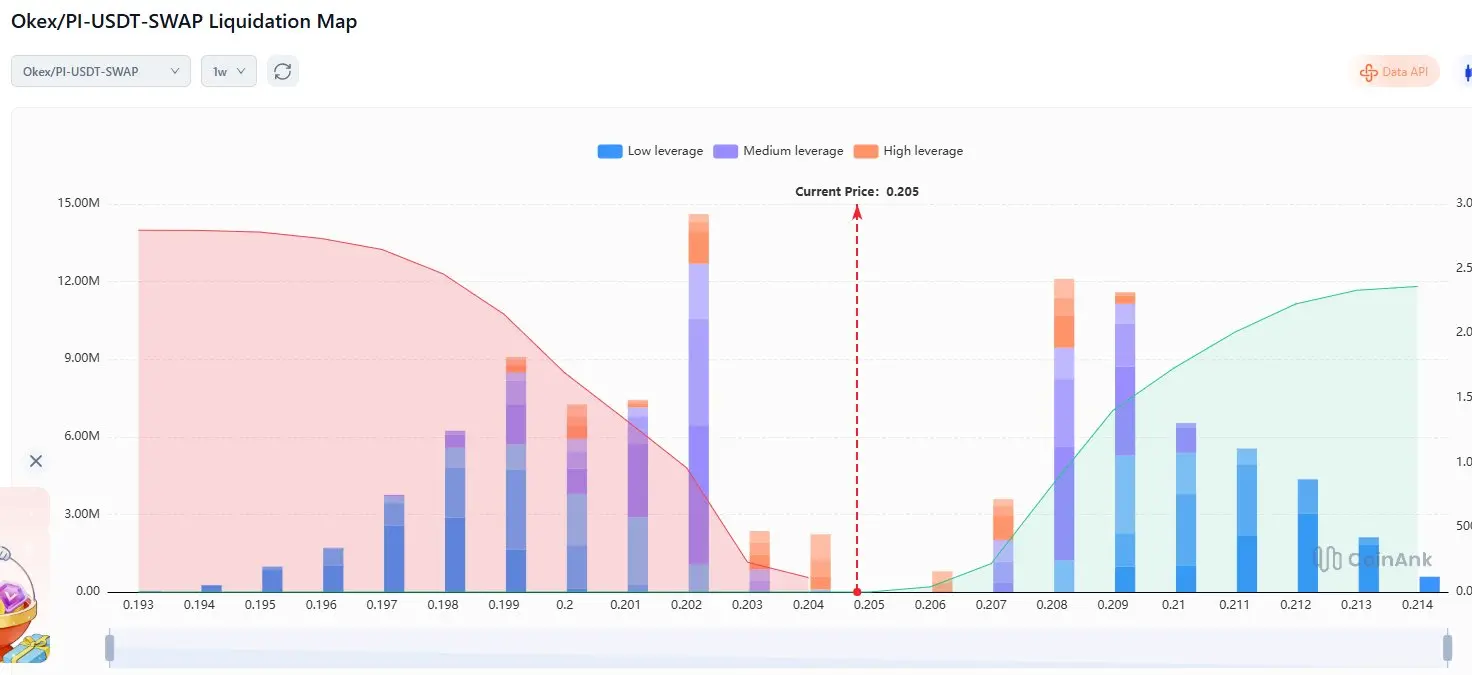
Pi coin has stabilized around $0.205 after weeks of consolidation, indicating signs of ending the consolidation phase. Dao World suggests that Pi may have entered the final stage of consolidation, with bulls and bears maintaining leverage balance. The CEX liquidation heatmap shows that both the $0.21 upward liquidation and the $0.19 downward liquidation could trigger chain reactions. This structure typically signals that after low volatility, an expansion phase is imminent, and the current zone holds significant technical importance.
Liquidation Heatmap Reveals Chain Explosion Risks
(Source: X)
The CEX liquidation position heatmap indicates that leverage positions for Pi are highly concentrated within a narrow range around the current price. This concentration makes small price movements capable of triggering chain liquidations. Once Pi moves outside its normal fluctuation range, the momentum for liquidation will intensify. Specifically, there are many short liquidation orders at the $0.21 level; if the price breaks above this level, short positions will be forced to close, creating passive buy pressure that pushes the price higher, forming a “short squeeze” effect.
Conversely, at the $0.19 level, there are many long liquidation orders. If the price falls below this support, long positions will be forcibly closed, accelerating the decline and potentially triggering a chain reaction until the next strong support zone. The existence of these dense bidirectional liquidation zones makes the $0.19 to $0.21 range the most critical battleground for Pi in the short term.
This concentration of liquidations is not accidental. After weeks of narrow fluctuations, many traders believe Pi has bottomed or is about to break out, leading them to leverage and open positions. Bulls bet on an upward breakout, setting stop-losses near $0.19; bears bet on a breakdown below $0.21, also placing stop-losses. When leverage positions accumulate to a certain scale, any breakout in either direction can evolve into a one-sided trend.
Dao World emphasizes that neutral leverage and narrow price movements sometimes reflect market fatigue rather than panic, offering investors opportunities for rational short-term operations. This suggests that the current situation is not a trend but the tail end of a range-bound oscillation. For short-term traders, this is a moment of both risk and opportunity: correct directional judgment can yield substantial gains; misjudgment can be cut with stop-losses, keeping losses manageable.
However, it must be clear that concentrated liquidations do not predict breakout direction. They only indicate that once the price leaves the current range, volatility will be amplified. Whether it breaks above $0.21 or below $0.19 depends on other factors, including volume changes, overall crypto market sentiment, and whether there are major news in the Pi Network ecosystem.
Scenario Paths at the End of Consolidation
As consolidation nears its end, ( Pi is currently in a decision zone. Since the price may leave the consolidation range, traders could see larger volatility. Confirmation from volume and overall market conditions will determine whether the price will trigger a short-term rebound or further decline. From a technical perspective, Pi’s next development can be summarized into three scenarios.
Optimistic scenario: If Pi breaks above $0.21 with increased volume, it will trigger short liquidations and accelerate upward movement. The next resistance could be around $0.25; if it continues to break through, previous resistance zones at $0.30 to $0.35 will become testing targets. This scenario requires significant positive news in the Pi ecosystem, such as top exchanges listing it genuinely, key applications breaking through, or the overall crypto market entering a risk-on phase.
Neutral scenario: Continued oscillation between $0.19 and $0.21. In this case, bulls and bears continue to battle but neither gains a decisive advantage. The consolidation could last weeks or even months until a clear catalyst appears. For long-term investors, this sideways movement is not necessarily bad, as it allows market rotation, digestion of previous selling pressure, and lays the foundation for future trend moves.
Pessimistic scenario: Falling below $0.19 support. If this occurs, long liquidations will be triggered, and the price could accelerate downward to $0.15 or test the October low of $0.172. This scenario might be caused by underwhelming progress in Pi ecosystem development, delays from the core team on key milestones, or systemic risks in the overall crypto market.
)# Three Scenarios Trigger Conditions and Trading Strategies
Breakout scenario (target $0.25 to $0.35): Triggered by breaking $0.21 with volume increase, major positive news in Pi ecosystem, or market risk appetite returning. Trading strategy: After breakout, open small long positions, set stop-loss at $0.20.
Consolidation continuation (range $0.19 to $0.21): Triggered by lack of clear catalysts, balanced forces. Trading strategy: Take profits at highs and buy at lows within the range, or wait for a clear direction.
Collapse scenario (target $0.15 to $0.172): Triggered by breaking $0.19 with volume increase, poor ecosystem progress, or systemic market risks. Trading strategy: Stop-loss and exit after breakdown, wait for lower levels or abandon positions.
Post Mainnet Technical Reconstruction
![Pi幣技術圖]###https://img-cdn.gateio.im/webp-social/moments-87a9b3933a-b75d164032-153d09-6d5686.webp(
(Source: Trading View)
Since Pi’s mainnet launched in February 2025, volatility has been extreme. After reaching a high of $2.99 early on, it quickly dropped to the October low of $0.172, a 95% decline. Such sharp fluctuations are common among newly launched tokens, reflecting the market’s price discovery process of the token’s true value. The rebound from $0.172 to the current $0.205 represents about a 19% increase, indicating some short-term buying support.
The technical picture is no longer as panic-driven as before. This change suggests that selling pressure has been largely released, and holders willing to sell at low prices have exited, leaving remaining holders with higher acceptance of the current price. Recent candlestick patterns show many small dojis and spinning tops, indicating a temporary balance between bulls and bears, with both sides waiting for new catalysts.
Decreasing volume is a typical feature of the end of consolidation. When prices oscillate within a narrow range with declining volume, it indicates market participants are observing, waiting for a clear direction. This low volatility, low volume state often precedes a significant move, as once the direction is confirmed, capital will flood in, pushing the price out of the range rapidly.
From a time cycle perspective, weeks of consolidation are sufficient. Technical analysis suggests that longer consolidation leads to stronger breakout momentum. If Pi truly breaks above $0.21 or drops below $0.19, the subsequent trend could last days or weeks, providing clear opportunities for short-term traders.
) Volume Confirmation Is a Key Variable
Dao World emphasizes that confirmation from volume and overall market conditions will determine whether the price movement triggers a short-term rebound or further decline. This highlights the core of current analysis: price patterns and leverage distribution only provide clues about imminent volatility, but the actual direction needs volume to confirm.
If volume significantly increases upon breaking $0.21, it generally confirms the breakout’s validity, with stronger upward momentum. Conversely, if volume diminishes during the breakout, it may be a false breakout, and the price could quickly return to the consolidation zone. The same logic applies to breaking below $0.19: volume surge confirms the breakdown, while declining volume suggests a technical breach or trap.
The overall crypto market condition is also crucial. If Bitcoin and Ethereum enter a bullish cycle, risk appetite will rise, lifting altcoins including Pi. As a project with a large community base, Pi could benefit. Conversely, if major coins remain weak, even a technical breakout may fail due to lack of market support.
For Pi holders, this is a key observation period. If bullish, consider small long positions near $0.205 with stop-loss below $0.19, targeting $0.25–$0.30. If bearish, wait for a breakdown below $0.19 with stop-loss above $0.21, and consider short positions. If uncertain, the most rational choice is to wait and see, only acting after a confirmed breakout with volume support.


