As Ethereum enters 2026, the network is poised for significant upgrades aimed at dramatically improving Layer 1 (L1) scalability, interoperability, and user experience.
The two major hard forks—Glamsterdam (mid-2026) and Heze-Bogota (end-2026)—will introduce perfect parallel transaction processing, substantial gas limit increases, higher data blob capacity, and a gradual shift toward zero-knowledge (ZK) validation. These changes set the stage for Ethereum L1 to approach 10,000 transactions per second (TPS) in the future, while Layer 2s (L2s) could handle hundreds of thousands TPS. Additional focus on cross-chain seamless operation, privacy enhancements, and censorship resistance will make 2026 a pivotal year for Ethereum’s evolution. For developers and users searching Ethereum roadmap 2026, Glamsterdam fork, or Ethereum scaling updates, these upgrades promise a more efficient, inclusive, and resilient network.
(Sources: X)
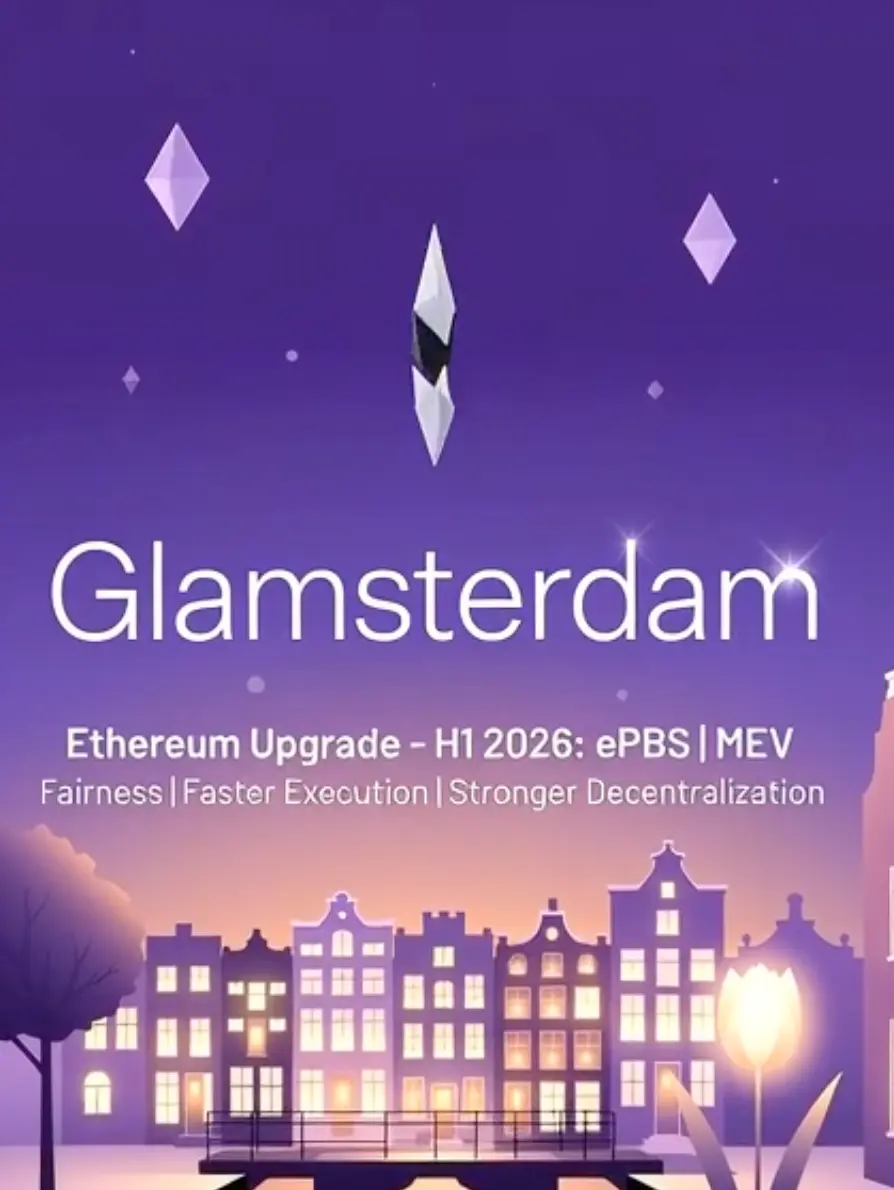
Glamsterdam Fork: Parallel Processing and Gas Limit Boost
The Glamsterdam hard fork, targeted for mid-2026, is finalizing its Ethereum Improvement Proposals (EIPs) with two headline features:
- Block Access Lists (EIP-7928): Enables “perfect parallel processing” by allowing transactions to specify data access in advance, reducing conflicts and enabling simultaneous execution.
- Enshrined Proposer-Builder Separation (ePBS): Formalizes the separation of block proposal and building, improving MEV management and network efficiency.
Combined, these changes will:
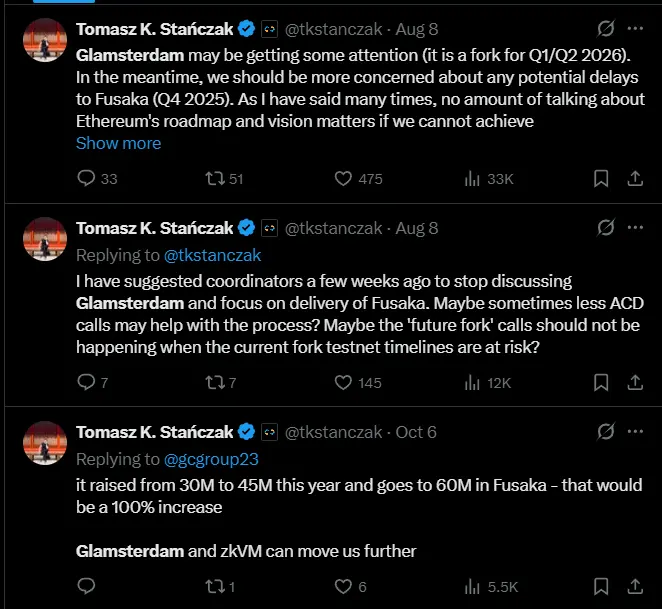
- Raise Gas Limit: From ~60 million today to 200 million, unlocking higher throughput.
- Prepare for ZK Transition: ~10% of validators expected to switch from re-execution to ZK proof verification.
- Path to 10,000 TPS: L1 scaling foundation, though full target likely post-2026.
While technical names dominate for now, community nicknames like “Firedancer” may emerge for client diversity efforts.
(Sources: X)
Increased Data Blobs: Supercharging Layer 2 Scaling
Data blobs—introduced with EIP-4844 (Dencun)—will see major expansion:
- Blob Count: Potentially 72+ per block (from current levels).
- L2 Impact: Enables rollups to process hundreds of thousands TPS collectively.
- User Experience: Innovations like ZKsync’s Atlas upgrade allow mainnet balances with L2-fast execution.
This blob boost makes Ethereum the settlement layer for massive parallel L2 activity.
Heze-Bogota Fork: Interoperability, Privacy, and Censorship Resistance
The year-end Heze-Bogota fork targets:
- Ethereum Interoperability Layer: Seamless cross-L2 communication and asset movement.
- Privacy Focus: Enhanced tools for private transactions and data.
- Censorship Resistance: Stronger protections against block-level exclusion.
These features address long-standing user pain points in multi-rollup environments.
Why 2026 Is Crucial for Ethereum Scaling
- L1 Throughput: Parallel execution + gas hikes lay groundwork for higher native TPS.
- L2 Explosion: Blob increases supercharge rollup capacity.
- ZK Shift: Gradual validator transition to proof verification reduces resource needs.
- User-Friendly: Abstraction and interoperability lower barriers.
While 10,000 TPS on L1 remains a multi-year goal, 2026 upgrades position Ethereum for exponential effective scaling via L2s.
In summary, Ethereum’s 2026 roadmap—headlined by Glamsterdam (parallel processing, 200M gas limit) and Heze-Bogota (interoperability, privacy)—will drive L1 efficiency, L2 explosion via more blobs, and a 10% ZK validator shift. These changes set the network on a path to higher TPS, better user experience, and stronger resilience. Monitor core dev calls and EIP discussions for finalized details on this transformative year for Ethereum scaling.
Disclaimer: The information on this page may come from third parties and does not represent the views or opinions of Gate. The content displayed on this page is for reference only and does not constitute any financial, investment, or legal advice. Gate does not guarantee the accuracy or completeness of the information and shall not be liable for any losses arising from the use of this information. Virtual asset investments carry high risks and are subject to significant price volatility. You may lose all of your invested principal. Please fully understand the relevant risks and make prudent decisions based on your own financial situation and risk tolerance. For details, please refer to
Disclaimer.
Related Articles
Trader MaJi's ETH Position Ranks Top 2 on Hyperliquid With $1.599M Unrealized Gains
Trader MaJi holds three long positions on Hyperliquid, with total unrealized gains of $1.599 million. His largest position is a 25x long on ETH, followed by a 40x long on BTC, and a 10x long on HYPE, making him a significant ETH holder.
GateNews9m ago
ETH/BTC ratio rebounds—are institutional funds rotating? A deep dive into structural signals in the crypto market
BTC breaks through $75,000; the Iran–Israel ceasefire and fresh highs in U.S. stocks lift risk assets, but the options market remains somewhat cautious. The ETH/BTC ratio rebounds, signaling capital rotation.
GateInstantTrends3h ago
Whale Deposits 3,500 ETH to Aave V3, Borrows 8M USDC, and Buys Back 3,386 ETH
A whale deposited 3,500 ETH worth $8.26 million into Aave V3, borrowed 8 million USDC, then purchased 3,386 ETH and redeposited it, now holding 6,886 ETH valued at around $16.22 million.
GateNews3h ago
BitMine’s quarterly net loss was $3.81 billion, with ETH’s unrealized losses accounting for 99%
BitMine Immersion Technologies filed its financial report with the SEC on April 15, 2026, showing that the company’s quarterly net loss as of February 28 totaled $3.81B, mainly due to unrealized losses from its Ethereum holdings. The company holds about 4.87 million ETH, with an average purchase cost of $3,794 per ETH. Its recent market value exceeded $10.7 billion. The BMNR stock has been upgraded to the New York Stock Exchange, and the current quote is $21.69.
MarketWhisper3h ago
Calastone token network access of $68 billion, L&G fund supports same-day settlement
Legal & General Asset Management(L&G AM)announced that it has successfully moved more than £50 billion of its liquidity funds on-chain through a tokenized distribution network built with Calastone, supporting T+0 settlement and multi-currency pricing. This deployment is based on Ethereum, and it plans to expand to more blockchains in the future while ensuring compliance with the regulatory framework.
MarketWhisper6h ago


