The festival season often ignites hopes of a “Santa Rally,” but as we move into 2025, the picture looks less bright for Bitcoin holders: instead of excitement, a series of warning signals are emerging.
Bitcoin’s price currently hovers around $87,440, up just 0.33%, reflecting cautious sentiment and fragility that are dominating the market.
Analysts Predict Bitcoin’s Bottom
This weakening has sparked what is called a “fractal fever” on social media platforms, as more analysts point out that Bitcoin’s current price structure mirrors the peak of the 2021 bull cycle.
Back then, Bitcoin (BTC) hit $51,700 on December 24, before plunging 34% in just one month. If history repeats itself, the market could face a volatile and risky January.
A widely circulated analysis on X platform suggests that if the 2021 sell-off rate is applied to the current context, Bitcoin’s price could easily slide back to the $70,000 zone.
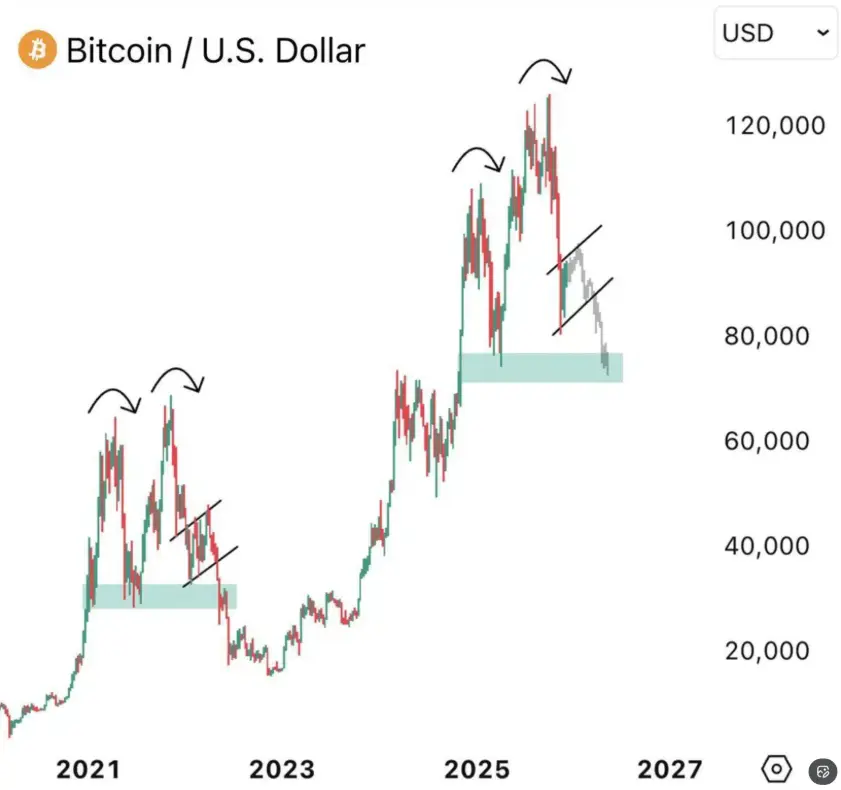
Amidst this, traders with a bearish outlook are especially watching this price level. The big question for 2026 seems less about when Bitcoin will hit six figures, and more about whether the current correction is deep enough to push the market into a prolonged downturn cycle.
Commenting on this view, another user on X shared:
“I’m not very convinced by fractals, but the current price and market behavior make this scenario quite plausible.”
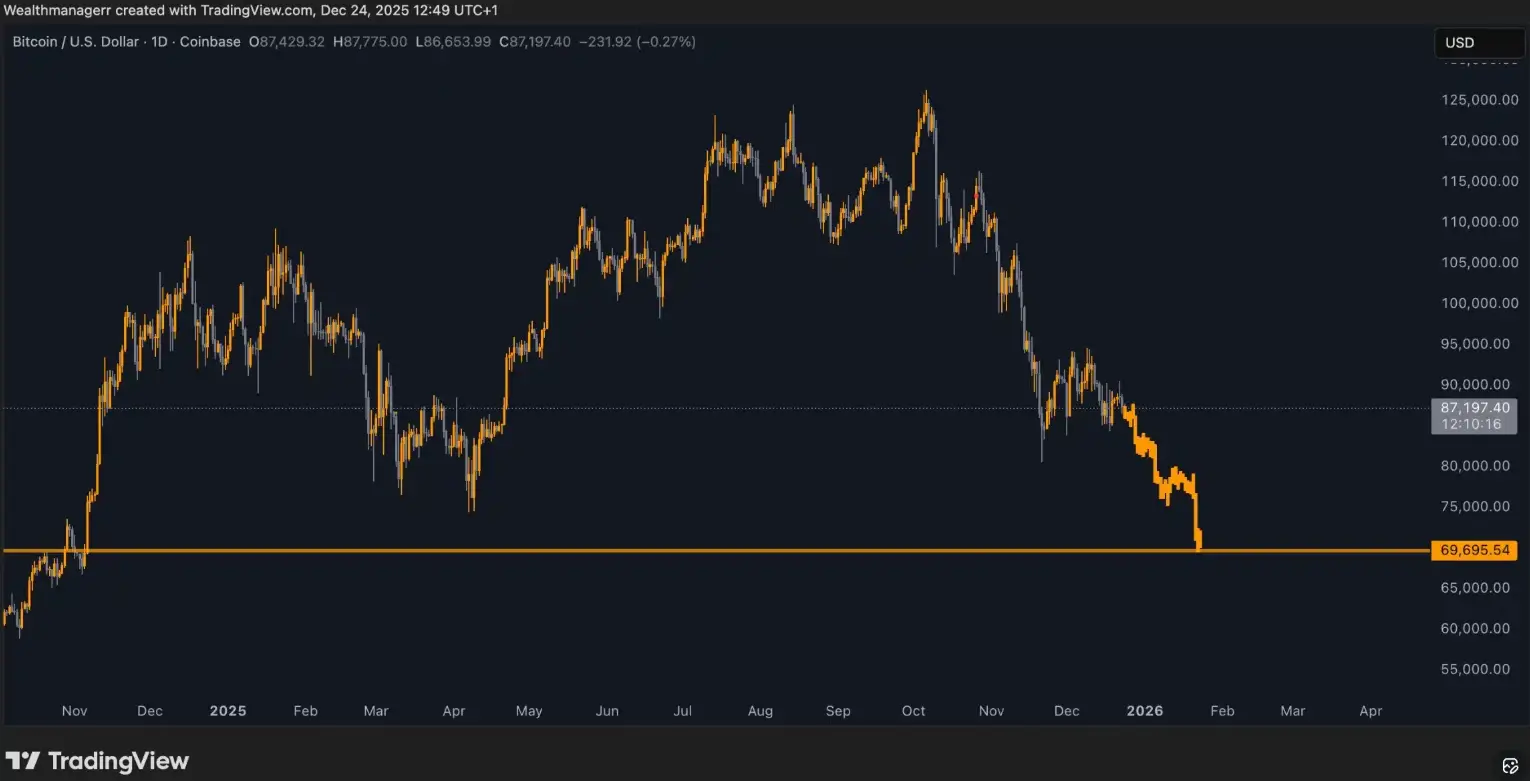
Analyst Kaleo also expressed a similar opinion, stating:
“I still believe the current market is quite similar to the fall of 2020.”
Is a Bitcoin Super Cycle Coming?
Bitcoin is moving within a pattern known as “mini-Bart,” where the price nearly erases all previous gains and gradually stabilizes within a lower trading range.
Losing a key support level has pushed the market into a slow accumulation phase, quiet and somewhat dull — a stage that often makes traders feel bored and unmotivated.
However, history shows that such pauses are often precursors to strong breakouts. Instead of signaling a prolonged bear cycle, the current price structure is opening hopes for the emergence of a new “Super Cycle.”
If Bitcoin can break out and establish new all-time highs in 2026, the market is likely to enter longer growth phases, bringing about genuine altcoin seasons and a wave of explosive adoption from mainstream crypto applications.
While the market may soon face a sharp correction, the quiet periods like now are precisely when major opportunities are quietly forming.
What Are Bitcoin’s Q1/2026 Outlooks?
Latest analysis from Coin Photon indicates Bitcoin remains resilient above a critical support zone, between the 50-week and 100-week moving averages, around $84,000–$85,000. Notably, analyst Beimnet Abebe even considers the sub-$80,000 region an attractive zone for long-term accumulation. However, despite the market gradually regaining price stability, Bitcoin faces another cultural barrier.
Social media interest is waning significantly, while the growing influence of financial institutions raises questions: Is Bitcoin gradually losing its original decentralized spirit? ETFs are helping support prices and reduce sharp declines, but at the same time, they also restrain the explosive rallies that once fueled market optimism.
Data from CryptoQuant shows that the True MVRV index in 2025 is only 2.17, considerably lower than previous cycles. This reflects a maturing market where smart money tends to take profits early, limiting extreme volatility. As 2026 approaches, investors must face a new reality: Bitcoin may be safer and more predictable, but the cost is a diminished energy that once made it uniquely powerful.
SN_Nour
Disclaimer: The information on this page may come from third parties and does not represent the views or opinions of Gate. The content displayed on this page is for reference only and does not constitute any financial, investment, or legal advice. Gate does not guarantee the accuracy or completeness of the information and shall not be liable for any losses arising from the use of this information. Virtual asset investments carry high risks and are subject to significant price volatility. You may lose all of your invested principal. Please fully understand the relevant risks and make prudent decisions based on your own financial situation and risk tolerance. For details, please refer to
Disclaimer.
Related Articles
Olenox Announces Merge With CS Digital to Develop Low Cost, Off-Grid Bitcoin Mining Opportunities
The two companies would agree to merge, with CS Digital receiving $55 million in an all-share transaction, to combine Olenox’s energy expertise with CS Digital’s expertise in bitcoin mining. The combined company would seek to develop off-grid mining and AI data center initiatives close to
Coinpedia40m ago
Bitcoin Spot ETFs Record $144.49M Net Inflows for 9 Consecutive Days, BlackRock IBIT Leads
Gate News message, April 26 — Bitcoin spot ETFs recorded total net inflows of $144.489 million on April 25, extending a streak of nine consecutive days of positive flows, according to SoSoValue data.
BlackRock's IBIT led all funds with single-day net inflows of $22.879 million, bringing its
GateNews41m ago
Bitcoin Community Questions U.S. Military's Understanding of Bitcoin, Admiral Criticized for "Reading Wikipedia"
Gate News message, April 26 — U.S. Navy Admiral Samuel Paparo told the Senate Armed Services Committee on Tuesday that the U.S. government operates a Bitcoin node, prompting members of the Bitcoin community to question the government's understanding of the network. Paparo described Bitcoin as "a com
GateNews2h ago
SEC Chair Paul Atkins Announces Digital Asset Classification Framework with CFTC
Gate News message, April 26 — U.S. Securities and Exchange Commission Chair Paul Atkins has reaffirmed efforts to advance "Project Crypto" and announced a joint initiative with the Commodity Futures Trading Commission (CFTC) to establish a digital asset classification framework that will clarify
GateNews3h ago
BlackRock IBIT Bitcoin Options Open Interest Surpasses Deribit for First Time
Gate News message, April 26 — BlackRock's Bitcoin spot exchange-traded fund IBIT saw its options open interest (OI) reach $27.61 billion, surpassing crypto derivatives platform Deribit's Bitcoin options market OI of $26.9 billion for the first time. The milestone signals accelerating institutional a
GateNews3h ago
CEX Exploiter Converts 21,000 ETH Worth $48.72M to Bitcoin Over Three Days
Gate News message, The CEX Exploiter has exchanged 21,000 ETH valued at $48.72 million for 617.43 BTC at a price of $0.0294 over the past three days. The hacker currently holds 1,000 ETH worth $2.32 million.
GateNews4h ago


