Bitcoin stabilized at 80,000 USD, but the market atmosphere is drastically different from early October. After the 19 billion USD liquidation event triggered by Trump’s tariffs on October 10, the order book depth disappeared, 3.6 billion USD flowed out of the ETF in November, BlackRock's IBIT had a single-day withdrawal of 523 million USD, and the leverage ratio dropped to a historical low, leading traders to intuitively feel that “something is wrong” which was validated by the data.
How the $19 Billion Liquidation Triggered by Trump's Tariffs Destroys Market Channels
(Source: Trading View)
The drop that occurred on October 10 was not an ordinary decline, but rather a systemic cleansing. Coin Metrics referred to it as “mass deleveraging,” and the process was as follows: news of Trump tariffs emerged, liquidity providers withdrew, and the leveraged market was forced to liquidate, triggering a chain reaction. Over $19 billion in leveraged positions were liquidated, a loss that far exceeded any previous crash, and it immediately sparked a frenzy in the options market to hedge against downside risks.
Scale is important because once it exceeds a certain threshold, the price no longer clearly reflects “people's thoughts,” but triggers forced selling, margin calls, and automatic liquidation, pushing the market into a void. Bitcoin fell more than 14% from its peak on October 6 (around $108,000) during the period from October 10 to 11, a speed and magnitude that is extremely rare in a bull market.
The more deadly factor is the chain reaction. Bitcoin plummets, and the crash of altcoins is even more severe. Coin Metrics points out that altcoins are hit harder during the deleveraging process because this part of the market needs reflexive momentum to survive. When Bitcoin loses momentum, funds do not stay in altcoins waiting for a rebound but instead withdraw directly from the entire crypto market. This dynamic not only leads to market declines but also changes market behavior in the following weeks, with market makers becoming cautious, retail trader activity shrinking, and every rebound feeling suspicious.
The collateral misalignment issue on Binance has further intensified the panic. Coin Metrics lists Ethena's synthetic dollar USDe as a notable victim, as its anchoring mechanism relies on hedging positions and market operations, being used as margin collateral on exchanges including Binance. During the crash, USDe briefly traded on certain platforms at prices far below $1, and Binance subsequently compensated approximately $283 million. This disparity, which varies by trading venue, made traders feel as if the rules changed overnight.
Liquidity Exhaustion and Order Book Depth Collapse
Traders' heartfelt feeling is that liquidity has vanished. When people say “there are no bids,” they mean that there are not enough genuine buy orders near the current price to take up the offer, so the price must drop further to find people willing to buy. Kaiko's in-depth research has come to a frustrating conclusion: there is almost no trading near the midpoint price on several exchanges, while meaningful buy orders appear at more distant positions, roughly between 4% and 10% away from the midpoint price, most notably on CEX.
Coin Metrics observed the same phenomenon from different perspectives, observing the order book depth of Binance BTCUSDT within a range of ±2% around the midpoint price. Under normal circumstances, this depth is sufficient to absorb normal sell-offs; however, during a crash, it thins drastically, and moderate selling pressure causes significant volatility. This is how the “pipeline” of cryptocurrencies operates; the market may always feel that liquidity is good until it suddenly loses liquidity.
Fast forward to December, even with stable prices, the liquidity in the spot market remains insufficient, indicating that the trading volume at major exchanges is still far below the levels seen in early October. Coin Metrics described a leverage reset consistent with the shift in market sentiment, with a significant reduction in open interest, weakened liquidity, and the market has yet to rebuild the same directional conviction. In more human terms: traders have suffered losses, market makers have become cautious, and the system can no longer easily keep up. This is why discussions about the “altcoin season” quickly faded away.
ETF capital outflows re-linked to macro risks
Bitcoin will spend most of 2024 and the first half of 2025 learning how to trade alongside institutional investors—spot Bitcoin ETF. When the fund flows are positive, it is a stable source of demand; when the fund flows turn negative, it drags down market sentiment, making it harder for investors to buy confidently during a downturn. The $3.6 billion outflow in November is not just a number, but represents a shift in institutional attitudes towards Bitcoin's short-term prospects.
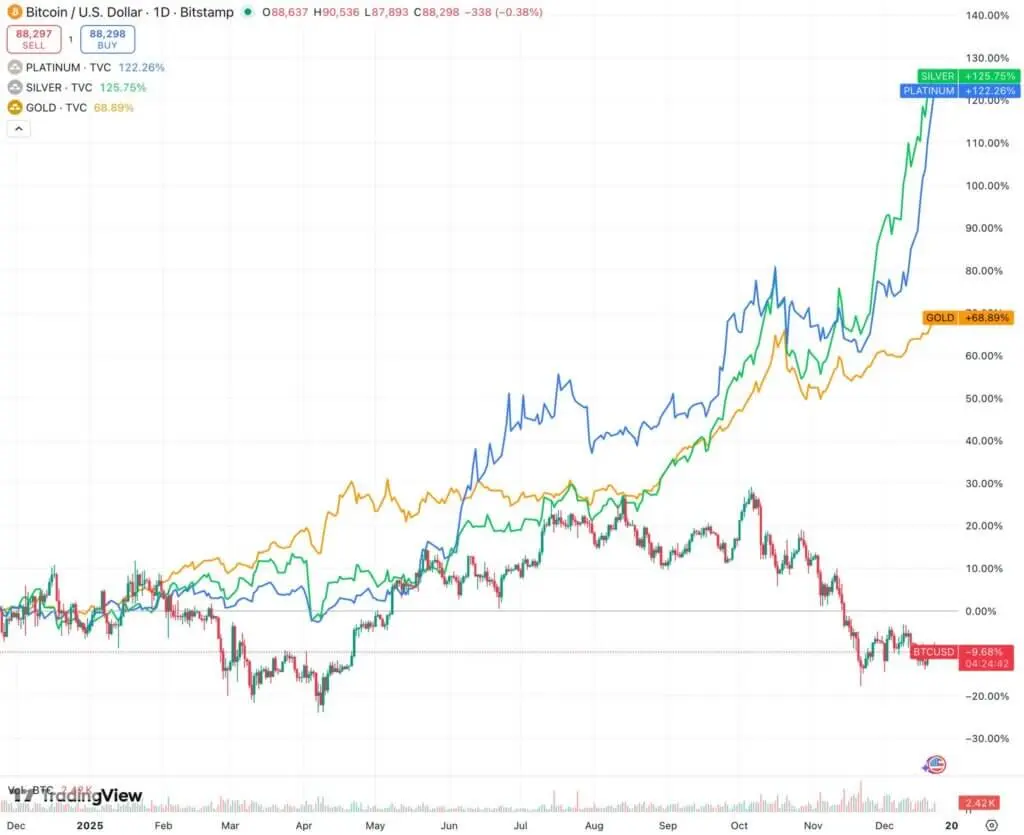
The biggest change after October 10 is not related to the internal politics of cryptocurrencies, but rather that Bitcoin has been re-integrated into the macroeconomic scope. The characteristic of cryptocurrencies never closing makes them a global 24/7 risk assessment tool, and macro shocks can spread faster through cryptocurrencies than through any other means. In simple terms, risks have disappeared from the system, bonds and gold look safer, while Bitcoin's trading performance resembles that of high beta coefficient assets.
Three Major Indicators Deteriorate Overall
ETF Fund Flow Collapse: In November, a record withdrawal of 3.6 billion USD from spot Bitcoin ETFs, with BlackRock's IBIT seeing a single-day withdrawal of 523 million USD, shaking institutional confidence.
Order book depth thins: Buy orders are sparse within a range of ±2% of the midpoint price, with effective buy orders far beyond 4-10%, and moderate selling triggers massive volatility.
Leverage Ratio at Historical Low: Open interest has significantly decreased, liquidity has weakened, and traders are hesitant to re-leverage.
Disclaimer: The information on this page may come from third parties and does not represent the views or opinions of Gate. The content displayed on this page is for reference only and does not constitute any financial, investment, or legal advice. Gate does not guarantee the accuracy or completeness of the information and shall not be liable for any losses arising from the use of this information. Virtual asset investments carry high risks and are subject to significant price volatility. You may lose all of your invested principal. Please fully understand the relevant risks and make prudent decisions based on your own financial situation and risk tolerance. For details, please refer to
Disclaimer.
Related Articles
Bitmine Upgrades to the NYSE Main Board! Tom Lee: US stocks may have bottomed out, and selling pressure on Ether could ease
Bitmine has officially moved from the New York Stock Exchange U.S. board to the main board, marking a major milestone for the company. Despite a sharp drop in the stock price, it has still increased the share repurchase plan to $4.0 billion. The company holds a large amount of Ethereum, and expects that a rebound in the crypto market will help strengthen its assets and stock price performance.
CryptoCity1h ago
RAVE’s hype surge triggers a flood of copycat coin mania, as FF and INX expose the “pump-and-dump” scheme
Recently, altcoins represented by RAVE have sparked a fierce investment craze, but some old star projects like FF and INX have used this wave of hype to carry out “pump-and-dump” operations—rapidly driving up coin prices to lure retail investors to buy, and then dumping them heavily, causing the price to plunge rapidly. Such behavior not only exposes the project team’s funding difficulties, but also damages investors’ trust. Investors need to stay alert to signals like abnormal short-term surges in order to avoid the risk of being manipulated by the market.
MarketWhisper1h ago
Bitmine gets promoted to the NYSE main board! Tom Lee: US stocks may have bottomed out, and sell pressure on Ether could ease
Bitmine has officially moved from the NYSE American board to the main board, marking an important milestone for the company. Despite the sharp decline in its share price, it has still increased the share repurchase plan amount to $4 billion. The company holds a large amount of Ethereum, and it expects that a rebound in the crypto market will help boost its assets and share price performance.
CryptoCity4h ago
Why Is Bitcoin Up Today? Hormuz Blockade Triggers Short Squeeze and a BTC Test of $75k
On April 13, Bitcoin rose from its early-session low of 70,741 to trade as high as $74,900 during the session, approaching the $75,000 level. The main drivers came from two directions: after Trump ordered the blockade of the Strait of Hormuz, traders began to view Bitcoin as a geopolitical hedge asset; and a massive net short position that had been building as funding rates stayed persistently negative was met with liquidation, triggering a chain of liquidations totaling millions of dollars near the $70,000 support level.
MarketWhisper6h ago
Bitmine gets promoted to the NYSE main board! Tom Lee: U.S. stocks may have bottomed out, and Ether’s selling pressure may ease
Bitmine has officially moved from the NYSE American board to the main board in the United States, marking an important milestone for the company. Despite a sharp drop in its stock price, it has still increased its share repurchase authorization to $4.0 billion. The company holds a large amount of Ether, and it predicts that a rebound in the crypto market will help boost its assets and stock price performance.
CryptoCity7h ago
U.S. stocks have recovered the losses since the Iran war, while Bitcoin pushes up to 74K
Due to market expectations that the United States and Iran will reach an agreement, the S&P 500 index has rebounded to its highest level since the war, and Bitcoin has also surged to $74,900. Despite the failure of peace talks between the U.S. and Iran, the U.S. has imposed a maritime blockade to pressure Iran. MicroStrategy once again made a large-scale purchase of Bitcoin, indicating that investor confidence is picking up.
ChainNewsAbmedia7h ago


