Ethereum Foundation researchers highlighted the growing challenge of “state bloat”—the exponential increase in data that full nodes must store and manage—as Ethereum’s usage expands.
With node storage requirements rising steadily due to DeFi, NFTs, and layer-2 activity, the network risks centralization if running a node becomes too resource-intensive for average participants. In a new report, the Foundation outlined three potential paths forward—State Expiry, State Archive, and Partial Statelessness—to make data storage more manageable while preserving decentralization. For Ethereum users, developers, and node operators tracking network scalability in late 2025, these proposals represent critical steps toward sustainable long-term growth.
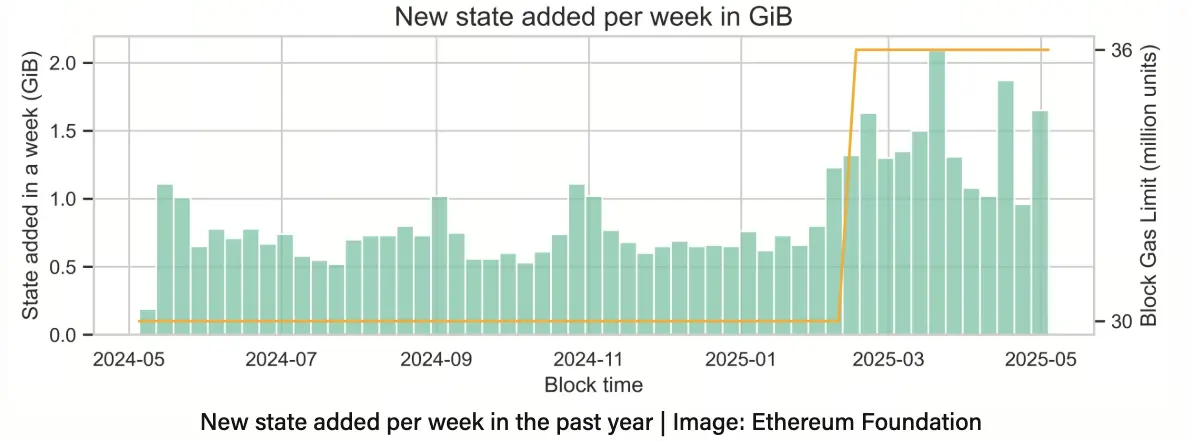
(Sources: the Block)
What Is State Bloat and Why Is It a Problem for Ethereum?
Ethereum’s “state” refers to all account balances, smart contract code, and storage data needed to validate transactions and execute blocks. As the network grows, this state expands continuously—currently exceeding 1TB for archival nodes and hundreds of GB for full validating nodes.
- Storage Growth: State size has doubled roughly every 1–2 years.
- Node Burden: Higher hardware requirements deter individual operators.
- Centralization Risk: Fewer nodes could concentrate validation power.
- Sync Times: New nodes take days/weeks to catch up.
- Current Mitigation: Pruning helps, but doesn’t solve root growth.
Without intervention, state bloat threatens Ethereum’s decentralized ethos by pricing out non-professional node runners.
The Three Proposed Paths to Address State Bloat
Ethereum Foundation researchers presented three complementary approaches:
- State Expiry
Old or inactive state data “expires” after a set period unless “renewed” by users, reducing mandatory storage while allowing opt-in preservation.
- State Archive
Separate archival nodes store historical state, while validating nodes keep only recent data—similar to Bitcoin’s pruned mode.
- Partial Statelessness
Nodes validate blocks without storing full state, using cryptographic proofs (witnesses) provided by block producers.
These can be combined or phased in gradually, with ongoing research into hybrids like “verkle trees” and EIP-4444 (history expiry).
- Goal: Keep full node requirements stable or declining.
- Trade-Offs: Balance between accessibility, security, and data availability.
- Timeline: Proposals in discussion; implementation likely multi-year.
Implications for Ethereum Users and the Ecosystem
Addressing state bloat is essential for:
- Decentralization: More individuals running nodes at home.
- Layer-2 Scaling: Healthier base layer supports rollups.
- Developer Experience: Lower barriers for testing and building.
- Long-Term Sustainability: Prevents “big blocker” centralization.
While short-term impacts are minimal, successful solutions could solidify Ethereum’s position as the most decentralized smart contract platform.
- Current Status: Active research and EIP development.
- Community Focus: Balances usability with core principles.
- Related Efforts: Verkle trees, EIP-4844 data blobs already easing pressure.
In summary, the Ethereum Foundation’s December 19, 2025, warning on state bloat—coupled with proposals for State Expiry, State Archive, and Partial Statelessness—addresses a critical bottleneck threatening node decentralization. As Ethereum matures, these paths aim to keep full node operation accessible while supporting continued growth in DeFi, NFTs, and layer-2 ecosystems. Monitor EF research blogs and EIP discussions for progress on this foundational scalability challenge.
Disclaimer: The information on this page may come from third parties and does not represent the views or opinions of Gate. The content displayed on this page is for reference only and does not constitute any financial, investment, or legal advice. Gate does not guarantee the accuracy or completeness of the information and shall not be liable for any losses arising from the use of this information. Virtual asset investments carry high risks and are subject to significant price volatility. You may lose all of your invested principal. Please fully understand the relevant risks and make prudent decisions based on your own financial situation and risk tolerance. For details, please refer to
Disclaimer.
Related Articles
ETH 15-minute drop of 0.69%: Price pressure from declining burn volume and short-term capital arbitrage
2026-04-09 18:00 to 2026-04-09 18:15 (UTC), ETH closed down 0.69% within a 0.88% intraday trading range, with the price fluctuating between 2203.91 and 2223.58 USDT. Trading volume in this range rose slightly, market attention stayed high, but short-term volatility increased, prompting investor caution.
The main drivers behind this unusual move are that ETH on-chain Gas fees have fallen to historical lows, causing the EIP-1559 burn amount to decline. As a result, the net-supply contraction effect weakened, and the supply-demand structure faced adjustment pressure in the short term. Meanwhile,
GateNews1h ago
ETH 15-minute pump of 0.71%: spot marginal buy pressure amplifies liquidity, pushing the short-term move higher
2026-04-09 17:00 to 2026-04-09 17:15 (UTC), the ETH price fluctuated in the range of 2207.09 to 2224.42 USDT, recording a positive return of +0.71%, with an amplitude of 0.78%. The short-term price increase attracted market attention. Although overall sentiment remains relatively cautious, volatility in the spot market has increased.
The main driving force behind this move was that the spot market saw marginal active buy orders amid a backdrop of tighter derivatives conditions and an overall contraction in liquidity. As ETH perpetual contract open interest and trading volume both saw a clear decline (within 24 hours, it c
GateNews2h ago
ETH 15-minute pump 1.31%: On-chain capital inflows and whale buying power are in sync, driving the rally
2026-04-09 15:30 to 2026-04-09 15:45 (UTC), the ETH price closed at 2219.86 USDT, with a range low of 2181.68 USDT. The 15-minute return was +1.31%, and the amplitude was 1.75%. During this period, market trading activity was active, attention increased significantly, and short-term volatility intensified.
The main drivers of this unusual move are on-chain capital inflows and persistent buying by large whales. First, on-chain trading volume suddenly surged during the window above; the frequency of large transfers increased, indicating that institutions or major players entered quickly. At the same time, active addresses
GateNews4h ago
Bitcoin ETF Sees $159.62M Single-Day Outflow While Ethereum and Solana ETFs Continue Negative Trend
Gate News message, according to April 9 data, Bitcoin ETFs recorded a single-day net outflow of 2,242 BTC (valued at $159.62M), while showing a 7-day net inflow of 2,723 BTC ($193.89M). Ethereum ETFs experienced a single-day net outflow of 23,158 ETH ($50.48M), with 7-day net outflows reaching 22,90
GateNews4h ago
Ethereum developer Joe Schiarizzi runs for Virginia congressional seat as a Democrat
Gate News update: On April 9, Ethereum developer Joe Schiarizzi is running for Congress in Virginia as a Democrat. Joe Schiarizzi says he is against Trump and argues that cryptocurrencies should focus on public-interest use cases, not be used for political profit. He also criticizes some lawmakers who support cryptocurrencies as opportunists, saying these people have no real interest in the underlying crypto technology.
GateNews4h ago
Grayscale transferred 5,322 ETH and 155.649 BTC to a certain CEX, with a total value of over $22 million
Gate News update, April 9. Arkham monitoring shows that about an hour ago, Grayscale transferred a total of 5,322 ETH (worth $11.6 million) and 155.649 BTC (worth $11.07 million) to a certain CEX Prime address.
GateNews5h ago


