Pi coin’s largest whale continued to increase holdings this week, with positions breaking through 391.5 million tokens valued at $82 million, approaching the 400 million milestone. Technical analysis shows a double bottom pattern and Wyckoff accumulation phase, with key support at $0.1942 USD holding firm, targeting $0.25 USD. Protocol 23 upgrade and expected mainnet launch of DEX and AMM provide catalysts.
Pi Coin’s Mysterious Whale Approaches 400 Million Token Milestone

(Source: PiScan)
Pi Network’s price has remained consolidating this year and has not benefited from recent cryptocurrency market rallies. As of January 7, it trades at $0.21 USD, far below its all-time high of over $3.6 USD. However, the largest advocate for Pi coin has continued to increase holdings this year.
According to on-chain data, this mysterious whale began accumulating this year starting Monday. On Monday, he transferred 313,565 PI tokens into a CEX, then transferred 391,174 PI tokens from the CEX into a self-custody wallet. This accumulation brought his total tokens over 391.5 million, valued at over $82 million, making him the largest token holder in the Pi coin ecosystem. This also suggests that this investor may hold 400 million tokens within the next few months.
The whale behind this transaction likely believes the token will rebound. Based on the operational approach, transferring tokens into a CEX and then out to a self-custody wallet shows that this whale is not conducting short-term trading on exchanges, but rather accumulating and holding long-term in cold storage. This behavioral pattern is typical of “smart money” accumulation strategy, contrasting sharply with retail panic selling.
However, on-chain data also shows contradictory signals. PiScan data shows there are currently 21 whales, down from 23 last week. This means that while the largest whale is accumulating, two whales have exited or reduced holdings below whale thresholds. This divergence indicates disagreement within the whale community about Pi coin’s prospects, with not all large holders optimistic about future performance.
Data shows that PI’s 24-hour trading volume is $11 million, making it one of the tokens with the smallest trading volume among the top 50. Considering its market cap of over $1.76 billion, its trading volume appears insignificant. This low trading volume reflects Pi coin’s liquidity issues—a large buy or sell order could cause dramatic price volatility.
Dual Catalysts: Protocol 23 Upgrade and DEX Mainnet Launch
A possible reason for Pi coin’s rebound is listing on one or more top exchanges. Currently, Pi coin only trades on exchanges like Gate and has not initiated a second round of CEX listings. If new CEX listings announce Pi coin, it will bring massive liquidity and exposure, potentially driving prices to double in the short term.
Another potential catalyst is the upcoming Protocol 23 upgrade and the expected mainnet launch of DEX and AMM this year. While the launch itself is important, the most critical events will be their activity and trading volume. If Pi coin’s DEX can attract substantial liquidity and provide low-slippage trading experiences, it will significantly improve user experience in the Pi coin ecosystem. Currently Pi coin users mainly rely on centralized exchanges, and DEX launch will provide decentralized trading options.
Three Major Catalysts for Pi Coin Rebound
Protocol 23 Upgrade: Technical improvements may enhance network performance and user experience, bolstering market confidence
DEX and AMM Mainnet Launch: Decentralized exchanges provide more liquidity options, reducing reliance on centralized platforms
Top Exchange Listing: If leading US compliant crypto exchanges list Pi coin, it will bring explosive demand and liquidity
However, whether these catalysts truly drive price rebound depends on execution. Pi Network has failed to deliver on multiple promised features and timelines in the past, making the market skeptical of future commitments. Only when the DEX truly launches and demonstrates substantial trading volume will the market reassess Pi coin’s value.
Technical Analysis Shows Double Bottom Pattern and Wyckoff Accumulation
(Source: Trading View)
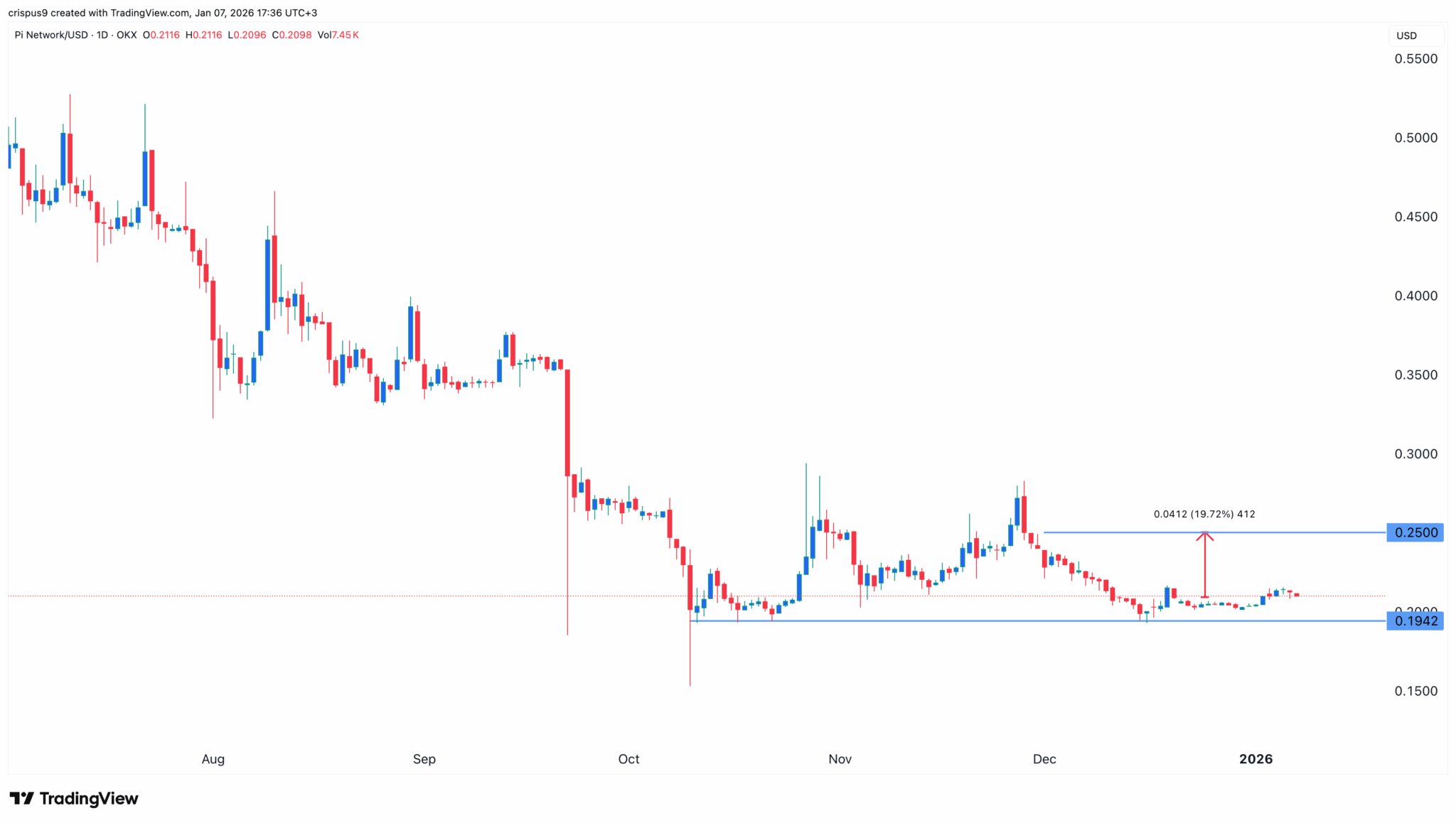
Technical analysis shows that Pi coin may be about to experience significant short-term breakout gains. The current price is slightly above the key support level of $0.1942 USD, which was the lowest point on October 11, 17, and December 16 last year. The price has consistently held above this support level, forming a double bottom pattern. A double bottom is a classic bullish reversal pattern, indicating that selling pressure at this price level has been fully absorbed and buying pressure is beginning to dominate.
The token is currently also in the accumulation phase of Wyckoff theory. Typically, an uptrend phase follows this stage, with asset prices showing parabolic increases. Zcash’s fourth quarter price surge is a good example, as that token had remained in a consolidation phase for years. Wyckoff theory divides market cycles into four phases: accumulation, uptrend, distribution, and downtrend. Pi coin is currently in the late stages of the accumulation phase, and if it successfully transitions to the uptrend phase, it could experience substantial gains.
Therefore, as long as Pi coin’s price remains above the key support level of $0.1942 USD, its price action is most likely bullish. If the price holds above support, it could rise to $0.25 USD. This represents approximately 19% upside from the current price, which is attractive for risk-seeking investors.
If it breaks below this level, it signals further price declines, indicating that bears have taken control. Breaking below a double bottom pattern typically leads to accelerated declines, as technical traders relying on pattern trading will quickly exit with stop losses. The next support level may be around $0.15 USD, a deeper psychological support level.
For Pi coin investors, the current period is critical for observation. The whale’s continued accumulation provides confidence support, and the technical double bottom pattern and Wyckoff accumulation also point to potential rebounds. However, low trading volume, declining whale numbers, and the project’s historical execution issues are risk factors that cannot be ignored.


