Pheonixprincess

vip
Age 1.3 Year
Peak Tier 5
No content yet
#TapAndPayWithGateCard
Tap and Pay with Gate Card
1. Introduction: A Shift in How the World Pays
In the modern financial world, money is no longer limited to physical cash or traditional banking methods, because technology has completely transformed how people buy, sell, and transfer value in their daily lives, and one of the clearest examples of this transformation is the concept of “Tap and Pay with Gate Card,” which represents a fast, contactless, and highly simplified payment experience designed for a digital-first generation.
This system is not just a convenience feature, but a reflecti
HighAmbition
#TapAndPayWithGateCard
Tap and Pay with Gate Card
1. Introduction: A Shift in How the World Pays
In the modern financial world, money is no longer limited to physical cash or traditional banking methods, because technology has completely transformed how people buy, sell, and transfer value in their daily lives, and one of the clearest examples of this transformation is the concept of “Tap and Pay with Gate Card,” which represents a fast, contactless, and highly simplified payment experience designed for a digital-first generation.
This system is not just a convenience feature, but a reflection of a global shift toward instant transactions, where speed, security, and simplicity are becoming the foundation of financial behavior, and users now expect payments to happen in seconds rather than minutes, without unnecessary steps or complications.
2. What Does Tap and Pay with Gate Card Actually Mean?
The idea behind Tap and Pay with Gate Card is very straightforward yet extremely powerful, because it allows users to complete payments simply by bringing their card close to a payment terminal, and the transaction is processed instantly without needing physical contact in the traditional sense of swiping or inserting the card.
This concept is based on contactless payment technology, which uses short-range communication systems to securely transfer payment information between the card and the payment machine, making the entire process smooth, fast, and highly efficient for everyday use.
In simple words, it means:
You do not swipe your card
You do not insert your card
You do not wait for long approval steps
You simply tap and pay instantly
3. How the Technology Works Behind the Scene
Behind the simplicity of Tap and Pay lies a complex and highly secure technological system known as NFC (Near Field Communication), which enables two devices to communicate when they are placed very close to each other, usually within a few centimeters.
When a user taps their Gate Card on a payment terminal:
The card sends encrypted payment data
The terminal reads and verifies the transaction
The system connects with the payment network
The transaction is approved in real time
Everything happens within seconds, and the user only experiences a smooth and effortless payment process without seeing the technical complexity behind it.
This invisible technology layer is what makes modern contactless payments so powerful and reliable.
4. Why Gate Card Concept is Becoming Popular
The growing popularity of Tap and Pay systems like Gate Card is not accidental, but driven by real-world needs and user behavior changes in a fast-moving digital economy.
People today prefer:
Faster checkout experiences
Reduced waiting times
Less dependency on cash handling
More secure and traceable transactions
Mobile and card-based flexibility
As a result, financial tools that reduce friction naturally become more widely adopted, especially in urban environments where speed and convenience are critical in everyday life.
5. Key Benefits of Tap and Pay with Gate Card
5.1 Extreme Speed in Transactions
One of the biggest advantages is transaction speed, because payments are completed in seconds, making it ideal for busy environments such as supermarkets, cafes, transport systems, and retail stores where time efficiency matters.
5.2 High-Level Security
Contactless payments use encryption and tokenization systems, which means sensitive card information is not directly exposed during transactions, significantly reducing the risk of fraud or data theft.
5.3 Ease of Use for Everyone
Even users who are not highly technical can easily understand and use Tap and Pay, because the process is intuitive, requiring only a simple tap to complete payment.
5.4 Reduced Dependency on Cash
This system reduces the need for carrying physical cash, which not only improves convenience but also lowers risks related to loss, theft, or handling errors.
5.5 Better Customer Experience
For businesses, faster payments mean shorter queues, happier customers, and smoother operations, which ultimately leads to improved service quality.
6. Role of Tap and Pay in the Digital Economy
Tap and Pay systems are not just payment tools, but they are part of a larger financial ecosystem that is moving toward complete digital transformation, where money is no longer tied only to physical currency but exists in multiple forms including digital wallets, bank systems, and blockchain-based assets.
Gate Card-style systems act as a bridge between traditional finance and modern digital finance, allowing users to interact with both worlds seamlessly, without needing complex conversions or technical understanding.
This makes financial systems more inclusive, accessible, and globally connected.
7. Impact on Everyday Life
The real power of Tap and Pay is visible in daily life scenarios:
Buying groceries becomes faster
Paying for transport becomes effortless
Dining experiences become smoother
Online-to-offline transitions become seamless
This creates a lifestyle where payments are no longer a “process” but a natural part of interaction, integrated into daily activities without interruption.
8. Security Framework and Trust Factor
Security plays a critical role in adoption, because users need to trust that their money is safe.
Tap and Pay systems rely on:
Dynamic encryption
One-time transaction tokens
Secure payment gateways
Fraud monitoring systems
Even if a card is tapped multiple times, the system ensures that actual financial data remains protected and cannot be reused maliciously.
This strong security foundation is one of the key reasons why contactless payments are expanding globally.
9. Business Advantages and Economic Efficiency
For businesses, Tap and Pay systems provide several operational advantages:
Faster customer processing
Reduced cash handling risks
Improved checkout efficiency
Higher transaction throughput
Better customer satisfaction
When payments become faster, businesses can serve more customers in less time, which directly improves productivity and revenue potential.
10. Financial Inclusion and Global Accessibility
In many regions, access to traditional banking services is still limited, but mobile-based and card-based Tap and Pay systems help bridge this gap by providing simple financial tools that anyone can use.
This contributes to:
Wider participation in digital economy
Easier access to financial services
Reduced dependency on physical banks
Increased economic mobility
In this way, Tap and Pay is not just a convenience feature, but also a tool for financial empowerment.
11. Future of Tap and Pay Technology
The future of Tap and Pay systems is expected to become even more advanced, with innovations such as:
Biometric authentication (fingerprint or face recognition)
AI-based fraud detection
Multi-currency and crypto integration
Wearable payment devices
Fully digital identity-linked payments
This evolution will gradually lead to a world where physical wallets may become unnecessary, replaced entirely by digital financial ecosystems.
12. Final Conclusion: A Step Toward a Cashless Future
Tap and Pay with Gate Card represents more than just a payment method; it represents a complete transformation in how humans interact with money, where speed, simplicity, and security are combined into a single seamless experience.
It removes complexity from everyday transactions, empowers users with faster financial control, and supports the global shift toward a digital-first economy, where payments are no longer a barrier but a natural part of life.
As adoption continues to grow, this technology is expected to become a standard worldwide, shaping the future of commerce, banking, and digital financial interaction in a way that is faster, smarter, and more connected than ever before.

repost-content-media
  • Reward
  • 1
  • Repost
  • Share
MrFlower_XingChen:
To The Moon 🌕
#TreasuryYieldBreaks5PercentCryptoUnderPressure Treasury Yields Above 5%
Full 2026 Macro Breakdown With Updated Crypto Prices & Real Market Pressure 🔥
The global financial system in 2026 is undergoing a powerful structural shift, and at the center of it lies one key driver: U.S. Treasury yields holding firmly above the critical 5% level. This is not just another macro statistic — it is a deep, systemic force that is actively reshaping capital flows, investor psychology, and the performance of risk assets, especially cryptocurrencies.
At the same time, crypto markets are showing a mixed but
BTC0.82%
ETH1.29%
HighAmbition
#TreasuryYieldBreaks5PercentCryptoUnderPressure Treasury Yields Above 5%
Full 2026 Macro Breakdown With Updated Crypto Prices & Real Market Pressure 🔥
The global financial system in 2026 is undergoing a powerful structural shift, and at the center of it lies one key driver: U.S. Treasury yields holding firmly above the critical 5% level. This is not just another macro statistic — it is a deep, systemic force that is actively reshaping capital flows, investor psychology, and the performance of risk assets, especially cryptocurrencies.
At the same time, crypto markets are showing a mixed but pressured structure.
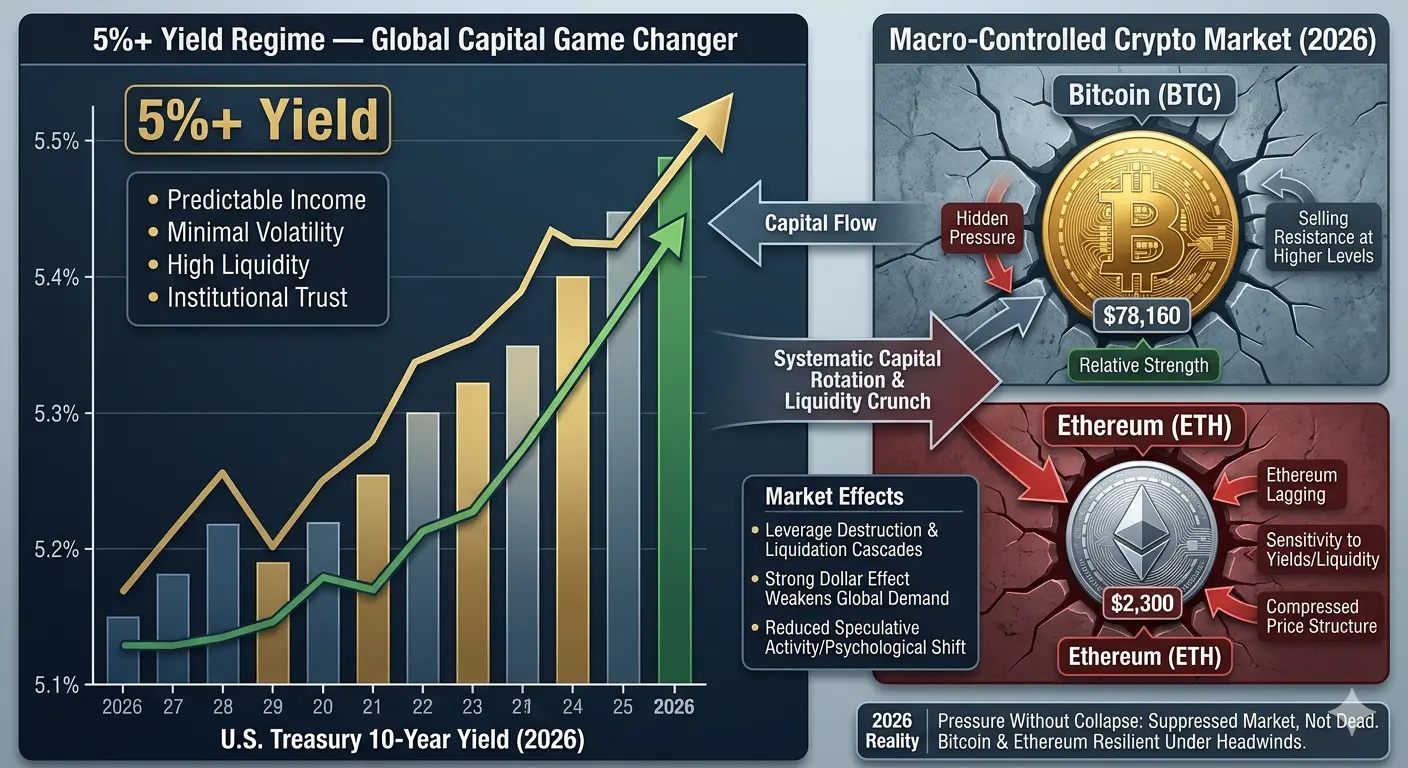
Bitcoin is currently trading around $78,160, showing relative strength but facing repeated resistance at higher levels, while Ethereum is sitting near $2,300, still struggling to build strong upside continuation despite multiple attempts.
This combination — strong macro pressure with partial price resilience — defines the current phase of the market.
The 5%+ Yield Regime — A Game Changer for Global Capital
When U.S. Treasury yields move from the 2–3% range into 5.1%–5.5% territory, the entire investment landscape changes dramatically because investors are no longer forced to take risks to generate returns, and instead can earn solid, stable income from government-backed instruments.
This effectively creates a direct competitor to crypto, and not just any competitor, but one that offers:
Predictable returns
Minimal volatility
High liquidity
Institutional trust
As a result, the opportunity cost of holding crypto rises sharply, and capital begins to re-evaluate where it should be allocated.
Bitcoin Holding Strong — But Facing Hidden Pressure
Even though Bitcoin is trading near $78K, which at first glance appears bullish, the underlying reality is more complex because the price is not expanding aggressively despite strong narratives like ETF flows, institutional adoption, and long-term scarcity.
This tells us that:
There is steady demand, but not explosive demand
Large players are not aggressively adding risk
Selling pressure exists at higher levels due to macro rotation
In a low-yield environment, Bitcoin at $78K could have easily pushed toward $90K+, but under 5%+ yields, upside is being actively capped.
Ethereum Lagging — A Clear Signal of Risk Sentiment
Ethereum at $2,300 reflects a different story — one of relative weakness compared to Bitcoin.
This happens because Ethereum is more sensitive to:
Liquidity conditions
Risk appetite
Yield comparisons (especially vs staking and DeFi returns)
When Treasuries offer 5%+ returns, many investors start questioning why they should lock funds in staking or DeFi for similar or slightly higher yields but with significantly higher risk.
This reduces demand and keeps ETH in a compressed price structure.
Capital Rotation — The Silent Outflow
The most important dynamic happening right now is not panic selling, but systematic capital rotation.
As yields increased from ~3% to above 5%:
Institutional portfolios began shifting allocations
Risk exposure is being trimmed gradually
Capital is flowing into bonds and cash equivalents
This is why:
Bitcoin rallies slow down near resistance
Ethereum struggles to gain momentum
Altcoins fail to sustain breakouts
The market is not crashing — it is being drained slowly.
Real Price Pressure Across the Market
Even with BTC at $78K, the pressure is visible in behavior:
Bitcoin experiences pullbacks of 8%–12% during yield spikes
Ethereum sees deeper corrections of 12%–22%
Altcoins continue facing 25%–50%+ drawdowns, especially in low-liquidity segments
This confirms that liquidity is not expanding — it is tightening.
Liquidity Crunch and Leverage Destruction
Crypto markets are heavily dependent on leverage, and higher yields indirectly attack this system.
As global borrowing costs rise:
Margin trading becomes expensive
Futures leverage reduces
DeFi borrowing demand declines
This leads to:
Liquidation cascades
Sudden volatility spikes
Weak recovery attempts
The market enters a cycle where every drop feeds the next drop, even if temporarily.
Strong Dollar Effect — Global Demand Weakens
Rising yields strengthen the U.S. dollar, which creates additional pressure on crypto because:
International investors need more capital to buy the same assets
Emerging market liquidity slows down
Global participation reduces
This creates a hidden resistance layer that prevents strong rallies.
Institutional Behavior — Quiet but Powerful
Institutions are not exiting crypto completely, but they are:
Reducing exposure slightly
Rebalancing toward safer assets
Waiting for better macro conditions
Even a small 1–3% shift in large portfolios equals billions in outflows, which reduces market strength significantly.
Psychological Shift — The Real Battlefield
Perhaps the most powerful impact of 5%+ yields is psychological.
Investors are now մտած:
“Why take high risk for uncertain returns?”
“Capital preservation matters more now”
This leads to:
Lower trading volumes
Reduced speculative activity
Slower dip buying
The market loses its aggressive energy and becomes cautious.
Altcoins — The Weakest Link
Altcoins are suffering the most because they rely on:
Retail enthusiasm
Excess liquidity
Narrative-driven hype
With liquidity tightening, these factors disappear quickly, leading to:
Sharp corrections
Weak recoveries
Long consolidation phases
Even strong projects struggle because macro conditions dominate everything.
2026 Reality — Pressure Without Collapse
What makes this cycle unique is that crypto is not in a full bear market, but rather in a macro-controlled environment.
Bitcoin at $78K shows strength
Ethereum holding $2.3K shows stability
But explosive growth is missing
This is a suppressed market, not a dead one.
Strategic Positioning — How Smart Money Is Adapting
In this high-yield environment, successful participants are not fighting the market — they are adjusting to it.
Key approaches include:
Accumulating strong assets gradually
Reducing leverage exposure
Holding stablecoins for flexibility
Diversifying into yield-generating instruments
Waiting for macro signals like yield decline or policy easing
The focus is shifting from aggressive gains to strategic survival and positioning.
Final Conclusion — Macro Is the Dominant Force
With Treasury yields holding above 5%, the crypto market is facing a powerful headwind that is:
Pulling capital into safer assets
Reducing liquidity
Limiting upside expansion
Increasing sensitivity to downside moves
Bitcoin at $78,160 and Ethereum at $2,300 are not weak — they are resilient under pressure, which actually highlights the strength of the asset class, but until yields decline or liquidity returns, the market will likely remain controlled, selective, and range-bound rather than explosively bullish.
The real edge in this market is not hype — it is understanding macro timing.
Are you accumulating during this pressure phase, protecting capital, or waiting for the next liquidity wave?
Because when yields eventually turn, the same market can move faster than most expect — and only prepared players will benefit.
repost-content-media
  • Reward
  • Comment
  • Repost
  • Share
#TreasuryYieldBreaks5PercentCryptoUnderPressure Treasury Yields Above 5%
Full 2026 Macro Breakdown With Updated Crypto Prices & Real Market Pressure 🔥
The global financial system in 2026 is undergoing a powerful structural shift, and at the center of it lies one key driver: U.S. Treasury yields holding firmly above the critical 5% level. This is not just another macro statistic — it is a deep, systemic force that is actively reshaping capital flows, investor psychology, and the performance of risk assets, especially cryptocurrencies.
At the same time, crypto markets are showing a mixed but
BTC0.82%
ETH1.29%
HighAmbition
#TreasuryYieldBreaks5PercentCryptoUnderPressure Treasury Yields Above 5%
Full 2026 Macro Breakdown With Updated Crypto Prices & Real Market Pressure 🔥
The global financial system in 2026 is undergoing a powerful structural shift, and at the center of it lies one key driver: U.S. Treasury yields holding firmly above the critical 5% level. This is not just another macro statistic — it is a deep, systemic force that is actively reshaping capital flows, investor psychology, and the performance of risk assets, especially cryptocurrencies.
At the same time, crypto markets are showing a mixed but pressured structure.
Bitcoin is currently trading around $78,160, showing relative strength but facing repeated resistance at higher levels, while Ethereum is sitting near $2,300, still struggling to build strong upside continuation despite multiple attempts.
This combination — strong macro pressure with partial price resilience — defines the current phase of the market.
The 5%+ Yield Regime — A Game Changer for Global Capital
When U.S. Treasury yields move from the 2–3% range into 5.1%–5.5% territory, the entire investment landscape changes dramatically because investors are no longer forced to take risks to generate returns, and instead can earn solid, stable income from government-backed instruments.
This effectively creates a direct competitor to crypto, and not just any competitor, but one that offers:
Predictable returns
Minimal volatility
High liquidity
Institutional trust
As a result, the opportunity cost of holding crypto rises sharply, and capital begins to re-evaluate where it should be allocated.
Bitcoin Holding Strong — But Facing Hidden Pressure
Even though Bitcoin is trading near $78K, which at first glance appears bullish, the underlying reality is more complex because the price is not expanding aggressively despite strong narratives like ETF flows, institutional adoption, and long-term scarcity.
This tells us that:
There is steady demand, but not explosive demand
Large players are not aggressively adding risk
Selling pressure exists at higher levels due to macro rotation
In a low-yield environment, Bitcoin at $78K could have easily pushed toward $90K+, but under 5%+ yields, upside is being actively capped.
Ethereum Lagging — A Clear Signal of Risk Sentiment
Ethereum at $2,300 reflects a different story — one of relative weakness compared to Bitcoin.
This happens because Ethereum is more sensitive to:
Liquidity conditions
Risk appetite
Yield comparisons (especially vs staking and DeFi returns)
When Treasuries offer 5%+ returns, many investors start questioning why they should lock funds in staking or DeFi for similar or slightly higher yields but with significantly higher risk.
This reduces demand and keeps ETH in a compressed price structure.
Capital Rotation — The Silent Outflow
The most important dynamic happening right now is not panic selling, but systematic capital rotation.
As yields increased from ~3% to above 5%:
Institutional portfolios began shifting allocations
Risk exposure is being trimmed gradually
Capital is flowing into bonds and cash equivalents
This is why:
Bitcoin rallies slow down near resistance
Ethereum struggles to gain momentum
Altcoins fail to sustain breakouts
The market is not crashing — it is being drained slowly.
Real Price Pressure Across the Market
Even with BTC at $78K, the pressure is visible in behavior:
Bitcoin experiences pullbacks of 8%–12% during yield spikes
Ethereum sees deeper corrections of 12%–22%
Altcoins continue facing 25%–50%+ drawdowns, especially in low-liquidity segments
This confirms that liquidity is not expanding — it is tightening.
Liquidity Crunch and Leverage Destruction
Crypto markets are heavily dependent on leverage, and higher yields indirectly attack this system.
As global borrowing costs rise:
Margin trading becomes expensive
Futures leverage reduces
DeFi borrowing demand declines
This leads to:
Liquidation cascades
Sudden volatility spikes
Weak recovery attempts
The market enters a cycle where every drop feeds the next drop, even if temporarily.
Strong Dollar Effect — Global Demand Weakens
Rising yields strengthen the U.S. dollar, which creates additional pressure on crypto because:
International investors need more capital to buy the same assets
Emerging market liquidity slows down
Global participation reduces
This creates a hidden resistance layer that prevents strong rallies.
Institutional Behavior — Quiet but Powerful
Institutions are not exiting crypto completely, but they are:
Reducing exposure slightly
Rebalancing toward safer assets
Waiting for better macro conditions
Even a small 1–3% shift in large portfolios equals billions in outflows, which reduces market strength significantly.
Psychological Shift — The Real Battlefield
Perhaps the most powerful impact of 5%+ yields is psychological.
Investors are now մտած:
“Why take high risk for uncertain returns?”
“Capital preservation matters more now”
This leads to:
Lower trading volumes
Reduced speculative activity
Slower dip buying
The market loses its aggressive energy and becomes cautious.
Altcoins — The Weakest Link
Altcoins are suffering the most because they rely on:
Retail enthusiasm
Excess liquidity
Narrative-driven hype
With liquidity tightening, these factors disappear quickly, leading to:
Sharp corrections
Weak recoveries
Long consolidation phases
Even strong projects struggle because macro conditions dominate everything.
2026 Reality — Pressure Without Collapse
What makes this cycle unique is that crypto is not in a full bear market, but rather in a macro-controlled environment.
Bitcoin at $78K shows strength
Ethereum holding $2.3K shows stability
But explosive growth is missing
This is a suppressed market, not a dead one.
Strategic Positioning — How Smart Money Is Adapting
In this high-yield environment, successful participants are not fighting the market — they are adjusting to it.
Key approaches include:
Accumulating strong assets gradually
Reducing leverage exposure
Holding stablecoins for flexibility
Diversifying into yield-generating instruments
Waiting for macro signals like yield decline or policy easing
The focus is shifting from aggressive gains to strategic survival and positioning.
Final Conclusion — Macro Is the Dominant Force
With Treasury yields holding above 5%, the crypto market is facing a powerful headwind that is:
Pulling capital into safer assets
Reducing liquidity
Limiting upside expansion
Increasing sensitivity to downside moves
Bitcoin at $78,160 and Ethereum at $2,300 are not weak — they are resilient under pressure, which actually highlights the strength of the asset class, but until yields decline or liquidity returns, the market will likely remain controlled, selective, and range-bound rather than explosively bullish.
The real edge in this market is not hype — it is understanding macro timing.
Are you accumulating during this pressure phase, protecting capital, or waiting for the next liquidity wave?
Because when yields eventually turn, the same market can move faster than most expect — and only prepared players will benefit.
repost-content-media
  • Reward
  • Comment
  • Repost
  • Share
#OilBreaks110
Oil Above $110 — The 2026 Macro Shockwave Reshaping Global Finance, Liquidity, and Crypto
What we are seeing right now is not just an energy rally — it is a global macro reset signal. Crude oil holding above $110 is acting as a central pressure point that is reshaping inflation expectations, interest rate outlooks, currency flows, and the entire risk asset ecosystem, including Bitcoin and Ethereum.
This is a market where everything is connected, and oil is currently pulling the strings.
The Core Reality: Oil Is Now a Macro Driver, Not Just a Commodity
Brent crude trading in th
BTC0.82%
ETH1.29%
HighAmbition
#OilBreaks110
Oil Above $110 — The 2026 Macro Shockwave Reshaping Global Finance, Liquidity, and Crypto
What we are seeing right now is not just an energy rally — it is a global macro reset signal. Crude oil holding above $110 is acting as a central pressure point that is reshaping inflation expectations, interest rate outlooks, currency flows, and the entire risk asset ecosystem, including Bitcoin and Ethereum.
This is a market where everything is connected, and oil is currently pulling the strings.
The Core Reality: Oil Is Now a Macro Driver, Not Just a Commodity
Brent crude trading in the $108–$116 range is not random volatility. It reflects a deeper structural shift where:
Global spare capacity is limited
Geopolitical risk premium is elevated
Supply chains remain sensitive
Demand has not meaningfully slowed
Oil is no longer reacting to markets — it is driving them.
Every move above or below $110 now changes expectations for inflation, central bank policy, and liquidity conditions worldwide.
Why $110 Is a Critical Global Inflection Zone
The $110–$112 range is effectively a global decision zone:
If oil stabilizes above it:
Inflation remains sticky
Central banks delay rate cuts
Liquidity stays tight
Risk assets remain capped
If oil fails and drops below:
Inflation pressure eases
Policy becomes more flexible
Liquidity conditions improve
Risk appetite returns
This is why markets are reacting so aggressively to every headline around crude.
Geopolitics: The Real Engine Behind the Surge
The key driver remains US–Iran–regional tension dynamics, especially around:
Energy infrastructure security
Shipping routes like the Strait of Hormuz
Retaliatory risk and sanctions pressure
Unstable diplomatic progress
Even without full-scale conflict, markets are pricing a permanent geopolitical risk premium.
That means oil is no longer just about supply and demand — it is about fear of disruption.
Scenario 1: De-Escalation (Risk-On Global Relief)
If diplomacy stabilizes tensions:
Oil could retreat toward $95–$105
Inflation pressure would cool
Central banks regain policy flexibility
Liquidity improves globally
Market impact:
Bitcoin could strengthen toward $85K–$90K
Ethereum could move toward $2,500–$2,800
Altcoins would likely experience renewed speculative inflows
Equity markets would enter relief rally mode
This would act like removing a major macro “tax” from the system.
Scenario 2: Escalation or Prolonged Tension (Risk-Off Regime)
If tensions persist or worsen:
Oil could push toward $115–$130
Inflation becomes more persistent
Rate cuts get delayed significantly
Liquidity tightens further
Market impact:
Stronger USD pressure globally
Emerging markets face stress
Crypto becomes uneven:
Bitcoin holds relatively better as macro hedge
Ethereum and altcoins remain under pressure
Risk assets struggle to trend upward
This is a liquidity-constrained environment, not a collapse — but a compression phase.
Extreme Risk Scenario: Supply Shock Event
If a major disruption affects critical supply routes:
Oil could spike toward $130–$150+
Global inflation shock intensifies
Central banks face policy conflict
Market behavior:
Gold and energy surge
Bitcoin behaves more like a defensive macro asset
Altcoins suffer the most due to liquidity drain
Volatility spikes across all markets
The Dollar Effect: Hidden Force Behind Everything
Rising oil typically strengthens the US dollar due to:
Inflation expectations
Safe-haven capital flows
Higher-for-longer rate expectations
A stronger dollar means:
Tighter global liquidity
Pressure on emerging markets
Reduced crypto buying power globally
This is one of the most important indirect effects of oil strength.
Crypto Market Position in This Environment
Crypto is currently in a macro-sensitive phase:
Bitcoin ($2.2K–$2.4K zone)
More sensitive to risk appetite
Depends heavily on liquidity expansion
Altcoins
Most vulnerable segment
Require strong risk-on conditions to outperform
Overall, crypto is not weak — it is liquidity-dependent.
The Full Macro Transmission Chain
The market is currently moving through a clear sequence:
Oil Surge → Inflation Pressure → Tight Monetary Policy → Liquidity Drain → Stronger Dollar → Risk Asset Compression
This is the dominant global financial loop in 2026.
Investor Psychology: The Real Battlefield
High oil environments shift behavior sharply:
Greed → caution → defensive positioning
Leverage reduces
Cash holdings increase
Safe assets gain attention
This phase rewards discipline, not aggression.
Strategic Positioning Approach
Smart market participants are currently:
Accumulating selectively during dips
Holding Bitcoin as macro exposure
Keeping stablecoin liquidity ready
Avoiding overexposure to weak altcoins
Watching oil, yields, and dollar more than crypto charts
The key is scenario readiness, not prediction certainty.
Final Perspective: This Is a Macro Transition Phase
Oil above $110 is not just a price level — it is a global stress indicator.
It tells us:
The world is still geopolitically fragile
Inflation risks are not fully resolved
Liquidity conditions remain sensitive
Markets are in transition, not expansion
Yet within this tension lies opportunity.
Because historically, when macro pressure peaks and eventually stabilizes, markets don’t just recover — they accelerate sharply.
Closing Insight
Crypto is not disconnected from oil.
Equities are not independent of geopolitics.
Everything is linked through liquidity.
And right now, oil is the strongest signal in that entire chain.
The real edge belongs to those who understand:
👉 When liquidity is tightening
👉 When macro stress is peaking
👉 When the system is preparing for its next shift
Because the next major move will not be random — it will be reactionary to this pressure cycle.
repost-content-media
  • Reward
  • Comment
  • 1
  • Share
#BitcoinSpotVolumeNewLow .
Bitcoin Spot Volume Hits New Lows
The ongoing collapse in Bitcoin spot trading volume to historically low or cycle-depressed levels represents one of the most structurally important liquidity developments in the entire 2026 digital asset market, because what we are witnessing is not a simple reduction in trading activity but rather a deep systemic slowdown in real capital participation where actual buying and selling pressure is fading while price continues to hold in a relatively tight equilibrium zone, and this divergence between stable price action and weakening
HighAmbition
#BitcoinSpotVolumeNewLow .
Bitcoin Spot Volume Hits New Lows
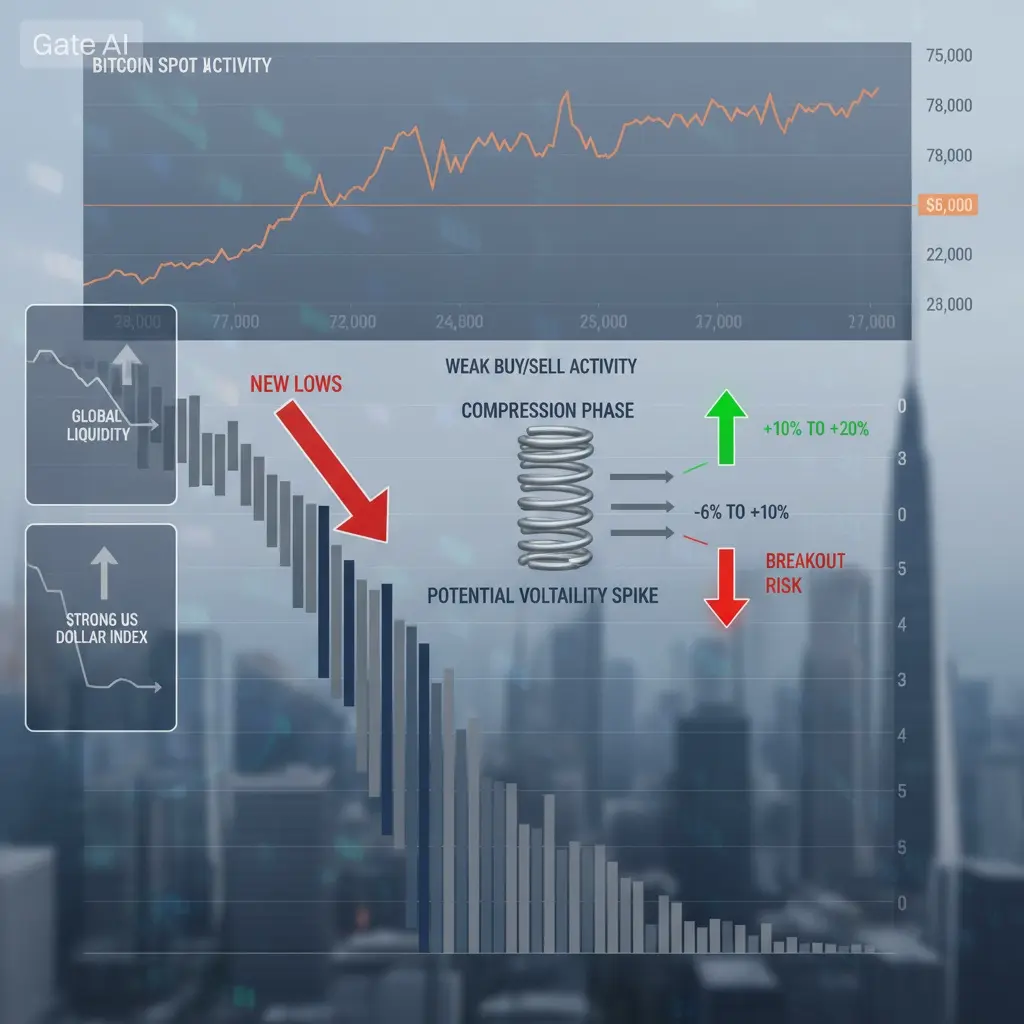
The ongoing collapse in Bitcoin spot trading volume to historically low or cycle-depressed levels represents one of the most structurally important liquidity developments in the entire 2026 digital asset market, because what we are witnessing is not a simple reduction in trading activity but rather a deep systemic slowdown in real capital participation where actual buying and selling pressure is fading while price continues to hold in a relatively tight equilibrium zone, and this divergence between stable price action and weakening underlying liquidity is creating a fragile market structure that appears calm on the surface but is increasingly sensitive beneath the surface to macro shocks, liquidity shifts, and derivatives-driven distortions.
As of current market conditions, Bitcoin continues to trade broadly within the $75,000 to $78,500 consolidation range, with occasional intraday extensions toward $80,000 to $82,000 resistance levels, while maintaining a structurally defended support zone around $72,000 to $74,000, yet despite this seemingly stable range-bound structure, spot volume has declined significantly by an estimated 25% to 45% compared to previous high-activity phases, which means that the majority of price stability is not being supported by organic accumulation or distribution flows but instead is increasingly dependent on derivative positioning, liquidity thinning, and macro-driven passive holding behavior rather than active market engagement.
Why Bitcoin Spot Volume Has Collapsed at This Structural Level
The first and most dominant explanation behind this persistent decline in spot trading activity lies in the global macro liquidity environment, because financial conditions across major economies remain tight due to prolonged high interest rate expectations, persistent inflation uncertainty, and strong US dollar dominance, all of which collectively reduce the willingness of capital to flow into high-volatility speculative assets such as Bitcoin, and when combined with elevated energy prices where oil remains structurally above the $110 per barrel macro pressure threshold, inflation expectations remain sticky, forcing central banks to maintain a cautious stance that further suppresses liquidity expansion into risk assets.
At the same time, market participants have increasingly migrated away from spot markets and toward derivatives-based trading instruments such as perpetual futures, options, and leveraged synthetic exposure products, which means that a growing percentage of Bitcoin’s short-term price movement is now driven by leveraged positioning rather than actual asset accumulation, and this creates a market structure where price appears active but underlying real Bitcoin exchange turnover remains weak, effectively producing what can be described as a “liquidity illusion environment.”
Another critical driver is the behavioral shift among investors toward capital preservation strategies, where instead of actively rotating capital into volatile assets, traders are increasingly holding stablecoins such as USDT and USDC, or allocating into low-risk yield-bearing instruments, while waiting for clearer macro signals before redeploying capital, and this collective hesitation significantly reduces spot exchange inflows, further deepening the volume contraction cycle.
Market Structure Impact — Deep Liquidity Compression Phase
The direct consequence of sustained low spot volume is the formation of a classical liquidity compression structure, where volatility contracts, price movement tightens, and order book depth weakens simultaneously, creating a market that is technically stable but fundamentally fragile.
Within this compression phase, Bitcoin’s realized volatility has declined by approximately 30% to 40% compared to previous expansion cycles, while average intraday price movement has tightened into a narrower 1% to 2.5% range on low-activity days, and this compression reflects not strength but rather absence of participation, because markets do not remain quiet indefinitely but instead accumulate energy during low-volume phases before transitioning into sharp directional expansions.
At the same time, exchange order books have shown measurable thinning, with liquidity depth estimated to have declined by 15% to 35% depending on venue and liquidity tier, which means that even moderate-sized institutional orders can now move price more aggressively than in high-liquidity environments, and this increases the probability of sudden volatility spikes triggered by relatively small external catalysts.
Bitcoin Price Behavior — Neutral Equilibrium with Fragile Balance
Despite macro uncertainty and declining volume, Bitcoin has managed to maintain a relatively stable trading structure between $75,000 and $78,500, which represents a neutral equilibrium zone where neither bulls nor bears have sufficient conviction to establish a sustained directional trend, and within this structure, upside attempts have consistently been capped within approximately +5% to +8% rally limits before encountering selling pressure, while downside movements have generally remained contained within -4% to -7% corrective ranges, indicating that although liquidity is weakening, there is still a baseline level of demand absorption present in the market.
However, the critical issue is that these movements are increasingly driven by short-term derivatives flows rather than sustained spot accumulation, meaning that rallies lack follow-through and corrections lack panic acceleration, resulting in a structurally compressed market that is waiting for a liquidity catalyst to define its next major directional phase.
Macro Liquidity Transmission Chain — The Real Driver of Bitcoin
The dominant macro chain currently influencing Bitcoin can be described in a continuous flow structure where elevated oil prices above the $110 macro threshold level contribute to sustained inflation expectations, which in turn forces central banks to maintain restrictive monetary policy conditions, resulting in a stronger US dollar environment, which then drains global liquidity from risk assets, and ultimately leads to reduced capital inflows into Bitcoin spot markets, thereby reinforcing the ongoing volume collapse and compression cycle.
This chain is critical because it demonstrates that Bitcoin is no longer primarily driven by internal crypto-native factors alone, but is instead increasingly integrated into the broader global macro liquidity system where external forces such as energy markets, inflation expectations, and currency strength dominate short-term price behavior.
Market Participant Behavior — Structural Divergence
The current market structure reveals a clear divergence in behavior among different participant groups, where long-term institutional investors continue to accumulate Bitcoin gradually within the $72,000 to $75,000 range, viewing this zone as a long-term value accumulation area, while active traders are simultaneously reducing leverage exposure due to increased unpredictability in liquidity conditions, and retail participants remain largely sidelined in stablecoin positions, waiting for either confirmed breakout signals or macro easing conditions before re-entering the market.
This creates a highly unusual environment where underlying accumulation is occurring quietly, but visible trading activity remains weak, giving the illusion of stagnation while positioning continues to shift beneath the surface
Scenario-Based Forecasting with Price and Percentage Targets
If macro conditions improve through potential liquidity easing, stabilization in energy prices, or shifts in central bank policy expectations, Bitcoin could transition into a liquidity expansion phase where spot volume increases by 30% to 60% from current depressed levels, triggering a breakout above $80,000 resistance with potential extension toward $85,000 to $90,000, representing an upside movement of approximately +10% to +20% from current equilibrium levels, and in stronger expansion scenarios, Bitcoin could even extend toward $92,000 to $95,000 zones, particularly if institutional inflows reaccelerate.
Conversely, if macro tightening conditions persist and spot volume remains suppressed, Bitcoin could remain range-bound or gradually drift lower toward $72,000 to $70,000 support zones, representing a downside adjustment of approximately -6% to -10%, particularly if US dollar strength continues and global liquidity remains constrained, while in extreme cases of macro stress or risk-off shocks, rapid volatility expansions of ±10% to ±15% within short timeframes remain possible due to thin liquidity conditions amplifying price sensitivity.
Strategic Trading Framework in Low Volume Regime
In this type of environment, trading strategy must shift away from aggressive momentum chasing and toward structured liquidity-aware positioning, where leverage is reduced significantly, ideally kept within 3x to 8x maximum exposure levels, while entries are focused primarily on major structural zones rather than short-term fluctuations, and confirmation through spot volume expansion becomes a critical requirement before breakout participation, because false breakouts are more common in low-liquidity environments.
At the same time, maintaining a significant portion of portfolio capital in stablecoins, typically between 20% to 50% depending on risk tolerance, allows traders to remain flexible and prepared for sudden dislocation events, while avoiding overexposure to unpredictable liquidity-driven spikes.
Final Structural Interpretation — Pre-Expansion Market Phase
The current Bitcoin spot volume collapse should not be interpreted as a bearish breakdown signal but rather as a deep liquidity compression phase within a broader macro cycle where markets are temporarily storing energy due to reduced participation, and historically, such phases tend to resolve into strong directional expansions once liquidity conditions shift, often producing rapid moves of +10% to +25% within relatively short timeframes once volume returns.
Ultimately, the most important insight is that Bitcoin is currently not in a trend phase but in a macro equilibrium compression zone between $72,000 and $82,500, where real capital is quietly positioning while surface-level activity declines, and the eventual breakout from this structure is likely to be sharp, fast, and heavily liquidity-driven rather than gradual or predictable.
repost-content-media
  • Reward
  • Comment
  • 1
  • Share
#GateSquareMayTradingShare
🚨 Bitcoin Liquidity Crisis 2026: Market at a Critical Compression Zone
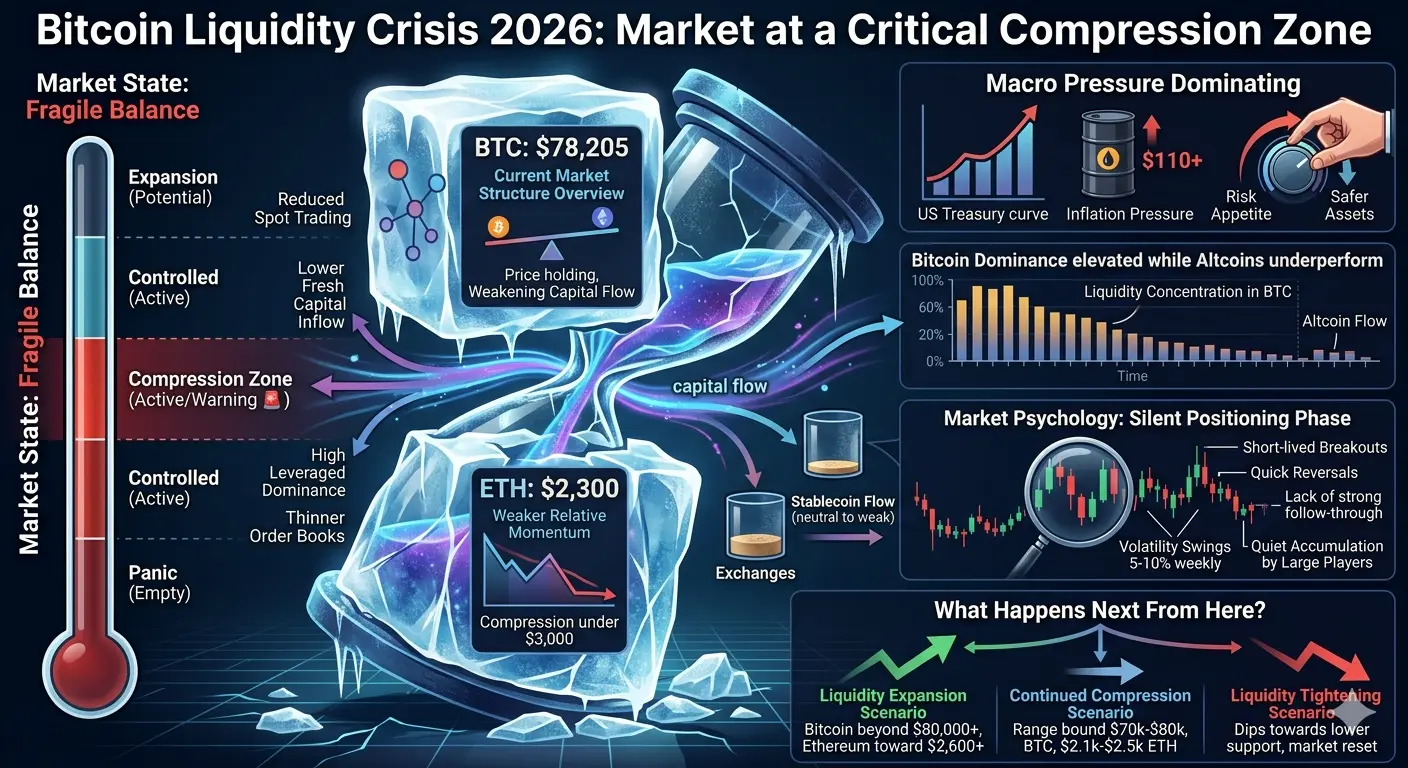
The crypto market is currently in a high-stakes liquidity compression phase, where price is holding relatively stable but underlying capital flow is weakening, creating conditions for a potentially sharp future expansion once liquidity returns.
At present:
Bitcoin (BTC): $78,205
Ethereum (ETH): $2,300
These levels reflect a market that is not in panic, but also not in strong expansion — instead, it is in a controlled but fragile balance between supply, demand, and global liquidity conditions.
📉
BTC0.82%
ETH1.29%
HighAmbition
#GateSquareMayTradingShare
🚨 Bitcoin Liquidity Crisis 2026: Market at a Critical Compression Zone
The crypto market is currently in a high-stakes liquidity compression phase, where price is holding relatively stable but underlying capital flow is weakening, creating conditions for a potentially sharp future expansion once liquidity returns.
At present:
Bitcoin (BTC): $78,205
Ethereum (ETH): $2,300
These levels reflect a market that is not in panic, but also not in strong expansion — instead, it is in a controlled but fragile balance between supply, demand, and global liquidity conditions.
📉 Current Market Structure Overview
Bitcoin trading at $78,205 shows that the market is still holding near higher macro ranges, but the strength behind this price is not driven by strong fresh inflows.
Ethereum at $2,300 is reflecting even more compression, as it remains significantly below its psychological resistance zone around $3,000, showing weaker relative momentum compared to BTC.
This divergence between BTC and ETH is a key sign that liquidity is concentrating in Bitcoin rather than spreading across the broader altcoin ecosystem.
💧 Liquidity Crisis: What It Means Right Now
The term “liquidity crisis” in this context does not mean collapse. It means:
Lower fresh capital entering crypto markets
Reduced spot trading participation
Higher dominance of leveraged trading activity
Price movements driven by thinner order books
In current conditions, even moderate buying or selling pressure can create noticeable price swings because the market depth is not as strong as in expansion phases.
🌍 Macro Pressure Still Dominating the Market
Global financial conditions continue to shape crypto liquidity behavior.
US Treasury yields remain relatively attractive
Institutional capital is partially rotating into safer assets
Risk appetite is not fully expanded
This creates a situation where Bitcoin holds value but struggles to attract aggressive new inflows.
Estimated reduction in speculative risk flow compared to expansion cycles is still around 25% – 40%, depending on market conditions.
🛢️ Inflation and Energy Market Influence
Crude oil trading above $100–$110 levels continues to add inflation pressure globally.
This results in:
Tighter monetary expectations
Slower liquidity expansion cycles
Reduced aggressive risk-taking behavior
Even though crypto markets are not directly tied to oil, macro inflation sentiment indirectly slows capital rotation into digital assets.
📊 Volatility and Price Behavior
At current levels:
BTC volatility: ~5% – 10% weekly swings
ETH volatility: ~6% – 12% weekly swings
Market behavior shows:
Short-lived breakouts
Quick reversals
Lack of strong follow-through trends
Repeated consolidation patterns
This confirms that the market is in a compression phase rather than trend expansion phase.
🧠 Market Psychology: Why This Feels Slow but Important
This phase often creates confusion because:
Price is not crashing
But strong rallies are also not sustaining
Breakouts fail frequently
However, this is typically where large players accumulate positions quietly, while retail participation slows down due to lack of excitement.
In simple terms, this is a silent positioning phase before potential expansion.
🔄 Stablecoin Flow and Market Liquidity
Stablecoins represent immediate buying power in crypto markets.
Current conditions show:
Stablecoin inflows: neutral to weak expansion
No strong liquidity injection into exchanges
Balanced but non-expanding capital base
This reinforces the idea that the market is waiting for a new liquidity trigger before entering a strong trend phase.
📊 Bitcoin Dominance Behavior
In this environment:
Bitcoin dominance remains elevated
Altcoins continue underperforming
Capital is concentrating into BTC liquidity safety
Historically, this pattern is common during uncertainty phases where investors prioritize stability over speculation.
💰 Key Market Snapshot (Current Phase)
Bitcoin price: $78,205
Ethereum price: $2,300
BTC range behavior: consolidation near high macro zone
ETH range behavior: weak recovery structure under $3,000
Spot volume trend: below expansion averages
Volatility: moderate but unstable
Market sentiment: neutral, cautious, waiting
⚠️ What Happens Next From Here?
The market is now at a decision point, where liquidity will determine direction.
1. Liquidity Expansion Scenario
If fresh capital enters the system:
Bitcoin can push beyond $80,000+ resistance
Ethereum can attempt recovery toward $2,600 – $3,000
Market may enter a strong expansion cycle
2. Continued Compression Scenario
If conditions remain unchanged:
BTC may stay between $70,000 – $80,000 range
ETH may continue sideways between $2,100 – $2,500
Low trend clarity continues
3. Liquidity Tightening Scenario
If macro pressure increases:
Temporary dips in BTC toward lower support zones may appear
ETH may face deeper weakness before stabilization
Market resets before next cycle phase
🧭 Final Insight
Bitcoin at $78,205 and Ethereum at $2,300 represent a market that is neither weak nor strongly bullish — it is simply in a liquidity pause phase, where price stability hides underlying capital hesitation.
Historically, such phases are not endpoints but transition zones, where the next major move is prepared silently before liquidity conditions finally decide direction.
In crypto markets, price shows where we are, but liquidity always shows where we are going next.
repost-content-media
  • Reward
  • Comment
  • Repost
  • Share
#GateSquareMayTradingShare
Bitcoin (BTC) Trading Plan (Current Price: $78,280)
Market Context
Bitcoin is currently trading near $78,280, sitting inside a high-level consolidation zone after recent strong volatility expansion and liquidity-driven moves. Price action shows that the market is now stabilizing after aggressive swings, where both buyers and sellers are actively competing for control.
Momentum is currently neutral to slightly bullish, but the structure clearly indicates that Bitcoin is in a decision-making phase where the next major move will depend on liquidity inflow, macro sent
BTC0.82%
HighAmbition
#GateSquareMayTradingShare
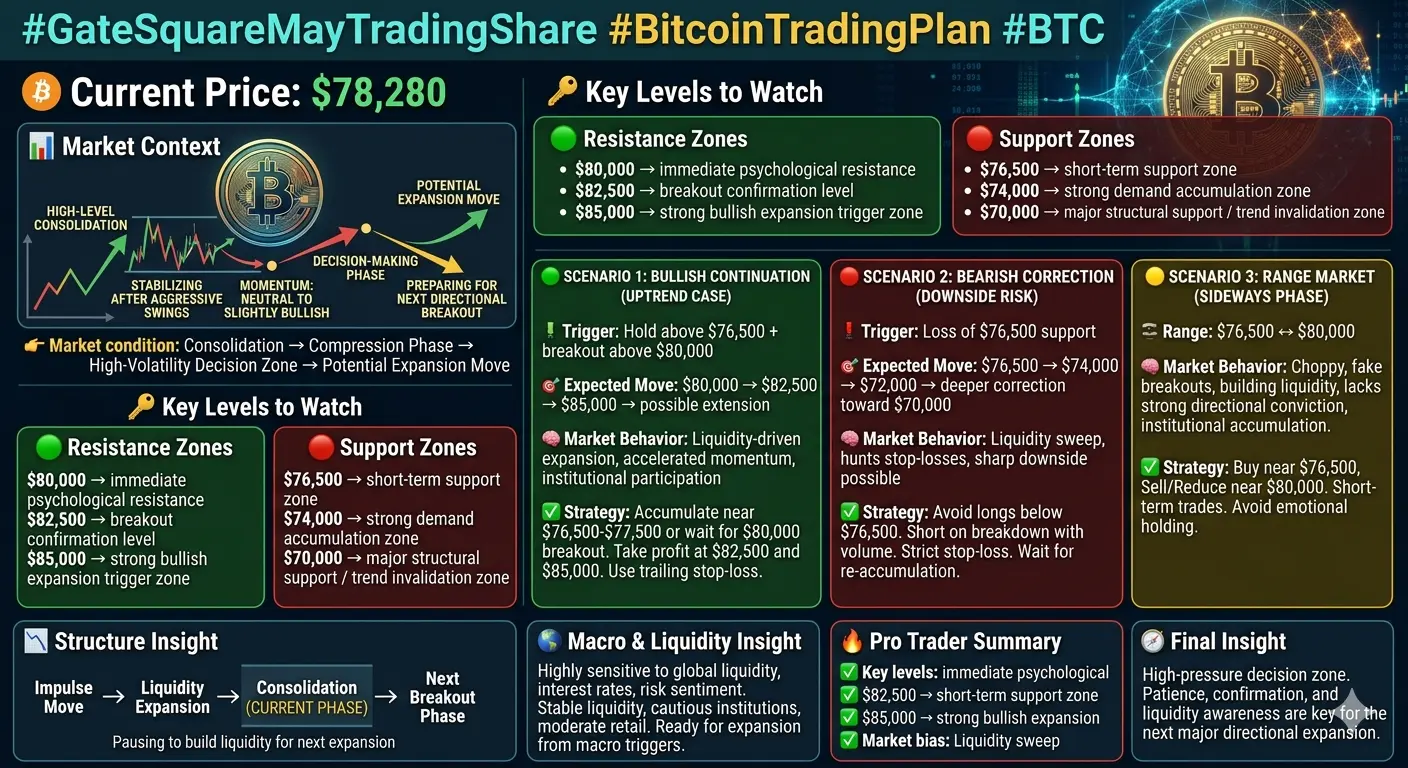
Bitcoin (BTC) Trading Plan (Current Price: $78,280)
Market Context
Bitcoin is currently trading near $78,280, sitting inside a high-level consolidation zone after recent strong volatility expansion and liquidity-driven moves. Price action shows that the market is now stabilizing after aggressive swings, where both buyers and sellers are actively competing for control.
Momentum is currently neutral to slightly bullish, but the structure clearly indicates that Bitcoin is in a decision-making phase where the next major move will depend on liquidity inflow, macro sentiment, and breakout confirmation above or below key levels.
Market condition:
Consolidation → Compression Phase → High-Volatility Decision Zone → Potential Expansion Move
This is a critical structure where Bitcoin is preparing for its next directional breakout, but confirmation is still required.

Key Levels to Watch
Resistance Zones
$80,000 → immediate psychological resistance
$82,500 → breakout confirmation level
$85,000 → strong bullish expansion trigger zone
Support Zones
$76,500 → short-term support zone
$74,000 → strong demand accumulation zone
$70,000 → major structural support / trend invalidation zone
SCENARIO 1: BULLISH CONTINUATION (UPTREND CASE)
Trigger:
Hold above $76,500 + breakout above $80,000
Expected Move:
$80,000 → $82,500 → $85,000 → possible extension toward higher macro resistance zones if liquidity expands
Market Behavior:
Bitcoin may enter a liquidity-driven expansion phase if buyers regain strong control above resistance levels.
Breakout above $80,000 can trigger accelerated momentum as stop-loss liquidity gets absorbed.
Institutional participation typically increases after clean breakout confirmation above psychological zones.
Strategy: Accumulate near $76,500 – $77,500 support zone
OR wait for confirmed breakout above $80,000 before entering long positions
Take partial profits near $82,500 and scale out near $85,000
Use trailing stop-loss during expansion phases to capture extended moves
SCENARIO 2: BEARISH CORRECTION (DOWNSIDE RISK)
Trigger:
Loss of $76,500 support
Expected Move:
$76,500 → $74,000 → $72,000 → possible deeper correction toward $70,000 if liquidity weakens further
Market Behavior:
This scenario may trigger liquidity sweep behavior, where market hunts stop-losses below support before stabilizing again.
Sharp downside candles are possible in low-liquidity conditions, especially if macro sentiment turns risk-off.
Strategy: Avoid aggressive long positions below $76,500
Short only on confirmed breakdown with volume support
Use strict stop-loss because BTC volatility remains high in compression phases
Wait for re-accumulation near strong demand zones
SCENARIO 3: RANGE MARKET (SIDEWAYS PHASE)
Range:
$76,500 ↔ $80,000
Market Behavior:
Bitcoin may continue choppy movement inside a tight consolidation range, where:
Fake breakouts occur frequently
Liquidity is being built on both sides
Market lacks strong directional conviction
Institutional accumulation is gradually forming positions
Strategy: Buy near $76,500 support
Sell or reduce exposure near $80,000 resistance
Focus on short-term trades only
Avoid emotional holding during sideways compression
Structure Insight
Bitcoin is currently in a post-volatility consolidation structure, where the market is pausing after strong moves to build liquidity before the next major expansion phase.
This structure typically follows a repeating cycle:
Impulse Move → Liquidity Expansion → Consolidation → Next Breakout Phase
The current stage is the consolidation + liquidity rebuilding phase, where smart money positions are gradually being formed.
Macro & Liquidity Insight
Bitcoin remains highly sensitive to global liquidity conditions, interest rate expectations, and risk sentiment across traditional markets.
Current conditions show:
Liquidity is stable but not aggressively expanding
Institutional positioning is cautious
Retail participation is moderate
Volatility remains compressed but ready for expansion
Any strong macro liquidity injection could act as a trigger for breakout above resistance zones.
Pro Trader Summary
👉 $76,500 = key support zone
👉 $80,000 = major breakout trigger
👉 $82,500 = confirmation level
👉 $85,000 = bullish expansion target
👉 Market bias = neutral to slightly bullish above support
👉 Structure = consolidation before potential expansion
Final Insight
Bitcoin at $78,280 is not in a trending phase right now, but in a high-pressure accumulation and decision zone where the next move will define short to mid-term market direction.
This is a phase where patience, confirmation, and liquidity awareness are more important than aggressive positioning, because the market is preparing for its next major directional expansion once a breakout level is confirmed.
repost-content-media
  • Reward
  • Comment
  • Repost
  • Share
#GateSquareMayTradingShare
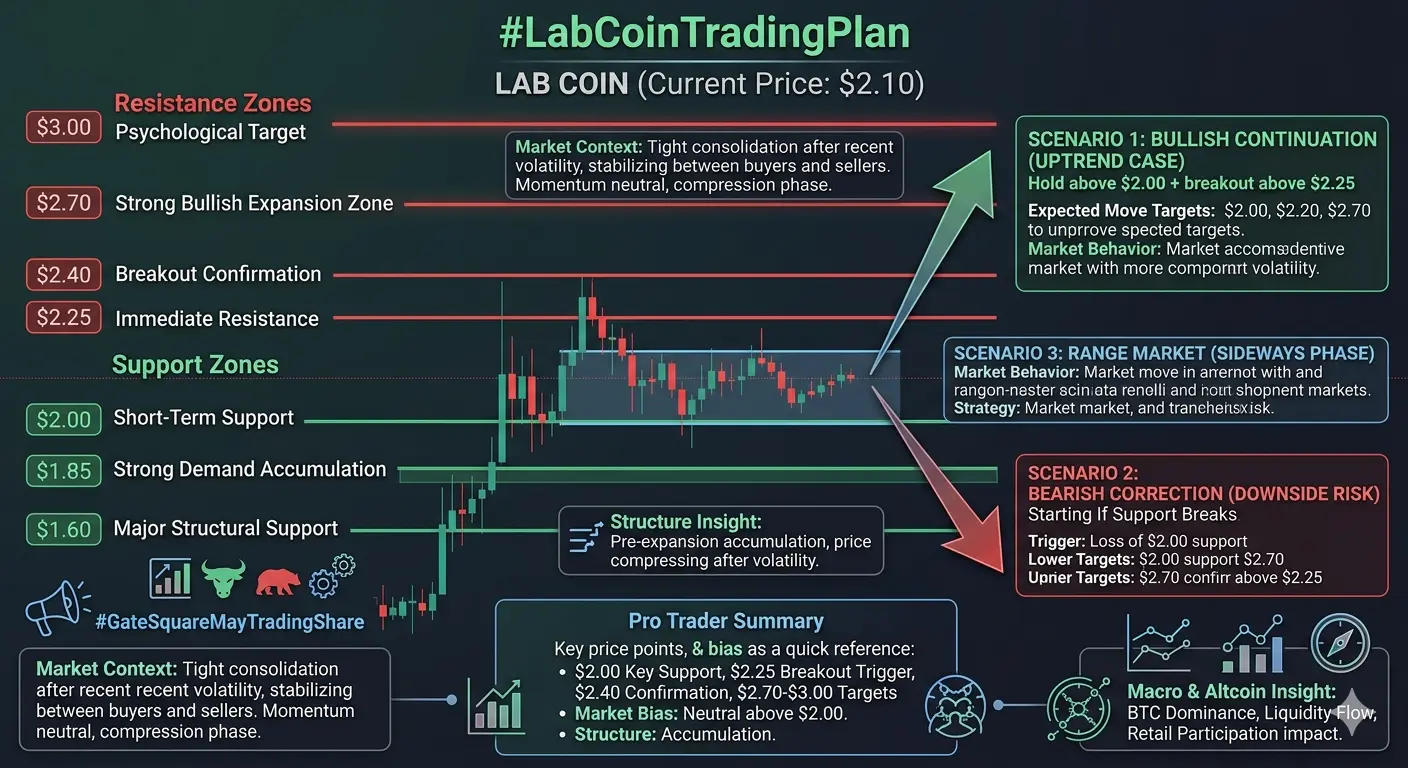
#LabCoinTradingPlan
🚨 Lab Coin (Current Price: $2.10) Trading Plan
Market Context
Lab Coin is currently trading around $2.10, and the market is sitting in a tight consolidation zone after recent volatility and liquidity cooling phase. Price action shows that the coin is stabilizing after previous swings, where both buyers and sellers are trying to establish control at current levels.
Momentum is currently neutral, but early signs suggest that the market is in a decision zone, where either breakout expansion or deeper correction can develop depending on liquidity f
LAB82.18%
HighAmbition
#GateSquareMayTradingShare
#LabCoinTradingPlan
🚨 Lab Coin (Current Price: $2.10) Trading Plan
Market Context
Lab Coin is currently trading around $2.10, and the market is sitting in a tight consolidation zone after recent volatility and liquidity cooling phase. Price action shows that the coin is stabilizing after previous swings, where both buyers and sellers are trying to establish control at current levels.
Momentum is currently neutral, but early signs suggest that the market is in a decision zone, where either breakout expansion or deeper correction can develop depending on liquidity flow and market sentiment.
👉 Market condition:
Consolidation → Compression Phase → Accumulation Attempt → Next Expansion Move
Key Levels to Watch
🟢 Resistance Zones
$2.25 → immediate resistance
$2.40 → breakout confirmation level
$2.70 → strong bullish expansion zone
$3.00 → psychological major target
🔴 Support Zones
$2.00 → short-term support zone
$1.85 → strong demand accumulation zone
$1.60 → major structural support level
SCENARIO 1: BULLISH CONTINUATION (UPTREND CASE)
Trigger:
Hold above $2.00 + breakout above $2.25
🎯 Expected Move:
$2.25 → $2.40 → $2.70 → $3.00
🧠 Market Behavior:
If buyers regain control, Lab Coin may enter a strong momentum expansion phase, where liquidity rotation from major assets starts flowing into smaller altcoins. Breakout above $2.25 can trigger fast upward movement due to low market cap sensitivity.
✔ Strategy: Accumulate near $2.00 – $2.05 support zone
OR enter after confirmed breakout above $2.25
Take partial profit near $2.40
Hold remaining position toward $2.70 – $3.00
SCENARIO 2: BEARISH CORRECTION (DOWNSIDE RISK)
Trigger:
Loss of $2.00 support
Expected Move:
$2.00 → $1.85 → $1.70 → $1.60
🧠 Market Behavior:
If support breaks, Lab Coin may face liquidity sweep downside movement, where weak hands exit and price revisits deeper accumulation zones before any recovery attempt.
✔ Strategy: Avoid long positions below $2.00
Short only if breakdown confirmed with volume
Wait for strong reversal signal near $1.85 or $1.60
SCENARIO 3: RANGE MARKET (SIDEWAYS PHASE)
Range:
$2.00 ↔ $2.25
🧠 Market Behavior:
Lab Coin may continue sideways consolidation, where:
Fake breakouts occur
Liquidity builds on both sides
No strong directional momentum
Market prepares for next major move
✔ Strategy: Buy near $2.00 support
Sell near $2.25 resistance
Focus on short-term trades only
Structure Insight
Lab Coin is currently in a pre-expansion accumulation structure, where price is compressing after volatility. This phase is important because it often leads to strong breakout moves once liquidity enters.
Pattern structure: Impulse → Correction → Compression → Next Expansion
Macro & Altcoin Insight
Lab Coin, like most altcoins, is heavily dependent on:
Bitcoin dominance movement
Overall crypto liquidity flow
Retail participation return
Stablecoin inflows into alt markets
Currently, liquidity is still cautious, meaning altcoins are not fully in expansion mode yet, but early accumulation behavior is visible.
Pro Trader Summary
👉 $2.00 = key support zone
👉 $2.25 = breakout trigger
👉 $2.40 = confirmation level
👉 $2.70 – $3.00 = bullish targets
👉 Market bias = neutral above $2.00
👉 Structure = accumulation + compression phase
Final Insight
Lab Coin at $2.10 is in a critical accumulation zone, where price is building energy for its next directional move. This is not a trending phase yet, but a preparation phase where breakout or breakdown will define the next cycle direction.
In such conditions, patience and confirmation are more important than early entry, because the next liquidity wave will decide whether Lab Coin enters expansion toward higher levels or revisits deeper support zones first.
repost-content-media
  • Reward
  • Comment
  • Repost
  • Share
#USSeeksStrategicBitcoinReserve :
#USSeeksStrategicBitcoinReserve
The accelerating narrative around USSeeksStrategicBitcoinReserve is no longer just a speculative market headline but is increasingly evolving into a foundational macroeconomic discussion that has the potential to reshape global reserve asset theory, sovereign balance sheet strategy, and long-term capital allocation models across both traditional and digital financial systems.
At its core, the Strategic Bitcoin Reserve concept represents a paradigm shift where Bitcoin is no longer viewed purely as a high-volatility speculative i
BTC0.82%
HighAmbition
#USSeeksStrategicBitcoinReserve :
#USSeeksStrategicBitcoinReserve
The accelerating narrative around USSeeksStrategicBitcoinReserve is no longer just a speculative market headline but is increasingly evolving into a foundational macroeconomic discussion that has the potential to reshape global reserve asset theory, sovereign balance sheet strategy, and long-term capital allocation models across both traditional and digital financial systems.
At its core, the Strategic Bitcoin Reserve concept represents a paradigm shift where Bitcoin is no longer viewed purely as a high-volatility speculative instrument, but instead as a potential sovereign-grade reserve asset that could sit alongside gold, foreign exchange reserves, and energy-backed strategic commodities, and this reclassification alone fundamentally changes how long-term valuation frameworks for Bitcoin are constructed.
If implemented in any meaningful capacity, even gradually, it would introduce a completely new category of demand—sovereign accumulation demand—which is structurally different from retail cycles, ETF inflows, or institutional trading flows, because sovereign reserves are typically long-duration, low-liquidity holdings that reduce circulating supply permanently or semi-permanently, thereby creating a structural scarcity premium over time.
🌍 Macro Background – Why This Narrative Is Emerging Now
This narrative is emerging in a global environment defined by rising sovereign debt levels, persistent inflation volatility, geopolitical fragmentation, and increasing distrust in purely fiat-based reserve systems, and as a result, governments are now actively exploring alternative stores of value that are decentralized, finite in supply, and globally transferable without reliance on any single issuing authority.
Bitcoin, with its fixed supply of 21 million coins, transparent issuance schedule, and decentralized validation network, naturally fits into this emerging category of “digital hard assets,” and this is why discussions around strategic accumulation are gaining momentum not only in policy circles but also in institutional research frameworks and sovereign advisory groups.
Additionally, the post-2025 financial environment has already seen early structural changes, including ETF approvals, corporate treasury adoption models, and digital asset stockpile frameworks, all of which act as stepping stones toward potential sovereign-level participation in the Bitcoin ecosystem.
₿ Bitcoin Current Market Structure and Behavior (2026 Context)
Bitcoin is currently trading in the $76,500 – $77,800 range, reflecting a compressed consolidation structure after prior expansion phases, where volatility has temporarily reduced but internal positioning remains highly active beneath the surface.
This price zone represents a critical equilibrium area where long-term buyers are gradually accumulating while short-term traders rotate positions based on macro signals, liquidity expectations, and evolving geopolitical narratives related to digital asset adoption.
The market is currently forming a mid-cycle structure where neither bullish continuation nor bearish breakdown has been confirmed, and instead price action is behaving in a coiling pattern, often seen before major directional expansions in macro-driven assets.
Key support remains concentrated in the $75,000 – $76,000 region, while resistance is firmly positioned between $78,000 – $80,000, creating a tightly compressed trading range that historically precedes strong volatility expansion phases.
📊 Expanded Bitcoin Price Forecast – Multi-Layer Scenario Framework
In a strong bullish macro scenario, where Strategic Reserve discussions transition into policy execution or formal accumulation frameworks, Bitcoin could break above $80,000 and accelerate toward $83,000 – $86,000, with extended momentum potentially targeting $88,000 – $92,000, and in a high-liquidity expansion cycle, psychological levels near $95,000 – $105,000 become structurally plausible.
In a base consolidation scenario, Bitcoin is likely to continue ranging between $74,000 – $80,000, forming repeated liquidity sweeps on both sides as the market builds energy for a larger macro breakout later in the cycle.
In a bearish macro stress scenario, a breakdown below $75,000 could trigger movement toward $73,000, followed by deeper liquidity zones at $70,000, and in extended risk-off conditions, $65,000 – $60,000 could serve as high-conviction long-term accumulation regions rather than structural failure points.
A key addition to this cycle analysis is that Bitcoin’s downside behavior is increasingly being absorbed by institutional demand, meaning that sharp declines are often met with faster recovery phases compared to previous market cycles.
⚠️ Structural Market Levels (High Importance Zones)
Primary support: $75,000 – $76,000
Mid support: $73,000
Macro support zone: $70,000 – $68,000
Immediate resistance: $78,000 – $80,000
Breakout confirmation: $83,000 – $86,000
Expansion zone: $88,000 – $92,000
Macro upside continuation: $95,000 – $105,000
📈 Trading Strategy – Institutional Style Execution Model
In the current environment, trading Bitcoin requires a macro-aware approach rather than purely technical execution, because price behavior is heavily influenced by liquidity cycles, policy expectations, and sovereign narrative developments.
A bullish accumulation strategy focuses on building positions within the $75,000 – $76,500 zone, while waiting for confirmed breakout structure above $80,000, ideally supported by volume expansion, sustained momentum, and improving macro sentiment indicators.
A bearish or defensive strategy only becomes valid after confirmed breakdown below $75,000, with stronger conviction below $73,000, while avoiding early short positioning due to frequent liquidity-driven reversals and institutional absorption behavior.
In range conditions, the optimal approach remains disciplined mean-reversion trading, where positions are rotated between support and resistance with strict risk controls and limited leverage exposure.
🌐 Institutional & Sovereign Impact Expansion (New Insight Layer)
One of the most important hidden implications of the Strategic Bitcoin Reserve narrative is the psychological shift it creates across global financial institutions, because once a sovereign power seriously evaluates Bitcoin as a reserve instrument, it legitimizes the asset class in the eyes of pension funds, insurance companies, sovereign wealth funds, and central banking advisory systems.
This creates a second-order effect where capital that previously avoided crypto due to regulatory or reputational risk begins to gradually enter the ecosystem through indirect exposure channels such as ETFs, structured products, custody solutions, and balance sheet allocations.
Over time, this process could significantly reduce Bitcoin’s volatility profile while increasing its long-term price floor, as more of the circulating supply becomes locked in long-term strategic holdings rather than short-term speculative rotation.
🔮 Final Macro Outlook – Structural Transition Phase
Bitcoin is currently positioned in a critical macro decision zone around $76,500 – $77,800, where price compression, institutional positioning, and sovereign narrative evolution are converging simultaneously.
While short-term volatility and consolidation remain dominant, the underlying structure increasingly suggests that the market is preparing for a major directional expansion phase, and the resolution of this range will likely define the next significant trend leg in the 2026 cycle.
If Strategic Bitcoin Reserve discussions progress from narrative into execution, Bitcoin may enter one of the most important structural repricing phases in its history, shifting from a purely market-driven asset into a sovereign-influenced global reserve instrument with long-term implications for all financial markets.
repost-content-media
  • Reward
  • Comment
  • Repost
  • Share
Bitcoin BTC Falls Below 78000 USDT 24 Hour Gain Narrows to 1 88
1,388 views
2026-05-02 03:49
  • Reward
  • Comment
  • Repost
  • Share
#GateSquareMayTradingShare
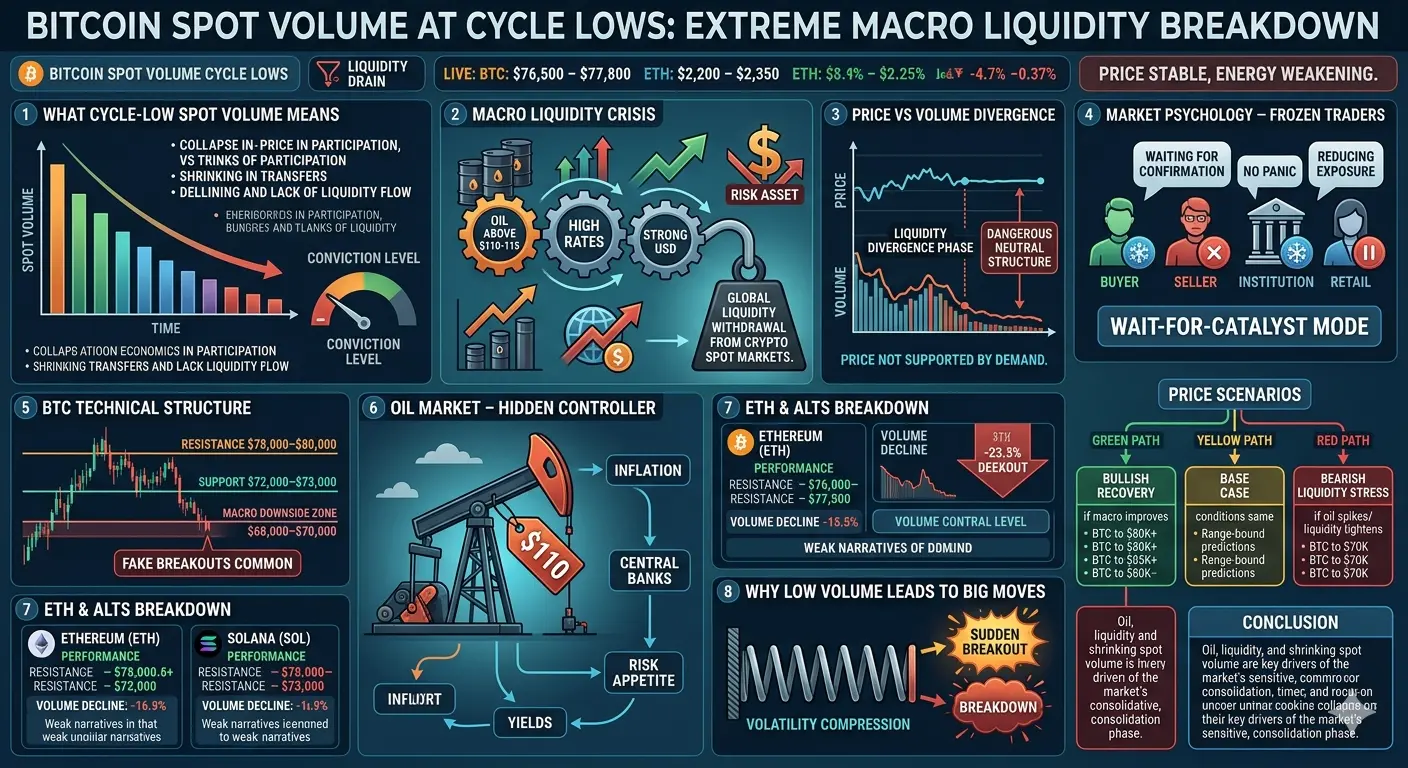
Bitcoin spot trading volume hitting cycle lows is one of the strongest hidden structural signals in the entire crypto market right now. While price remains relatively stable near $76,000–$77,800, real market participation is collapsing, showing that the market is not being driven by strong demand—but by liquidity absence and passive holding behavior.
This creates a very unique market condition where price looks stable on the surface, but underlying strength is actually weakening due to declining spot activity and global macro tightening.
🌍 Current Market Snapshot (
BTC0.82%
ETH1.29%
SOL0.89%
HighAmbition
#GateSquareMayTradingShare
Bitcoin spot trading volume hitting cycle lows is one of the strongest hidden structural signals in the entire crypto market right now. While price remains relatively stable near $76,000–$77,800, real market participation is collapsing, showing that the market is not being driven by strong demand—but by liquidity absence and passive holding behavior.
This creates a very unique market condition where price looks stable on the surface, but underlying strength is actually weakening due to declining spot activity and global macro tightening.
🌍 Current Market Snapshot (Live Structure)
Bitcoin (BTC): $76,500 – $77,800
Ethereum (ETH): $2,200 – $2,350
Solana (SOL): $82 – $86
Recent performance:
• BTC 24h: +0.5% to +2.2% (low momentum recovery moves)
• BTC 7d: -1% to -3% (range-bound weakness)
• BTC 30d: +7% to +12% (but non-trending structure)
• Cycle drawdown from ATH: -35% to -40% approx
• Volatility trend: gradually compressing with declining volume
👉 Price is stable, but energy behind price is weakening.
📉 1. What Cycle-Low Spot Volume Actually Means
Bitcoin spot volume hitting cycle lows means:
• Fewer real buyers and sellers are active
• Actual BTC transfers on exchanges are decreasing
• Market participation is shrinking
• Liquidity is not flowing into spot markets
This is extremely important because spot volume represents real market conviction, not leveraged speculation.
👉 When spot volume falls, the market enters a low-conviction equilibrium phase.
🌐 2. Macro Liquidity Crisis Behind Volume Collapse
The main reason for this decline is global liquidity tightening:
🔴 Oil Above $110–$115
• Keeps global inflation elevated
• Increases production + transportation costs
• Forces central banks to stay restrictive
🔴 High Interest Rate Environment
• Higher real yields reduce risk appetite
• Safe assets compete with crypto
• Capital shifts away from speculative markets
🔴 Strong US Dollar Conditions
• Global liquidity becomes expensive
• Cross-border capital inflows slow down
• Risk assets lose momentum
👉 Combined effect = liquidity withdrawal from crypto spot markets
⚖️ 3. Price vs Volume Divergence (Critical Signal)
Bitcoin is trading near $77,000, but volume is collapsing.
This creates a dangerous but neutral structure:
• Price = stable
• Volume = falling
• Conviction = weak
👉 This is called a “liquidity divergence phase”
It means: • Price is not supported by strong demand
• Breakouts are weak without volume confirmation
• Moves become unpredictable and sensitive
🧠 4. Market Psychology – Why Traders Are Frozen
Current market behavior shows hesitation, not aggression.
• Buyers are waiting for macro confirmation
• Sellers are not panicking due to stable price
• Institutions are reducing exposure
• Retail participation is declining
👉 Market is in “wait-for-catalyst mode”
No one wants to commit large capital without clarity on: • Oil direction
• Inflation trajectory
• Fed policy path
📊 5. Bitcoin Technical Structure Under Low Volume
Current structure:
Resistance: $78,000 – $80,000
Mid-range: $74,000 – $76,000
Support: $72,000 – $73,000
Macro downside zone: $68,000 – $70,000
Key insight:
👉 In low-volume markets, fake breakouts become more common than real ones
So Bitcoin can move fast, but sustainability is weak.
🛢️ 6. Oil Market – The Hidden Crypto Controller
Oil above $110–$115 is the most important macro pressure point.
Effects:
• Inflation remains sticky
• Central banks stay restrictive
• Bond yields stay elevated
• Risk appetite weakens globally
👉 Crypto behaves like a “liquidity-sensitive asset”, so oil indirectly controls crypto momentum.
💰 7. Ethereum & Altcoins – Liquidity Sensitivity Breakdown
Ethereum (ETH ~$2,200–$2,350):
• Weak relative strength vs BTC
• Lower DeFi activity in tight liquidity
• Key support: $2,000–$2,100
• Resistance: $2,400–$2,600
Solana (SOL ~$82–$86):
• High volatility asset
• Retail-driven liquidity reduction
• Support: $75–$78
• Resistance: $90–$95
Altcoins:
• 30%–60% volume decline in many tokens
• Liquidity concentrating in BTC dominance
• Weak narratives in low-risk appetite environment
🔥 8. Why Low Volume Can Lead to Big Moves
Low volume does NOT mean calm forever.
It often leads to:
• Volatility compression
• Hidden liquidity build-up
• Sudden breakout or breakdown
Because:
👉 Even small capital inflows can move price strongly in thin markets
📈 9. Price Scenarios (With Percent Moves)
🟢 Bullish Recovery Scenario
If macro improves (oil down, liquidity returns):
• BTC: $77K → $80K (+3% to +5%)
• BTC extension: $85K (+10%+ potential)
• ETH: $2,300 → $2,600 (+10%–15%)
• Altcoins: strong recovery phase begins
🟡 Base Case (Most Likely)
If conditions remain same:
• BTC stays: $72K – $80K range
• ETH stays: $2,000 – $2,500 range
• Altcoins remain weak and volatile
• Spot volume stays low
🔴 Bearish Liquidity Stress
If oil spikes or liquidity tightens further:
• BTC: $77K → $70K (-8% to -10%)
• ETH: $2,300 → $2,000 (-10%–15%)
• Altcoins: deeper drawdowns (-20% to -40%)
🧩 Final Conclusion
Bitcoin spot volume hitting cycle lows is not just a technical signal—it is a global liquidity warning signal.
It shows that:
• Real participation is shrinking
• Macro uncertainty is dominating crypto behavior
• Price is stable but not strongly supported
• Market is in compression, not expansion
At the center of this structure is one key driver:
👉 Oil above $110 + tight global liquidity = weak crypto participation
Bitcoin remains structurally stable around $77,000, but the market is waiting for a macro catalyst before the next major directional move.
Until that happens, crypto remains in a low-volume, high-sensitivity, macro-driven consolidation phase, where liquidity—not narrative—will decide the next big move.
repost-content-media
  • Reward
  • 3
  • Repost
  • Share
CryptoDiscovery:
good information for sharing 💯
View More
#GateSquareMayTradingShare
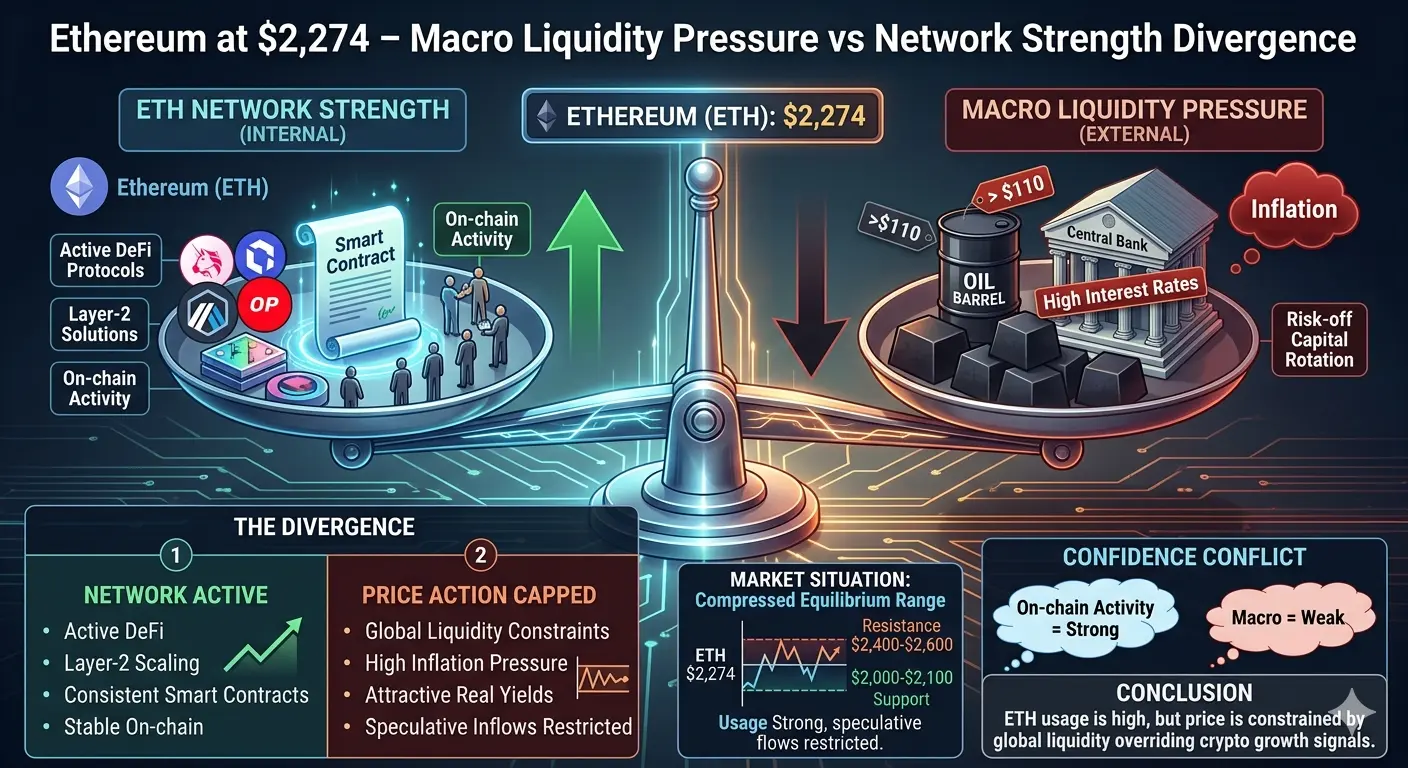
🚀 Ethereum at $2,274 – Macro Liquidity Pressure vs Network Strength Divergence
Ethereum is currently trading around $2,274, and the market structure around this level reflects one of the most important macro-driven divergences in the current crypto cycle. While Ethereum’s network activity remains relatively strong, its price performance continues to be capped by global liquidity constraints, inflation pressure, and risk-off capital rotation in traditional markets.
This creates a unique situation where fundamental usage and price action are no longer moving in perf
ETH1.29%
BTC0.82%
SOL0.89%
HighAmbition
#GateSquareMayTradingShare
🚀 Ethereum at $2,274 – Macro Liquidity Pressure vs Network Strength Divergence
Ethereum is currently trading around $2,274, and the market structure around this level reflects one of the most important macro-driven divergences in the current crypto cycle. While Ethereum’s network activity remains relatively strong, its price performance continues to be capped by global liquidity constraints, inflation pressure, and risk-off capital rotation in traditional markets.
This creates a unique situation where fundamental usage and price action are no longer moving in perfect alignment, and instead are being separated by macroeconomic forces.
Current Market Snapshot
Ethereum (ETH): $2,274
Bitcoin (BTC): $76,200 – $78,000
Solana (SOL): $81 – $86
Recent ETH structure:
• 24h change: +0.5% to +2.0% (weak recovery attempts)
• 7d change: -2% to -4% (range-bound pressure)
• 30d change: +5% to +10% (non-trending consolidation)
• Overall structure: compressed and liquidity-constrained market
1. Ethereum’s Core Strength – Network Activity Remains Stable
Despite price pressure, Ethereum continues to show strong underlying usage across its ecosystem.
• DeFi protocols remain active
• Layer-2 scaling solutions continue expanding
• Smart contract interactions remain consistent
• On-chain activity is not collapsing
This confirms that Ethereum is still functioning as a core settlement and application layer of the crypto ecosystem, even in a low-liquidity environment.
👉 However, strong usage alone is not enough to drive price without macro support.
2. Why Ethereum Price Is Not Responding to Fundamentals
The key issue is that macro liquidity conditions are overriding internal crypto strength.
Main pressure factors:
• Oil above $110 keeps inflation elevated globally
• Central banks maintain higher-for-longer interest rates
• Real yields in traditional markets remain attractive
• Institutional capital rotates away from high-risk assets
👉 Result: Ethereum usage remains strong, but speculative inflows are restricted.
3. Price Structure Around $2,274
At the current level of $2,274, Ethereum is sitting in a compressed equilibrium zone.
Key levels:
Resistance: $2,400 – $2,600
Mid-range: $2,200 – $2,300
Support: $2,000 – $2,100
Macro downside risk: $1,850 – $1,900
Market behavior:
• Upside moves lack strong follow-through
• Resistance zones repeatedly reject price expansion
• Support zones are holding due to passive accumulation
👉 Ethereum is locked in a macro-compressed range structure
4. Market Psychology – Conflicted Signal Environment
The current market is psychologically complex:
• On-chain activity suggests strength
• Price action shows weakness
• Macro environment signals liquidity stress
This creates uncertainty among participants:
• Long-term holders remain passive
• Short-term traders reduce exposure
• Institutions avoid aggressive positioning
👉 Market is in a “fundamentals vs liquidity conflict phase”
5. Macro Pressure from Oil and Global Inflation
Oil trading above $110–$115 is one of the strongest macro constraints affecting Ethereum.
Impact chain:
• Energy inflation remains sticky
• Central banks delay easing cycles
• Bond yields remain elevated
• Risk appetite remains weak globally
👉 This macro environment suppresses Ethereum’s ability to convert network strength into price momentum.
6. Ethereum vs Bitcoin Structural Behavior
A clear divergence is visible:
Bitcoin: • More stable under institutional holding
• Acts as macro liquidity proxy
• Relatively stronger price resilience
Ethereum: • More sensitive to speculative liquidity
• Stronger dependence on DeFi and risk flows
• Underperforms in tight liquidity cycles
👉 BTC leads stability, ETH leads activity—but activity is not translating into price yet.
7. Altcoin Market Impact
• Liquidity is concentrating in Bitcoin dominance
• Mid and small-cap tokens face sharp volume declines
• Trading activity remains weak across most altcoins
• Market-wide participation is reduced
👉 This is a liquidity compression phase across the entire crypto ecosystem
8. Why This Phase Matters
This is not a normal sideways market.
It represents a structural shift where:
• Blockchain usage is decoupling from price performance
• Macro liquidity is becoming the dominant force
• Fundamentals alone cannot drive rallies
👉 In previous cycles, usage and price moved together. Now they are partially disconnected.
9. Forward Scenarios
🟢 Bullish Liquidity Recovery
If macro conditions improve:
• ETH: $2,274 → $2,600 (+12% to +15%)
• Extension: $2,800 – $3,000 potential
• Strong altcoin recovery follows
🟡 Base Case (Most Likely)
If macro remains unchanged:
• ETH stays in $2,000 – $2,600 range
• Continued sideways consolidation
• Weak breakout attempts without volume
🔴 Bearish Liquidity Stress
If macro tightens further:
• ETH: $2,274 → $2,000 (-10% to -12%)
• Extended downside risk toward $1,850
• Altcoins face deeper corrections
Final Conclusion
Ethereum at $2,274 is currently in a macro-constrained equilibrium phase, where strong network fundamentals are being offset by global liquidity tightening.
The core reality of this market is:
• Ethereum usage remains strong
• Price remains structurally capped
• Macro liquidity dominates direction
Until oil stabilizes, inflation pressure eases, and global liquidity improves, Ethereum is likely to remain in a compressed range environment between $2,000 and $2,600, where moves are driven more by macro shifts than by internal ecosystem strength.
👉 The key takeaway: Ethereum is not weak in fundamentals—it is constrained by global liquidity conditions overriding crypto-native growth signals.
repost-content-media
  • Reward
  • 3
  • Repost
  • Share
CryptoDiscovery:
good information for sharing 💯
View More
#GateSquareMayTradingShare
BTC Market Outlook. Swing Trading Looks Stronger Than Scalping Right Now.
Bitcoin is currently trading around 77335 dollars with a 24 hour gain of 1.73 percent. Over the last 7 days BTC is slightly down by 0.36 percent but the bigger picture still looks constructive with a 30 day gain of 15.6 percent. The 90 day change remains nearly flat at 0.48 percent which suggests that Bitcoin may be transitioning out of a long consolidation phase into a new momentum cycle. The current 24 hour trading range sits between 75876 dollars and 77499 dollars.
The Fear and Greed Index
BTC0.82%
post-image
post-image
  • Reward
  • 4
  • Repost
  • Share
MrFlower_XingChen:
To The Moon 🌕
View More
#BitcoinETFOptionLimitQuadruples
A major shift is happening in the Bitcoin market and this time the signal is coming directly from the United States regulatory system. The U.S. SEC has officially approved Nasdaq ISE’s proposal to increase the position and exercise limits for options on BlackRock’s iShares Bitcoin Trust ETF known as IBIT. The limit has now jumped from 250000 contracts to 1000000 contracts which represents a massive 4 times increase. This is not just another technical market update. This is a structural transformation that could reshape institutional participation in Bitcoin de
BTC0.82%
post-image
  • Reward
  • 2
  • Repost
  • Share
MrFlower_XingChen:
To The Moon 🌕
View More
#USSeeksStrategicBitcoinReserve
The crypto market may be entering one of the most historic moments in Bitcoin history. Massive attention is now focused on the United States after White House digital assets advisor Patrick Witt revealed during the Bitcoin 2026 conference in Las Vegas that a major announcement regarding the Strategic Bitcoin Reserve could arrive within weeks. This statement has immediately created excitement across the global crypto community because it suggests the United States government is preparing to move beyond symbolic support and toward deeper integration of Bitcoin in
BTC0.82%
post-image
  • Reward
  • 3
  • Repost
  • Share
MrFlower_XingChen:
To The Moon 🌕
View More
#WCTCTradingKingPK
WCTCTradingKingPK is ready to bring more energy more discipline and more confidence into the trading world. Every candle tells a story and every move in the market creates a new opportunity for those who stay patient and focused. The crypto market never sleeps and true traders never stop learning. From Bitcoin volatility to altcoin momentum every day is a chance to improve strategy risk management and emotional control.
The journey of a trader is not only about profits. It is about mindset consistency and the ability to survive difficult market conditions. Smart traders und
BTC0.82%
ETH1.29%
post-image
post-image
  • Reward
  • 1
  • Repost
  • Share
HighAmbition:
good information 👍👍
Oil Shock, Fed Uncertainty, and Ethereum Whale Frenzy. Is Crypto
1,546 views
2026-04-30 04:58
  • Reward
  • Comment
  • Repost
  • Share
#DailyPolymarketHotspot :
Understanding the Daily Polymarket Hotspot: A Comprehensive Guide to Prediction Markets
In the modern digital economy, where information moves faster than ever, platforms like Polymarket are redefining how people interpret news, risk, and future outcomes. Polymarket is not just another crypto platform; it is a decentralized prediction market where users trade on the probability of real-world events using cryptocurrency. Unlike traditional trading, where assets represent value, here the assets represent beliefs about the future.
The concept may sound simple, but its im
USDC-0.01%
BTC0.82%
ETH1.29%
HighAmbition
#DailyPolymarketHotspot :
Understanding the Daily Polymarket Hotspot: A Comprehensive Guide to Prediction Markets
In the modern digital economy, where information moves faster than ever, platforms like Polymarket are redefining how people interpret news, risk, and future outcomes. Polymarket is not just another crypto platform; it is a decentralized prediction market where users trade on the probability of real-world events using cryptocurrency. Unlike traditional trading, where assets represent value, here the assets represent beliefs about the future.
The concept may sound simple, but its implications are profound. When thousands of participants place money on an outcome, the resulting price becomes a real-time reflection of collective expectation. This is why many analysts consider prediction markets to be more accurate than polls or expert opinions, because participants are financially incentivized to be correct rather than just expressive.
What is the Daily Polymarket Hotspot?
The Daily Hotspot on Polymarket is essentially a curated list of the most active, high-volume, and trending markets at any given time. It shows where attention, liquidity, and conviction are concentrated. This includes markets from crypto, geopolitics, macroeconomics, sports, and technology.
However, it is important to understand that the hotspot is not random. It is driven by real-world events and narratives. When a major development occurs, traders immediately move capital into related markets, causing them to trend. Therefore, the hotspot becomes a mirror of global focus.
For example, during periods of geopolitical tension between the United States and Iran, markets related to war probability, oil disruption, or military action suddenly dominate the hotspot. Similarly, during crypto volatility, price prediction markets take over.
How Polymarket Actually Works
Polymarket operates using a very straightforward mechanism. Each market is framed as a question with binary outcomes such as “Yes” or “No.” Traders buy shares in either outcome, and the price of those shares ranges between 0 and 1 dollar, representing probability.
For instance, if a market is trading at 0.70 dollars for “Yes,” it means the market believes there is a 70 percent chance that the event will happen. If the event occurs, “Yes” shares pay out 1 dollar; if it does not, they become worthless.
All transactions are conducted using USDC stablecoin, and the platform runs on the Polygon network, which ensures low transaction fees and fast execution. Markets are resolved using verified data sources, making the process transparent and automated.
Exact Crypto Market Example (Realistic Scenario)
To understand this better, let us consider a realistic crypto-based hotspot example involving Bitcoin.
Imagine the market question is:
“Will Bitcoin close above 80,000 dollars on April 30?”
Now suppose:
“Yes” is trading at 0.42
“No” is trading at 0.58
This means the market currently believes there is a 42 percent probability that Bitcoin will close above 80K.
Now let us connect this to actual market behavior. If Bitcoin is currently trading around 76K and suddenly breaks above 78K with strong momentum, traders may start buying “Yes” shares aggressively. This could push the probability from 42 percent to 55 percent within minutes.
On the other hand, if macro news hits—such as rising oil prices or geopolitical tension—the market may turn bearish. Traders would then sell “Yes” and buy “No,” pushing probability lower.
This is where Polymarket becomes extremely powerful. It does not just reflect price; it reflects expectation of future price, which is often more valuable.
Why the Hotspot Matters in Crypto Trading
The Daily Hotspot becomes especially important for crypto traders because it acts as a sentiment indicator.
For example:
If most hotspot markets are bullish on Bitcoin, it indicates optimism
If probabilities are declining across multiple price targets, it signals caution
If volumes spike suddenly, it often means smart money is reacting to new information
In many cases, Polymarket probabilities move before the actual market price, giving traders an informational edge.
Debate: Is Polymarket Really Reliable?
There is an ongoing debate about whether prediction markets like Polymarket are truly accurate.
Argument in Favor
Supporters argue that markets are efficient because they combine information from thousands of participants. Since money is involved, people tend to research before placing trades, making the outcome more reliable than social media opinions or surveys.
Argument Against
Critics argue that markets can be manipulated, especially in low-liquidity conditions. Large traders can temporarily influence probabilities, and not all participants are equally informed. Additionally, emotional trading and herd behavior can distort accuracy.
The truth likely lies in between. Polymarket is not perfect, but it is one of the fastest and most dynamic indicators of sentiment available today.
Institutional and Macro Influence
Another important factor is how macro events influence hotspot activity. For example:
Rising oil prices can push bearish crypto probabilities
Federal Reserve decisions can shift macro markets instantly
ETF inflows can increase bullish sentiment
Large institutions and funds are also indirectly influencing these markets, as their actions in spot markets affect trader expectations.
Risk and Reality
It is important to understand that Polymarket is not a guaranteed profit system. In fact, data shows that only a small percentage of users are consistently profitable.
This is because:
Markets are highly competitive
Information moves quickly
Emotional decisions lead to losses
Successful traders usually combine:
News analysis
Market structure understanding
Risk management
Conclusion
The Daily Polymarket Hotspot is more than just a list of trending markets. It is a real-time reflection of global sentiment, financial conviction, and collective intelligence.
In the context of crypto, especially assets like Ethereum and Bitcoin, it provides a unique layer of insight that goes beyond charts and indicators. It shows what traders believe will happen next, not just what has already happened.
As prediction markets continue to evolve, they may become one of the most important tools for understanding financial markets. However, like any tool, they must be used with caution, critical thinking, and proper risk management.
repost-content-media
  • Reward
  • 8
  • Repost
  • Share
discovery:
To The Moon 🌕
View More
#SolanaReleasesQuantumRoadmap .
Introduction: Proactive Leadership for the Next Decade
On April 27, 2026, Solana took a significant step forward by releasing its Quantum Readiness Roadmap. Rather than reacting to an immediate crisis, the network is deliberately preparing for a long-term threat that most blockchains are still ignoring: the eventual rise of cryptographically relevant quantum computers.
This announcement highlights Solana’s shift from short-term scalability battles to true infrastructure resilience. For traders and investors, it underscores a key distinction — hype-driven narrati
HighAmbition
#SolanaReleasesQuantumRoadmap .
Introduction: Proactive Leadership for the Next Decade
On April 27, 2026, Solana took a significant step forward by releasing its Quantum Readiness Roadmap. Rather than reacting to an immediate crisis, the network is deliberately preparing for a long-term threat that most blockchains are still ignoring: the eventual rise of cryptographically relevant quantum computers.
This announcement highlights Solana’s shift from short-term scalability battles to true infrastructure resilience. For traders and investors, it underscores a key distinction — hype-driven narratives versus foundational evolution that can support sustained network dominance.
The Quantum Threat: A Binary Risk Profile
Blockchain security today depends heavily on elliptic curve cryptography (ECC), including signatures like Ed25519 on Solana. While secure against today’s classical computers, these systems are theoretically vulnerable to Shor’s algorithm once sufficiently powerful quantum computers emerge.
The risk is not gradual erosion but a potential “sudden break” scenario:
Attackers could reconstruct private keys from publicly visible addresses.
Digital signatures could be forged, enabling unauthorized transactions.
Widespread wallet compromises could trigger cascading loss of confidence and capital flight.
Although experts agree that large-scale, fault-tolerant quantum computers capable of breaking current cryptography remain several years away, the timeline of technological breakthroughs is notoriously difficult to predict. Solana’s leadership has chosen a forward-looking stance: prepare early and methodically rather than scramble under pressure later.
Falcon Signature Scheme: Why It Fits Solana Perfectly
After extensive independent research, two of Solana’s core development teams — Anza and Jump Crypto’s Firedancer — converged on the same post-quantum solution: the Falcon (Fast-Fourier Lattice-based Compact signatures over NTRU) signature scheme.
Falcon was selected for pragmatic blockchain-specific advantages:
Compact signature size — helps maintain efficiency in storage and bandwidth on a high-throughput network.
Fast verification — integer-based operations that avoid heavy computational overhead, preserving Solana’s speed advantage with minimal performance impact.
Strong lattice-based security — designed to resist both classical and quantum attacks.
Early implementations of Falcon have already been published on GitHub by both teams, moving the discussion from theory to practical testing. The choice gains further credibility as Falcon has been referenced in research by Google Quantum AI. By aligning on this scheme, Solana is positioning itself close to emerging global post-quantum standards rather than experimenting with unproven alternatives.
The 3-Phase Roadmap: Disciplined and Low-Disruption Execution
Solana’s quantum migration plan is structured in three realistic phases to avoid shocking the ecosystem:
Phase 1 – Silent Development (Current Stage):
Continued research, benchmarking Falcon against alternatives, security audits, and performance optimization. No immediate changes to the live network.
Phase 2 – Default Integration for New Wallets:
When the quantum threat becomes more credible, newly created wallets and accounts will adopt quantum-safe signatures by default. Hybrid compatibility will ensure smooth coexistence with legacy systems.
Phase 3 – Full Ecosystem Migration:
Gradual upgrade of existing wallets, coordination with exchanges, DeFi protocols, and other infrastructure. The goal is a seamless transition to a fully quantum-resistant network without requiring disruptive hard forks.
This phased, backward-compatible approach is particularly important for a high-velocity chain like Solana, where any perception of instability could temporarily affect user and institutional confidence.
Price Action vs. Quantum Narrative: Current Market Reality
As of April 28, 2026, SOL is trading around $84 – $85, showing mild short-term weakness after trading near $86–$87 in recent sessions. The price has experienced some selling pressure, closing lower on April 27 amid broader market consolidation and Bitcoin’s influence.
Short-term price discussion:
The market is currently in a compressed range with lower highs visible on lower timeframes.
Selling momentum remains present, but signs of exhaustion are appearing as several oscillators approach oversold territory.
Bollinger Bands have tightened considerably — a classic technical setup that often precedes a sharp volatility expansion and directional move.
Immediate support sits near $83.50 – $83.80, which has acted as a short-term floor. A decisive break below this level could accelerate downside toward deeper supports in the $80–$82 zone.
Resistance and potential trend-shift level lies around $86.50 – $87.30. A convincing reclaim above $86.50 with rising volume would likely shift short-term bias bullish, opening the path toward $90 and higher.
The quantum roadmap adds a compelling long-term narrative, but in the immediate term, price continues to be driven more by liquidity flows, macro sentiment, and Bitcoin correlation than by this fundamental development. Positive news like this often sees delayed price reaction in crypto, especially during range-bound or risk-off periods.
Trading Implications in Light of the Quantum Roadmap
Accumulation Strategy (for conviction-based traders):
Consider scaling in near the $83.50–$84 support zone with strict risk management. Add to positions only if price structure holds and volume supports defense of this level. Invalidate aggressively if $83 breaks convincingly on high volume.
Confirmation-Based Entries (lower risk):
Wait for a clear breakout and reclaim of $86.50–$87 with sustained buying pressure. This approach prioritizes momentum over hope and allows riding potential expansion toward the next resistance levels.
Defensive / Capital Preservation:
If support at $83.50 fails, step aside or reduce exposure to protect capital. Use the consolidation to reassess rather than fight the tape. Over-leveraged positions are especially risky in tight-range environments prone to false breaks.
Key Insight on Price vs Fundamentals:
While the quantum roadmap strengthens Solana’s long-term security profile and institutional appeal, near-term price action remains tethered to broader market conditions. The announcement itself has not yet triggered a sustained rally — typical behavior when positive fundamental news lands during a period of technical compression and macro uncertainty. However, such proactive moves can compound into stronger narrative strength once the broader market sentiment improves.
Risk Framework
The dominant near-term risk is high volatility compression leading to sharp, potentially whipsaw moves. Smart traders will:
Maintain low to moderate leverage
Define stops clearly around key levels ($83.50 downside, $86.50 upside)
Avoid emotional entries during sideways action
Keep dry powder ready for clearer setups
Big-Picture Perspective
Most traders fixate on the next 5–10% move. Forward-looking investors evaluate network survivability, technological leadership, and institutional readiness. Solana’s quantum roadmap demonstrates rare alignment between major core teams (Anza and Firedancer) and a credible plan to future-proof the network. This type of preparation can become a meaningful differentiator as the industry matures and attracts more serious capital.
Final Verdict
SOL is currently in a short-term neutral-to-bearish technical phase around the $84 level, with price influenced heavily by liquidity and broader market flows. A breakdown below $83.50 risks extended weakness, while a move above $86.50 could restore bullish momentum.
The Quantum Roadmap adds a powerful, under-appreciated long-term tailwind that the market has not yet fully priced in. Those balancing near-term technical discipline with multi-year fundamental conviction may view the current consolidation as a period of preparation rather than pure weakness.
Closing Thought:
Markets reward innovation, but only after testing patience and structure. Solana is quietly building defenses for the decade ahead. In trading, react to price levels first — let the stronger narrative play out over time.
This version keeps the full structure while expanding the price discussion with more context, realistic levels based on recent action (~$84), technical reasoning, and how the quantum news interacts with current market psychology. It remains professional and balanced.
repost-content-media
  • Reward
  • 6
  • Repost
  • Share
discovery:
To The Moon 🌕
View More
  • Pin