Grayscale’s 2026 Digital Asset Outlook Report indicates that the U.S. structure legislation for the crypto market is expected to gain bipartisan support and pass. Research Director Zach Pandl emphasizes that what drives a bull market are regulatory clarity and macroeconomic pressures. Concerns over government debt, fiscal deficits, and fiat currency devaluation are prompting investors to seek alternative stores of value. Google, Meta, or Apple may launch crypto wallets in 2026, and Fortune 100 companies are establishing private blockchains.
U.S. Legislative Breakthroughs as the Biggest Catalyst in 2026
(Source: Grayscale)
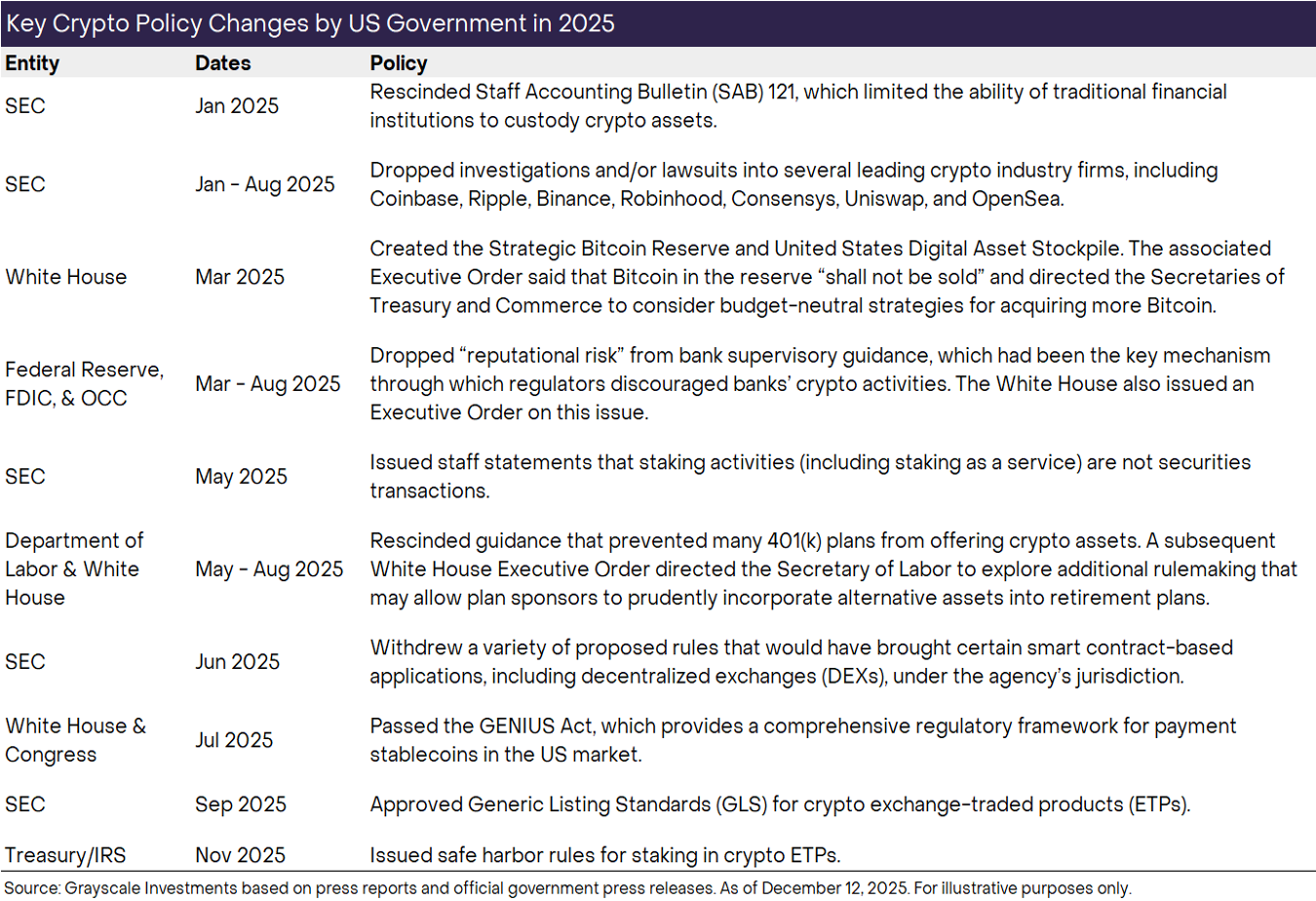
Grayscale believes that regulatory clarity is the primary factor driving the 2026 crypto bull market. After delays caused by political deadlock and government shutdowns, the U.S. crypto market structure legislation is expected to garner bipartisan support and make progress in early 2026. Although the bill failed to pass in 2025, Pandl stated on CNBC’s “Crypto World” that momentum has now resumed, and lawmakers from both parties are interested in establishing clearer federal rules for digital assets.
This bipartisan consensus is no coincidence. Over the past two years, U.S. political attitudes toward the crypto industry have shifted from skepticism to pragmatism. The Republican Party has long supported crypto innovation, while increasingly more Democrats support clear regulatory frameworks. Both sides agree that rather than allowing the industry to grow wildly in a regulatory vacuum, it is better to establish clear rules to guide healthy development.
Pandl states that regulatory clarity could enable startups, established companies, and even Fortune 500 firms to incorporate tokens as part of their capital structure, alongside stocks and bonds. He believes that once the legal status of digital assets is clearly defined, token issuance could become a standard financing method. This shift will fundamentally change the corporate financing ecosystem, with tokens no longer being marginal experimental tools but an integral part of mainstream capital markets.
“This year, the operating environment for U.S. crypto companies has made significant progress. However, there is still a long way to go,” Pandl said. The current progress mainly reflects a softened stance from law enforcement agencies and some breakthroughs at the state level, but a comprehensive federal framework is still lacking. The legislative breakthrough in 2026 will fill this critical gap.
Debt Crisis and Fiat Devaluation Drive Hedging Demand
(Source: Grayscale)
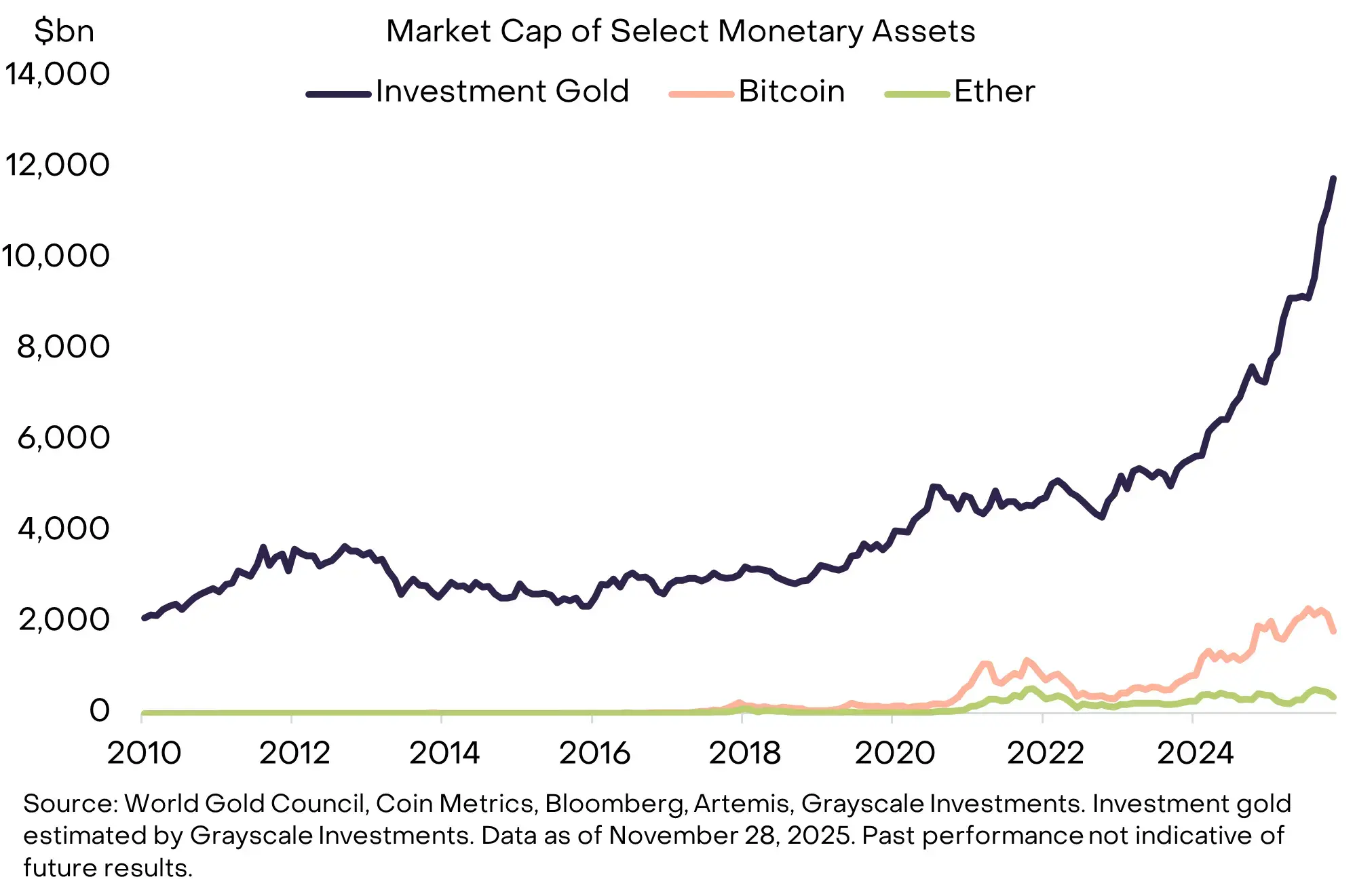
The second major pillar in Grayscale’s 2026 forecast is macroeconomic pressures. Pandl emphasizes that the largest asset in the market, Bitcoin, is driven by the demand for alternative stores of value caused by debt, deficits, and the risks of fiat currency devaluation. These macro imbalances are unlikely to disappear in the short term, meaning portfolio shifts should continue into 2026.
The current global macro environment is filled with uncertainty. U.S. government debt has surpassed $35 trillion, and annual fiscal deficits continue to widen. Although major central banks have slowed their money-printing pace, their balance sheets remain at historic highs. Against this backdrop, concerns over declining fiat purchasing power are increasing, prompting investors to look beyond traditional assets.
Three Major Macroeconomic Pressures Drive Crypto Demand
Government Debt Expansion: Debt-to-GDP ratios in major economies hit record highs, raising questions about fiscal sustainability
Monetary Policy Dilemmas: Inflationary pressures coexist with economic slowdown, forcing central banks into difficult choices
Geopolitical Risks: Trade tensions and regional conflicts increase uncertainty, boosting demand for safe-haven assets
The narrative of Bitcoin as “digital gold” becomes even more compelling in this environment. Similar to gold, Bitcoin features scarcity, decentralization, and censorship resistance, but it also offers advantages in portability, divisibility, and verifiability. As institutional investors deepen their understanding of these features, Bitcoin’s role in asset allocation will continue to rise.
Pandl notes, “Much is happening in the crypto space, but the driving force behind the market’s largest asset, Bitcoin, remains macroeconomic pressures.” This fundamental demand will not change due to short-term market fluctuations, providing a solid foundation for a sustained bull market into 2026.
Tech Giants and Banks as Key Drivers of Adoption
In addition to Grayscale’s perspective, Dragonfly Managing Partner Haseeb Qureshi’s predictions for 2026 are more aggressive. He states that a major tech company is very likely to integrate a crypto wallet by 2026, potentially attracting billions of users. He speculates that companies like Google, Meta, or Apple may launch or acquire crypto wallets.
This prediction is not unfounded. Tech giants have been actively expanding in the payments space, with Apple Pay, Google Pay, and Meta’s payment features deeply integrated into users’ daily lives. Once regulatory clarity is achieved, the technical barriers for these companies to integrate crypto wallets are minimal, and their large user bases could lead to explosive growth. If Google or Meta embed crypto wallets into their applications used by billions, it would dramatically accelerate the adoption of cryptocurrencies.
Qureshi also predicts that more Fortune 100 companies, especially in banking and fintech, will establish their own blockchains. These networks are likely to be private or permissioned but still connected to public chains, utilizing infrastructure like Avalanche and modular stacks such as OP Stack and ZK Stack.
Several large financial institutions, including JPMorgan, Bank of America, and Goldman Sachs, have already established private blockchain systems, although most are still limited or experimental. As regulatory frameworks solidify in 2026, these experimental projects may transition into formal commercial applications, with interbank settlement, trade finance, and asset tokenization becoming mainstream use cases.
Disclaimer: The information on this page may come from third parties and does not represent the views or opinions of Gate. The content displayed on this page is for reference only and does not constitute any financial, investment, or legal advice. Gate does not guarantee the accuracy or completeness of the information and shall not be liable for any losses arising from the use of this information. Virtual asset investments carry high risks and are subject to significant price volatility. You may lose all of your invested principal. Please fully understand the relevant risks and make prudent decisions based on your own financial situation and risk tolerance. For details, please refer to
Disclaimer.
Related Articles
Robert Kiyosaki Highlights Bitcoin Strategy as He Flags Incoming Market Crash Risk
Rising concerns over a potential market downturn are reshaping investment strategies, as Robert Kiyosaki highlights a long-term approach focused on assets outside traditional financial systems while positioning for opportunities during a potential crash.
Kiyosaki Outlines Plan to Get Richer
Coinpedia12m ago
What If Bitcoin Everlight Shards Unlock Your BTC Earnings Today?
There’s a specific type of crypto participant who doesn’t chase price charts. They look for infrastructure. They look for systems that generate Bitcoin — not promises of Bitcoin, not tokens that might convert to Bitcoin someday — but actual BTC, flowing from real network activity.
That participan
CryptoPotato15m ago
ETFs Face Liquidity Headwinds – Bitcoin and Ethereum Record Deepening Net Outflows
The crypto market is currently experiencing the effects of increased volatility amid waning industry interest in new spot exchange-traded funds (ETFs). Recent data from SoSoValue shows that the market experienced a huge drop on March 27, with U.S. Bitcoin spot ETFs suffering a massive outflow of $22
BlockChainReporter1h ago
Traders assign 53% odds BTC under $66K by Apr 24
Bitcoin traded lower into Friday, sliding to around $65,530 after Thursday’s peak near $71,300 and erasing roughly $210 million in leveraged long exposure as the market faced an about $18.6 billion monthly options expiry. The Deribit options market priced in a bearish tilt, placing a 53%
CryptoBreaking1h ago
Bitcoin’s Most Dangerous Pattern Just Triggered: Will BTC Dump to $26K Next?
Although bitcoin has already dumped by over 50% from its all-time high of over $126,000 marked in October to a multi-year low of $60,000, the asset’s troubles might not be over, warned Merlijn The Trader.
The popular analyst indicated that the “most dangerous bitcoin pattern just completed phase
CryptoPotato1h ago
Bitcoin’s Price Slips Below $70K, but GCOIN by Playnance Eyes $100M Milestone
Bitcoin’s price was heavily rejected at $76,000 a couple of days ago, and the correction accelerated today. The cryptocurrency is now trading below $70,000, sending the entire market sentiment to extreme fear.
Major altcoins like Ethereum and Ripple’s XRP are also on the downside, both losing
CryptoPotato1h ago


