Author: William M Peaster, Bankless; Compiler: Jinse Finance xiaozou
1. Full chain game analysis
In the crypto world, the word “onchain” has two different meanings. One of the newer, looser meanings refers to the general application of blockchain. “Put your music on the chain”, such as putting your song on sound.xyz as an NFT, etc. This meaning is being used more and more widely.
But keep in mind that you can mint tokens on Ethereum while still storing art or other resources for that token off-chain, i.e. on a private server or external storage like IPFS.
And the second, earlier, more technical meaning of “onchain” is that all the content of an NFT series or blockchain-based project is stored directly on the chain, such as directly on Ethereum.
Although this type of on-chain storage is relatively expensive compared to off-chain storage, it provides considerable durability and openness, because as long as Ethereum exists, on-chain projects will exist and can be around indefinitely. It builds.
Of course, there is a certain range of division. Some projects are minimally dependent on the blockchain, some use a combination of off-chain and on-chain storage, and some are fully on-chain. This range also applies to blockchain gaming scenarios.
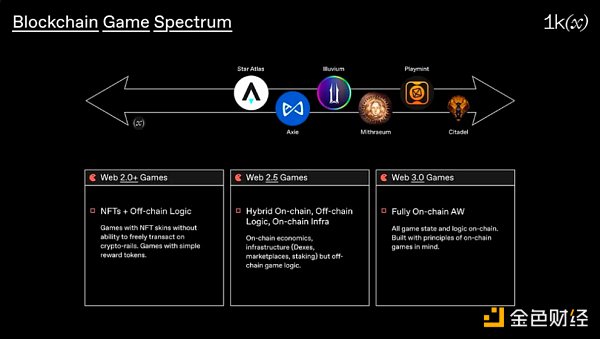
Autonomous Worlds is a “fully on-chain” game. In this type of project, the logic and state of the games are completely stored on the chain, which means that their rules and progress dynamics are tracked in smart contracts, and all game data is on the blockchain, which paves the way for interoperability. leveled the road. Therefore, the autonomous world is also client-agnostic, and anyone can create their own interface to interact with the underlying game.
**2. Why is an autonomous world important? **
Autonomous worlds can be infinite games, games that run independently of their creators, are open to all, and evolve over time. The game itself becomes a world of protocols and autonomy, allowing users to build on top of it.
Therefore, the “open source + always-on” nature of these games is a huge boon for interoperability and fundamentally changes the practice of traditional games, which are closed systems controlled by their creators. In an autonomous world, players can create their own expansions on their own terms, forming an ever-evolving bottom-up ecosystem.
In addition, games made in this full-chain manner can also become economic systems themselves. They can have their own currencies, markets, and economic rules, creating new forms of economic organization that can co-exist with traditional economies. These games are not only about entertainment, but also the road to the “new economic and social structure” of the virtual world.
3. Autonomous World Game Engine
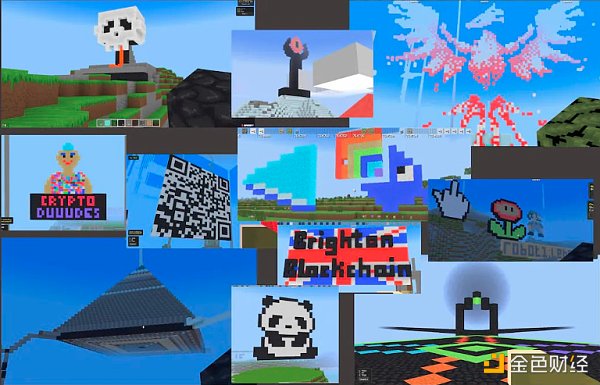
The autonomous world scene is currently small, but is expected to grow significantly over the next decade. In order to achieve this goal, some important early efforts are now mainly around the development of “on-chain game engines”, that is, frameworks for publishing their own autonomous worlds, or related construction of autonomous worlds.
For example, some of the on-chain game engines you should be looking at right now are:
MUD: Developed by the Lattice team, this “multi-user dungeon” framework enables the creation of complex on-chain applications directly on the Ethereum Virtual Machine (EVM) network. As you may recall, it was used to create the on-chain voxel game OPCraft on Optimism last year.
Keystone: Built by the Curio team, this framework is a true Optimism-based L2 chain with a built-in engine dedicated to parallel game activity. Curio is currently using the stack to build its own on-chain diplomacy game, Treaty.
Dojo: A StarkNet-based on-chain game engine and “toolchain” that supports the Rust and Cairo programming languages.
**Argus:**Argus is a game publisher working on its own on-chain game developer studio stack, World Engine, an L2 platform that supports sharding so games can be built horizontally on that network.
4 Conclusion
In the December 2022 edition of Zora Zine, author and entrepreneur Yancey Strickler predicts that the on-chain age is upon us, which he predicts will be defined as “a period in which much of the world’s creative cultural output, shared history, and information infrastructure will period of establishment, storage and access on-chain.”
I totally agree with Strickler that I think the rise of Autonomous Worlds is part of the flourishing on-chain era. Maybe 10 years from now we’ll look back and think these types of games were obvious with hindsight, but right now we’re standing at the beginning of the field. It’s exciting, and if Lattice’s recent Top 100 Project Autonomous World Hackathon is any indication, the fun is just getting started! Pay attention and show your skills!
Disclaimer: The information on this page may come from third parties and does not represent the views or opinions of Gate. The content displayed on this page is for reference only and does not constitute any financial, investment, or legal advice. Gate does not guarantee the accuracy or completeness of the information and shall not be liable for any losses arising from the use of this information. Virtual asset investments carry high risks and are subject to significant price volatility. You may lose all of your invested principal. Please fully understand the relevant risks and make prudent decisions based on your own financial situation and risk tolerance. For details, please refer to
Disclaimer.


