Institutional outflows and macro uncertainty drove ETF declines, with Bitcoin holding a stronger positioning than Ethereum.
Bitcoin spot exchange-traded funds reversed a recent upswing as investors pulled $296 million in net outflows for the week ending March 27, according to SoSoValue data. The withdrawal streak pushed total net assets down 7.5%, dropping from a March 23 peak of $91.7 billion to $84.8 billion by Friday’s close. Market jitters also spread beyond U.S. venues, with global digital asset investment products posting $414 million in outflows.
Macro Headwinds Push Crypto Funds Into Outflows as Bitcoin Pulls Back
CoinShares Head of Research James Butterfill pointed to the first net withdrawals in five weeks. He said the pressure showed up most strongly among major institutional providers, not just in scattered marginal activity.
iShares led with $282 million in redemptions, followed by Grayscale at $96 million and Bitwise at $85 million. That concentration suggested core allocators were actively reducing risk rather than reacting to low-volume sentiment.
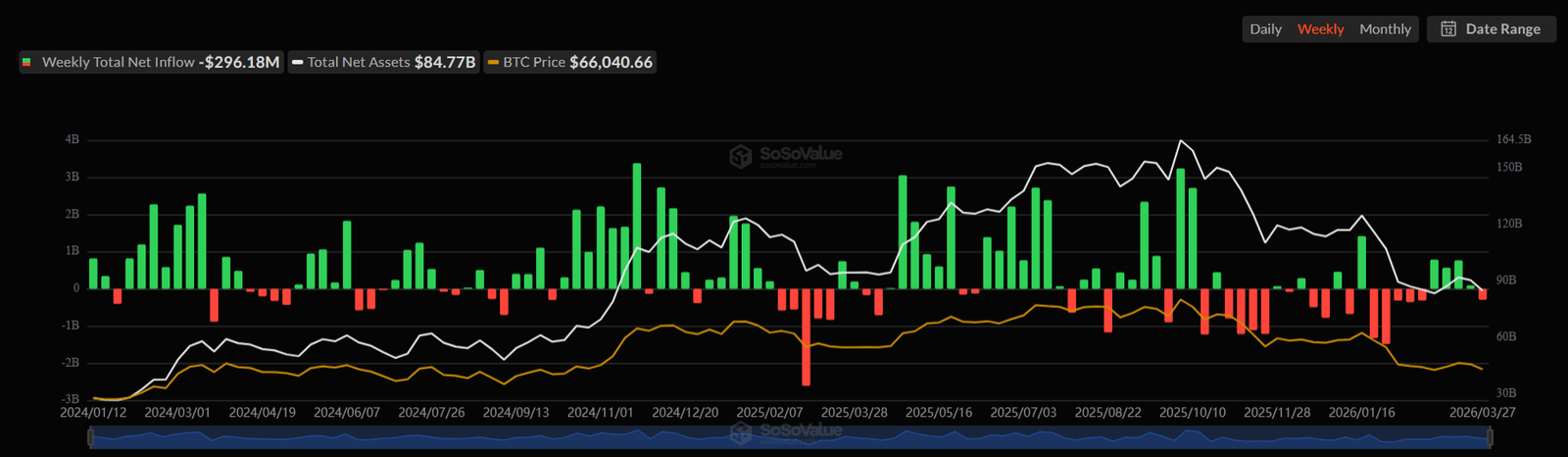
_Image Source: _SoSoValue
Butterfill tied the wider outflow pattern to growing unease around the drawn-out Iran conflict and rising inflation concerns. He also noted that June FOMC rate expectations flipped from cuts toward hikes. As those macro worries intensified, digital asset allocations appeared to cool, as both prices and capital left investment products.
Across all global funds, assets under management fell to $129 billion. That level matched roughly the period of April 2025 seen during the first phase of Trump’s tariffs, the report said.
The AUM decline reflected two forces working together: Bitcoin’s pullback and continued redemptions. Bitcoin fell from above $71,000 to near $65,000 during the same week, shifting risk appetite downward.
U.S. Outflows Weigh on Global Crypto Funds Despite Overseas Dip Buying
The United States accounted for $445 million of global outflows, essentially driving the entire net withdrawal. Germany and Canada recorded inflows of $21.2 million and $15.9 million, respectively.
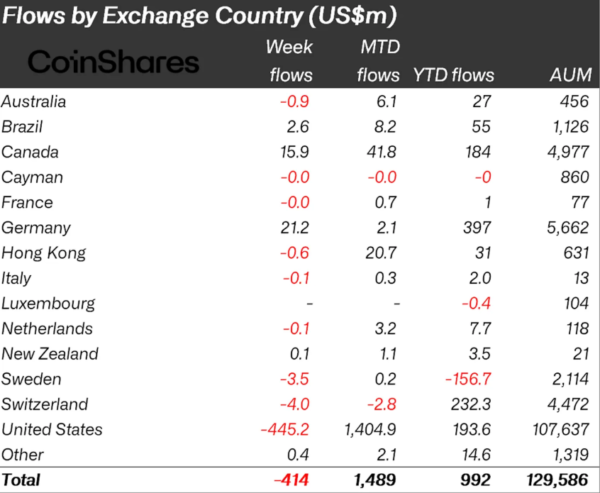
_Image Source: _CoinShares
Meanwhile, Switzerland saw a smaller $4 million outflow. Those numbers suggested some investors bought dips outside U.S. markets, even as U.S. flows stayed negative.
At the product level, Ethereum investment vehicles took the hardest hit. They saw $222 million in weekly outflows and ended the year-to-date period with net negative flows of $273 million, the weakest position among major digital assets.
Institutional Selling Hits Bitcoin ETFs as Assets Drop to $84.8 Billion
Bitcoin-focused funds posted $194 million in global net outflows yet remained in positive year-to-date territory with $964 million in net inflows. In practice, Bitcoin held a stronger structural positioning than Ether during the rotation.
Still, the selloff did not look entirely uniform. Minor inflows were observed in assets such as XRP and Solana, as well as in multi-asset products. Short-Bitcoin products added $4 million in inflows, suggesting tactical hedging amid price declines. Under the surface, some reallocation occurred rather than straight market capitulation.
U.S. spot Bitcoin ETF outflows were driven by a sharp single-day decline on March 27, when $225.5 million left products that day. BlackRock’s IBIT led the largest fund-level drop, shedding $201.5 million in one session, the biggest outflow among funds during the five-day window.
The volatility followed a mid-week bounce that briefly pushed Bitcoin above $71,000 before it retreated to $65,000 by Friday. The largest coin exchanged hands around $67,376 early Monday, up about 1.4% over the prior 24 hours, as investors weighed macro pressure against remaining ETF inflows.
Disclaimer: The information on this page may come from third parties and does not represent the views or opinions of Gate. The content displayed on this page is for reference only and does not constitute any financial, investment, or legal advice. Gate does not guarantee the accuracy or completeness of the information and shall not be liable for any losses arising from the use of this information. Virtual asset investments carry high risks and are subject to significant price volatility. You may lose all of your invested principal. Please fully understand the relevant risks and make prudent decisions based on your own financial situation and risk tolerance. For details, please refer to
Disclaimer.
Related Articles
BTC 15-minute rise of 0.53%: Institutional derivatives adding positions drives a short-term rebound
Between 2026-04-20 01:30 and 2026-04-20 01:45 (UTC), the BTC spot price fluctuated within a narrow range of 74290.9 to 74709.7 USDT. Over the 15-minute period, the return was +0.53%, with a range of 0.56%. Overall market volatility increased, drawing attention, but the number of active on-chain addresses remained steady, with no sign of extreme capital movements.
The main driver behind this move is institutional capital inflows into mainstream futures platforms and adjustments to derivatives position structures, especially CME futures open interest (OI), which rose against the trend by 2.61%. Meanwhile, some institutions added to defensive hedges and positioned for short-term rebounds within the price consolidation range. In addition, short-term Put options trading on platforms such as Deribit was active: the main contracts were concentrated on near-term downside protection, indicating that derivatives capital has increased its allocation to defensive strategies and that the spot market has passively followed the upward move.
In addition, ETF funds recorded $1.87 billion in net inflows in Q1, easing the consecutive net outflow trend seen earlier before March and providing medium-term background support for spot prices. Although on-chain active addresses over 1 hour stayed in the 19500–19600 range without abnormal increases or decreases, structural behavior by institutions across the derivatives and ETF markets converged to push short-term price volatility higher. There were no signals of sell pressure from retail traders or major whales, and no large transfers or extreme liquidation events; overall momentum came from institutional-level maneuvering.
It is worth noting that the derivatives market Put/Call ratio remains on the high side. If the price cannot continue moving upward, short-term exit pressure could intensify at any time. With overall OI shrinking, the activity of leveraged funds in the market weakens. Going forward, it is important to focus on changes in derivatives positions, ETF fund flows, and the in-and-out movements of active capital on-chain in order to respond to the risk of sharp short-term volatility. For more market information, it is recommended to continuously track relevant data indicators and capital-level anomalies.
GateNews35m ago
BTC falls 0.44% in 15 minutes: ETF fund outflows and derivatives shorts add to the slide
From 21:45 to 22:00 (UTC) on April 19, 2026, the BTC price dropped by 0.44% within 15 minutes. The candlestick range was 74,366.1 to 74,789.3 USDT, with an amplitude of 0.57%. Short-term volatility was concentrated. During this period, the trading volume for large orders rose significantly, market attention increased, and volatility intensified.
The main driving force behind this deviation was that U.S. spot Bitcoin ETFs saw a large net outflow of $291 million over two days from April 18 to April 19. This reflected institutional funds pulling away in the short term, which led to a marked increase in sell pressure in the spot market. At the same time, BTC perpetual contract
GateNews4h ago
BTC falls below 74000 USDT
Gate News bot message, Gate market data shows that BTC has fallen below 74000 USDT, with a current price of 73979.6 USDT.
CryptoRadar4h ago
BTC dips slightly by 0.53% in 15 minutes: whale transfers increase sell pressure and amplified liquidity widen the short-term drop
From 17:45 to 18:00 (UTC) on 2026-04-19, within 15 minutes BTC’s spot price fell -0.53%, with a price range of 74648.4 to 75212.8 USDT and a swing of 0.75%. During this period, market attention increased, volatility clearly accelerated, and the magnitude of the abnormal move exceeded typical levels for the same timeframe.
The main driver behind this abnormal move was that large-whale accounts concentrated transfers of BTC to a certain major exchange; the All Exchanges Whale Ratio (EMA14) rose to a near-ten-month high, and sell pressure increased significantly in a short time, becoming a direct cause of the spot price decline.
GateNews8h ago
BTC falls below 75,000 USDT
Gate News bot message, Gate quotes show that BTC has fallen below 75,000 USDT, with a current price of 74,985.2 USDT.
CryptoRadar8h ago


