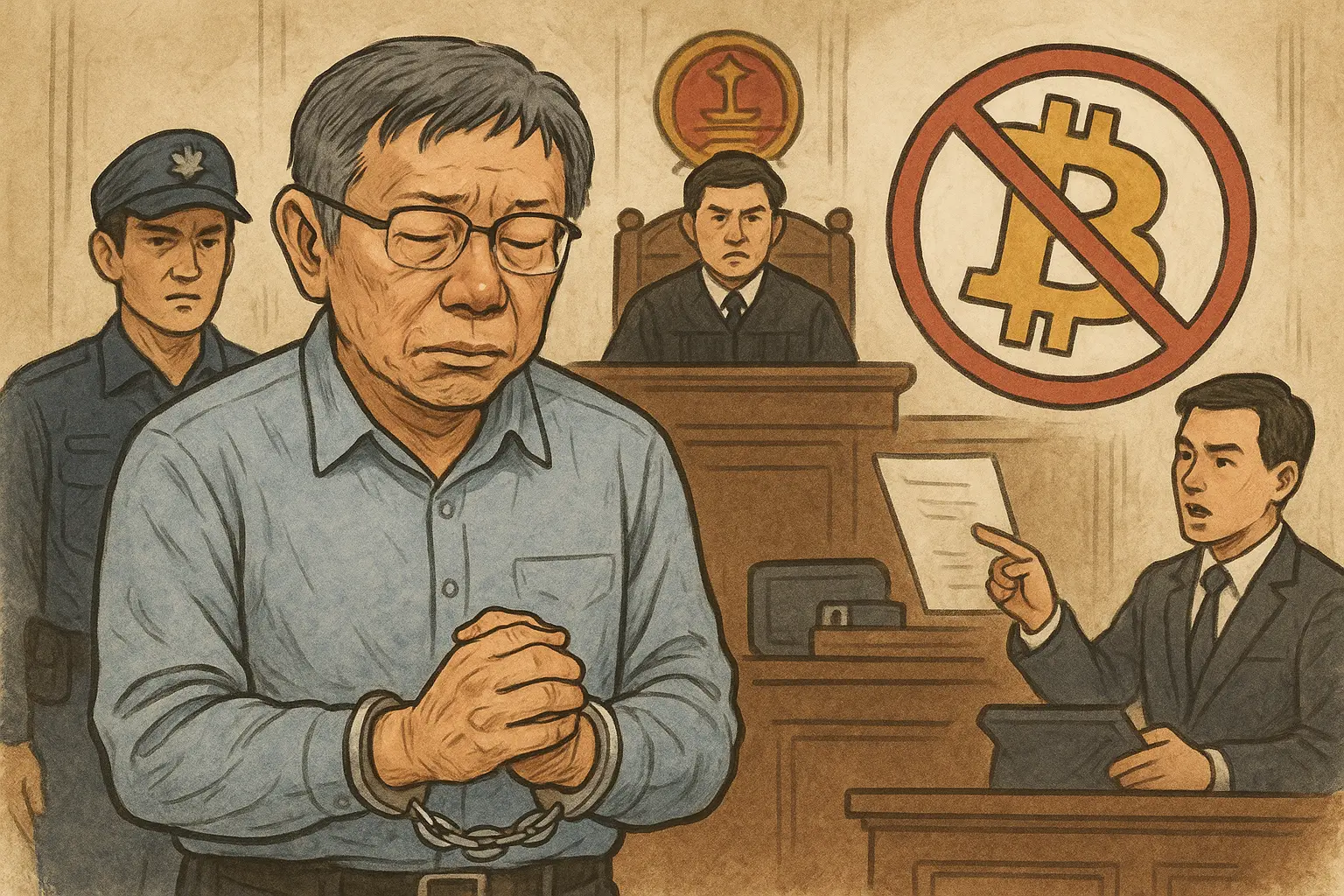
On March 26, the Taipei District Court issued a first-instance verdict regarding the Jinghua City corruption case and the political donation case, finding former chairman of the Taiwan People’s Party, Ko Wen-je, guilty of four crimes, resulting in a combined sentence of 17 years in prison and a 6-year deprivation of civil rights. The case is subject to appeal. Additionally, the widely circulated claims during the investigation about “1,500 bitcoins” and “USB cold wallets” were never mentioned in the official indictment from the Taipei District Prosecutor’s Office.
First-instance Verdict Results: Overview of Sentences for Ko Wen-je and Other Defendants
Ko Wen-je was found guilty of graft and bribery in the Jinghua City case, and of public interest embezzlement and breach of trust in the political donation and public welfare foundation case. The Taipei District Court sentenced him to a combined 17 years, which is less than the prosecution’s original request of 28 years and 6 months. The current chairman of the People’s Party, Huang Kuo-chang, stated in a press release that he was “incredulous and still unable to calm down” upon hearing the verdict, and indicated that he could not provide a complete explanation until he had read the full reasoning of the verdict.
Main Co-defendants’ First-instance Verdict Results
Chairman of Weijing Group, Shen Qing-jing: 10 years of imprisonment
Taipei City Councilor, Ying Hsiao-wei: 15 years and 6 months of imprisonment
Former Vice Mayor, Peng Zhen-sheng: 2 years of imprisonment, 3 years probation
Former Director of the Urban Development Bureau, Huang Jing-mao: 6 years and 6 months of imprisonment
Former Finance Officer, Li Wen-zong: 4 years and 6 months of imprisonment
Person in charge of Muke Company, Li Wen-juan: 2 years and 4 months of imprisonment
Accountant, Duan Mu-zheng: 1 year of imprisonment
Indictment Disproves Rumors: Little Shen 1,500 is Cash, Not Related to Bitcoin
During the investigation of the Ko Wen-je case, certain political commentary programs and media frequently spread specific cryptocurrency claims. These claims included: that Ko Wen-je’s USB drive might be a “cold wallet,” that “Little Shen 1500” in the Excel file represented 1,500 bitcoins, and that the PowerPoint presentation software pertained to “virtual currencies,” which sparked widespread discussion.
However, according to the official indictment released by the Taipei District Prosecutor’s Office at the end of 2024, the terms bitcoin, virtual currency, or cold wallet never appeared in the text. The indictment clearly states that the “1500” record in the Excel file on Ko Wen-je’s mobile hard drive was recognized by the prosecution as a record of receiving 15 million New Taiwan Dollars in cash bribes from Shen Qing-jing, completely unrelated to cryptocurrency.
Notably, in this first-instance verdict, the court only recognized that Ko Wen-je received 2.1 million New Taiwan Dollars, while the “Little Shen 1500” part was acquitted due to insufficient evidence. Although the court confirmed that “Little Shen” indeed refers to Shen Qing-jing, and that the workbook was created by Ko Wen-je himself, it determined that the existing evidence was insufficient to confirm the actual receipt of the 15 million New Taiwan Dollars bribe by both parties.
The bitcoin rumors surrounding the Ko Wen-je case once again highlight the mainstream media’s tendency to confuse concepts and lack fact-checking when reporting on issues related to crypto assets. The publication of judicial documents provides clear answers to the cryptocurrency rumors that have persisted for nearly two years.
Frequently Asked Questions
What exactly is “Little Shen 1500” in the Ko Wen-je case?
According to the indictment from the Taipei District Prosecutor’s Office, “Little Shen 1500” refers to Shen Qing-jing, chairman of the Weijing Group, and “1500” was identified by the prosecution as a record of a cash bribe of 15 million New Taiwan Dollars, having no connection to bitcoin or any cryptocurrency. The first-instance court ultimately acquitted Ko Wen-je on this part due to insufficient evidence.
What is a cold wallet, and why did the Ko Wen-je case trigger related rumors?
A cold wallet is a type of hardware device used to store the private keys of cryptocurrency offline, commonly in forms such as USB flash drives. Due to the appearance of a storage medium in USB form in the Ko Wen-je case, some media hastily equated it with a cold wallet without verification, but the official indictment never confirmed this claim.
Disclaimer: The information on this page may come from third parties and does not represent the views or opinions of Gate. The content displayed on this page is for reference only and does not constitute any financial, investment, or legal advice. Gate does not guarantee the accuracy or completeness of the information and shall not be liable for any losses arising from the use of this information. Virtual asset investments carry high risks and are subject to significant price volatility. You may lose all of your invested principal. Please fully understand the relevant risks and make prudent decisions based on your own financial situation and risk tolerance. For details, please refer to
Disclaimer.
Related Articles
Senator Warren Presses Musk on X Money Risks, Citing Stablecoin Concerns and Regulatory Gaps
Senator Elizabeth Warren has asked Elon Musk for details on X Money, a payments feature for X, raising concerns about stablecoin risks, regulatory issues, financial stability, and data privacy, with a response due by April 21, 2026.
GateNews14m ago
Florida and Massachusetts jointly recover $5.4 million in cryptocurrency scam assets
The Florida State Attorney’s Office and the Marion County Sheriff’s Office jointly recovered $5.4 million in cryptocurrency scam funds, involving an investment fraud scheme that used romance as a cover. Some of the funds have been returned to victims in Florida and Massachusetts. Since its inception, CFEU has recovered $7.2 million, and another $12.6 million in assets remains frozen. Massachusetts has also carried out multiple law-enforcement actions, shutting down scam websites and recovering funds.
MarketWhisper4h ago
Kalshi Launches Parental Portal and AI Verification to Combat Underage Misuse of Prediction Market
Kalshi is introducing a parental portal for identity verification and selfie authentication to prevent minors from bypassing age restrictions. This follows scrutiny over its compliance with prediction market regulations amid ongoing lawsuits.
GateNews5h ago
Florida and Massachusetts Recover $5.4M in Crypto Fraud Assets from Romance Scam Scheme
Authorities in Florida and Massachusetts recovered $5.4 million in cryptocurrency from romance scam-related investment fraud, with victims receiving partial refunds. Ongoing efforts continue against crypto fraud, with additional assets under litigation.
GateNews5h ago
Criticized for freezing too slowly: USDC freezes are taking too long! Circle CEO: We will definitely wait for a court order before freezing; we refuse to freeze it on our own
Circle CEO Jeremy Allaire said the company will not proactively freeze wallet addresses unless it receives a court order or law-enforcement requirement. Even amid allegations of hacker money laundering and community backlash, Circle continues to insist on operating under the rule of law.
Jeremy Allaire sets Circle’s law-enforcement bottom line
-----------------------------
As the global cryptocurrency market surges with uncertainty, Circle’s CEO Jeremy Allaire, at a press conference in Seoul, South Korea, made a clear stance on the market’s most sensitive issue of “asset freezes.” He noted that while Circle has technical means to freeze specific wallet addresses, unless it receives a court order or an official directive from law-enforcement agencies, the company will not
CryptoCity18h ago


