
Pi Network (PI) rose 3% on Friday, showing signs of a preliminary recovery after a 10% plunge earlier this week, indicating that the early profit-taking phase is cooling down. Meanwhile, PiScan confirms that Kraken and LBank have been added to the official list of centralized exchanges (CEX) supporting PI trading, further expanding PI’s liquidity landscape.
Interpreting the Significance of Kraken Joining the CEX List and On-Chain Data
Adding Kraken and LBank to the official CEX list via PiScan is an important node in expanding liquidity within the Pi Network ecosystem. Kraken is one of the most reputable and high-traffic cryptocurrency exchanges globally, and listing PI trading pairs on Kraken signifies significant recognition for potential institutional and high-net-worth users.
On-chain data provides a more detailed market sentiment indicator than price alone:
Net inflow into CEX turns positive (+165,044 PI): A positive value indicates more PI is flowing into exchanges rather than being withdrawn. During previous profit-taking peaks, capital flow was typically net outflow (more PI withdrawn from exchanges to private wallets), reflecting long-term holding intentions. The recent net inflow turning positive may suggest some holders are still selling, but overall selling pressure has significantly slowed compared to earlier phases.
Interpretation: If net inflow later turns negative (withdrawals exceed deposits), it is generally seen as a stronger bullish signal, reflecting investors’ preference to hold rather than sell on the market.
Technical Analysis: Key Levels and Multi-Indicator Insights
 (Source: Trading View)
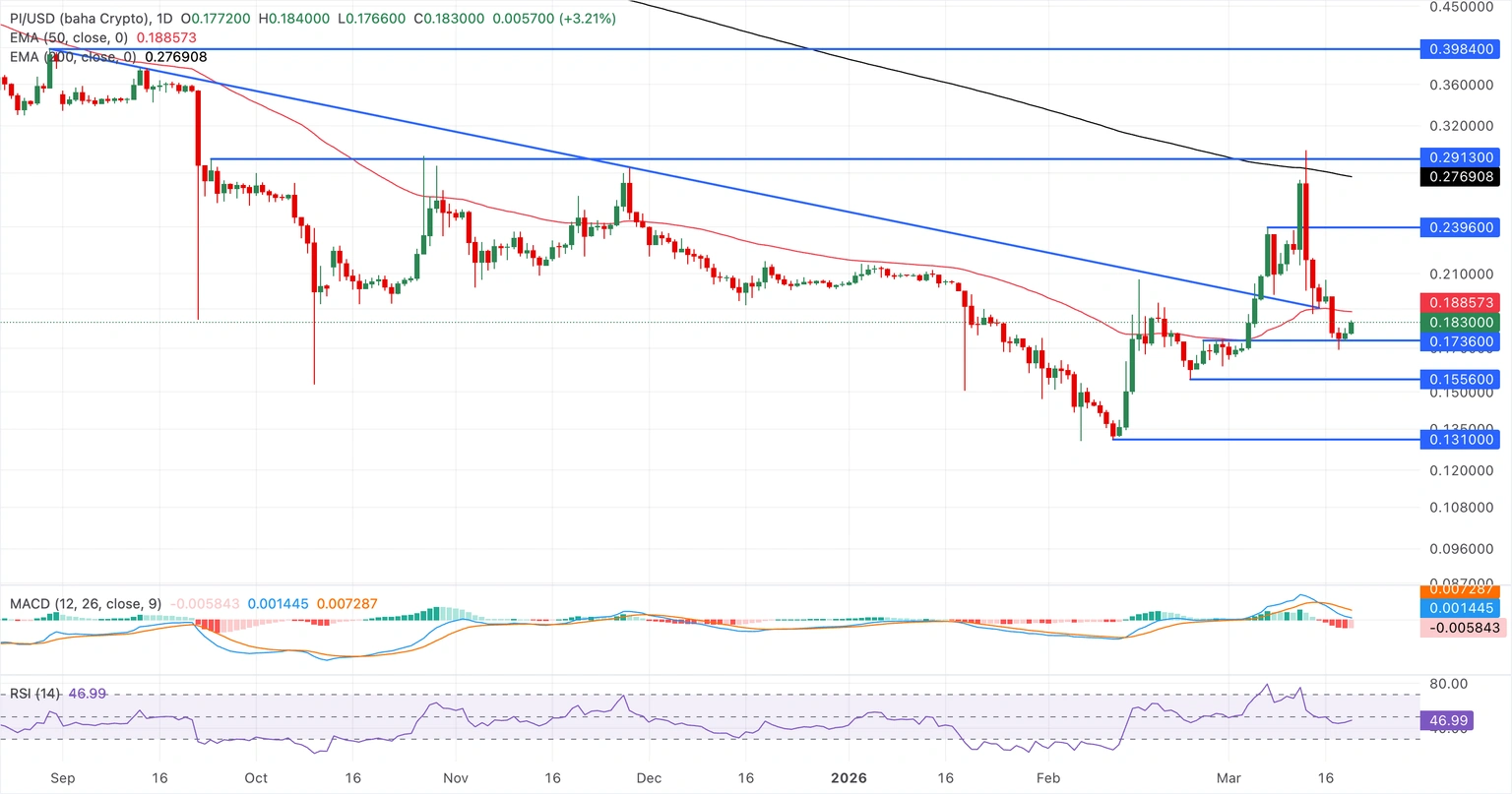
PI’s current technical structure shows a complex pattern: “short-term neutral leaning bearish, but with potential for rebound.” Analysts highlight the following key technical observations:
Bearish Factors (Resistance to Break Through)
- PI is trading below the 50-day exponential moving average (EMA) at $0.1885, which acts as a dynamic resistance.
- Also below the 200-day moving average, reinforcing a medium- to long-term bearish trend.
- MACD is below the signal line and below zero, with increasing negative histogram bars, indicating ongoing downward momentum.
- RSI is at 47, below the 50 midpoint, suggesting that the earlier overbought condition has been digested, but bullish momentum has not yet recovered.
Technical Targets
Key Resistance: $0.2000 (psychological round number). If broken, next resistance is at $0.2396 (the seller congestion zone from March 7).
Key Support: $0.1736 (recent low where buyers stepped in this week). If broken, bearish outlook strengthens, with next support at $0.1556 (February 23 low).
Frequently Asked Questions
Q: What is the actual impact of Kraken joining the Pi Network official CEX list on PI liquidity?
Kraken’s inclusion means PI holders now have access to a more reputable, compliant trading platform. This is significant for institutional investors and high-net-worth individuals, who often prioritize regulated platforms. In terms of liquidity, more mainstream exchanges listing PI can help narrow bid-ask spreads and reduce market impact costs for large trades.
Q: Does positive net inflow into CEX mean profit-taking has ended for PI?
A positive net inflow is an initial sign that profit-taking has slowed, but it does not confirm that profit-taking has completely stopped. The inflow of 165,044 PI is moderate and may reflect a temporary slowdown rather than the end of selling pressure. Technical analysts typically look for several consecutive days of net outflows (funds moving from exchanges to private wallets) to confirm a stronger bullish bottom.
Q: Under the current technical pattern, what conditions are needed for PI to break above $0.20?
Breaking $0.20 requires several conditions to improve simultaneously: RSI must break above 50 and stay above; MACD should turn positive with increasing bullish histogram; and PI needs to recover and hold above the 50-day moving average ($0.1885) as support. If the market environment remains stable and PI closes above $0.19 for two to three consecutive days, it will create more favorable technical conditions to challenge the $0.20 psychological level.
Disclaimer: The information on this page may come from third parties and does not represent the views or opinions of Gate. The content displayed on this page is for reference only and does not constitute any financial, investment, or legal advice. Gate does not guarantee the accuracy or completeness of the information and shall not be liable for any losses arising from the use of this information. Virtual asset investments carry high risks and are subject to significant price volatility. You may lose all of your invested principal. Please fully understand the relevant risks and make prudent decisions based on your own financial situation and risk tolerance. For details, please refer to
Disclaimer.


