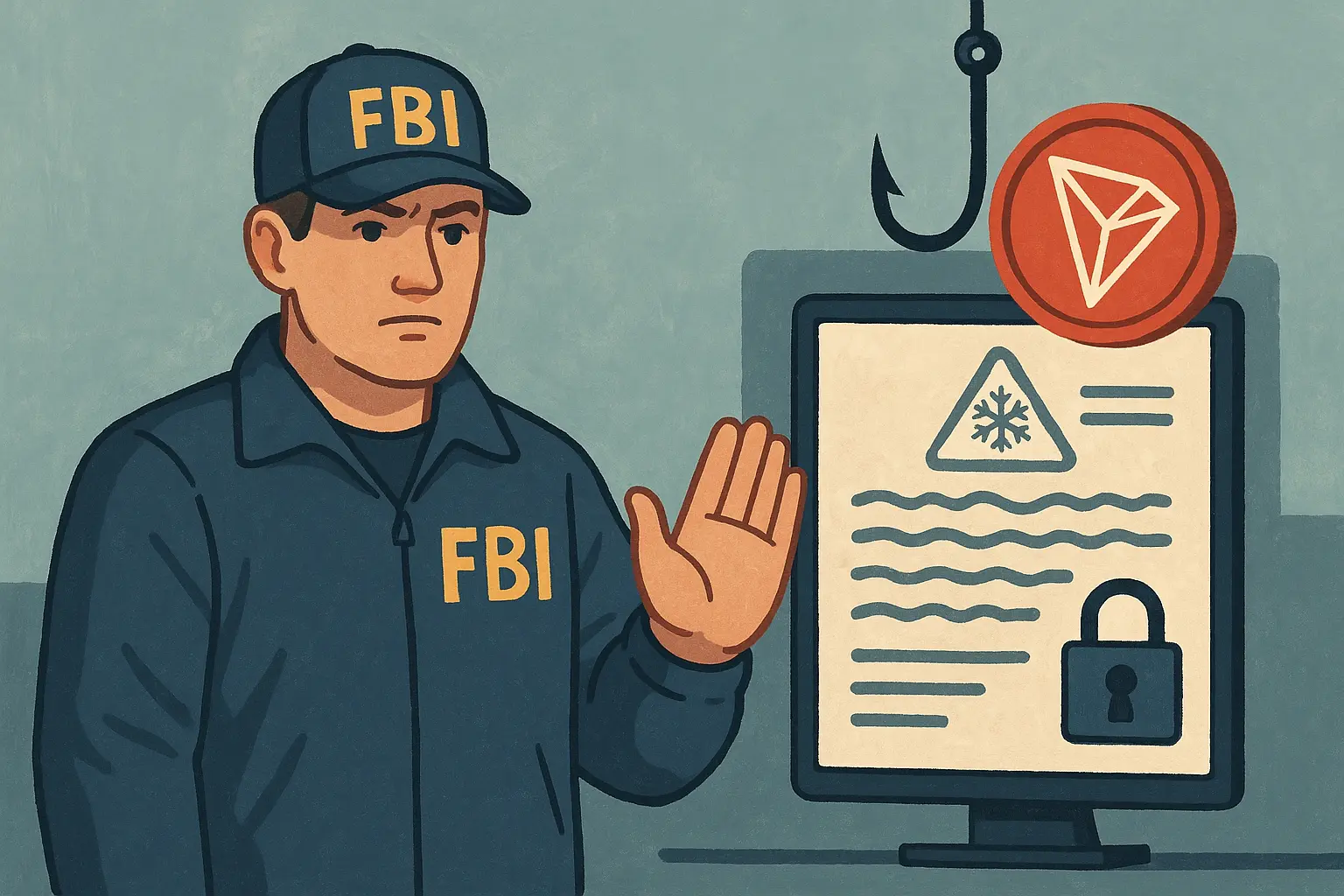
The Federal Bureau of Investigation (FBI) New York Field Office issued an official warning on the X platform on Thursday, urging Tron blockchain users to remain vigilant. Scammers are creating fake FBI tokens using the TRC-20 token standard, actively airdropping them into user wallets, and threatening to freeze assets for “violating anti-money laundering (AML) regulations,” thereby deceiving users into visiting phishing websites to provide personal identification information.
Analysis of the Scam Method: The Three-Step Logic of Fake FBI Tokens

(Source: FBI)
The core of this scam lies in forging the authority of the FBI, using the law enforcement agency’s name to create a sense of legal pressure on users. Tron’s TRC-20 token standard allows anyone to quickly create tokens without permission and mass send them to any wallet address at very low transaction costs, providing technical convenience for “airdrop scams.”
Three Steps of Fake Token Scam
Token Airdrop: Scammers create counterfeit TRC-20 tokens labeled “FBI” and proactively send them to Tron network users’ wallets.
Intimidation and Pressure: The tokens carry threatening messages claiming the user is violating AML laws and that their assets will be frozen, creating a sense of urgency.
Phishing and Inducement: Users are prompted to visit external websites linked to the token to “appeal” or “unfreeze” their assets, tricking them into submitting personal identification information.
The FBI explicitly states in its announcement: “If you receive tokens from a specific account, do not provide any personal information to any website associated with that token.”
FBI’s Official Position: No Public Communication via Tokens
The main message of the FBI’s warning is that the agency never communicates with the public through blockchain tokens. Receiving tokens claiming to be from the FBI is an unmistakable sign of scam. The FBI states that investigations into cryptocurrency-related scams are ongoing, “the FBI is investigating fraudulent cryptocurrency investment platforms and companies.”
This incident of fake tokens exemplifies the rapid evolution of crypto scams in recent years. According to the FBI’s 2024 report, losses related to cryptocurrency scams have reached billions of dollars, a 45% increase compared to 2022, and the FBI has listed cryptocurrency investment fraud as its “largest category of financial losses.” The U.S. Federal Trade Commission (FTC) also reported that romance scams (commonly called “pig butchering”) involved in investment fraud caused over $1 billion in losses within a single year.
Impersonating Law Enforcement: A New Form of Crypto Scam
Fake FBI token scams represent an escalation from passive inducement to active coercion in crypto scams. Traditional scams often lure victims with high-return investment promises, while newer scams impersonate law enforcement agencies, using fear of legal sanctions as a tool to manipulate victims into voluntarily revealing personal information or funds.
Choosing the Tron network as the platform also has strategic reasons: compared to other blockchains, creating and mass sending TRC-20 tokens is cheaper, enabling scammers to reach many potential victims at minimal cost. The specific scale of this scam’s impact has not yet been disclosed, and investigations are ongoing.
Frequently Asked Questions
Q: What is the fake FBI token scam, and how does it work?
A: Scammers create fake tokens labeled “FBI” on the Tron network using the TRC-20 standard, proactively airdrop them into user wallets, and include threatening messages claiming AML violations and asset freezing, tricking users into visiting phishing websites to provide personal information.
Q: What should I do if I receive a suspicious FBI token?
A: The FBI recommends: do not click any links attached to the token, do not provide any personal information to related websites, and report the incident to the FBI Internet Crime Complaint Center (IC3). The FBI never communicates with the public via blockchain tokens; receiving such tokens is a clear scam indicator.
Q: Why do scammers choose the Tron network to carry out these scams?
A: Because TRC-20 tokens can be created and distributed in bulk quickly without permission, at low cost, making it a common choice for “airdrop scams.” These tokens can be sent to thousands of wallets within minutes, with minimal operational costs and little prior prevention.
Disclaimer: The information on this page may come from third parties and does not represent the views or opinions of Gate. The content displayed on this page is for reference only and does not constitute any financial, investment, or legal advice. Gate does not guarantee the accuracy or completeness of the information and shall not be liable for any losses arising from the use of this information. Virtual asset investments carry high risks and are subject to significant price volatility. You may lose all of your invested principal. Please fully understand the relevant risks and make prudent decisions based on your own financial situation and risk tolerance. For details, please refer to
Disclaimer.
Related Articles
Encourage innovation! A U.S. judge bans Arizona’s regulation of prediction markets and suspends the prosecution of Kalshi
A U.S. federal district court ruled that Arizona may not rely on its gambling law to prosecute the prediction market platform Kalshi, finding that the U.S. Commodity Futures Trading Commission has exclusive jurisdiction. The ruling affects the line between state and federal authority in financial market regulation, while Kalshi maintains that its business is a financial product rather than traditional gambling. Decisions by states on prediction markets have differed, and the Trump family has also expressed support for prediction markets.
CryptoCity38m ago
Nigeria's FIRS Begins Trial Against Major CEX Over Alleged Tax Evasion
Nigeria's tax authority, FIRS, has begun legal proceedings against a centralized exchange for alleged tax evasion related to VAT and CIT on cryptocurrency transactions. The trial is set for April 11, 2025, as questions arise regarding the obligation of foreign entities to comply with local tax laws.
GateNews3h ago
Thepeer Co-Founder Denies Fraud Claims Nearly Two Years After Shutdown, Says $750K Never Received
Michael Okoh, co-founder of Thepeer, refuted allegations of missing funds before the company's shutdown, clarifying that claimed investments were never made and funds were fully accounted for. He cited internal governance issues, not fraud, as the problem.
GateNews3h ago
Encouraging innovation! U.S. judges ban Arizona from regulating prediction markets, and pause the prosecution against Kalshi
A U.S. federal district court ruled that Arizona cannot use its gambling laws to prosecute the prediction market platform Kalshi, finding that the U.S. Commodity Futures Trading Commission has exclusive jurisdiction. The ruling affects the boundary between state and federal authority in financial market regulation, and Kalshi insists that its business is financial products rather than traditional gambling. Rulings on prediction markets vary across states, and the Trump family has also expressed support for prediction markets.
CryptoCity3h ago
Is it possible to bypass FSC regulations on buying crypto with card payments? Oadingding rolls out the Wallet Pro service for buying crypto with a U.S. debit card
The OwlPay and Wallet Pro services launched by OdinTing use stablecoin technology to enable B2B cross-border payments, and they partner with international payments giants to showcase their ambitions to expand in the fintech space. By operating from abroad, OdinTing bypasses Taiwan’s regulatory restrictions, offering faster virtual-asset trading, while also facing the newly issued Virtual Assets Services Act; in the future, it may become a reference template for other foreign-invested companies entering the Taiwan market.
CryptoCity4h ago
Thodex Founder Farul Fatih Ozer Arrested in Turkey, Faces Charges Over Alleged $2B Theft
Farul Fatih Ozer, founder of the collapsed cryptocurrency exchange Thodex, was arrested in Istanbul, facing fraud and money laundering charges. Allegedly fleeing with $2 billion in investor funds, Ozer's case claims significant financial losses and has led to a nationwide cryptocurrency payment ban in Turkey.
GateNews6h ago


